Additional Information
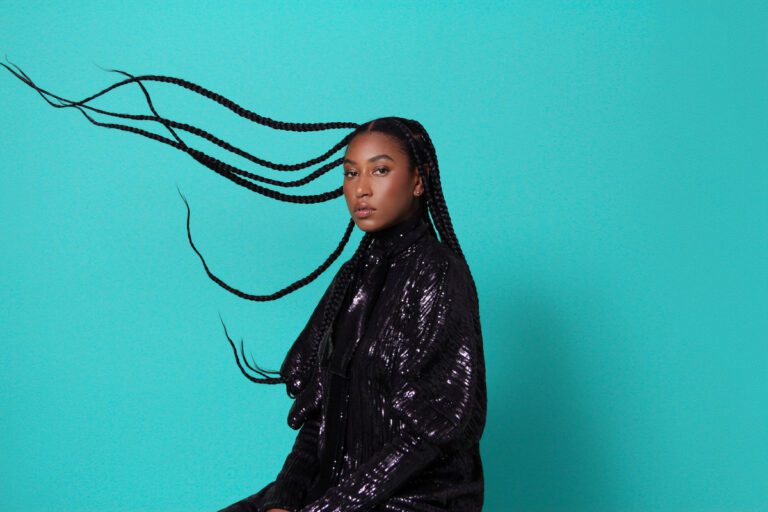
Dominique Fils-Aimé is prolific. After a trilogy of albums on the history of Afro-American music, with Our Roots Run Deep she begins a new trilogy on more personal and contemporary angles.
This album gives pride of place to the multiple voices of the Montreal-born singer from the Haitian community. We spoke to her about the evolution of her music, her life and her upcoming tour.
PAN M 360: If you don’t mind, let’s take a step back in time. Before you became a professional musician, what did you do?
Dominique Fils-Aimé: I’ve had a thousand lives before. Growing up, I always loved the arts: I sang, I danced, I drew. But for many people in the Haitian community, art isn’t a job, it’s a hobby. So I looked for a more suitable path. I studied fashion design, philosophy, photography, public relations and psychology. I was looking for a way to help people.
After that, I worked with children living with autism, I provided psychological support to the employees of a company, but it was mentally very burdensome. So I started making music, initially as a form of personal therapy, before realizing that I felt very much at home in this world. And that all these fields of study that interested me led naturally to music.
PAN M 360: And how are you discovering your musical identity through this trilogy of Afro-American albums: Nameless (2018), Stay Tuned (2019) and Three Little Words (2021)?
Dominique Fils-Aimé: There was a quest for identity in this trilogy, both personal and musical. I wanted to go back to the source. Who turned me on? Who made me vibrate musically? I listened to documentaries and my albums: Billie Holiday, BB King, Aretha Franklin, Nina Simone, Erykah Badu, Lauryn Hill, Mariah Carey… And I realized that all these musical styles were born in a historical context. How African Americans felt, what their emotions were, and so on. The heaviness of the blues and jazz was perceived as a revolutionary fire, a community of artists looking for avenues of freedom. Then came disco, funk, soul, and a little more sunshine and lightness, and that’s when I started looking for my identity, my uniqueness. And that led me to jazz, which, for me, is freedom.
PAN M 360: This singularity is clearly evident in the use of your voice, your plural voice. After all, you like to multiply your voices, don’t you?
Dominique Fils-Aimé: Yes, it’s a very pleasant thing to do. And these voices were trying to tell a story. An almost academic desire to tell this African-American story, the common thread between all these styles. I also try to tell this story with empathy, to bring people together rather than create divisions.
PAN M 360: After this musical trilogy, you decided to make a second one, the first opus of which is Our Roots Run Deep. Why do you work in trilogies?
Dominique Fils-Aimé: I don’t know… I like to take my time… A lot of people say to me: “These days, everything goes so fast, and people don’t have time to pay attention to content that’s too long”. I hear that, but I wanted to go against that trend because I don’t agree with it. I decided to give myself this freedom, and I like the coherence of this idea of a trilogy, of a common thread.
PAN M 360: And what is the main theme of this new trilogy?
Dominique Fils-Aimé: It’s more about my inner self, a personal quest for self-improvement. I’m taking on more of myself, drawing on my roots to present who I am today, and what my beliefs are. It’s about sharing my beliefs in a more united, gentler world, and creating music to match. On the other hand, this new trilogy will be less pre-planned than the first. I’m leaving myself room to develop it as my life experience takes me.
PAN M 360: On Our Roots Run Deep, you’ve composed everything, whereas previous albums featured covers such as Strange Fruit or Stand By Me. How would you describe the musical evolution of this new album? I feel there’s even more vocal presence.
Dominique Fils-Aimé: That’s true. The instrumentation is more reminiscent of the Nameless album in its simplicity. On the other hand, in 2018, I felt like an illegitimate musician because my only instrument was my voice. Today, I fully embrace my voice as a legitimate instrument. Before, I tried to link my voice to other instruments. Now, my voice is the main instrument. There’s also the notion of repetition, the mantra aspect, which I wanted to get more into. I like to start with a phrase, then slowly build up the complexity with the addition of other voices, drawing people into a meditative space similar to the one I find myself in when I’m singing. There’s also the importance of percussion of all kinds, which takes up more space.
PAN M 360: You’ve really multiplied the vocal scores on this album. In the room with the most vocal scores, how many Dominique Fils-Aimé sing simultaneously?
Dominique Fils-Aimé: You’d have to ask the director, Jacques Roy, but there are a lot of them. Sometimes we’d triple certain harmonies, then add effects and textures. It’s a bit crazy, but we played around with it.
PAN M 360: But how can you reproduce these effects on stage?
Dominique Fils-Aimé: That’s a question we’re asking ourselves just before we start touring. Of course, the musicians will do certain voices. They’ll be able to put certain scores in their hands. We also want the live performance to be different from the album. Of course, if we had the means, I’d hire a choir. But we’re not there yet.
PAN M 360: We’ve got a big tour coming up: Quebec, Canada, Europe and the United States.
Dominique Fils-Aimé: I consider myself very lucky, the interest and the welcome have been really wonderful. I sometimes wonder how show organizers found us. For the first time, we’ll be touring in the United States. It’s really exciting.
PAN M 360: Finally, let’s talk a little politics. There’s a whole debate about racism and wokism in Quebec. How do you perceive this reality?
Dominique Fils-Aimé: For my part, I find that we live in a very divided world, that there’s a lot of space to shout loudly from all sides, but very little space to understand how the other feels and where they come from. We lack the space for conversation rather than confrontation. Everyone is frustrated on their own, caught up in their own pain, and we can’t understand how the other is feeling. Perhaps music can help. It brings a sense of well-being and leads people to a state of open-mindedness. Maybe it can set the table for more empathetic conversations. We have to get beyond the “I’m right and you’re wrong” stage. Maybe everyone’s right and maybe everyone’s wrong. I’d like to see a space for discussion.