électroacoustique / expérimental / musique contemporaine

Le Vivier / Semaine du Neuf |  Alexandra Templier — Chant 2 : Le Murmure Du Vivant / Les mots de la direction artistique

par Rédaction PAN M 360

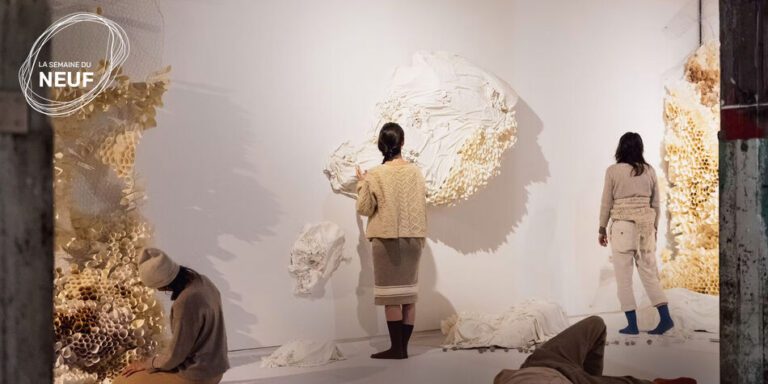
Expérience immersive, musique improvisée (voix et électroacoustique), danse, arts visuels Le Murmure du Vivant est un écosystème pluridisciplinaire où le son, le mouvement et le visuel se tissent de façon organique pour convier le public à une expérience transformative: écouter autrement pour penser autrement.

Directeur artistique du Vivier, Jeffrey Stonehouse défend ici brièment ce choix de programmation:

« Une très belle proposition d’Alexandra Templier ici ! Alexandra qui fait partie du pôle relève du Vivier, donc notre pôle de mentorat artistique. Sa proposition est en fait, une rencontre entre un genre de scénographie vivante et une interprétation en temps réel. Ce que je veux dire ici, c’est que l’élément de scénographie joue un rôle super central à la proposition d’Alexandra. Elle explore presque, je trouve, des zones de ASMR ! Donc, tous les sons sont super subtils. Par exemple, des verres qui sont juste légèrement bougés sur le sol. Mais tout ça aussiavec des interprètes en temps réel. Donc, c’est comme une espèce d’installation vivante, mais avec une proximité d’écoute très intéressante et très intime. »

Immersive experience, improvised music (voice and electroacoustic), dance, visual arts Le Murmure du Vivant is a multidisciplinary ecosystem where sound, movement, and visual elements are woven together organically, inviting the audience into a transformative experience: listening differently to think differently.

Artistic Director of Le Vivier, Jeffrey Stonehouse briefly defends this programming choice here:

« A very beautiful proposal from Alexandra Templier here! Alexandra is part of the Vivier’s next generation program, which is our artistic mentoring program. Her proposal is actually a combination of a kind of living scenography and real-time interpretation. What I mean here is that the scenography element plays a central role in Alexandra’s proposal. I think she’s almost exploring areas of ASMR! So all the sounds are very subtle. For example, glasses being moved slightly on the floor. But all this is also done with performers in real time. So it’s like a kind of living installation, but with a very interesting and intimate listening experience. »

POUR ACHETER VOTRE BILLET, C’EST ICI!

Ce contenu provient de Le Vivier et est adapté par PAN M 360

expérimental / contemporain / Piano

Le Vivier : Joseph Houston — Quietly Rising à l’espace Ste-Hilda

par Rédaction PAN M 360

S’ouvrant sur le doux et lumineux Quietly Rising de Bryn Harrison, ce programme explore les profondeurs de résonance du piano. Tout au long du concert, l’instrument se transforme : l’électronique vient le doubler et le prolonger grâce à des ondes sinusoïdales et à des sons préenregistrés. Ces ajouts mettent en valeur certains aspects du piano tout en en révélant d’autres, plus cachés. La répétition, tour à tour méditative et exploratoire, est le fil conducteur de ces œuvres, qui se déploient progressivement jusqu’à l’aboutissement du programme, Philip the Wanderer de Cassandra Miller, une pièce portée par une énergie extatique.

Opening with Bryn Harrison’s soft and luminous Quietly Rising, this program explores the edges and depths of the piano’s resonance, uncovering hidden and hushed corners of sound and beauty in various guises. The use of electronics, including a blended doubling of the piano, sine waves, and other prerecorded electronics, illuminates both existing aspects of the instrument, as well as revealing dimensions previously obscured or unrealised. Repetition forms a central idea through which each of the works unfold, the program reaching its conclusion with the ecstatic energy of Cassandra Miller’s Philip the Wanderer. Consisting of a collection of repeated hushed phrases — each slower than the last — Bryn Harrison’s Quietly Rising is a restrained albeit spatially expansive release of the piano’s sonority. By meticulous use of the sustain pedal, a shimmering, gently sifting harmonic field is created of which a distinct aspect is revealed in each successive iteration. The second piece, Duo, sees the seamless melding of identical material presented by the acoustic piano and its pre-recorded acousmatic double. Eschewing any means of coordination however, these two lines necessarily diverge, constantly entering into and out of focus. Silence and vertical chords interrupt the landscape until finally a restless, but ultimately static, cloud of gradually shifting, nearly inaudible pitches takes over, drawing the ear into a flickering void. In her piece Constellations I-III, composer Chiyoko Szlavnics combines the piano with sine waves to create a delicate and fragile soundscape. Variously perceived as a single expanded instrument, or as distinct entities, Szlavnics painstakingly traces a beautiful and otherworldly sonorous architecture. The first half of the programme concludes with Linda Catlin Smith’s The Underfolding: a work whose multi-layered harmonies and colours establish a meditative and deeply textured landscape. The composer writes: « I wanted to find a way to condense the texture of my compositional world. Since the piano can sustain, there is an inherent possibility for the layering of sounds, like the undertones in painting, where many colours can be layered to create an overall hue or atmosphere….There is a sense of hidden or implied melody everywhere, clothed in the surrounding pitches and shades, though there is a line, a deep melody, that is unadorned.” Ágnes Wrote, by Max Murray, is a vertiginous exploration of the deep resonances of the piano. The sounds of prerecorded bass drums, piano resonance and sine waves envelop the acoustic instrument, slowly revealing a formal architecture at once tectonically vast, and intensely intimate, often held at the the threshold of the audible. The last piece in the programme, Cassandra Miller’s Philip the Wanderer, is a three-movement work based on transcriptions of Mandowa II, played by the Mozambican musician Zhukake Masingi. The piece begins in the lowest octave of the piano before a distant melody gradually moves to the sonorous fore. The second movement’s descending scales are interrupted by the increasingly ecstatic chords before the feverishly joyous world of the third movement drifts away into the piano’s upper octaves.

POUR ACHETER VOTRE BILLET, C’EST ICI!

Ce contenu provient de Le Vivier et est adapté par PAN M 360
musique contemporaine / Piano / post-romantique

Le Vivier : Pamela Reimer — Hommage au Piano à l’Espace Ste-Hilda

par Rédaction PAN M 360

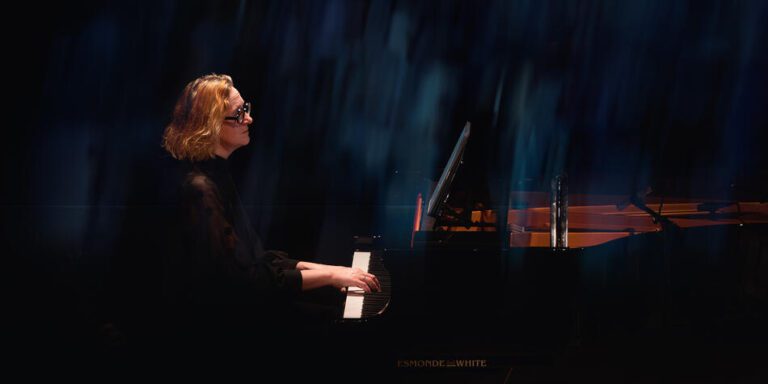
Ce concert-marathon traversant les époques met en lumière l’art et la passion de Pamela Reimer pour son instrument. De Couperin à Stockhausen, la pianiste propose un programme foisonnant qui rend hommage à l’inépuisable richesse du piano.
Erinnerungsspuren, un cycle de pièces pour piano d’Alberto Posadas, est un hommage au piano en six parties.  Dans ses “reminiscences”, le compositeur espagnol mentionne quelques-uns des meilleurs compositeurs pour piano et clavecin, les prenant comme sources pour ses études sur l’espace sonore du piano: de François Couperin à Robert Schumann, de Claude Debussy à Bernd Alois Zimmermann, de Giacinto Scelsi à Karlheinz Stockhausen.
Ce qui importe à Posadas dans son cycle n’est pas d’établir des liens explicites avec le passé, mais plutôt de dégager des concepts du répertoire historique, à savoir les ‘Erinnerungsspuren’ [traces mnésiques], qui trouvent leur expression dans des expérimentations pianistiques.  Des techniques de jeu spécifiques, avec les pédales, les préparations à l’intérieur du piano, permettant de modifier les sons individuels et les micro-intervalles pendant leur résonance, créant ainsi un espace sonore transhistorique.  
Dans son cycle, Alberto Posadas apporte moins de réponses qu’il ne soulève de questions où la musique de ses six prédécesseurs peut être entendue comme des sons de souvenir:  comment le nouveau et l’ancien peuvent-ils se mettre mutuellement en lumière, voire se redéfinir ? Et quel peut être le sens des citations lorsqu’il s’agit de construire des ponts entre l’ancien et le nouveau, entre le connu et l’inconnu?
Reconnue pour sa polyvalence et sa grande complicité musicale, Pamela Reimer s’est produite avec des ensembles phares tels que Bradyworks, l’ECM+, la SMCQ, Orford Six Pianos, Erreur de Type 27 et l’Ensemble Paramirabo. Son parcours l’a amenée à collaborer avec des artistes et institutions de renom, dont Les Grands Ballets Canadiens, le Ballet National du Canada et le London Sinfonietta. Explorant autant le répertoire classique que la création contemporaine, elle a aussi conçu des projets novateurs comme le concert théâtralisé 50 questions @ 50.

This marathon concert spanning the ages highlights Pamela Reimer’s artistry and passion for her instrument. From Couperin to Stockhausen, the pianist offers a rich and diverse program that pays tribute to the boundless wealth of the piano.
Erinnerungsspuren, a cycle of piano pieces by Alberto Posadas, is an homage to the piano in six parts. In his « reminiscences », the Spanish composer brings to mind several of the most innovative keyboard composers, taking them as sources for his studies of the piano’s sound space. From François Couperin to Robert Schumann and Claude Debussy to Bernd Alois Zimmermann, Giacinto Scelsi and Karlheinz Stockhausen.
What matters to Posadas in his cycle is not to make explicit connections to the past; he rather discerns concepts from the historical repertoire, namely Erinnerungsspuren [traces of memory], that find expression in pianistic experiments. Special pedalling techniques, preparations on the strings and other parts of the piano allow changes of individual sounds and micro-intervals while they are resonating, creating a trans-historical sound space. 
In his cycle Alberto Posadas gives fewer answers than he raises questions in which the music of his six predecessors can be heard as sounds of remembrance: how can new and old material put each other in a different light and perhaps even redefine themselves? And what can be the meaning of quotations when it comes to building bridges between old and new, between the known and the unknown?

POUR ACHETER VOTRE BILLET, C’EST ICI!

Ce contenu provient de Le Vivier et est adapté par PAN M 360

Création / installation

Semaine du Neuf 2025 : Totem Contemporain – Spirituel

par Rédaction PAN M 360

Au cœur de cette installation cinétique, sonore et visuelle, un ballet céleste se déploie, orchestré par un mouvement circulaire qui insuffle vie et élan aux sons ainsi qu’à la lumière. Les treize dispositifs résonnent dans une danse envoûtante, où chaque sonorité tourbillonne et prend vie, invitant le public à se laisser emporter dans ce voyage sensoriel au paysage changeant. Chacun est convié à explorer les méandres de son être, à contempler ces instants uniques où le visuel et le sonore se rencontrent dans une harmonie inédite. La disposition en cercle vous invite à circuler et vivre l’œuvre à votre rythme sous différents angles. Sans faire référence à une religion ou un culte précis, les harmonies changeantes de l’œuvre peuvent rappeler tantôt des cloches d’église, tantôt des bols tibétains. Elle invite donc à l’imagination et à l’introspection sur le rapport que nous avons individuellement avec la spiritualité.

At the heart of this kinetic, sound and visual installation, a celestial ballet unfolds, orchestrated by a circular movement that breathes life and momentum into both sound and light. The thirteen devices resonate in a captivating dance, where each sound swirls and comes to life, inviting the audience to let themselves be carried away on a sensory journey through a changing landscape. Everyone is invited to explore the meanders of their own being, to contemplate these unique moments when visual and sound meet in a unique harmony. The circular layout invites you to move around and experience the work at your own rhythm, from different angles. Without referring to a specific religion or faith, the work’s shifting harmonies can be reminiscent of church bells or Tibetan singing bowls. It thus invites imagination and introspection on our individual relationship with spirituality.

Programme

Jean-François Laporte: Spirituel , 2024

Program

Jean-François Laporte: Spirituel , 2024

POUR ACHETER VOTRE BILLET, C’EST ICI!

Ce contenu provient du Vivier et est adapté par PAN M 360

Inscrivez-vous à l'infolettre