
CET ÉVÉNEMENT EST GRATUIT!
Ce contenu provient du Piknic Électronik et est adapté par PAN M 360
CET ÉVÉNEMENT EST GRATUIT!
Ce contenu provient du Piknic Électronik et est adapté par PAN M 360
La série Jazz@Vue est présentée par le Théâtre Outremont en collaboration avec Effendi, l’une des étiquettes jazz les plus importantes au Canada, les Productions Yves Léveillé et les Productions Félix Stüssi, organismes voués à la production et la présentation de concerts de jazz contemporain. Du 29 octobre au 1er novembre, découvrez chaque soir un plateau double d’artistes.
Gentiane MG
La pianiste et compositrice montréalaise Gentiane MG présente Can You Hear the Birds? (Entends-tu les oiseaux?), un projet profondément humain, façonné par la connexion et l’écoute. La musique de cet album, enregistré avec son trio de longue date, composé du bassiste Levi Dover et du batteur Mark Nelson, se déploie comme une expérience partagée, ancrée dans la confiance, l’intuition et l’expression collective.
LéNo
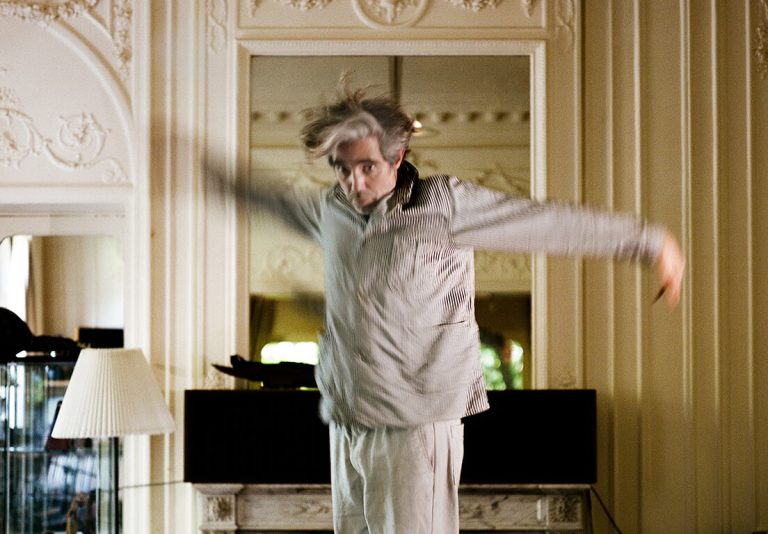
LéNo c’est Arnaud Dolmen et Léonardo Montana, un duo français piano/batterie avec voix. Entraîné par les rythmes et la danse, envoûté par les ostinatos du piano, les cascades et sauts dans le vide, l’esprit s’abandonne… Un monde où deux musiciens sonnent comme cinq ou dix, et où dans chaque interstice jaillit l’histoire, les convictions, l’imaginaire et le rêve. Tirant le meilleur de sa Jazzette, la plus petite espèce de kit de batterie, Dolmen transcende l’héritage, décuple son champ d’expression et montre une inventivité folle, donnant à chaque ligne de Leonardo de nouveaux reliefs.
The Jazz@Vue series is presented by Théâtre Outremont in collaboration with Effendi, one of the most important jazz labels in Canada, Productions Yves Léveillé and Productions Félix Stüssi, organizations dedicated to the production and presentation of contemporary jazz concerts. From 29 October to 1 November, every evening discover a double platter of artists.
Gentian MG
Montreal pianist and composer Gentiane MG presents Can You Hear the Birds? , a profoundly human project, shaped by connection and listening. The music on this album, recorded with his longtime trio of bassist Levi Dover and drummer Mark Nelson, unfolds as a shared experience rooted in trust, intuition and collective expression.
LéNo
LéNo is Arnaud Dolmen and Léonardo Montana, a French piano/drums duo with vocals. Driven by the rhythms and the dance, bewitched by the ostinatos of the piano, the cascades and jumps into the void, the spirit abandons itself… A world where two musicians sound like five or ten, and where in each interstice springs history, convictions, imagination and dream. Making the best of his Jazzette, the smallest kind of drum kit, Dolmen transcends heritage, multiplies its field of expression and shows a crazy inventiveness, giving each line of Leonardo new reliefs.
POUR ACHETER VOTRE BILLET, C’EST ICI!
Ce contenu provient du Théâtre Outremont et est adapté par PAN M 360
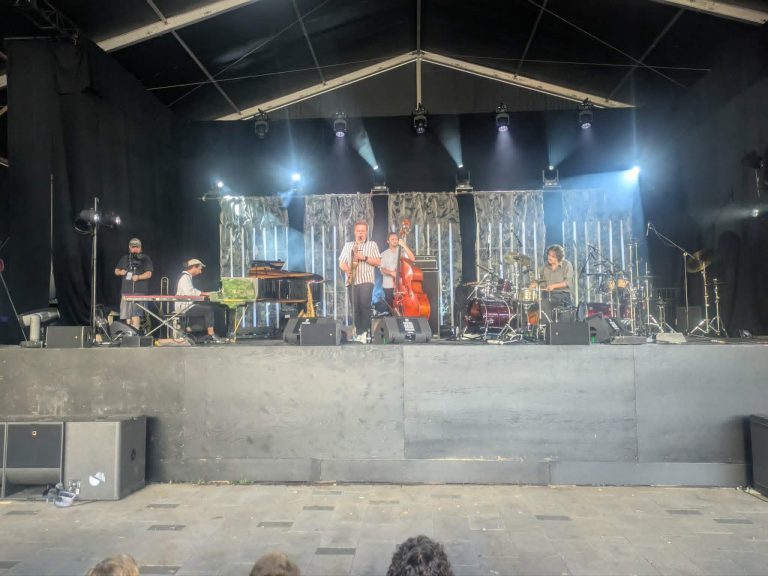
I went to see the free show by the Quebec quartet Solarium last Saturday at the Molson Pub during the Montreal International Jazz Festival. I had never seen and heard them live before, and I guarantee it won’t be the last time I do.
They are four young guys, intertwined during their time at the CEGEP of Saint-Laurent (a good brewing pool of up-and-coming-talent, the “St-Lo”): Karl-André Rozankovic (Compositions, Pianos, Keyboards), Léo Minville (Compositions, Drums, Guitar), Louis Plouffe (Saxophones), and Vincent Dessureault (Double Bass, Bass). Their mark is that of a vigorous post-bop, enhanced with modern rock touches and, occasionally, traditional references. It lifts, it grooves, it rips a bit, sometimes, and we like what we hear from one track to the next. The guys are having fun, obviously, and they allow us to envision a bright future for both them and us, attentive music lovers.
While waiting to have the immense pleasure of seeing them on stage somewhere, I will dive back into their discography (available on Bandcamp). Their most recent album (released just a few weeks ago) is called Live à Montréal. Put that in your ears, you’ll get the vibe.
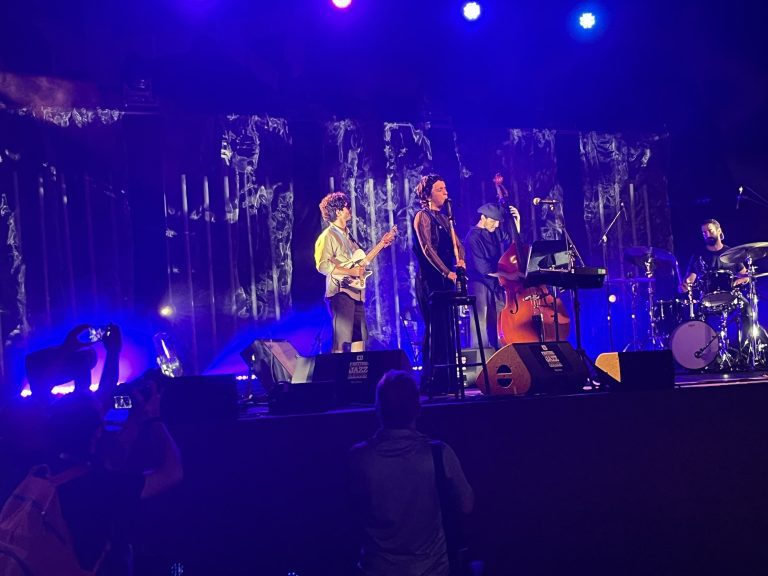
Away from the large crowd heading towards Patrick Watson’s concert, the spectators who had chosen the Molson Pub were treated throughout the evening to moments of varied and generous Latin music.
Follow me and you’ll understand that “everything is in everything,” as the poet Raoul Duguay said. At 7 p.m., Quebec trumpeter Rachel Therrien presented her Latin jazz show; in the middle of it, she introduced us to her “great friend” from Colombia, Anamaria Oramas. The two women embarked on a rather inspiring dialogue between flute and flugelhorn.
Once the show is over, I head towards Ste-Catherine Street, where Hilario Duran is preparing to deliver a solo piano performance, right in the middle of the street. Originally Cuban, Duran has lived in Toronto for two decades. Is he the best pianist living in Canada right now? The question deserves to be asked. A magnificent solo performance, a moment of grace, only spoiled by the too omnipresent presence of a speaker which broadcast totally different music, too close.
Back at the Molson Pub at 9 p.m., it was the turn of Colombian flautist Anamaria Oramas to take the stage. It was her first time at the FIJM, she told us in French tinged with Spanish, but after five minutes, she had won over a fairly large audience.
The flautist, who plays the transverse flute but also the typically Colombian gaita and the gauta, a sort of mixture of the two instruments, quickly made us understand that her music was a percussion jazz which encompasses all Colombian musical influences. And it worked very well.
Accompanied by an excellent trio of drums, double bass and electric guitar, Anamaria delivered original, vibrant music, which she presented as a form of resistance and freedom.
His country, Colombia, won its soccer match against Ghana while playing in Montreal. However, it has just elected a Donald Trump wannabe as its new president.
This always poses the dilemma of Latin America and the South for me: how can music and culture be so bold when these countries are so burdened by problems of inequality and corruption?
In the middle of her concert, the Colombian singer invited her Quebec friend, Rachel Therrien, to join her on stage. She told us that the two women had studied music at university together in Cuba 20 years ago.
The only thing missing to complete the Latin hat trick was the presence of Hilario Duran on stage.
It was an evening that seemed to satisfy fans of innovative music. Including the person writing this text.
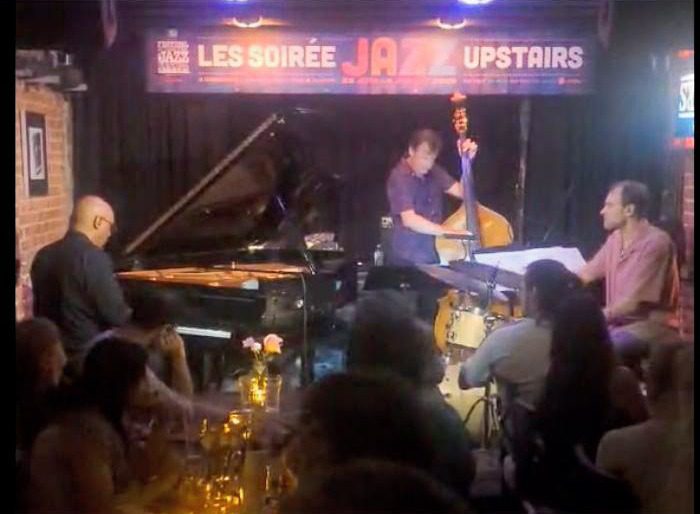
The pianist Billy Childs may not be a super star of jazz piano, like Brad Mehldau, Robert Glasper, or Vijay Iyer, but he has been carving out a very high-quality personal path for about forty years and knows how to offer music lovers exceptional jazz evenings. This is exactly what happened on Friday evening at the Upstairs club, which was lucky enough to welcome him for the first of two evenings (four sets, therefore) that will remain in the memory. If you are reading this text on this little Saturday morning, know that there may still be a few rare spots left for tonight. Maybe.
Childs launched his program with 34 Skidoo by Bill Evans. The message is clear: there will be good energy, without any fuss but with a lot of class. Childs is a marathon runner on the keyboard: he maintains the pace without rushing, sometimes daring a few deviations, but the overall focus is unshakeable, assured, logical, and above all, inspired. He is with two giants of the rhythm section: Matt Penman on double bass and Ari Hoenig on drums. These two guys finely frame the leader’s discourse, but not only that. They are intrinsically part of the discussion, often stepping out of the pulsing skeleton to chat more freely. That said, we never lose the thread. A close and intimate symbiosis.
Childs then introduces one of his compositions, Tight Rope, followed by another, Like Father, Like Son, a tribute to his father. One of Childs’ early pieces, released on the album Twilight Is Upon Us in 1989. Exciting hard bop flights on a solid but subtly undulating rhythmic cushion. Next comes a classic by Dexter Gordon, another giant of Hard Bop.
Between the pieces, Childs briefly introduces the pieces to us, without any fuss, but sometimes with an anecdote, a reflection. Above all, with class, restraint, and authenticity. In the hushed atmosphere, crowded with attentive ears, at Upstairs, we are experiencing a jazz event of a high level of classicism and intelligence together. Upstairs is one of the best clubs in North America. Maybe in the world. This is the proof.
The set officially ends with New World Disorder, a committed commentary dating back to the era of U.S. President George H.W. Bush, but which applies with even more acuity in 2026. The sharp chords, the disjointed pulse bring a dose of modernity not heard until now. A curious way to end a concert. What the “encore” (Whisper Not by Benny Golson, a benevolent standard) quickly corrected.
The music lovers and other curious attendees at Upstairs were lucky: we haven’t heard much from Childs in a trio format in recent years. The recent release of the album Triumvirate, by the way, is a return to form after a thirty-year absence! Once again, the three masters will be there tonight, Saturday, July 4th.
Hurry up and call Joel (Giberovitch, the owner of Upstairs) to hope to get a spot (if there are any left, honestly I’m not sure).
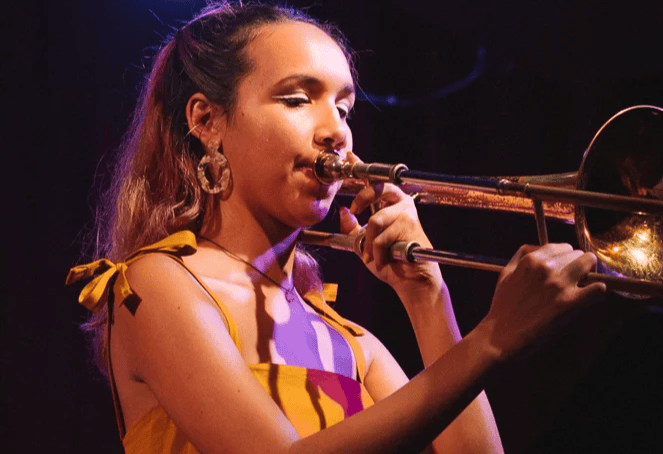
At the Molson Pub, on the Jazz Fest’s Esplanade Tranquille, we were quite a crowd Wednesday night to savour the music of Kalia Vandever, a new voice on the trombone, whose reflections you can further explore by reading the interview I conducted with them.
READ THE INTERVIEW WITH KALIA VANDEVER
The artist based in New York (Brooklyn) manipulates her instrument in a way different from her usual jazz colleagues. Don’t think of Trombone Shorty, Steve Turre, Wycliffe Gordon, etc. Vandever does not take much pleasure in distributing bouquets of notes in virtuosic fireworks. It is the long and patient melodic lines, as many cushions for elegant improvisations, that inspire them.
Vandever creates atmospheres that oscillate between ambient and chamber rock groove inherited from the previous generation (E.S.T.), endorsed by the current one (Bad Plus). They are solidly supported by their colleagues on stage in the deployment of well-structured horizontal frameworks. The rhythmic backbone is well maintained by Kayvon Gordon (drums) and Kanoa Mendenhall (double bass), the same as on the album Another View (released in 2025), which constitutes the essence of the performance. On guitar, the only deviation from the album’s lineup, Gregory Uhlmann knows his stuff. Although Mary Halvorsen is inimitable in her unusual timbral creations, Uhlmann still manages to hold his own. He knows how to colour the discourse and even generate astonishing soundscapes. He surprises us by imitating a saxophone in a stunning passage.
A performance that leaves a pleasant memory, like a soft moment of nocturnal and groovy mood at the end of a humid and slightly rainy evening.
Much, much to like.
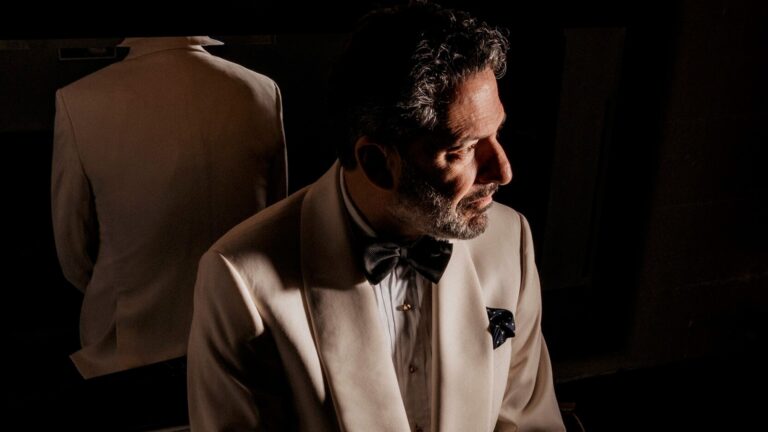
Reconnu comme l’un des meilleurs interprètes contemporains du Great American Songbook, John Pizzarelli a élargi son répertoire en y incluant la musique de Paul McCartney, Joni Mitchell, Neil Young, Tom Waits, Antônio Carlos Jobim et les Beatles. Le guitariste et chanteur a également été salué par le Boston Globe pour avoir « redonné vie au Great American Songbook et remis le jazz au goût du jour ». En plus d’être chef d’orchestre et artiste solo, Pizzarelli a été invité spécial sur des enregistrements de grands noms de la pop tels que Natalie Cole, Kristin Chenoweth, Tom Wopat, Rickie Lee Jones et Dave Van Ronk, ainsi que d’artistes de jazz de premier plan tels que Rosemary Clooney, Ruby Braff, Johnny Frigo, Buddy DeFranco, Harry Allen et, bien sûr, son père Bucky Pizzarelli. Il a remporté un Grammy Award dans la catégorie Meilleur album vocal pop traditionnel en tant que coproducteur de l’album American Standard de James Taylor en 2021. Personnalité de la radio depuis ses débuts en 1984, Pizzarelli co-anime, aux côtés de sa femme Jessica Molaskey, l’émission Radio Deluxe with John Pizzarelli. Il s’est produit dans les émissions de télévision nationales les plus populaires des États-Unis, telles que The Tonight Show Starring Jimmy Fallon, Conan et Great Performances, ainsi que dans les talk-shows de Jay Leno, David Letterman, Regis Philbin et la Macy’s Thanksgiving Day Parade.
Guitarist and singer John Pizzarelli has been hailed by the Boston Globe for “reinvigorating the Great American Songbook and re-popularizing jazz.” Established as one of the prime contemporary interpreters of the Great American Songbook, Pizzarelli has expanded that repertoire by including the music of Paul McCartney, Joni Mitchell, Neil Young, Tom Waits, Antônio Carlos Jobim and the Beatles. In addition to being a bandleader and solo performer, Pizzarelli has been a special guest on recordings for major pop names such as Natalie Cole, Kristin Chenoweth, Tom Wopat, Rickie Lee Jones and Dave Van Ronk, as well as leading jazz artists such as Rosemary Clooney, Ruby Braff, Johnny Frigo, Buddy DeFranco, Harry Allen and, of course, his father Bucky Pizzarelli. He won a Grammy Award in the Best Traditional Pop Vocal Album category as co-producer of James Taylor’s American Standard in 2021. A radio personality who got his start in the medium in 1984, Pizzarelli is co-host, alongside wife Jessica Molaskey, of Radio Deluxe with John Pizzarelli. He has performed on America’s most popular national television shows such as The Tonight Show Starring Jimmy Fallon, Conan, and Great Performances, as well as the talk shows of Jay Leno, David Letterman, Regis Philbin and the Macy’s Thanksgiving Day Parade.
POUR ACHETER VOTRE BILLET, C’EST ICI!
Ce contenu provient de la Place des Arts et est adapté par PAN M 360
CE SPECTACLE EST GRATUIT!
Ce contenu provient du Festival International de Jazz de Montréal et est adapté par PAN M 360
POUR ACHETER VOTRE BILLET, C’EST ICI!
Ce contenu provient du Piknic Électronik et est adapté par PAN M 360

Avec son charisme et son petit côté entertainer, à la manière d’un animateur enthousiaste de radio-crochet, Idriss le Viking Noir était la personne toute indiquée pour accueillir cette série qui applaudit la grande influence, le modernisme et la versatilité des musiques mandingues, que Nuits d’Afrique n’a eu de cesse de mettre de l’avant ces 40 dernières années. Sur des grooves du feu de Dieu, tel un sage un peu frondeur, Idriss, conquérant sympathique et décomplexé, distille ses conseils et conte la vie, de sa voix qui porte et de laquelle pointent des accents reggae.
Pour terminer le Festival en apothéose, Idriss le Viking Noir, qu’on surnomme affectueusement Tonton pour souligner son rôle auprès de la relève, invite ses « petits » du Togo et de Côte d’Ivoire à se mêler à la fête.
A born showman with the ebullience of a radio talent show host, the charismatic Idriss le Viking Noir was the obvious choice to host this series, which celebrates the versatility, contemporary appeal and undeniable influence of Mandinka music, which Nuits d’Afrique has proudly promoted for the past 40 years. Set to groovy beats, like a slightly rebellious sage, the charming and fun-loving Idriss shares his wisdom and recounts stories about life in his resonant voice with its subtle reggae inflections.
For an uplifting close to the Festival, Idriss le Viking Noir—affectionately known as Tonton (Uncle) because of his commitment to emerging talent—invites his “young’uns” from Togo and Côte d’Ivoire to join in the festivities.
POUR ACHETER VOTRE BILLET, C’EST ICI!
Ce contenu provient du Festival international Nuits d’Afrique et est adapté par PAN M 360
The American Devices
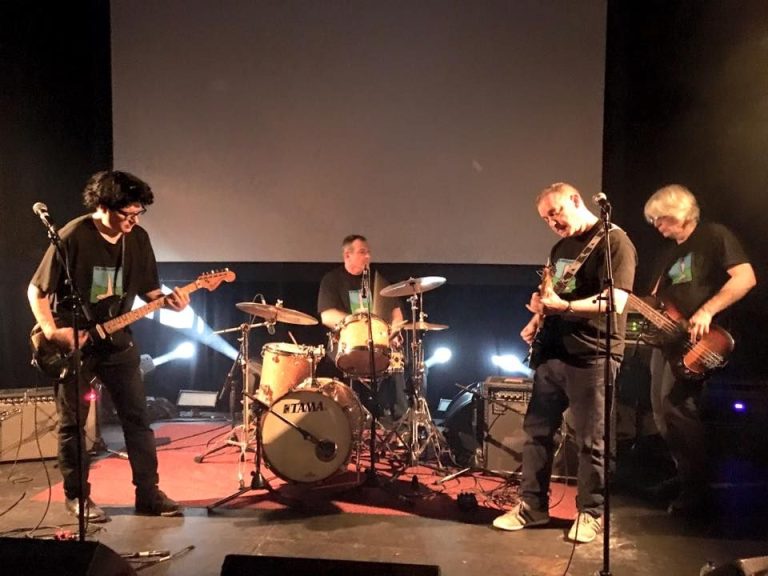
The American Devices est le groupe de « rock » montréalais en activité depuis le plus longtemps (fondé en 1980) ; ce sont des légendes locales (et nationales) qui ont inspiré de nombreux autres groupes au fil des décennies. La formation se compose du guitariste et auteur-compositeur Rick Trembles (musicien, bédéiste et artiste de renommée internationale), du guitariste et auteur-compositeur Rob Labelle (membre fondateur de l’un des groupes punk pionniers du Canada, The Normals), du bassiste prolifique et puissant André Asselin (Nutsak, Galaxy of Terror) et du batteur Howard Chackowicz (également membre des groupes Nutsak et Manners, bédéiste et ancienne figure de l’émission Wiretap sur les ondes de CBC). Leur musique est souvent qualifiée de « post-punk », mais ils proposent en réalité une variété de sonorités et de styles, reconnaissables avant tout au jeu de guitare unique et aux entrelacements mélodiques caractéristiques de Trembles et Labelle. Asselin et Chackowicz (une section rythmique basse-batterie soudée depuis plus de 30 ans) assurent une assise rythmique massive et pleine de groove. Si certains morceaux sont lourds et rock, d’autres se font plus expérimentaux ou empruntent des voies totalement différentes ; tous partagent toutefois une signature stylistique singulière — que ce soit dans le ressenti, le timing ou l’intensité — sans jamais perdre en cohérence ni en musicalité. Bien qu’ils se soient toujours tenus à l’écart des normes de la musique « grand public », The American Devices ont su fidéliser leur public grâce à leur talent, à leur complicité musicale quasi magique et à leur puissance, ainsi qu’à leurs concerts toujours dynamiques et divertissants.
The American Devices is Montreal’s longest-running “rock” band (founded in 1980), local (and national) legends who have inspired many other musical groups over the decades. The band is comprised of guitarist/songwriter Rick Trembles (internationally renowned musician, cartoonist and artist), guitarist/songwriter Rob Labelle (founding member of one of Canada’s pioneering punk bands – The Normals), the prolific, powerhouse bassist André Asselin (Nutsak, Galaxy of Terror) and drummer Howard Chackowicz (also in the bands Nutsak and Manners, a cartoonist and one-time radio personality from CBC’s Wiretap, as well). Their music has often been described as “post-punk” but, in actuality, they present a variety of sounds and styles, most recognizable by the distinct and unique guitar intertwining between Trembles and Labelle. Asselin and Chackowicz (a tight bass/drum team going back over 30 years) provide the massive, groovy, rhythmic backups. Some tunes are heavy and rocking, some are more experimental, other songs may be something else entirely – but they all share idiosyncratic stylings, sometimes in terms of feel, timing or intensity, while never losing cohesion and musicality. Although The American Devices have always been outside the norms of “mainstream” music, they’ve kept a loyal fanbase due to their skill, magical-musical interconnectedness and power and for always having dynamic, fun live shows!
110%
Originaire d’un groupe d’amis d’enfance, 110% est un supergroupe basé à Montréal ancré dans la communauté et la collaboration créative. Ces dernières années, des collaborateurs de confiance et loyaux sont devenus de nouveaux membres, faisant du groupe le septuor qu’il est aujourd’hui; quatre chanteurs, un bassiste, un guitariste et une harpiste. Ensemble, n’ayant rien d’autre à perdre que leur perception par les autres, leur dernier EP Exposure Therapy a vu le jour. Si votre humilité était en liberté, la laisseriez-vous se libérer?
Originated by a group of childhood friends, 110% is a Montreal based supergroup rooted ion community and creative collaboration. In recent years, trusted and loyal affiliates were turned into new members making the band the septet that is is today; four vocalists, a bassist, guitarist and a harpist. Together with nothing else to lose but their perception from others, their latest EP Exposure Therapy came to be. If your humility was at large, would you let it run free?
Sari Lightman
Sari Lightman s’est taillé une place dans la scène musicale canadienne avec sa sœur jumelle, Romy, en formant un duo folk expérimental sous une série de noms : Tasseomancy, Lightman & Lightman, aujourd’hui Lightman Sisters. Au fil des ans, les deux sœurs ont élargi leur univers sonore commun, créant un folklore mélodique : synthés chatoyants et arrangements acoustiques tissés de fils mythiques et familiaux, explorant leurs idées sur la foi, les blagues cosmiques, la sensualité et la défiance. Avec son disque solo, Lightman quitte l’habit expérimental pour s’inscrire dans la tradition des troubadours folk : Leonard Cohen, Bridget St John, John Prine. « Ces chansons sont ma tentative de dessiner une silhouette : la figure d’une personne qui semble à la fois passagère et intime, une tranche de vie ordinaire, comme celles dont proviennent mes chansons préférées. »
Sari Lightman has forged a presence in the Canadian music scene with her twin sister, Romy as an experimental folk duo with a series of musical appellations: Tasseomancy, Lightman & Lightman, now Lightman Sisters. Over the years, the sisters expanded their shared sonic landscape, creating a melodic lore: shimmering synths and acoustic arrangements woven within mythic and familial threads, exploring their ideas of faith, cosmic punchlines, sensuality, and defiance. With her solo debut, Lightman sheds the experimental suit to follow in the tradition of the folk troubadours: Leonard Cohen, Bridget St John, John Prine. “These songs are my attempt to draw a silhouette — a figure of a person that feels momentary and intimate.; a casual slice of life that my favorite songs are drawn from.”
Laurie Torres
Laurie Torres est une musicienne et compositrice née et élevée à Montréal. Depuis 2008, elle est une interprète de confiance sur scène comme en studio. Son premier album, Après coup, centré sur le piano, la batterie et le synthétiseur, est paru en février 2025 sur Tonal Union, une étiquette qui brouille les genres. Cet album est le fruit d’un travail d’improvisation méticuleux et intuitif, reflet de son évolution artistique et de son exploration de nouvelles formes d’expression.
Laurie Torres is a musician and composer born and raised in Montreal. Since 2008, she has been a trusted stage and studio performer. Her debut album, Après coup, which centers around the piano, drums and synthesizer, was be released in February 2025 on the genre blurring label imprint Tonal Union. This album is the result of meticulous and intuitive improvisational work, reflecting her artistic evolution and her exploration of new forms of expression.
CE SPECTACLE EST GRATUIT!
Ce contenu provient de POP Montréal et est adapté par PAN M 360
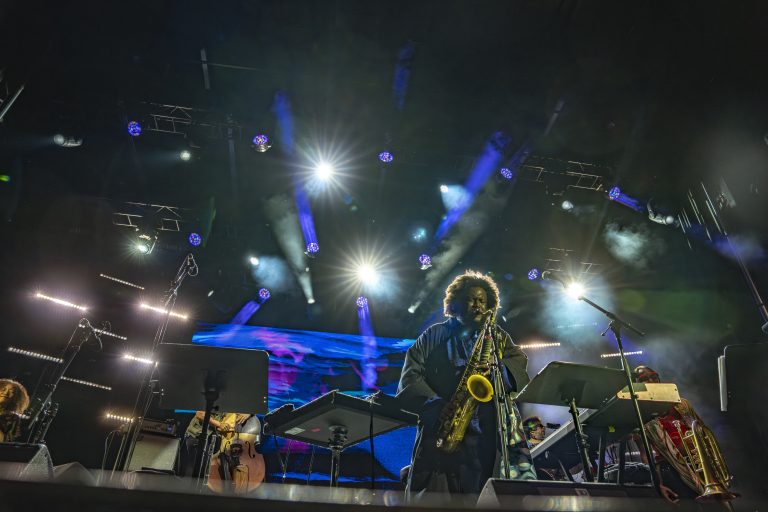
After an absolutely stellar performance from St. Vincent with the Montreal Symphony in the Salle-Wilfrid Pelletier, I raced outside to witness my first-ever Kamasi Washington performance at the Scène TD. It was kind of a big moment for me as I’ve missed Kamasi Washington every time he has played Jazzfest and his solo Montreal shows for the last five years, and I listen to his cosmic jazz epics while writing quite frequently.
The 45-year-old jazz saxophone god was dripping in style, wearing a black kimono, and clutching his tenor saxophone like a child in awe while watching singer Patrice Quinn absolutely belt out some vocals about space and the universe. She was finishing up the 12-minute song, which really stretched into 15, “Askim,” from the 2015 album The Epic. Washington led the song to a close with a spirited saxophone squeal, which seemed to stretch out for minutes. The lungs on this man are insane.
Next was “The Pslamnist,” from my personal favourite album, Heaven and Earth, which featured live solos on trumpet by Ryan Porter, thundering Double bass from Miles Mosley, and rapid drum work by Ronald Bruner Jr. (brother of Stephen Bruner aka Thundercat). Washington’s saxophone mastery is a marvel in itself to witness, but his not-so-secret weapon is his band. Every player could easily lead their own band. Take Cameron Graves’ beat-to-beat keyboard opening with Bruner. You could joke that this is just as good as Domi and JD Beck, honestly. “Any anime fans out there?” Washington asks the crowd of 10s of thousands.
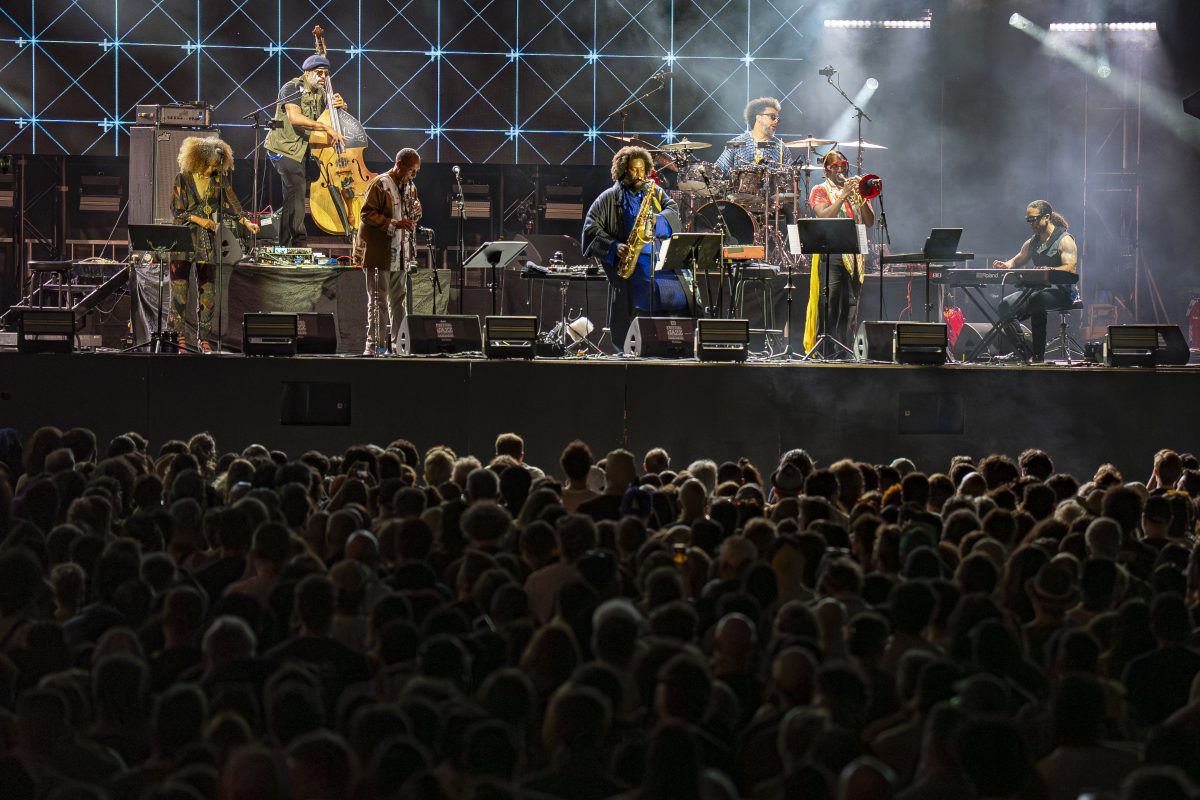
The track is “Lazarus,” a song that Washington hoped would be the opening to the newer anime by Shinichirō Watanabe, Lazarus. Instead, Watanabe chose “Vortex,” but we are feeling the monolithic “Lazarus.” The backing vocals, led by Quinn, are this track’s true formula for success. Washington’s otherworldly saxophone is also, again, unreal. Mosely also unleashed a fierce bass solo on his double bass, his fingers moving like frenzied airplanes as he switched on a phaser pedal. I’ve never seen a double bass solo actually rival one of the electric bass. Mosley is another god of his craft.
After a wonderful and extended cover of “Prologue” by the Argentinian Tango composer, Astor Piazzolla, Kamasi said he will be back in Montreal soon. This was Washington’s third Jazz Fest performance, so I have no doubt we will see him again.
Photos by Victor Diaz Lamich