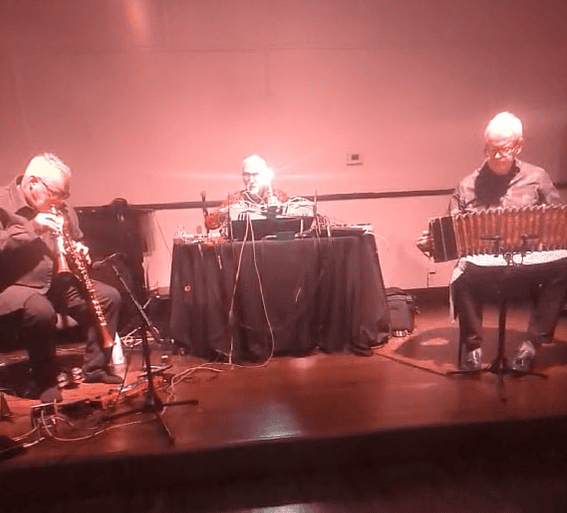
Le Vivier presented a double program of free improvisation last night. First, the Montreal violin/electric guitar duo of Adrianne Munden-Dixon and Raphaël Foisy, followed by the atypical Vancouver trio Squid in Chains, consisting of John Oliver on synthesisers, François Houle on clarinets, and Douglas Schmidt on accordion.
Munden-Dixon and Foisy, two regulars of the avant-garde scene, offered a noise performance in free improvisation, closely blending their two instruments. Foisy’s granular chirps on his electric guitar found a complementary echo in the jerky, random rubs of Munden-Dixon’s violin. Sometimes rough (the strings rubbed with the wood of the bow), sometimes ethereal (the strings barely touched), the sounds expressed by the violinist had something frenetic and nervous, while the guitar seemed to laugh playfully. About thirty minutes of very focused listening, not for all ears, certainly, but stimulating for those with enough muscle to tackle it.
The most substantial performance of the evening was that of the trio Squid in Chains. Fairly free improvisation here too, but more structured and linear, as one can guess, from a script that guides the artists for about 45 minutes. While it starts in a fragmented impressionism, the soundscape transforms to become, for a few minutes, melodic, thanks to François Houle’s Jewish-influenced clarinet, which reveals certain klezmer affinities. Then, it transforms again to become denser and more ecstatic, alternating or juxtaposing timbral fractures (Houle again), accordion pulsations, recessive and expansive waves from the synth, etc.
One comes away well-fed and impressed by the quality and coherence of the overall play of the three Canadians.
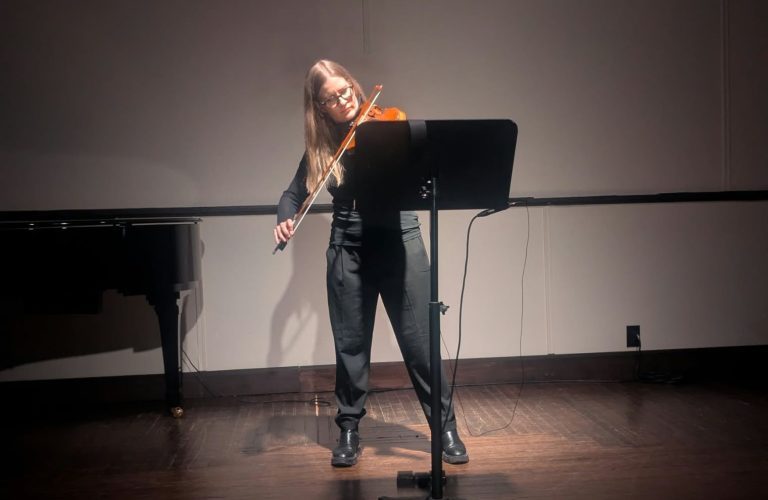
In the very intimate Sainte-Hilda space, Le Vivier hosted the Austrian violinist Judith Fliedl on Friday evening (October 30). The young lady is, of course, a master of the classical repertoire (she has a particular fondness for Bach and Mozart), but for several years now she has been concentrating on contemporary and avant-garde music. As she mentioned in our conversation, Judith Fliedl enjoys producing sounds “that are not normal.”
These are therefore bold sounds, sometimes strange, but more often atypically seductive, that the young artist offered during a concert that greatly impressed the audience at Sainte-Hilda.
Through the musical astonishments of the four works on the program (Ultraviolin by Benedikt Alphart, Partita for Solo Violin No. 1 by Chris Paul Harman, …när korpen vitnar (when the raven whitens) by Malin Bång and Frises by Kaija Saariaho) it is primarily a splendid technique, breathtaking in its mechanical ease and tonal accuracy, that we are able to perceive. One can only imagine such a level of performance in Bach or Mozart. Which will perhaps be for next time, if the concert programmers in Montreal read this text. That said, people in Toronto will receive her exactly for this November 3 : a program of Mozart and Korngold will be played, to launch the new Mozarteum Canada Society. Enjoy!
In the meantime, we will fondly remember this very beautiful hour of demanding music, delivered with passion and conviction by the lady. Alphart’s Ultraviolin refers to the use of ultrasound (obviously brought down to an audible level for humans) in a sound tape accompanying the soloist, who interacts with it in a very delicate manner. To the point that at certain moments, the whispers of the violin were completely drowned out by the said tape. Ironic, for sounds that were initially impossible to hear…
In short, while the idea seems interesting, the result is not always as convincing. The opposite of the next piece, …när korpen vitnar by the Swedish Malin Bång, an expressive and technical tour de force, like a shattered and breathtaking toccata, brilliantly conducted by Judith Fliedl. The remarkable Partita for Solo Violin No. 1 by Montrealer Chris Paul Harman brought a classical elegance, albeit strictly abstract. Fliedl learned it in anticipation of her visit to Canada, a gesture that is not only respectable but also delightful, given the evident and authentic personal investment the young lady put into it. Her interpretation is flattering, as it demonstrates the full value of Canadian music. Fliedl described it as very difficult to master. You can believe it, the impressive passages of tactile boldness, as well as the impossible contrasts of nuances, add up mercilessly, while showing no sign of being able to overcome Fliedl’s perfection of play. If the Austrian ever records this piece, it could become the reference.
Excerpt from Frises (Kaija Saariaho) by Judith Fliedl – Sainte-Hilda hall, Montreal, October 30, 2026 (with the kind permission of Judith Fliedl):
The short recital ended with the interpretation of a gem, already a classic of the current violin repertoire: Frises by the Finnish composer Kaija Saariaho. Fliedl reveals that it is one of her favourite works, due to its sound beauty, the countless colours and glimmers it contains, and the bewitching dreaminess that emanates from the score. Once again, Fliedl brilliantly succeeds in conveying all the almost fairy-tale magic and wonder. Her personal affinity with this piece shines through and powerfully communicates with the audience. The delicate electronic track accompanying the violin sometimes evokes a vibraphone, while creating a broad and warm reverberation of the melodic lines played by Fliedl. A moment of very beautiful magic.
An inspiring meeting. Hats off, Le Vivier, for making us experience it!