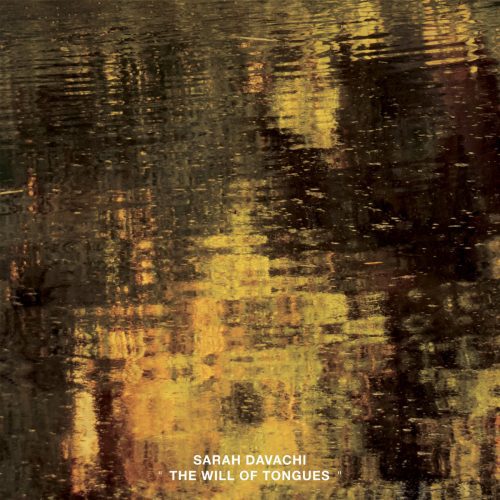
Some commentators have described the music of Canadian Sarah Davachi as “a hybrid between Eliane Radigue and Terry Riley.” For my part, after listening to The Will of Tongues, I would rather say that it is an astonishing marriage between Ligeti and Pärt with a dose of unsettling ambient music.
The Davachi method is remarkably coherent and clear throughout this very generous album of over two hours of music: a dynamic minimalism that is not at all propulsive. On the contrary, they are long, very long sustained notes on which shorter notes oscillate, forming series of consonant chords, but in an expanded manner. The effect is powerfully instigative of contemplative trance.
However, due to certain tighter harmonies, this trance does not induce placid bliss in us, as in the music of Brian Eno, for example. Davachi is more demanding. She asks us to immerse ourselves for the entire duration of the works and to actively participate in the listening, in order to allow our minds to free themselves from the dictates of quick and fragmented listening imposed by contemporary media culture. What she proposes is actually almost audacious, so much have we forgotten that listening to good music takes time. The time to attentively perceive all the details and all the subtle changes.
The album seeks to articulate a deep reverence for the act of listening…
This collection of music is not easy listening, and it’s not meant to be – when long durations and a reduction of materials are at play, the ear and the mind are forced to truly face the reality of sound itself… [This is] a celebration of iterative listening and of extreme engagement, of intimate aural experience and its vast psychic horizons.
The most convincing pieces are those for choir. The occasionally microtonal inflections unfold there with elegance and naturalness. There are also pieces written for organ that create original atmospheres of contemplation, in the spirit of the mystical minimalism of Pärt and Tavener, but even more stripped down in terms of textural development.
Counterintuitively, the works for woodwinds (Interlude V Harmonic, for Woodwinds) and for brass (Interlude II Unison, for Brass) offer surprising perspectives. On the contrary, some works for strings disappoint, such as, for example, the duo from The Rose Dialogues, Part I and II, which, at two times 23 minutes, drag on and lack variety.
Whatever one may think, Sarah Davachi’s approach is coherent, focused, and more often than not succeeds in offering engaging listening spaces.
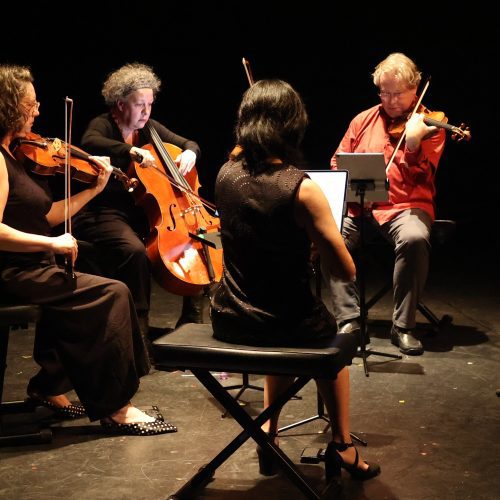
PERFORMED BY:
THE SUNG BLOOD PLAYERS
Whitney Johnson, viola
Eyvind Kang, viola
Lucy Railton, cello
PHAEDRUS
Liane Sadler, tenor flute
Charlotte Schneider, tenor flute
Mara Winter, tenor flute
Luis Martinez Pueyo, bass flute
DIAPASON
Nev Wendell, trumpet
Nicholas Ginsburg, horn
Mattie Barbier, trombone
Mason Moy, tuba
CHAMBER CHOIR IRELAND
conducted by Nils Schweckendiek
SARAH DAVACHI
on five pipe organs tuned in historical temperaments
Tour dates for Sarah Davachi :
September 25 | Brooklyn, NY, USA | First Unitarian Church | organ
October 8 | Kraków, Poland | Kraków Philharmonic Hall / Unsound | organ + Interludes woodwinds
October 16 | Venice, Italy | Teatro Goldoni / La Biennale di Venezia | Chanters
world premiere in ensemble with Parco della Musica Contemporanea Ensemble
October 18 | Venice, Italy | Teatro Piccolo Arsenale / La Biennale di Venezia | organ
October 22 | Berlin, Germany | Gedächtniskirche | organ + Interludes woodwinds
October 24 | Namur, Belgium | Église Saint-Loup | organ
October 27 | London, UK | St James’s Church Sussex Gardens | organ + Interludes woodwinds
October 28 | London, UK | St James’s Church Sussex Gardens | organ + Interludes strings
October 30 | Leuven, Belgium | Stuk Arts Centre | electric organ