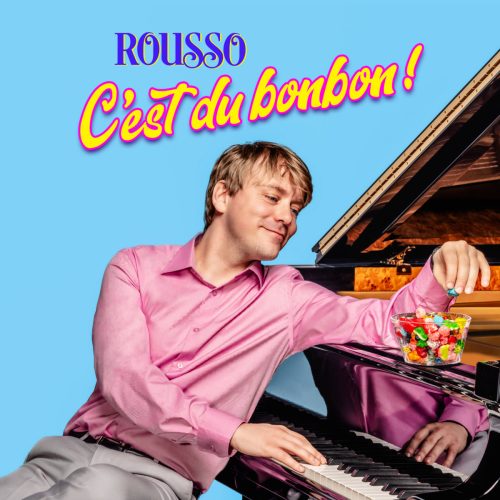
If it is true that the current neoclassical wave offers us its share of generic products that imitate each other with basic harmonies and often rather poor melodies, there are a few artists who, without shaking the stilts overlooking the predictable tides of the style itself, still manage to sprinkle their little pieces with original and interesting touches. The Montreal pianist Rousso (Xavier Rousseau on his passport) is of this ilk.
The one who was part of the cast for the tribute to André Gagnon (Neiges) on December 13, 2025, at the Orchestre Métropolitain (I mentioned that he delivered a “skilful” version of Ta Samba) started by offering two entirely solo piano albums (Iceberg in 2021 and Rosemont in 2018), in which he demonstrated understated but notably superior skills compared to many other pianists in the neo movement. In other words, this young man really knows how to play.
Perhaps due to his collaboration with the OM, it seems he has taken a liking to group music. Even though far from being an orchestral score, it is still in a chamber music format, with a violin (Ryan Truby) and a double bass (Pierre-Alexandre Maranda) accompanying the composer on the piano.
The melodies have a beautiful quality, that of offering sometimes unexpected twists. The rhythms dare to be danceable and prompt, rather than a slow, wall-to-wall melancholic agony. And the contributions of the violin and the double bass have substance. Their presence is not just cosmetic. There is a genuine dialectical discourse and a cohesive ensemble performance. We even have some surprises, like in Vortex where the rhythms shift and fragment, the double bass growls, and the violin fidgets nervously. Elsewhere, some distinctly jazz colours emerge.
Thus, with Rousso, I think more of the instrumental pop of the 1980s, but in much better renderings. Frank Mills, for the clarity of the melodic lines and their danceable quality, Richard Clayderman for his pianistic skills. That said, and fortunately for us, Rousso is much more understated than Clayderman, who drowned his themes in cascades of unnecessary notes. This is absolutely not the case for the Montreal pianist.
Frank Mills, for his part, took his compositions to the extreme with flashy beats of bad beatboxing and synthetic strings (due to a lack of means or simply because at that time, it seemed beautiful to people. Yuck). Rousso remains entirely acoustic. Moreover, the sound recording is quite natural, which is notable for this type of product.
It’s like candy (the meaning of C’est du bonbon), but it dares to be a bit more.
Piano: Rousso
Violin: Ryan Truby
Double bass: Pierre-Alexandre Maranda