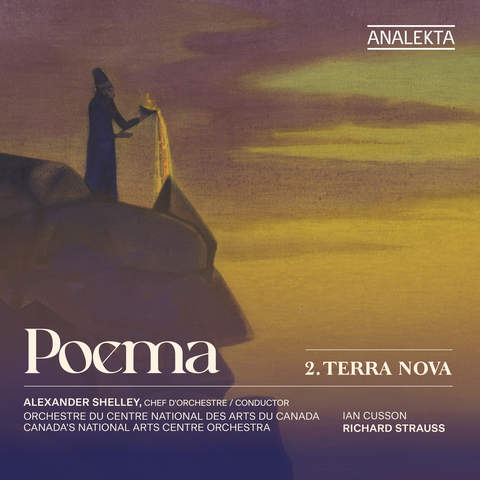
Ottawa’s National Arts Centre (NAC) Orchestra’s Poema series pairs Richard Strauss’s symphonic poems with new Canadian works commissioned to engage with the German composer’s. Poema 1 Ad Astra linked Don Juan and Death and Transfiguration with works by Kelly-Marie Murphy and Kevin Lau. Here, it is the famous Also sprach Zarathustra that is called upon to rub shoulders with a work by Ian Cusson, 1Q84 Sinfonia Metamoderna. A huge challenge if ever there was one, Strauss’s Zarathustra being an incomparable masterpiece, firmly based on a literary monument (Nietzsche) and itself developing a universe of symbolic depth through the composer’s abundant writing. In light of Strauss’s rich and complex perspective, Cusson also decided to seize a literary masterpiece, the novel 1Q84 by Haruki Murakami. This symbolist and surrealist science fiction novel tells the story of two people living in 1984 and reuniting after years of separation in a parallel universe and through metamorphosed identities.
If in Nietzsche humanity is confronted with itself through the transcendent experience of Nature, in Murakami, it is the individual who faces themselves through identity struggles and in a panorama of infinite possibilities of choices and consequences, the Multiverse.
zCusson’s musical language is here deployed through marked but not ungracious contrasts. Sumptuous surges recall Strauss, one can guess. But the textural shifts between a modernized romanticism (Britten-esque, let’s say) and a crystallized impressionism take root in our post-modern 21st century to give life to virtual characters in search of truth, connection and meaning in a world that defies certainty. Some harmonic inflections and percussion commentary also tell us that this story is set in Japan. 1Q84 is a meaningful work that I really enjoyed listening to multiple times.
The version of Zarathustra by Shelley and the CNA Orchestra is not lacking in panache or muscle, proof that this ensemble has progressed over the past twenty years. Without being a revelation, it is still a version that deserves to be listened to.
A pleasant dialogue between two eras and two literatures with music as the mediator.