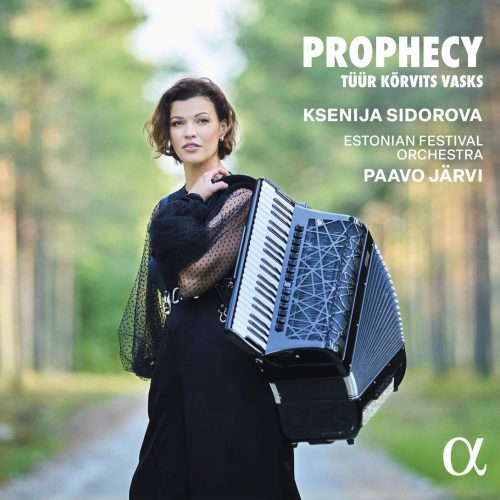
Three substantial works for accordion and orchestra, from three Baltic composers: Tüür and Kõrvits from Estonia, Vasks from Latvia. Each of these three artists has succeeded over the past few decades not only in creating their own sound universe but also in rising to the ranks of the most admired creators in the world of contemporary music. Ksenija Sidorova is a young Latvian accordionist of immense talent who has been playing her instrument since the age of six. I have long been a great admirer of the three composers present. Their language represents the best in new music: intellectual rigour, a demand for attentive listening, and a sense of dramatic storytelling that makes the auditory experience captivating.
This is exactly the case with Prophecy, the title piece of the album, a concerto for accordion and orchestra by Erkki-Sven Tüür. The concerto is divided into four uninterrupted sections, each creating dramatic atmospheres vividly and with great expressiveness. Prophecy is inspired by the character of the Seer, capable of predicting the future, an individual ironically often ostracised in his society. The accordion as well as the orchestra are used with an extended sound and timbre range, combining mass effects and passages of great pointillist subtlety. Tüür borrows from spectral music with abundant textural scintillations, but in a distilled manner within a rather classically modernist framework. The score written for Ksenija Sidorova is spectacularly detailed and demands a high level of personal investment, which the young lady delivers with strength and conviction. An exceptional work.
Next are the four Dances by Tõnu Kõrvits, named Darkness, Passacaglia, Siciliana, and Sarabande, thus inspired by the Baroque. The style is different from the previous work: the textures become more sumptuous, with generous strings on which the accordion and woodwinds float more or less agitatedly, revealing colours. Very evocative, sometimes enchanting, these dances seem designed to accompany some cinematic panorama. That said, they are anything but tacky pastiches. Rather abstract landscapes with a seductive character. Magnificent.
The album concludes with the short piece The Fruit of Silence by Peteris Vasks, inspired by a text from Mother Teresa. Originally written for choir and piano, it has been arranged here for accordion, vibraphone, and strings. The music is peaceful, even contemplative, somewhat, but with differences (and without titinnabuli), like an Arvo Pärt score. Sidorova demonstrates, after the robust and virtuosic gestures expressed previously, great tonal and dynamic subtlety.
The Estonian orchestra conducted by Paavo Järvi is in its element, to say the least.
This album is a source of exceptional sonic and musical pleasures.