Simplicity, truth, “almost nothing.” Behind these minimalist qualifications are the collections of piano miniatures Játékok (Games) by György Kurtág, the unique and unclassifiable Hungarian composer who will be 100 years old in February 2026. Throughout his career, he has added to these collections, or Books,, which now number ten. Rarely exceeding two minutes, the pieces are meant to harness a certain youthful state of mind in piano practice.
That said, far from being dance pieces or strictly playful in nature, they are first and foremost a collection of almost spontaneous reflections on a very wide range of subjects. His wife Marta, winks at composers of the past, fleeting impressions, tributes to friends, etc. Like sonic haikus, the Hungarian pushes the exercise of meticulousness to an exceptional degree of perfection. If he could summarise all his thoughts in a single sound, he would.
I’m looking for a note and maybe I’ll eventually find it
– György Kurtág
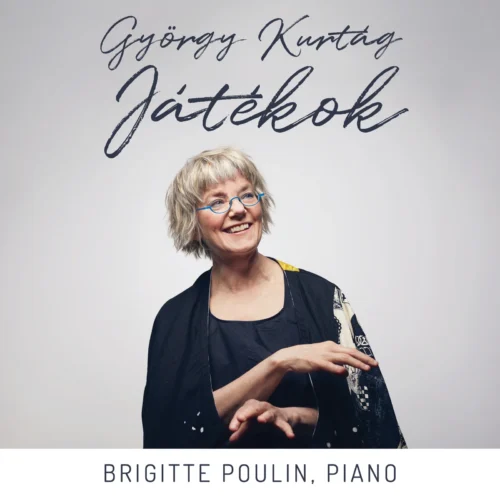
The pianist Brigitte Poulin has been interested in this repertoire for several years. She has already, by the way, performed Jatekok in concert in 2022 here in Montreal. She therefore masters this hyper-stripped-down, post-Webernian language with conviction. Combining gentleness and conviction, her own pianistic playing is in holistic harmony with Kurtág’s scores.
What’s more, through the large number of available pieces, she managed to construct a program that coherently divides the approximately 50 pieces of the program into five “acts”: Act 1 – Paradise and Hell, Act 2 – The Human World, Act 3 – Homage to Marta Kurtág, Act 4 – In Memory of… and Act 5 – Nature and Transformation.
Thus, the pieces are not played in chronological order but rather based on their (subjective but justified) belonging to these themes. The listening becomes more focused, even guided. Kurtág’s music is such that another formula could have worked just as well, but this one is a very valid proposition, and I must admit that I greatly appreciated its structure.
This LEAF publication offers us a fine and meticulous look at a repertoire that is still largely unknown but imbued with a quiet, penetrating, and memorable strength.