Additional Information
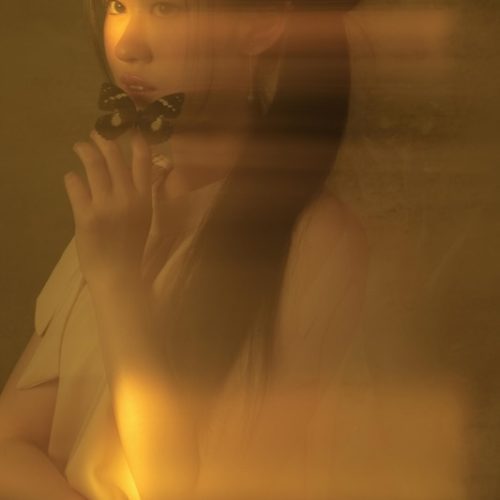
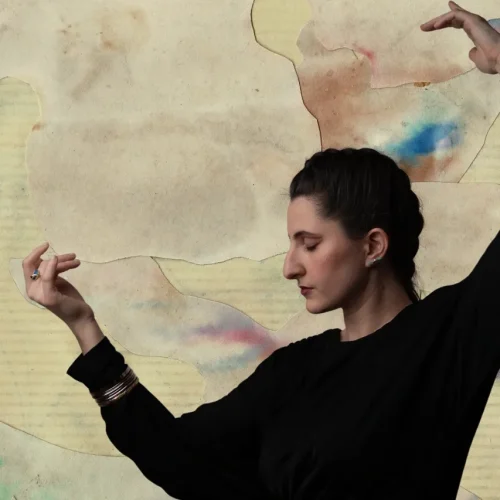
Photo: Benoît Paillé
Like so many dedicated artists, propelled by the mechanisms inherent in pop culture, Klô Pelgag has ridden, and roughly, the inevitable whirlwind generated by the profession that welcomed her. She found it very cool at first, then less cool… to the point of disillusionment. At the bottom of the barrel. against all odds, she tried to understand the ins and outs of this negative chaos.
Notre-Dame-des-Sept-Douleurs is the culmination of this creative self-care effort, during which she made peace with the physical places in the village whose name had terrified her when she travelled with her parents between Rivière-Ouelle (where they lived) and Sainte-Anne-des-Monts (where they worked).
“Starting in 2013,” says Klô Pelgag, “I didn’t stop recording. At a certain point, it went a lot faster. I had to learn how to work with it, how to approach each thing at a speed that was too high for me. We did a lot of touring! You go to Europe, you travel with seven people in a van, you come back to Quebec to record again, you go back to France? Anyone would end up hitting a wall. I had a bit of anxiety after the tour for the first album, I told myself I was going to slow down for the tour for the second one, but that’s not what happened. I just didn’t have time to deal with it anymore.”
At the end of the second album’s cycle, the singer hit that wall and visited the symbolic hell of which Notre-Dame-des-Sept-Douleurs would speak. In real life? Klô Pelgag doesn’t hesitate to talk about depression.
“I went through an amicable break-up, that was very painful! At the relational level, I experienced other breakdowns, other wounds. You don’t want, when you do this job in life, that people envy you. People think what you do is hot. And then some of your friends get harder on you, read too much into things you’ve been through… that happened a lot! It happened while I was rushing, doing hundreds of shows, interviews, public events, galas, things that are not natural to me. All I wanted to do was make music! What I didn’t know at the beginning was that this job comes with all these media things, the impact on your personal life, the way people look at you… You’re kind of helpless in that regard.”
This is what Notre-Dame-des-Sept-Douleurs is all about: escaping from overwork, regaining one’s balance and reference points, taking one’s creative process in hand. Pelgag sums up the process as a “natural path” through which she regained her strength, and gave birth to a human being and a third album.
“I have always tried to bring my feelings and emotions into my music. My music has always been at the service of that, with healing properties. The lyrics of my songs allow me to name things, it’s also a way to heal them. This album, however, is much more frontal in its lyrics. It’s more direct, more raw, more transparent, less metaphorical, but also true and authentic.”

Leaning less to the semantic proliferation that’s become her trademark, and that some have misinterpreted, the new album puts forth a limpid evocation of its emotions, without denying earlier outbursts, for all that. Her words can’t be summarized with a superficial epithet.
“When, for example, my style is described as absurd, I get shivers of frustration. I’m talking about real emotions and real things! Calling it absurd, or other such adjectives, is reductive. Yes, I did absurd humour when I was first seen on stage – I was really shy and my defence reflex was to fool around, to make jokes. Some people saw only that, and classified my work… I understand that maybe they didn’t have time to see things more clearly.”
One of the highlights of Klô Pelgag’s still-early career was a concert for chamber orchestra, given at Montreal’s Théâtre Maisonneuve in June 2017 in the context of the Francofolies. The Orchestre du Temple Thoracique echoed the title of his second opus, L’étoile thoracique. It was the culmination of his collaboration with her brother Mathieu (Pelletier-Gagnon), a composer and arranger… and it was also a breaking point.

“Until the second album, the instrumentation was very much like what my brother had brought to my music. After that show at Théâtre Maisonneuve, there was a shift in the staff and instrumentation of my band. I found musicians with whom I had a real affinity, a new core that was going to be very influential for the third album.”
Here is that core: Étienne Dupré on bass, synthesizers and a little percussion; François Zaidan on guitars; Pete Pételle on drums; Sylvain Deschamps on co-production and various instruments. Brother Pelgag is no longer present, devoting himself to other projects, starting with his career as a composer of contemporary music.
How to explain this change in direction?
“I needed to free myself and trust myself as a musician,” says the younger sister. “I’ve always admired Mathieu, just as I admire my other older brother, who is currently doing a post-doctorate on the impact of video games on Japanese youth. When I was working with Mathieu, it is important to remember that I was co-arranging and composing with him. My brother would use my ideas, melodic or harmonic, but I didn’t have the confidence to carry them on my own.”
This is one of the fundamental differences between this album and the two others by Klô Pelgag: the total reclaiming of one’s potential, the consolidation of the ego.
“I kicked myself in the arse to break my fear of composition, technique, and software. I started creating compositions on the computer, organising several voices, better understanding polyphony. Sylvain helped me to put that down on paper, the cellist Marianne Houle, who also plays keyboards and sings very well, also helped me with that.
“I co-produced everything with Sylvain, I arranged all the instruments, except for three songs where I called on Owen Pallett – ‘Soleil’, ‘J’aurai les cheveux longs’, ‘À l’ombre des cyprès’. I took the risk to contact him, he was super busy but he accepted, and we corresponded by email. I wanted to recruit someone who’s a little inaccessible, whom I admire a lot, and who’s from outside the French-speaking Quebec milieu.”
Born from a desire for simplicity and a return to balance, the project gradually became more complex.
“At the beginning, I was in reaction to the whirlwind I wanted to get out of. My intention was to do something lighter. Then I realised that I wanted to explode, to really go somewhere else in terms of composition, to do things I’d never done before, to get rid of my fears as a musician.”
Pelgag subscribes to the notion of systemic sexism in the world of music.
“The group Femmes en musique encouraged me to trust myself musically. It’s sneaky and unconscious, but you often get the impression that we women need someone else to achieve what we want to achieve. I’ve been composing and co-producing my songs since I started out, but I had the reflex of putting my male colleagues forward and giving them all the credit. I grew up listening to women performers, but I grew up listening to a lot fewer women guitarists, composers, and producers… That’s what shapes your imagination. I had to take responsibility for my musical side, my ability to do things and evolve. I love myself more, I hate myself less.”
Having left Notre-Dame-des-Sept-Douleurs for good, Klô Pelgag hurtles full throttle towards Notre-Dame-de-l’Assomption, “free like violence”.