Additional Information
Composed entirely with an instrument he designed himself, Graham Hudson-Jameson (Dr. Jekyll Project) took on the challenging task of melding a completely experimental approach with the traditional style of Lied music. And well, he succeeded.
It is an album that is to be listened to in its entirety, and I would add, several times. While the first listen may be an overwhelming experience of awe and curiosity, the second and third listens reveal the interlocking dimensions that encompass this powerful feeling. In typical electroacoustic fashion, each song manages to orchestrate varying textures and voices which phase in and out of a non-rhythm, meeting naturally at the breaking points of an overseeing storyline.
Set to a poem which embraces the discomforts of aging, Gwyneth Hudson-Jameson’s intimate confessions of fears, yearnings, and regrets are boldly amplified by the dramatic appeals only a skilled opera singer such as she could execute. In a way you wouldn’t expect, her singing always finds the right tone to either accompany or contrast the music. Sometimes tearful, sometimes standing tall and strong, you can let yourself be carried away, vicariously living through her voice.
In its entirety, this album is exploding with meaning. Graham and Gwyneth are both noticeably experienced, and their chemistry as siblings creates a whole like we rarely see in duos.
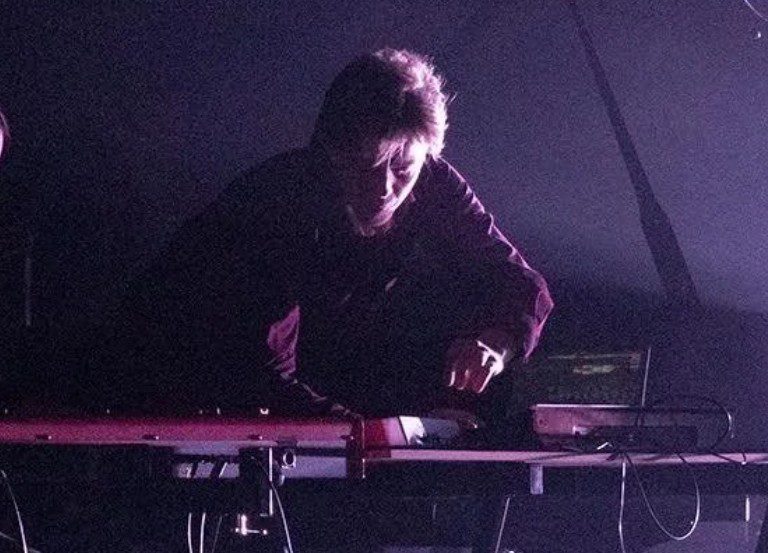
With the Festival Vibrations coming up (his performance is on Friday), I spoke to Graham who is preparing their performance with this instrument of his, the Lightbox, to better understand how such an unique approach came to be.
PAN M 360 : The album’s central metaphor is the fading of colors to describe the transition from childhood to adulthood. Could you elaborate on how this specific visual metaphor translates into sound, both in your vocal composition and in the electronic textures you create?
Graham Hudson-Jameson : I was inspired to use the visual metaphor of fading colors because I once read that as we age, the lens of the eye yellows, making colors appear less bright. I didn’t fact-check it, but the idea stuck with me. The fading of color reflects the loss of childlike innocence, gradually giving way to a monochrome, jaded perspective on life. Sonically, I approached this metaphor quite literally. In the first part, the sounds are bright and clear, and the vocals express freedom while describing the vibrant world around them. In the second part, the colors and the music begin to blur, with faster tempos and more chaotic rhythms. In the third part, the sound is almost entirely choral, with most voices holding sustained, monotone notes, reflecting the monochrome world of old age. There is also a section that reaches back to childhood, but the memory is fragmented and distorted before returning to the present.
PAN M 360 : The title “Autoportrait” contains many tracks, suggesting multiple self-portraits. Are these songs different facets of a single self at different times, or are they portraits of different, perhaps archetypal, individuals going through this universal passage?
Graham Hudson-Jameson : I divided the self-portrait into three distinct parts to represent different stages of a person’s life. The first part depicts childhood, when everything moves slowly and the world feels bright and fascinating. The second part represents adulthood, when time rushes by and life’s beauties blur together. The third part portrays old age, when everything has turned monochrome, and the person looks back with nostalgia and a hint of regret for not having enjoyed life to the fullest. Together, the three parts tell the story of one individual moving through these milestones.
PAN M 360 : You developed the concept for this album in the context of the Musiques Numériques Bachelor program. Can you talk about how mentorship guided you through this process?
Graham Hudson-Jameson : I started brainstorming ideas for this project while taking the project class with Ana Dall’Ara-Majek. She helped me develop the Lightbox, an instrument that uses light sensors to control sound parameters in Max/MSP. I was also taking a writing class with Philippe Gareau, who helped me understand harmonic structures and choral voicing. Lastly, in a history of Romantic music class with François de Médicis, I learned about the structures of various Lieder, which greatly influenced both my musical ideas and my narrative approach.
PAN M 360 : In this learning curve, is there something you wish you understood earlier on in your studies?
Graham Hudson-Jameson : The hardest part was coding in Max/MSP. I was taking the class at the same time as I was writing the album, and I often had ideas that I couldn’t put into practice right away because I lacked the necessary knowledge of the program. As the course progressed, however, I was able to apply what I was learning directly to the project. I do regret not taking the class earlier.
PAN M 360 : What has inspired you the most throughout the past couple of years to keep creating?
Graham Hudson-Jameson : I’m inspired by stories and narrative structures. I love listening to stories and expressing them through my music. I believe storytelling is how we connect with one another and how we come to understand the human condition.
PAN M 360 : Despite having studied electronic music, you are a brilliant composer, and I think this is what sticks out from your work. It seems obvious now, but why did you choose to pursue electronic music?
Graham Hudson-Jameson : I am classically trained on the piano and studied jazz and pop in cégep, but I have always loved experimenting with the timbre of my instruments. As a child, I would open my family’s upright piano, scratch the strings, and fill it with aluminum foil or socks just to explore new sounds. In high school, I saved up to buy my first synthesizer, and I immediately fell in love with electronic music. I still deeply enjoy classical and choral music, but I also crave timbral experimentation. For this project, I chose to blend both worlds as a way to challenge the boundaries of musical genres.
PAN M 360 : For this project you chose to work with your sister Gwynneth who is an incredible opera singer. Can you tell us about how this came about?
Graham Hudson-Jameson : I grew up learning music alongside my sister, and we both fell in love with it. She pursued a classical path, while I explored experimental music, and I’ve always thought it would be fascinating to combine our worlds. When I asked her to join me on this project, she was enthusiastic about the idea—and that’s how we came to collaborate!
PAN M 360 : The Lied tradition and live electronic music seem to be completely opposed practices, yet they work very well together. Did either of you have to adapt the techniques of your respective practices in the process of creating this piece?
Graham Hudson-Jameson : A Lied is a German song, especially from the Romantic period, typically for solo voice accompanied by piano. A Lied cycle is a series of songs that together present a narrative or thematic progression. The tradition began with Franz Schubert in the 19th century, and since then, composers have written song cycles in many languages and with various accompaniments, sometimes piano alone, sometimes with strings or other instruments. My approach to the song cycle is similar. I created three songs meant to be performed in sequence as a single musical work, but I chose to accompany them with my Lightbox instead of piano. The main adaptation was in execution. Electronic music often relies on improvisation and free time, which isn’t always intuitive for classical singers. We practiced extensively, and now Gwynneth is able to follow my cues seamlessly.
PAN M 360 : Having completed this intense exploration of a fragile transition, where does this project leave you as an artist? What emotional or creative territory are you interested in exploring next?
Graham Hudson-Jameson : I am very happy with the results and proud of the work I accomplished with Gwynneth, but this project wouldn’t have been possible without the support of several others, including Ana Dall’Ara-Majek, Jules Argis, Dominic Thibault, Nicolas Bernier, Gaëtan Proulx, the Mosaïque team, and the LFO team. For my next project, I plan to focus on developing a solo repertoire for my Lightbox. While I’m not yet certain about the specific themes, I want to further explore sample manipulation, synthesis, and spatialization through the instrument.