Additional Information
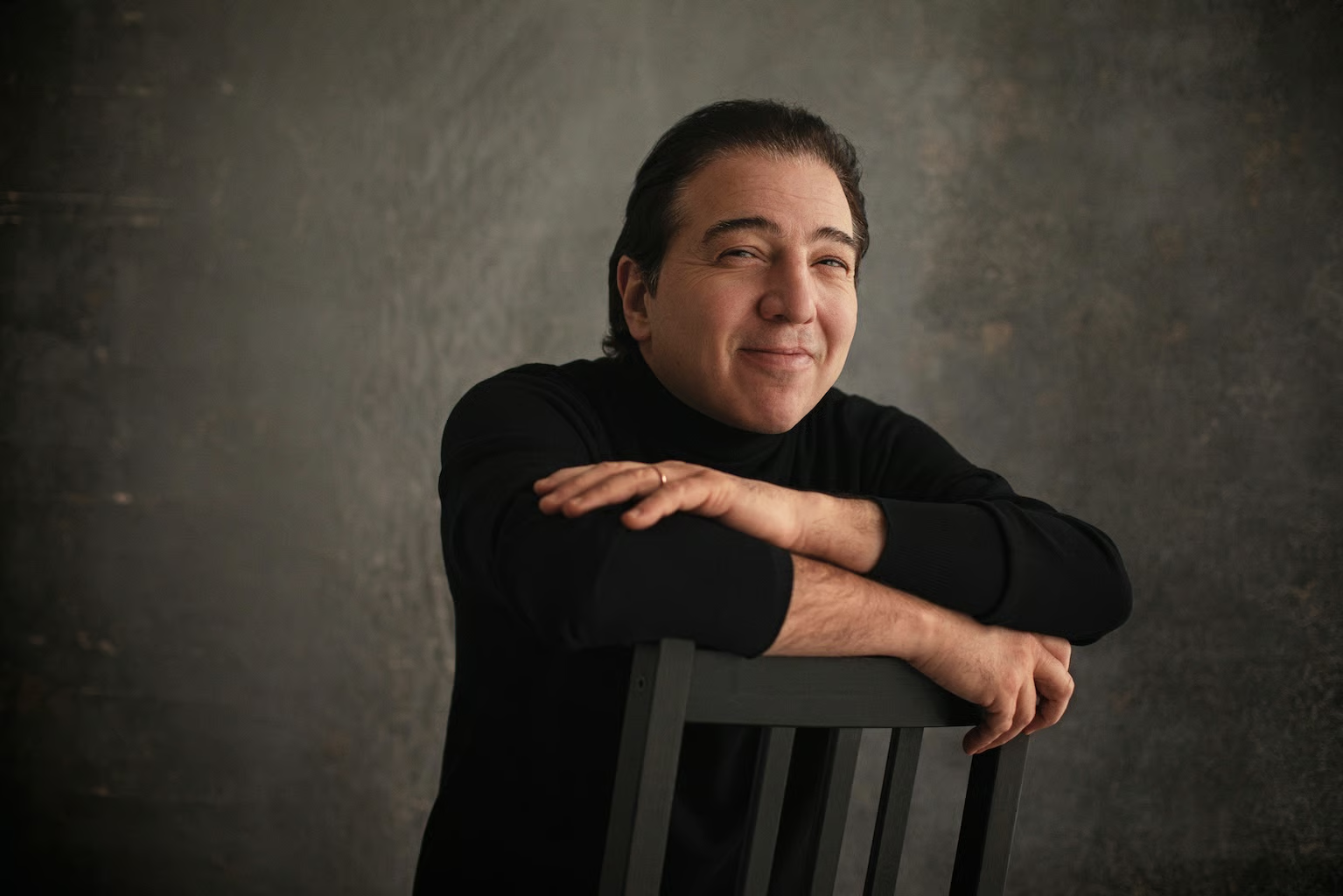
The Turkish pianist Fazil Say is one of the most remarkable artists of the last 30 years. His particular style, crouched over his keyboard, almost embracing it and murmuring more or less loudly while playing, may remind one of Glenn Gould. The artist, however, is more versatile than the Canadian. He does not shy away from the stage, on the contrary. He gives about a hundred concerts a year. Moreover, he composes a lot. He has already reached number 120 in his opus catalogue. Symphonies, concertos, and piano pieces, of course. In 2022, he recorded Bach’s Goldberg Variations, about twenty years after his previous album dedicated to the composer. Since then, he has been performing them in concert all over the world. On Tuesday, February 17, he will perform them at the Bourgie Hall in Montreal, as part of the “Exceptional Pianists” series (and believe me, in Say’s case, it’s true!). In addition, he will also play several of his piano works, including Black Earth and his Sonata Yeni Hayat (“A New Life”). I discussed Bach and his own music with Fazil Say before his visit to Montreal.
CONCERT DETAILS (No tickets are available, the concert is sold out)
PanM360: The recorded Goldberg Variations arrived in 2022, about twenty years after the previous recording dedicated to Bach. Why such a long hiatus?
Fazil Say: You know, I play between 90 and 100 concerts a year, in addition to writing a lot of music. Bach is important in my life, but you have to take the time to learn this music, especially major works like the Goldbergs. For the Goldbergs, it was the pandemic that gave me the opportunity. During the lockdown, I felt the urge to take the time that was suddenly offered to me to immerse myself in certain Great Works, such as the Goldbergs and Schubert’s last sonatas. For the Variations, I dedicated 3-4 months to the analysis, which was a great joy for me.
PanM360: In concert, do you do all the reprises?
Fazil Say: If we do them all, the piece can last almost 90 minutes. I decided to cut some repetitions and offer the entire thing in a timing of about 55-60 minutes. I don’t think this hurts the piece, and it allows me to offer a different second part of the concert.
PanM360: The Goldberg Variations are a masterpiece of musical architecture. They can be played with different narrative perspectives. Gould 1955 is almost atomistic, with each movement as a universe in itself. One can be completely holistic, with a pointed arch peak, like in a cross of ogives, at variation no. 16, a French Overture that can serve as a “second start” towards the second half. One can also conceive the whole as ten groups of three variations (a character piece, a virtuosic variation, and a canon) to which the initial Aria and its final reprise are added. In short, what is your narrative vision of this edifice?
Fazil Say: You are right to say that there are ten groups of three variations. You are also right to talk about the symbolic value of variation no. 16, right in the middle of the structure. For my part, I never play that way, with that idea in mind. I rather consider the long line, from beginning to end.
PanM360: Since 2022, how have the Variations evolved under your playing? What changes have you made to them, compared to the recording?
Fazil Say: After several dozen performances, I think the ideas are clearer, the whole is more mature. It’s normal. It’s a process that resembles life. I think my way of playing now is better than on the record.
PanM360: Do you want to play and, perhaps, record more Bach?
Fazil Say: I would like to record The Well-Tempered Clavier soon. But soon doesn’t mean tomorrow (laughs). Through all my concerts, commissioned works, chamber music, etc., I have to find the time. My next two years are already completely booked. And the Clavier is even more demanding than the Variations. So maybe in two years, a little more, I will be able to do the First Book. Then the Second, but I haven’t scheduled that yet…
PanM360: In the second part of the concert, on February 17, you will play your piano compositions, several of which are influenced by jazz. What place does this music have in your life?
Fazil Say: I have loved jazz all my life. Jazz and classical are not very different. I see jazz as a contemporary development of harmony and rhythmic play. A composer today must be interested in all kinds of music. Also the traditional music of one’s own country, or other countries, which I often incorporate into my compositions.
PanM360: Let’s talk about it. You will play, among other pieces, Black Earth, one of your first compositions and one of the most performed in the world. At one point, you mute the piano strings with one hand while playing with the other. It produces a sound that resembles a saz, a traditional Turkish instrument. How did you come up with this idea?
Fazil Say: By doing tests, experiments. I realised that it produced this sound, very interesting, very particular. That said, I didn’t invent anything. The prepared piano is a 20th-century innovation by John Cage. He would place pieces of wood, or metal, or plastic between certain strings to create strange percussive sounds. I don’t do that, but I draw inspiration from it.
PanM360: The program also includes the Sonata Yeni Hayat (New Life), Op. 99. What can you tell us about it? Why this title?
Fazil Say: I wrote it at the end of the lockdown during the pandemic period. I had in mind this terrible ordeal and all those deaths. I felt the urge to celebrate a new beginning. Hence the title. It’s a rather expressive piece, full of drama but also of hope.
I am also happy to be able to play some of my pieces in Canada. They are performed quite often elsewhere in the world, but, to my knowledge, not so much in your country. I hope people will enjoy them and want to hear more.
PanM360: What are you currently writing?
Fazil Say: Among others, a concerto for piano four hands. And other pieces for orchestra.
PanM360: There are no operas in your catalogue yet. Are you interested in writing one someday?
Fazil Say: I have been asked a few times to do it. The problem is finding a subject and especially a libretto that suits me. Moreover, I am someone more familiar with instrumental music. I should also learn how to write an opera, a challenge in itself, as it is an art with its own requirements, its codes, etc. Let’s just say it’s not on my agenda for the moment.
PanM360: But it’s not impossible…
Fazil Say: One should never say impossible.
PROGRAMME
J. S. BACH Goldberg Variations, BWV 988
Fazil SAY
Piano Sonata, Op. 99, “Yeni hayat” [New life]
Nazim, Op. 12, No. 1
Ses, Op. 40b
Kumru, Op. 12, No. 2
Black Earth, Op. 8
Claros: Temple of Prophecies, Op. 112
Summertime Variations, Op. 20
Paganini Jazz, Op. 5c