Additional Information
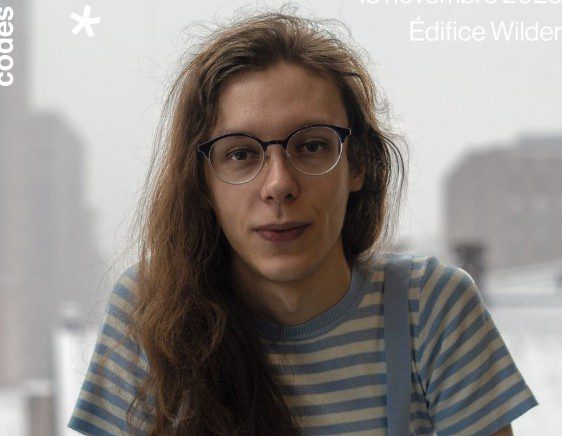
Presented on Saturday by Codes d’Accès, an organization whose purpose is to promote the work of emerging composers, the electroacoustic program Troubles et méandres presents “innovative artists whose works blur the lines of musical and performance conventions.” For those who responded to the call, PAN M 360 is posting their responses online and wishes them a long and fruitful creative career! At the Espace Bleu du Wilder, Kasey Pocius will present Hollow Points on Saturday, which aims to separate the components of a recording and then combine them into a new piece. Here is his background:
PAN M 360: The goal is to make you more visible, so introduce yourself:
Kasey Pocius: I am a gender-fluid multimedia artist and researcher based in Montreal, originally from Newfoundland. I completed my BFA in Electroacoustics at Concordia and a Master’s degree in Music Technology at McGill. Currently, I teach electroacoustic composition and improvisation at Concordia in the Music Department. I am very interested in mixed-media and mixed-medium works, and in the textural and spatial possibilities of digital systems.
PAN M 360: Present your work to the program: title, subject matter, content, form, stylistic references, instrumentation, performers (if any), live performance, angle of approach.
Kasey Pocius: For this program, I present a fixed media work entitled “Hollow Point.” I use algorithms designed to separate a complete mix of a song into its basic elements (guitar, vocals, drums, etc.), but I apply them to field recordings from Sydney and Glace Bay (lookout points in Nova Scotia). The new files sound “hollow” due to the inaccuracy of these algorithms and the musical assumptions built into these systems, and artifacts remain. However, when all the files are combined, these imperfections cancel each other out, recreating the original audio. By keeping the layers separate, they can be processed individually, creating new textures and spatial effects that are difficult to achieve with the source file alone. Exaggerating these artifacts can generate new musical patterns and materials, and makes the imperfections more apparent to the audience.
PAN M 360: How are you connected to this program, whose title Troubles et méandres (Troubles and Meanders) seems to suggest a theme? Or to the organization Codes d’Accès? Or to an emerging cohort on the creative music scene?
Kasey Pocius: My piece is a meander, a long sound environment in which one takes a sound walk on one side that is fictional and another side that is based on the real environment of Nova Scotia. It also draws attention to disturbances: on one side, the assumptions and biases of machine learning systems, and on the other side, the problems of noise pollution created by boats and other mechanical systems.
With this work, I return to a concept that interests me greatly: sound environments that are both delicate and heavy at the same time.
This is the third concert with Codes d’Accès that I have participated in as a composer, and I am grateful for their continued support of my work. I am always pleased to see that the organization continues to program a wide variety of voices from the creative music scene.
PAN M 360: What are your upcoming projects or events?
Kasey Pocius: I will be presenting a live performance with video and the T-Stick at LIVE@CIRMMT on December 12.