Additional Information
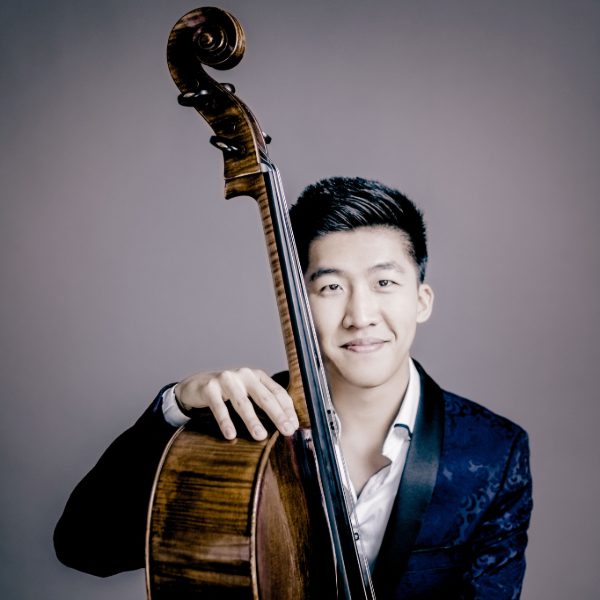
For the last concert of its 2024-2025 season, the Orchestre symphonique de Laval invites the public to an evening of discoveries, with a program essentially made up of German Romantic music, Johannes Brahms’ first symphony and two works that are rarely performed: Robert Schumann’s Genoveva Overture and the Cello Concerto by French composer Marie Jaëll. Under the direction of young conductor Andrei Feher, the OSL will welcome Bryan Cheng, a Canadian cellist who has established himself as one of the most captivating young artists on the classical music scene. Alexandre Villemaire of PAN M 360 spoke with him before the concert to discuss repertoire, interpretation and future projects.
PAN M 360: In this concert with the Orchestre symphonique de Laval, you’ll be performing the Cello Concerto in F major by Marie Jaëll, a French composer from the late 19th century whose work is little known or performed. Was this work a discovery for you, and why?
Bryan Cheng: Yes, it was a real discovery. I didn’t know Marie Jaëll’s cello concerto, or even her music in general, before this project, and I was struck by the great lyrical quality of her voice. It’s also refreshing to play a historic cello concerto by a female composer, as they have been vastly under-represented over the centuries. This is a real hidden gem of the repertoire, with something deeply captivating to offer.
PAN M 360: Tell us a little about this concerto. How is it constructed, and what are the particularities of its interpretation?
Bryan Cheng: The concerto is in three movements and follows a fairly classical structure, but it stands out for its great personality. The first movement has a dramatic intensity, with sweeping outbursts and harmonic surprises. The second is very lyrical, deeply introspective, almost reminiscent of an operatic scene. The last movement is both exuberant and virtuosic. Performing the concerto requires technical finesse as well as real emotional sensitivity. It’s not a demonstration concerto: what’s needed is honesty and a richness of colour.
PAN M 360: The concert program gives pride of place to German music with, in addition to the Concerto, Schumann’s Genoveva Overture and Brahms’ Symphony No. 1. How does Jaëll’s musical language complement the other two works on the program?
Bryan Cheng: Jaëll shares with Schumann and Brahms a depth of expression and a solid architecture. In her language, we sense an affinity with the Germanic school, but enriched by a harmonic finesse that evokes French refinement. In a way, she builds a bridge between these two traditions. Her concerto, placed between Schumann and Brahms, allows us to perceive both the common resonances and the singularity of her voice.
PAN M 360: You play a 1696 Stradivarius “Bonjour” cello, on generous loan from the Canada Council for the Arts Musical Instrument Bank. What is your relationship with this instrument?
Bryan Cheng: It’s a great privilege to play this cello. The “Bonjour” has a powerful voice with remarkable subtlety. It has a strong character, but it’s also very responsive – you really feel you’re having a dialogue with a full-fledged musical partner. After seven years of playing with him, a real complicity has developed. This instrument has shaped not only my sound, but also my way of thinking about music.
PAN M 360: Does the nature of the instrument influence the way you interpret works, or the way you approach them?
Bryan Cheng: Yes, absolutely. Each instrument pushes you to rethink certain passages, to explore new colours, new articulations. With the “Bonjour,” I find myself listening more attentively to the inner voices, searching for more supple phrasing and deeper resonance. It’s not an instrument that simply reproduces what’s asked of it: it pushes us to go further.
PAN M 360: You enjoy a prolific career that began at a very young age. Carnegie Hall at 14, debut at the Elbphilharmonie at 20 with the Deutsche Kammerphilharmonie Bremen, in addition to several distinctions and nominations, including the Prix Yves Paternot, and two JUNOS nominations. What are the challenges of starting a career when you’re still a teenager or young adult, and what drives you today in pursuing your career and what you want to share with the public?
Bryan Cheng: Starting young can be both exhilarating and demanding. You grow as a person at the same time as you evolve as a musician, and finding a balance isn’t always easy. I’m grateful for the mentors and experiences that have kept me grounded. Today, what motivates me is connection: through music, with audiences, with composers past and present. I want every concert to be a living encounter, a shared moment of discovery.
PAN M 360: What are your next projects?
Bryan Cheng : This year and the season to come promise to be rich in highlights, with several highly anticipated debuts alongside exceptional orchestras and musicians, in some of the world’s most prestigious halls. These include my debut with the Chamber Orchestra of Europe under Sir András Schiff, at Carnegie Hall with pianist Kirill Gerstein, at Amsterdam’s Concertgebouw with Ostrava’s Janaček Philharmonic Orchestra, as well as with Hannover’s NDR Radiophilharmonie and Musikkollegium Winterthur.
In Canada, I’m delighted to be playing with the Orchestre symphonique de Québec for the first time, and to be reunited with the National Arts Centre Orchestra in Ottawa for the world premiere of a work for cello and orchestra by Canadian composer Samy Moussa.
I’ll also be Musician-in-Residence at Cecilia Concerts in Halifax for the 2025-2026 season, where I’ll be offering three highly varied programs in the company of some of my closest international collaborators.
I’m always keen to develop new projects and collaborations, such as recordings featuring little-played works – like the Jaëll concerto. I’m passionate about continuing to build bridges between the familiar repertoire and that which has yet to be discovered.
crédit photo : Andrej Grilc