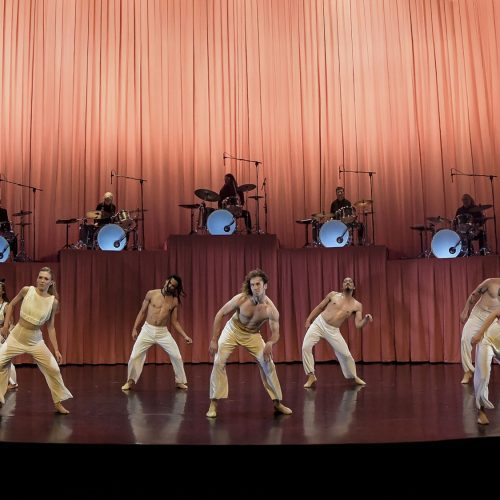
Among the highlights (if not the highlight) of this “Semaine du Neuf,” Hide to Show is a mind-blowing work that demands extreme virtuosity to convey a metaphor for the virtual universe in which we are now immersed. The interview with its artistic director, cellist Pieter Matthynssens, had already piqued our interest, and Saturday afternoon’s performance in a studio-theater at the Wilder—unfortunately sparsely attended—definitely won over the majority of those who came to see this truly memorable show.
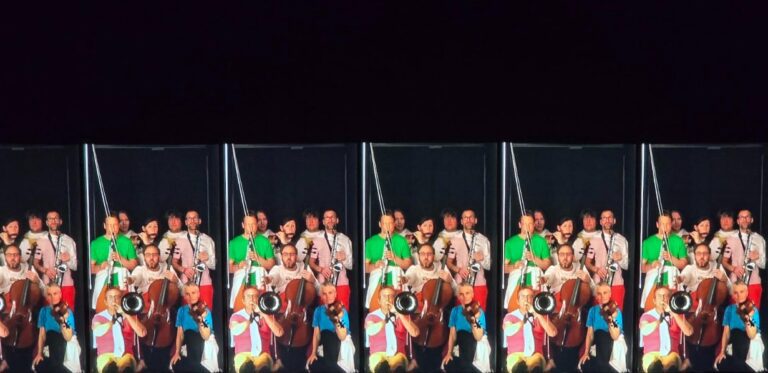
The work by Cologne-based composer Michael Biel challenged the eight musicians of the Flemish Belgian ensemble Nadar (cello, violin, clarinet, saxophone, flute, trombone, keyboard, percussion) to acquire a new skill: performing an extremely complex score in harmony with an electronic soundtrack, singing, dancing, moving through the space, operating the Venetian blinds in one of the six cubicles set up in the center of the stage, and playing in a group, as a duo, or individually.
For 70 minutes, this relentless barrage is unlike anything heard before, although the work is clearly descended from multi-style integrated collages—one thinks in particular of the works of John Zorn, Hermeto Pascoal, Frank Zappa, or Sun Ra. A generation or two later, the current era has led composer Michael Biel—who is not an orchestra leader like those mentioned above—to evolve his concert language/collage with the Nadar ensemble, blending multiple musical references drawn from electro, Japanese anime, pop, modern film music, and also contemporary music with classical roots. But… in a way, let’s agree that Nadar is somewhat Michael Biel’s band, at least in terms of the body of work presented over time.
Inspiration in music is a snapshot of the present moment, and we could witness its diversity in *Hide to Show*. This fragmentation of listening on the web inevitably leads to a multi-genre culture, as the composer demonstrates to further his point: what is real before your eyes and what is not, whether performed live or projected on a screen. Michael Biel does not explore deepfakes here (we imagine that will come later!), but rather real or virtual performance within a work where the performers evoke the loneliness of the web and the way each person expresses themselves there without always revealing their true identity—or revealing it only partially.
Thus, the lines are brilliantly blurred, and the game inevitably involves trying to distinguish between what is being performed in real time and what was previously recorded by the production cameras. The re-inserted recordings are therefore integral to Hide to Show, to such an extent that we gradually lose interest in distinguishing what is being performed in real time from what is not. As Pieter Matthynssens pointed out in an interview. This mind-bending whirlwind can also be seen as a legitimate extension of musical theater or chamber opera—a sort of hybridization of multimedia performance with the forms that preceded it, as we observed the day before with Quigital Corporate Retreat, another excellent work presented by soprano Sarah Albu and Architek Percussion. This is where we stand, and Hide to Show lifts us up.