Semaine du Neuf | Horror-themed kick-off event

by Alain Brunet

Tout ce qui m’épouvante” is a program inspired by a poem by Guillaume Apollinaire and, as you can well imagine, by the dark conjuncture that needs no explanation here. The theme of horror was the keynote of this top-quality performance, courtesy of the Quasar saxophone quartet, celebrating 30 years of exploratory practice.

Thus, the Semaine du Neuf has been in full swing since Saturday. Presented at the Wilder Building, the first program featured the North American premiere of three Lithuanian works: Calligrammes (Kristupas Bubnelis), Trauma (Mykolas Natalevičius), Azaya (Egidija Medekšaitė), and Saxopho(e)nix für Saxophontrio by Vykintas Baltakas. These Lithuanian works were joined by The Saxophone Quartet/While Flying Up by Ukrainian composer Alla Zagaykevych, who was in residence at Le Vivier during the 2022-23 season. Performed first, Asaya by Egidija Medekšaitė, is a work based on an electronically generated drone (a direct evocation of the Predator military drone) and supported by drones produced in real time by the saxophonists as an introduction and conclusion. These drones constitute the bed of a river of linear frequencies harmonized by four saxes (soprano, alto, tenor, baritone) alternating between consonance and dissonance, peaceful and harmonious sounds broken by chaos and tragedy. A video by Lukas Miceika supported the message.

Mykolas Natalevičius’s Trauma is an almost direct evocation of post-traumatic stress disorder, musically embodied by a succession of relaxations and tensions, consonances and dissonances, emphasized by the performers. Needless to say, the extended techniques allow for the production of low and high harmonics executed as long, continuous exhalations, relayed by the performers. The work’s linear calm embodies the hope for healing; its dissonant shifts obviously express the trauma.

Vykintas Baltakas’s Saxopho(e)nix für Saxophontrio is inspired by the phoenix rising from the ashes, a sort of optimistic metaphor for the context that occupies and preoccupies us. The tenor sax is excluded from the trio work. This work for saxophone trio is expressed first as a series of waves that sometimes form a unity and construct short harmonic motifs according to a discourse not unlike circular breathing. Other moments in the work contrast continuous sounds with other shaggy sounds emitted by the saxophones, atonal melodic fragments that illustrate its rough edges. Interesting, certainly, despite this impression of déjà vu in the territory of contemporary music.

Alla Zagaykevych’s The Saxophone Quartet/While Flying Up is a richly ornamented work, whose melodic discourse perfectly matches the generally atonal constructions of the sounds gathered together. Without producing any aesthetic shock because it falls within the vocabulary and lexicon of contemporary sounds, this work proves to be very subtle; we observe its frank, soft, or corrosive sonorities, its simple lines or its multiphonic passages. In fact, all these sounds find their place where they should be and demand great rigor from its performers. Very successful. Finally, Calligramme by Kristupas Bubnelis, a Lithuanian composer living in New York, is the result of a concept where the notes climb and tumble onto an obviously imaginary battlefield. This jerky, almost wild discourse focuses on contrasts and extremes. The percussive effects of the pads on the metal, the direct exhalations, the corrosive sounds and other frequencies resulting from “normal” playing or extended techniques follow one another. The work concludes with melodic twists towards the high and low registers, virtuoso and spectacular.

Semaine du Neuf began on Saturday with the screening of an art film, a performance by Toronto cellist Amahl Arulanandam of The Holy Presence of Joan D’Arc, a work composed by the late African-American composer Julius Eastman (1940-1990). The interest of this screening lies in the split screen, the superposition of strings from the same cello. It is indicated that this method results from 4 hours of synchronized video sequences and arranged on the multiple squares of the split screen. The composer Clarice Jensen thus proceeded to the transcription of an archival recording since the score had disappeared. Based on a melodic-harmonic discourse all in staccato, dominant from beginning to end, interspersed with melodic lines both silky and dissonant. This is an excellent idea to pay tribute to this artist who was forgotten for ages, who died in anonymity and whose talent has been resurrected by several players in the world of creative music, three decades after his death.


Publicité panam

Dômesicle | Kap Bambino and Alix Fernz transform the Dome into sensory chaos

by Félicité Couëlle-Brunet

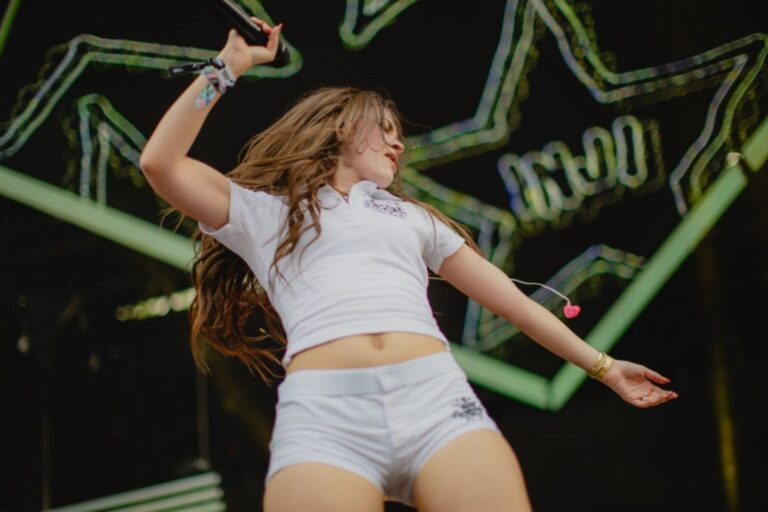
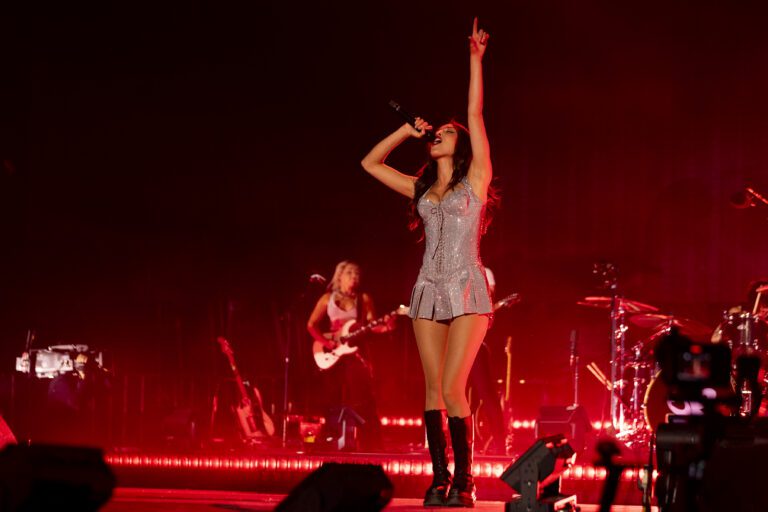
You’ve got to see it to believe it: after a career spanning over twenty years, Kap Bambino continue to unleash their raw, chaotic energy on stage, just as visceral as in their early days. Singer Caroline Martial literally embodies this fury. An inescapable ball of fire, she runs, jumps, screams and twists in all directions, absorbed body and soul in the violence of the music. This sound, a saturated and nervous synth-punk, leaves no respite. Each track is a raw adrenaline rush, constantly pushing the limits of physical endurance, both for the band and the audience.

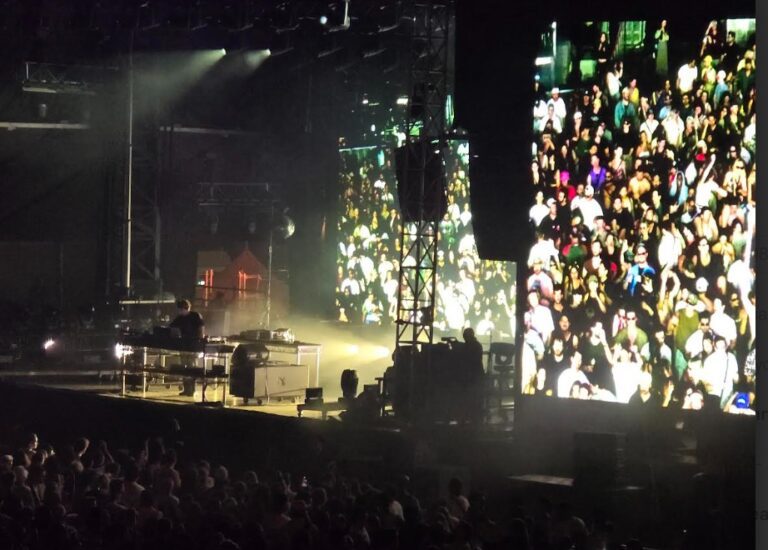
The SAT Dome, usually a space for immersive contemplation, was transformed into a frenetic arena. It was the first time I’d seen mosh pits there. The crowd, galvanized by Kap Bambino’s visceral energy, literally seemed to want to explode. TIND’s visuals accompanied this madness with glitchy aesthetics and heavy, fragmented textures, as if the image exploded under the pressure of sound. Stroboscopes dazzled to the rhythm of saturated kicks, melting reality into total sensory chaos.

Alix Fernz’s opening act had already plunged the room into a sticky, almost suffocating tension. Her stage presence is magnetic, tinged with an abrasive noise punk darkness. Unlike the physical explosion of Kap Bambino, Alix Fernz exerts a more insidious hold. The sonic textures are heavy, distorted, built like a slow, seeping poisoning. Every beat, every scream seems to dissolve the barrier between performer and audience, until the whole room becomes one pulsating organic mass.

The transition between the two performances was brutal. Alix Fernz had left the crowd in a state of sickly hypnosis, then Kap Bambino arrived like a detonation. Where one saturated the space with tension, the other exploded with raw energy. The result: total immersion, a feeling of being physically sucked into each artist’s universe.

And that’s precisely what made this evening so unique. Kaminska’s visuals, more fluid and organic, tried as best they could to maintain a form of visual coherence in the face of sonic chaos. But Kap Bambino’s brute force systematically prevailed. It was like being run over by a train after slowly sinking into a sonic swamp. A head-on collision between two diametrically opposed but equally striking intensities.

The evening ended with DJ Raven, whose new wave and funk sounds brought us back down to earth with classics like Prince’s Kiss.

As we left the Dôme, there was a strange feeling of floating. As if what had just happened was a euphoric nightmare, a moment of total derealization. This evening was a brutal reminder of what live music can still provoke: a derangement of the senses, a loss of control, and that sweet violence that remains imprinted on the body long after the last note.

Baroque / Choral Music / Classical / Classical Singing

Violons du Roy and La Chapelle de Québec | An Evening of Discovery in The Footsteps of Bach’s Early Cantatas

by Mona Boulay

Les Violons du Roy, accompanied by the chamber choir La Chapelle de Québec and conducted by Bernard Labadie, presented an interesting repertoire on March 6: Bach’s early cantatas, the first works of the man who was to become the absolute benchmark of Baroque music.

The concert opens with a brief, but very light-hearted, introduction by Bernard Labadie. We have no record of his compositions before his apprenticeship, with the exception of one piece written around the age of sixteen. What did he write during his student years, before publishing his first cantatas? A great mystery, which makes us all the more curious to hear these famous early works broadcast.

The first notes of “Cantata BWV 150 Nach dir, Herr, verlanget mich” echo through the Palais Montcalm. As throughout the rest of the concert, the ensembles are split up: this time, there are no violas, just a cello, double bass and bassoon. Immediately, we hear colors that, without knowing Bach perfectly, we would not have imagined coming from the composer’s mind: daring harmonies, lively tempo changes, and, thanks to the particular formation, a singular sound balance. Les Violons du Roy render the beauty of this cantata with excellence. The choral passages are perfectly successful, but we felt that the first passages by the soloists (from La Chapelle) were a little more timid.

“Cantata BWV 131 Aus der Tiefe rufe ich, Herr, zu dir” continues the evening, and this time it’s the violin section that becomes rarer. The violas return to the balance, and above all, an oboe makes its appearance, almost to the rank of soloist as it knits in counterpoint with the solo singers, and responds to their interventions. It seems that this work is at times taxing, and although the majority of the cantata is very well mastered by the musician, one can detect certain tensions in places (it should also be pointed out that the score requires quite impressive respiratory endurance). During the Arioso sung by the bass, Stephen Hegedus, the tempo seems to be disputed between the singer, the oboe and the organ, giving a feeling of imprecision without it being clear who is to blame. Nevertheless, the overall impression of the piece is good, with a perfectly mastered finale that leaves us with a taste of splendor before the intermission.

An even more atypical formation opens the second half of the concert, with two violas da gamba and two recorders replacing the violin section in Cantata BWV 106 Gottes Zeit ist die allerbeste Zeit. A well-assumed early-music color, evocative of Renaissance instrumentations, which nonetheless gives rise to a few inaccuracy challenges. The soloists seem to have come into their own, and their interventions are more striking, notably the “Ja, komm, Herr Jesu, komm!” performed by soprano Myriam Leblanc with brio. The cantata unfolds, with a fine mezzo solo by Marie-Andrée Mathieu, previously unheard, pleasantly supported by tenor Hugo Hymas.

To close the concert, the Cantata BWV 4 Christ lag in Todes Banden was chosen. This time, the Baroque line-up is a little more standard. The cantata is more austere, in keeping with the text, with the exception of the Alleluias that punctuate the end of each verse. There’s a fine duet between Myriam Leblanc and countertenor Daniel Moody, although the latter loses some of the beauty of his timbre on the higher notes. Later, we hear Stephen Hegedus’s voice, highlighted more prominently than in his previous performances, in his Aria for verse 5. The concert ends with a final, grandiose “Alleluia”.

The concert BACH, LES PREMIÈRES CANTATES AND BERNARD LABADIE, will be presented again in Quebec City on March 7, 2025 and in Montreal on March 8 2025.

TICKETS AND INFO HERE

expérimental / contemporain / musique acousmatique / musique actuelle

Closing night of M/NM: an acousmatic haven in the frantic Nuit Blanche

by Judith Hamel

Last Saturday evening, the city was swarming with bundled-up crowds, drawn by the bustling of the Nuit Blanche. Like a colony on the move, we threaded our way through the frenzied sounds of the DJ set on the Place des Festivals before branching off to the Agora Hydro-Québec, on the other side of Maisonneuve. There, in the semi-darkness, the public spiral into the heart of the dome of 32 loudspeakers to listen to the sounds and vibrations of the works in the great musical marathon that closes the two intense weeks of the 12th edition of Montreal/New Music.

Produced by the Groupe de Recherche-création sur la Médiatisation du Son (GRMS) in collaboration with Hexagram, this event promises to be a great immersive night.

In fact, this musical marathon must have given rise to a number of new acousmatic passions, as many first-timers, curious about the Nuit Blanche program, temporarily joined the initiates, letting themselves be carried away by the experience, before resuming their race through the Montreal night.

The program featured no fewer than 25 works, many of them premieres. The first sounds resounded around 7.30pm with Exercices in Estrangement (Vietnam Radio) by Sandeep Bhagwati, a work that explores the strangeness of the world through a series of poetic exercises. In this one, she questions how to live as an uprooted person.

A second block opens an hour later, featuring seven pieces by Austrian composers, most of whom were with us this evening.

Among the works presented, Brandung IV by Katharina Klement deploys continuous sound articulations, weaving together dense, sometimes granular sound materials, evoking the clashing and movement of liquids. In Martina Claussen’s Mosaic, we witness a sound construction in which realistic timbres are progressively sculpted into the material, and sound is continually constructed. With Inner outer self-variance and my deranged disembodied voices by Enrique Mendoza, the experience becomes more unsettling, with an immersion in the experience of auditory hallucinations, where we sometimes no longer know whether the sounds are coming from the work or from our seatmate, creating a certain sensory vertigo.

After a short break, the evening continues with a block of three works incorporating a visual dimension.

The first, Point Line Piano by Jarosław Kapusciński, projects onto a large screen the real-time vision of the virtual reality headset worn by the performer. In this digital space, he draws shapes that interact with sound. The repetitiveness of the performance and the constant return to empty tableaux make for a somewhat static experience. Moreover, the impact of the gestures on the music seemed to me rather unclear.

Next up is Fluyen by Valentina Plata, a contemplative work that contrasts man-made tunnels with Mexico’s natural underground water caves.

Finally, Third State by Mike Cassidy and Kristian North is the most compelling work. Like an oscilloscope, this piece for three lasers visualizes sounds. Timbres emerge through the complexity of luminous figures and the superimposition of colors, generating new sonorities.

Then, back to the acousmatic formation with a long block of nine works. The spatialization provided by Kasey Pocius was spot-on and impressive, complementing the dynamics and narrativities of the works. Among the works presented, Rodrigo Sigal’s Friction of Things in Other Places and Francisco Colasanto’s Mambo were particularly well suited to the listening context, with their borrowings from popular, folkloric sounds and Latin rhythms.

Around half-past midnight, I finally bid farewell. After more than four hours of acousmatic immersion, Montreal and its Nuit Blanche ants called me back.

The evening continued, with two more blocks to come. Five creations were programmed, but they will remain, for me, shrouded in mystery…

Contemporary / période romantique

Ensemble Obiora: Sisterhood in music

by Frédéric Cardin

An all-female, feminist concert and an example of cultural diversity in contemporary music, Ensemble Obiora’s Sororité (Sisterhood) drew a large audience to Salle Pierre-Mercure yesterday afternoon. Led by Janna Sailor, the programme featured the music of Reena Ismaïl, one of the most exciting voices in contemporary music, for a too rare time in Montreal. After a rather academic opening composition (Rachel McFarlane’s When Enchantment Comes, inspired by Oscar Peterson but rather unrepresentative of the pianist’s music), it was the Indo-Western fusion universe of Ismaïl, a composer of Indian origin living in the United States, that provided the most colourful moment of the afternoon. Meri Sakhi ki Avaaz (My Sister’s Voice), for chamber orchestra, soprano and Hindustani singer (the classical vocal style of North India), offered a spellbinding encounter between two very different vocal styles, set against a romantico-impressionist orchestral backdrop (Debussian to be precise, but with evident indian colourings) with no contemporary harmonic asperities, but expertly detailed. The work opens with a tape extract of the famous flower duet from Léo Delibes’s opera Lakmé (set in India), followed by a more ‘authentic’ version of this melody, sung by soloist Anuja Panditrao (excellent). 

Lyric soprano Suzanne Taffot joins in later and the two women talk about friendship and sisterhood in an echo of the more than famous opera aria (so often used in advertisements). The meeting of the two types of singing is very well balanced and skilfully constructed by Ismaïl. The finale even demands a great deal of virtuosity from Taffot, who imitates the virtuosic flights typical of Hindustani singing with great precision. Well done!

The concert’s finale was Amy Beach’s Gaelic Symphony, a work long neglected but almost on the way to becoming a staple of the repertoire. Sailor’s reading called for great precision, generally offered by Obiora, apart from occasional rhythmic inaccuracies. Above all, the orchestra offered a beautiful, full ensemble sound, transcending its character as a ‘large chamber orchestra’ rather than a true symphony orchestra. 

The Obiora ensemble is proving to be an important addition to the musical landscape of Montreal and Quebec, because if the large, diverse, family-friendly and above all attentive audience is anything to go by, it has succeeded in winning the loyalty of a new audience to whom it introduces a little-known and inspiring repertoire. An EDI success that must be celebrated!

expérimental / contemporain

M/NM | La Grande Accélération, Ambitious and Maximalist

by Vitta Morales

The M/NM came to a close with an ambitious and maximalist piece by composer and guitarist Tim Brady at the Saint-Joseph Oratory. Indeed, the performance of La grande accélération: Symphonie no. 12 demanded one-hundred electric guitars, a percussion ensemble, and two orchestras to be separated in sections and placed carefully along the perimeter of the space. 

Theoretically, a listener situated anywhere in the middle, (surrounded by the massive ensemble), should have been able to experience the full effect of the piece with little perceptual variation thanks to microphones and speakers being placed strategically to compensate for temporal delays. Also worth mentioning is that the piece required several conductors to direct different portions of the ensemble to ensure that everyone remained in time. The musicians too wore in-ear monitors with click tracks with this in mind.

So how did all this preparation translate in practice and what was it like to experience such an immersive piece? Well, it was very captivating to say the least. To start with, in keeping with the theme of this year’s festival, (the marriage between music and images), visuals and lights were projected on the ceiling and walls that matched vaguely the intensity of the music as the immersive piece unfolded. Readers of a certain age will know what I mean when I say that it resembled the visuals of Windows Media Player. Kind of trippy and pretty cool, (but really more of an afterthought compared to the music itself it seemed to me). On the subject of the music, it contained gentle string pads; tremolo from one-hundred clean electric guitars; hefty percussion solis; crunchy tutti chords; various swells that dovetailed from one section to another; and some electric guitar solos involving pick slides. Although efforts were made to have the listening experience be as uniform as possible, in reality the experience changed depending on if one was seated, where they were seated, and if at any point they chose to wander around the room. But this wasn’t necessarily a bad thing. In fact, I found that exploring temporal and perceptual variations was more fun than sitting in a pew for an hour. At various times I got closer to the percussion section, the guitars, the horns, et cetera, when something called my attention over to them.

I will admit that the description of the piece by itself made me recall the scene from Jake Kasdan’s Walk Hard in which the character Dewey Cox demands “an army of fifty-thousand didgeridoos!” to complete his masterpiece. However, unlike Dewey Cox, Tim Brady seems to be the furthest thing from a looney country singer; he seemed to me a very intentional composer and guitarist that created a fascinating listening experience. At times raucous, at times trance-like, perhaps a touch too long for my own liking, but an extremely interesting piece more than deserving of being this year’s festival closer.

Contemporary / Musique de création / période moderne / post-romantique

M/NM | University Climax at the Maison symphonique

by Alain Brunet

The idea of a co-production between the Société de musique contemporaine du Québec and McGill University’s Schulich School of Music is an excellent one. And it’s not a new idea: the two institutions have collaborated in the past.

L’idée d’une coproduction entre la Société de musique contemporaine du Québec et l’École de musique Schulich de l’Université McGill est en soi excellente. Et cette idée n’est pas neuve, les deux institutions ont collaboré par le passé.

What does this relationship look like in 2025? Friday’s evening at the Maison symphonique, in the context of Montréal / Nouvelles Musiques, was an opportunity to think about this.
Over the years, Maestro Alexis Hauser has continued to lead Montreal’s finest student symphony orchestra. At the Maison symphonique, this was certainly the case. Very well behaved. Rigor. Clarity. Cohesive, solid performances, particularly in the more classical works on the program – we’re talking here about Richard Strauss’s symphonic poem Thus Spoke Zarathustra, and Prokofiev’s 2nd Piano Concerto played by Alexey Shafirov, twice winner of the McGill Concerto Competition – precise throughout, lively and tonic in the attack, fluid in general, and at the encore a generous Prelude Op. 3 No. 2 by Rachmaninov.

Au fil du temps, maestro Alexis Hauser dirige encore et toujours le meilleur orchestre symphonique estudiantin à Montréal. À la Maison symphonique, c’était certes le cas. Fort belle tenue. Rigueur. Clarté. Exécutions cohésives, solides, particulièrement dans les œuvres les plus classiques au programme – on parle ici du poème symphonique Ainsi parlait Zarathoustra de Richard Strauss, ainsi que du 2e Concerto pour piano  de Prokofiev joué par Alexey Shafirov, lauréat à deux reprises du concours de concertos de McGill –  précis sur toute la ligne, vif et tonique dans l’attaque, fluide de manière générale, et au rappel un généreux Prélude op. 3 n° 2 de Rachmaninov. 

The final piece on the program, by Richard Strauss, whose main theme was widely popularized as the theme for the film 2001: A Space Odyssey, was also exemplary in the context of a university performance and a floor filled with an audience of mostly students, friends, family and many other open-minded music lovers, all happy to be there.

However, it seems to me that the performance of György Ligeti’s Lontano, played in the first part of the program, demanded more timbral depth, texture and power to carry through the work’s obsessive discourse, based on plays of tension deployed slowly over an unusual (for the time of its creation) linear flow. We had the impression that this very important part of the program, at the heart of its theme, had been less well chiselled, and it was the same for Continental Divide, an SMCQ commission to young composer Liam Gibson, presented as a premiere. Did we really grasp all its nuances?

In the first half, Ligeti’s Musica ricercata, transposed for organ and played by the excellent Jean-Willy Kunz, was impeccable in the context of a transposition.

For the cinematic side of things, there was no question of showing film extracts on the big screen during the orchestral performances. Instead, we opted for scenic evocations of Stanley Kubrick’s great classics: the spectral binoculars from The Shining, the ceremonial mask from Eyes Wide Shut, the famous monolith from 2001, around which primates begin to think like sapiens, and so on. We also tried mapping projections on a rear façade of the amphitheatre – too bright for the projected forms to be intelligible?  Good flashes, a certain taste, interesting premises, a certain discretion… How can this evocation of brilliant cinema be maximized in a symphonic performance context? There’s no doubt that the highly gifted Sylvain Marotte will be able to answer this question for the future.For the cinematic side of things, there was no question of showing film extracts on the big screen during the orchestral performances. Instead, we opted for scenic evocations of Stanley Kubrick’s great classics: the spectral binoculars from The Shining, the ceremonial mask from Eyes Wide Shut, the famous monolith from 2001, around which primates begin to think like sapiens, and so on. We also tried mapping projections on a rear façade of the amphitheatre – too bright for the projected forms to be intelligible?  Good flashes, a certain taste, interesting premises, a certain discretion… How can this evocation of brilliant cinema be maximized in a symphonic performance context? There’s no doubt that the highly gifted Sylvain Marotte will be able to answer this question for the future.

And then there was a full house that evening, mostly populated by delighted people. That was already a lot for the SMCQ and the McGill Symphony Orchestra. Who, by the way, complained about some of the program’s inconsistencies (Prokofiev for piano and orchestra after Ligeti… why?) and the thinness of some of the performances on the contemporary side. Nevertheless, most of us enjoyed a fine Friday at M/NM.And then there was a full house that evening, mostly populated by delighted people. That was already a lot for the SMCQ and the McGill Symphony Orchestra. Who, by the way, complained about some of the program’s inconsistencies (Prokofiev for piano and orchestra after Ligeti… why?) and the thinness of some of the performances on the contemporary side. Nevertheless, most of us enjoyed a fine Friday at M/NM.

Baroque / classique

Violons du Roy, Celebrating Friendship at The Crossroads of Baroque and Classical Music

by Mona Boulay

Continuing their 40th-anniversary series, Les Violons du Roy presented their Jonathan Cohen, Mozart, and Friendship concert at the Palais Montcalm on Thursday. As the title suggests, the program offered a repertoire drawn both from Mozart’s works and from those of his close friends.

The evening opened with the Sinfonia for Strings in F Major, Fk. 67, by Wilhelm Friedemann Bach, eldest son of his famous father Johann Sebastian. This work is a very interesting choice, with avant-garde colours for its time, in the midst of the transition from Baroque to Classical. There are daring harmonic tensions right from the opening of the Vivace, perfectly underlined by Les Violons du Roy, who give us a superb version of the work. This is an opportunity for each orchestra section to shine, particularly in the Allegro, where the question-and-answer play of the theme is wonderfully executed, a veritable wave of sound moving from one part of the chamber orchestra to the next.

The concert continues with two guests: Mélisande McNabney on fortepiano and Isaac Chalk on viola, for a concert in C Major by Michael Haydn, older brother of the more famous Joseph Haydn, and, as the title suggests, also close to Mozart. The piece highlights each of the two soloists in turn, despite their rather different playing styles: on the one hand, the pianist’s precise, subtle touch, and on the other, the violist’s more rocambolic, baroque flights of fancy. While there is no doubting the individual quality of each of these two performers, their joint playing is open to question. Indeed, while each shines in his or her solo parts, the duet parts sometimes lack synchronization and ensemble playing, especially for the ornamentation effects or the rallentando and accelerando, typical of the style of the period. The staging may have something to do with this: Melisandre at the pianoforte has her back to Isaac Chalk.

After a short intermission, Les Violons du Roy return to the stage, this time with two flutes, two natural horns, and a bassoon. The wind section swells the ranks for the Symphony in E-flat Major by Carl Philipp Emanuel Bach, also the son of Johann Sebastian, and a friend of Mozart. At the start of the piece, it seems that one of the horns is struggling to warm up, the instrument being renowned for its technical difficulty. The piece unfolds well, although the flutes, often in their lower registers, are hard to hear, yet they stand upright in the middle of the stage, giving greater visual impact than aural impact.

The concert closes with Mozart’s Clarinet Concerto in A major. Stéphane Fontaine, clarinet teacher at the Conservatoire de Québec and principal clarinet of the Orchestre Symphonique de Québec, brilliantly interprets the soloist’s part with a well-rounded, worked-out sound, mastered from low to high register, with absolutely remarkable soft nuances. Her highly successful performance leaves a strong impression on the audience as she closes the concert, accompanied by all the subtlety of Les Violons du Roy, decidedly masters in the art of dosage, finesse and precision.

Africa / Morna

Black History Month | Cape Verde Honoured at Théâtre Maisonneuve

by Sandra Gasana

Lucibela opened the evening after a purely instrumental first track, beautifully orchestrated by a total of seven musicians: two brass players, a cavaquinho, bass, guitar, drums, and the musical director at the piano. Usually, the solos come a little later in the evening, but this time we were treated to saxophone and trumpet solos right from the start of the concert.

In an average French, she addressed the crowd: “It’s a pleasure to be here. Cape Verde is known thanks to Césaria,” she adds, before moving on to Areia de salamanza, which she performed with unparalleled mastery. Her voice is the closest I can think of to Césaria Evora. With a few dance steps, she seemed to float in her orange dress.

The show was a mix of classics and lesser-known pieces by the barefoot diva. The star among the musicians that evening was undoubtedly the saxophonist. Even when he wasn’t playing, he stayed on stage to dance, unlike the trumpeter, who came and went. And when he played, he carried the audience with him, as the applause testified.


The classic Besamo Mucho was a particular highlight of Lucibela’s performance, as she got the audience singing along, before giving way to Ceuzany.


“I’m very happy to sing for you,” she says in shaky French. “Thank you Cesaria!” Like Lucibela, her first song was gentle, bringing out the depth of her voice, and after that, it was party time. In fact, she takes off her heels and starts dancing barefoot, a little nod to the diva?


After Sodade, which delighted the audience, she continued with Amor Y Mar, this time without the horns. The horns return for Ceuzany’s last song, in which she pushes her voice a little like American soul singers.
After a brief intermission, we’re off again with Teófilo Chantre, who wrote many of Césaria Evora’s songs. In impeccable French, he addresses the crowd between Fatalidade and Mãe Carinhosa.


He continued with Voz de Amor and then invited the crowd to dance, which they did timidly, but as the evening progressed, the audience loosened up. Indeed, they let loose completely when Elida Almeida, who was the last to perform, challenged the audience: “Is this how you dance at home?” she asked, addressing the crowd. “Well, you have another opportunity,” she added, and that’s all it took for the entire theater to get to its feet and show what it could do.


Paying homage to Cape Verde’s best-known musical style, the Morna, she transported the audience with her unique and distinctive voice. Each of the singers offered melancholy and festive tunes, sometimes switching from one to the other almost without transition.

As this was the last show of the tour, Elida brought the house down, getting the audience to sing along with Sodade, but this time with all the artists who joined her on stage, taking the time to thank all the musicians, before finishing with more classics.


The only snag of the evening: the song E Doce Morrer No Mar was missing. It’s true that this song is by Brazilian artist Dorival Caymmi, but Césaria popularized it all the same. I’d been waiting for it all evening and came home empty-handed. But that’s just a detail. I’ll continue to sing it in my shows, as I’ve been doing for the last 5 years.

Photo Credit: Adam Mlynello

expérimental / contemporain

M/NM | No Hay Banda : Red Dada Theatre

by Frédéric Cardin

Last night, the Théâtre Plaza was transformed into a timeless and disconcerting space, somewhere between ‘early twentieth century’ Dadaism and ‘early twenty-first century’ avant-garde, for the premiere of No Hay Banda’s multidisciplinary show, Il Teatro Rosso. To put it into context, watch my interview with Noam Bierstone, of No Hay Banda : 

Il teatro rosso, a tribute to Montreal’s Red Light

While the primary inspiration for the work, by Steven Kazuo Takasugi (music) and Huei Lin (direction and videography), was the old theatres of the early 20th century, often filled with heady red (seats, curtains, walls, etc.), the music had nothing to do with this retro-kitsch universe. 

For an hour or so, an ultra-pointillist score, performed with precision by the members of No Hay Banda and accompanied by tape and video, teased the audience with varying degrees of intensity. Waves followed waves in crescendo-decrescendo, oscillating between almost naked passages and moments of almost unbearable sound saturation. As they churned out tons of notes, none lasting more than a second at most, the artists on stage (as far as possible) assumed poses that responded to or contradicted those projected on screen (pre-recorded with the same instrumentalists, playing the same score). There was a kind of discrepancy, both sonically and visually, between the live and the recorded performances (on stage, the musicians were dressed in vaguely Seventies attire, while the video was more 1920-1930s, but not stereotypical). 

The music, which is totally abstract, is certainly not ‘easy’, but its reliance on staging and the relationship between the body language of the musicians on stage versus their doubles in the video creates a dramatic dynamic, a theatricality, that captures and holds attention. 

And does this theatricality tell a story? More or less. The programme shows a division into two acts, Il Teatro Rosso and The Drowning. These are divided into three and four scenes respectively (The Spasms of Trapped Animals, Tar Pits, Grumpy Old Man, etc.), which are themselves further subdivided. What exactly do these titles mean? Everyone will find their bearings, more or less explicit. But having said that, the gestures of the artists and the dynamic nature of the music made it possible to follow the sequence more or less precisely. There was something reminiscent of Tristan Tzara’s creative fires at Cabaret Voltaire, accompanied by noise music and post-modern sets by Arp and Janco. The spirits of Cocteau, Picabia, Schwitters, and Duchamp were probably present in the Montreal venue. 

In the end, this homage to the old red theatres of the interwar decades of the 20th century is also, in truth, a symbolic connection between two avant-gardes separated by a hundred years. On the one hand, one of the sources of all the experimental movements of the 20th and 21st centuries: Dadaism in the 1920s, and on the other, a young, hyper-active and inventive Montreal avant-garde (well represented in the audience that packed the Théâtre Plaza) of the 2020s.

No Hay Banda : 

Sarah Albu, voice; Adrianne Munden-Dixon, violin; Émilie Girard-Charest, cello; Lori Freedman, bass clarinet; Felix Del Tredici, bass trombone; Daniel Áñez, piano; Noam Bierstone, percussion; Gabriel Dufour-Laperrière, sound engineering.

Publicité panam
expérimental / contemporain / Musique de création

M/NM | The Use of Audiovisuals as Creative Material—Welcome to Nicole Lizée

by Alain Brunet

Gravelbourg-born Montrealer Nicole Lizée is a true visionary in the field of using cinematographic or videographic material in the composition of musical works. On Saturday evening at UQAM’s Cœur des sciences (Agora Hydro-Québec), this was the program dedicated to her: Montréal/Nouvelles Musiques presented three of her works in a program of five.

The audiovisual materials Nicole Lizée employs in her works include various items taken from everyday life at different times in her life, toys, audiovisual archives, and other everyday artifacts. The composer also films her own scenes involving actor-musicians, such as the teacher who mistakenly explains to us what is an acceptable rhythm and what is an unplayable one.

It also makes use of absurdist humour and fantasy when it makes fake scores appear in the hands of a musician who recounts her setbacks with a possibly malevolent entity. Yet this narrative framework has no other purpose than to be one of the channels of expression for a piece of music, in this case, the re-orchestration of 8-Bit Noir, composed in 2019. In this case, flutist Marie-Hélène Breault is the sole instrumentalist on stage, around whom the composer has erected an audiovisual environment made up of video sketches. The DIY nature of the work is also a feature of this aesthetic, as can be seen in the other pieces on the program.

By Margareta Jeric, Les échos de l’Adriatique was premiered on Saturday by the Ensemble de la SMCQ under the direction of Cristian Gort. For flute, clarinet, percussion, electric guitar, piano, cello, double bass, support, and video device, this piece is accompanied by images of the Adriatic Sea—particularly a dilapidated, abandoned sardine factory on the Croatian coast, whose fate is unknown. The sounds imagined by Margareta Jeric illustrate the cracks in the scenery and nature’s reassertion of its rights. The musical work is full of percussive details, bells, high-pitched bow strokes, and more.

“Black Midi,” composed in 2017 by Nicole Lizée, is an evocation of this sub-trend also called Black MIDI, which consists of compositions using MIDI files to create a piece or remix containing a mind-boggling number of notes, arbitrarily placed on the score or in the composition program, to such an extent that the sheet of music ends up blackened with notes, hence the expression. Execution requires mind-boggling results, impossible for human fingers to interpret such scores. Around this idea of impossible-to-play music, the composer has imagined a narrative: the characters from the previous video are back, recounting their adventures with a sense of humour, stunned by the phenomenon.

For piano and audiovisual treatments performed in phase, this work includes frequent changes of tempo, accelerandos, metric modulation, and the use of musical toys. The aim is to extract this computerized compositional process and link it to the live performance, the piano played by Pamela Reimer wearing a wig in this context of strangeness and fantasy. Very interesting, entertaining, and humorous, but… you might want to give up before the 22nd and final minute of this work, which nevertheless makes its way into Nicole Lizée’s already considerable body of work.

Closures by Philippe Macnab-Séguin is a work in which the mass of sound expands, spreads, contracts, coils, or explodes in the manner of our life trajectories. The piece opens with a whirring sound, followed by slow glissandos leading to bursts of high frequencies. These successive waves are generated by an Ensemble de la SMCQ, this time comprising flute, clarinet, percussion (prominent vibraphone), electric guitar, piano, cello, double bass, stand, and video device. The movement of the tides gradually becomes a continuous rhythm, lightening again with ascending melodic spirals of clarinet and flute, then building up again and slowly fading out until a final percussive blow, topped by the same roar served up in the introduction. Frankly, this Philippe Macnab-Séguin must be taken seriously.


We conclude with “Dancist,” Nicole Lizée’s third work on the program, composed in 2019. In the same spirit as her other works on the program. “Dancist,” for clarinet, percussion, electric guitar, piano, cello, double bass and audio/video device, is dedicated to the surreal evocation of dance music, taking up a similar narrative framework, tinged with a kind of magical realism, as well as with caustic humour and self-reflexivity about her own creative process. The results lie somewhere between audiovisual installation and composition. As we leave the amphitheatre, we are reminded that Nicole Lizée has often performed her works with her own ensemble, which is less visible given her burgeoning career as a composer. The challenge ahead for her, we thought as we left the concert hall, is to create works that will have the same impact as those produced by her own orchestra.

Publicité panam

Classical / Modern Classical

OSM and Khachatryan | Music, Politics and The Human Condition

by Hélène Archambault

There are moments when you feel privileged to be where you are. Such was the case on Wednesday evening at the Maison symphonique. I think the feeling was mutual, at least if I’m to judge by the encore given by violinist Sergey Khachatryan, who gave a superb performance of Tchaikovsky’s Violin Concerto in D major, Op. 35.

The orchestra provided a setting in which he could express his sincerity, as when the flutes pick up at the end of his very personal cadenza, or again in the opening bars, as the strings introduce the solo violin.

The reminder is a piece by Grigor Narekatsi, a 10th-century Armenian mystic poet and saint of the Armenian Apostolic Church. In 2015, in commemoration of the 100th anniversary of the Armenian genocide, Pope Francis declared St. Gregory of Narek (Frenchized name), Doctor of the Church, the 36th, for his timeless writings. Timeless, Havoun, havoun is. More than 1,000 years apart, his play resonates.

After intermission, Payare and the OSM attack Shostakovich’s Symphony No. 11, Op. 103 “The Year 1905”. 11 young instrumentalists from Montreal’s Conservatory, McGill, and Université de Montréal music schools join the orchestra for the occasion. Knowing the history of this symphony is the key to fully appreciating it because it’s not the kind of piece you listen to while preparing a chickpea salad on Monday morning before catching the metro. The program notes are illuminating. Symphony No. 11 is intimately linked to the history of Russia, and later the Soviet Union, both in its writing and its reception by the regime. With the USSR having decreed Shostakovich’s music an enemy of the workers in the aftermath of the Second World War, new compositions had to wait until the 1950s. Composed at the beginning of 1957, Shostakovich recounts in music the popular uprising of 1905 against the Russian Empire.

The first movement, “Palace Square”, opens with a hostile winter scene, where bloody repression soon unfolds. Military snare drums, bugles, and folk song illustrations are all sound manifestations of the violence of the repression. The second movement evokes Red Sunday, and here again, Shostakovich uses musical material to depict the horror of the massacre and the desolation of death. The third movement, “Eternal Memory”, is reminiscent of the Revolutionaries’ Funeral March. As for the Finale, “Tocsin”, this is revolutionary fervor, characterized by trumpets and low strings, interrupted by an English horn melody, and ending with the sounds of cymbals and bells. When the music stops, you wonder what you’ve just experienced. I was moved, disturbed, and thrown to the ground. This concert embodies the human condition in all its fragility.

Photo Credit: Antoine Saito 

Subscribe to our newsletter

Inscription
Infolettre

"*" indicates required fields

Type of Suscribers