expérimental / contemporain / Musique de création

Semaine du Neuf | Loving and Cosmic Conclusion

by Alain Brunet

La Semaine du Neuf, presented for the third in a row year by Groupe Le Vivier, came to a close on Sunday at the Music Media Room (MMR) of McGill University’s Schulich School of Music. On the program: propulsion towards love and the cosmos!

An opera for one voice, nothing else. An opera soliloquizing, sung, said, whispered, growled, whispered, shouted and more. Love unbridled, tender, protective, lost, found, passionate, mature, stable, serene, you name it. A hundred languages. Melodic, diatonic, chromatic, atonal, noisy and textural discourses. The main themes of Ana Sokolović’s work are introduced by movements symbolically embodied by doves singing declarations of love expressed in 100 languages, except for the theme of loss.

In short, all the angles, all the facets, all the states of love are reviewed here by the composer and performed before an audience by mezzo-soprano Kristin Hoff. The latter has been working on the work for a dozen years, and needless to say, she has mastered its most minute details, communicating the experience with consummate skill.

An authentic performance, a physical feat lasting 40 minutes! The demands of the work are high for this performer alone with herself, who must also exude a theatricality of love while meeting the work’s technical challenges.

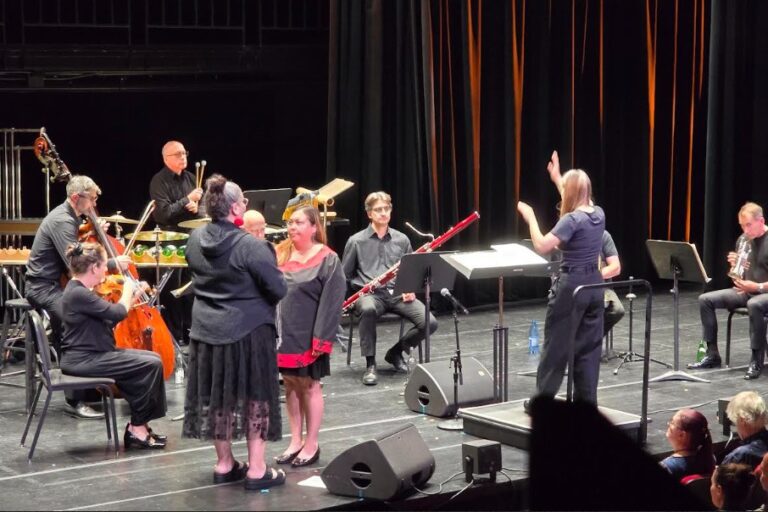
The second part of the program was from New York: Star Maker Fragments, composed in 2021. American Taylor Brook composes for instrumental and/or electronic music, as well as for robotics, generative music, video, theater and dance. A devotee of the microtonal approach, he strives to integrate all the sound tools and practices representative of our times.

New York-based ensemble TAK has been working with Taylor Brook since the early days of his career, at the turn of the last decade. The work Star Maker Fragments, which closed La Semaine du Neuf, is based on the novel Star Maker by British writer Olaf Stapledon, now considered a classic of science fiction. The novel’s narrator is “transported” out of his body and finds himself exploring interstellar space. His mind merges with those of beings from other worlds, traveling across galaxies. In this way, a collective mind is formed, and eventually meets the Star Maker, a supreme being who created the universe. The narrator realizes that his universe is just one of many, that it is not the greatest of all, and that every universe is a work of art.

As such, this work attempts to embody suspension in infinite space. The instrumental parts (flute, bass clarinet, violin, percussion) remain relatively simple, fluid and continuous, with no high demands on articulation. Soprano Charlotte Mundy provides the vocals and narration, and we’re in space for an hour of microvariations and complementary electroacoustic effects produced by the composer and triggered by percussionist Ellery Trafford. Understandably, the individual real-time interventions are perhaps less important than their interstellar alloy. Hovering, cosmic, definitely in the air (and space) of time. This concludes the 3rd Semaine du Neuf.

Publicité panam
Chamber Pop / Contemporary

Semaine du Neuf | A lot of chamber groove from collectif9 and Architek Percussions

by Frédéric Cardin

Five contemporary works, as many composers. The common thread? In addition to the words woven by author Kaie Kellough – groove. Indeed, this element so rarely associated with creative music was the central element of the evening of March 15 at the Espace Orange du Wilder in Montreal’s Quartier des Spectacles. As part of the Semaine du Neuf organized by Le Vivier, a show entitled Quelque part, mon jardin / My Backyard, Somewhere was presented, bringing together the creative universes of two of the most original and dynamic ensembles on the Montreal/Canadian scene: collectif9 and its nine strings, and Architek Percussions and its four genial tappers and pickers… To find out much more about the origins of this concept, read the interview conducted by colleague Alain Brunet HERE

Gracieuseté Semaine du Neuf – Le Vivier crédit photo : Philippe latour par Frederic Cardin

The interpretative strategy adopted by the artists is quite original: the five works are cut into various parts, and then mixed together to form a continuous framework lasting around an hour and fifteen minutes. A bit like taking five models of Lego blocks and reassembling them into a single new, entirely coherent construction. 

The evening’s sonic thread was criss-crossed by contrasts between the glitch/syncopated aesthetics of Nicole Lizée, post-minimalist/dissonant of Luna Pearl Woolf, chamber pop of Eliot Britton, almost muzak of Brett Higgins and neo-impressionist/rock of Derek Charke. Kellough’s lyrics sometimes chanted or declaimed by the artist himself, have a spoken word style and are very urban, sometimes pre-recorded and altered, marking the blow and offering a very street colour to the whole concert. 

Quelque part, mon jardin / My Backyard, Somewhere is a contemporary proposition whose topicality is rooted in the blurring it creates between the scholarly contemporary creation and multi-trend pop worlds. Above all, it is an attempt to include the swaying pulse of Black music rather than the metronomically regulated pulse of Minimalism, another stylistic school based on rhythmic affirmation. You may have to pass for lovers of harmonic modernity, or especially the avant-garde, as this is almost totally consonant territory. 

The end result is resolutely contemporary, yet very accessible, even for an audience unfamiliar with creative music. Perhaps even a little too “polished” for some, if a few of the comments I’ve heard are anything to go by?

Be that as it may, and as far as I’m concerned, Quelque part, mon jardin / My Backyard, Somewhere is one of the very good projects by collectif9 and Architek.

Luna Pearl Woolf: But I Digress… (2018) – 19 min

Bret Higgins: among, within, beneath, atop (2018) – 8 min

Derek Charke: the world is itself a cargo carried (2018) – 15 min

Eliot Britton: Backyard Blocks (2018) – 17 min

Nicole Lizée: Folk Noir/Canadiana (2018) – 14 min

Contemporary

Semaine du Neuf | Quatuor Bozzini: Outpourings of friendship in a dreamlike sonic calm

by Alexandre Villemaire

To celebrate its silver anniversary, the Quatuor Bozzini joined forces with three exceptional composers: Martin Arnold, Linda Catlin Smith and Michael Oesterle. The program emphasized the friendship and close ties that have united the quartet’s musicians with these avant-garde composers for 25 years. On a musical level, this friendship translated into ethereal sonorities in works with an essentially gentle, calm aesthetic.

The first work presented was Martin Arnold’s 3-Way Cotillon, in its Montreal premiere. For the occasion, the members of Quatuor Bozzini (Isabelle Bozzini, cello; Stéphanie Bozzini, viola; Alissa Cheung, violin and Clemens Merkel, violin) were joined by violist Elisa Trudel and cellist Audréanne Filion, in a sextet formation. The harmonic environment is essentially diatonic. Among the many influences that characterize Arnold’s language, it was the use of folk-inspired material and the inspiration of early music that stood out for us. The musical inflections of the cotillion, a popular dance in 18th-century Europe and America, bear in some respects the sonic stamp of an Aaron Copland. The piece evolves with sporadic interventions of string lines, which are played dispersedly by the instrumentalists. There is a general evolution in the texture and timbre of the piece, starting from the treble and moving quietly into the lower strings throughout. As the work progresses, the jumbled, spaced-out material contracts over time, eventually coming together to create a coherent, interrelated whole.

Linda Catlin Smith’s Reverie, composed expressly for the occasion, echoed this same spirit of plenitude, but with a more stable melodic construction defined by thematic sections clear to our ears. We begin with long bow strokes exposing pure notes, while the sounds melt into each other timbrally. Midway through, a harmonic carpet supports dissonant melodic passages played above it, in an expressive, ominous half-tone character. Further on, in a tonal calm with a melancholy atmosphere, a recurring modal theme is expressed and repeated several times, creating a feeling of weightlessness and temporal elasticity. We fully understand the artistic choice to follow these two works, given their difference from the last piece of the concert and their strong aesthetic similarity. But, at a certain point in the sound treatment, one had the impression of hearing a kind of continuation of Martin Arnold’s piece in Linda Catlin Smith’s, despite a very different musical treatment and narrative language.

Keeping the listener’s senses alert is a challenge, and can be a double-edged sword in such an arrangement. The final work of the evening was Michael Oesterle’s String Quartet No. 4, and was, in terms of texture, the most varied. It thus balanced the dreamlike character of the works in the first half. After an introduction worthy of a 19th-century musical line, the central parts of the work explore different instrumental timbres, with extended playing techniques to create bursting sonorities, from string rubs to high notes. For example, in Oesterle’s quartet, the interaction between violinists Clemens Merkel and Alissa Cheung’s swift motives, over which energetic pizzicato interventions were brushed, or the thematic superimposition that initiates the work’s conclusion, which reintroduces the opening theme.

The highly focused acoustics of the MMR at McGill University meant that the sound didn’t travel far, but remained anchored. For the repertoire played, this hall was ideal, as it gave us a detailed appreciation of the interpretation of each of the instrumentalists, whose act of supporting these pieces with these long-developing musical lines demands sonic constancy and mastery of sound, as well as sensitive and precise listening to the various changes in dynamics. An attentiveness that echoes the friendly ties that bind the musicians together.

Contemporary

Semaine du Neuf | A Symphony and a World Premiere for Tim Brady

by Vitta Morales

The Chapelle Theatre hosted Tim Brady, his guitars, and his pedals on March 15th as part of the Semaine du Neuf festival. A last-minute change to the program would mean Brady would play the entirety of his forty-five or so minute piece, Symphony in 18 Parts , as well as the premiere of For Electric Guitar.

It should be said, for starters, that The Chapelle was a great choice of venue for this repertoire. The black box-style venue helped focus the audience’s attention squarely on Brady’s tools (his pedals, amps, and guitars) and soundscapes. Against a black background, little could distract a listener; this, coupled with good lighting, meant the vibes were set very appropriately for Brady’s electric inventions.

Concerning Brady’s Symphony in 18 Parts, I happened to have it more or less fresh in my ears as I consulted it a lot in preparation for the concert and the interviews we conducted in the lead up. As such, I think I could tell which movements were more rehearsed than others. Occasionally, when a passage of fast notes came up, the execution would come out slightly less clean than that of the recording. This was more discernible in the moments where distortion and overdrive were absent. I, of course, don’t really blame Brady who wasn’t originally planning to play the whole thing. At other points he performed aptly and impressively pulled off tricky sweep picking passages and hammer-on flurries; (especially in For Electric Guitar).

All told, an enjoyable afternoon of shredding, ethereal soundscapes, and shimmery tapping. In addition, it was noteworthy that Brady had a good sense of humour, a relaxed demeanour, and took the time to explain the sounds he was making before letting his Godin guitars do the talking. Clearly the mark of a composer and performer who has been doing this for decades.

photo : Paola Benzi

Jazz

UdeM | A tribute to the female voice inspired by the Big Band

by Michel Labrecque

On March 13, students from the jazz voice program and instrumentalists from the Big Band of the Université de Montréal’s Faculty of Music joined forces to create a concert in tribute to the female voice, in March, Women’s Rights Month. Michel Labrecque attended. João Lenhari, the Big Band’s musical director and a trumpeter himself, was excited as the concert began. Proud to present a tribute to the female jazz voice, the Brazilian-born musician, with a charming accent when he speaks (very correctly) French, expressed his delight that six of the seventeen members of his Big Band were women. “One day, they will be 50%,” declared João. Before the first note, the tone for the evening was set.

Then the music began, first with a Brazilian instrumental, Doralice, by Dorival Caymini and Antônio Almeida. You could sense a bit of nervousness among the musicians; they were students, after all. But very quickly, the atmosphere relaxed, the fingers loosened, and the magic of the ensemble took root.

Then the singers began, sometimes solo, sometimes in duos, always with the unwavering and complex support of the Big Band. Margaux Deveze, Marie-Soleil Lambert, Gabrielle Nessel, Marie-Eve Caron, Maude Brodeur, and Juliette Oudni are students in the university’s jazz singing program, but several of them have already embarked on professional careers. You can hear them in some bars and studios.

These voices are all different, each with its own strengths and weaknesses. But overall, the performances are very pleasant to listen to, especially during certain duets where the harmonies or vocal dialogues hit the mark.

The musical program ranges from Billie Holiday to Tom Jobim, including Cole Porter and Jerome Kern. Halfway through the concert, the most astonishing moment arrives: the six singers perform a cappella performance of “Central Park West,” an originally instrumental piece by the great saxophonist John Coltrane. Singer Gabrielle Nessel wrote the lyrics, and João Lenhari, who usually arranges instruments, did the vocal arrangement. For those three minutes, time stood still. The room levitated. We floated with these six voices, totally in harmony. So much so that the song was reprised as an encore at the end of the concert, and the entire audience remained. For its part, the student Big Band displays excellent performance. Each member has the opportunity to express themselves through short solos. It’s important to understand that these young musicians are still learning, and that the Big Band is a wonderful school of listening and musical solidarity.

There’s no doubt that most of them are destined for a professional musical career, like Benjamin Cordeau, the only graduate of the program who performed on stage playing the trumpet.

But above all, this concert gave way to the captivating arrangements of musical director João Lenhari, who seemed to be enjoying every moment of the concert. These arrangements were undoubtedly often inspired by his native Brazil, but not only that.

On April 16, the Big Band will return to the stage with a distinguished American guest: trumpeter Marcus Printup, a member of Wynton Marsalis’s Jazz Lincoln Center Orchestra. To be continued…

Photo Credit : Nina Gibelin Souchon

Classical / Classical Period / Modern Classical / musique de chambre / période romantique

Les Violons du Roy | Trios inattendus: The Intimate Charm of Chamber Music

by Mona Boulay

Early in the evening, as part of the “Apéro Series,” we meet up with Les Violons du Roy for the concert Dvořák et Cie: Trios inattendus. The concert, shorter in duration than Les Violons du Roy’s usual concerts, draws its repertoire from pieces written for bourgeois or noble private settings: receptions, dinners… So many occasions to be entertained by smaller instrumental ensembles.

The first piece, Mozart’s String Trio in B-flat major, features two violins accompanied by the double bass, an uncommon alliance in Baroque trios, but one that was surely practiced at the time to carry the bass a little more than the cello at private parties. The “Adagio” gives us a chance to hear some lovely exchanges between the three musicians, while the “Menuetto” is much more bouncy. The musicians play nicely together, and all the variations, whether in the phrasing of the eighth notes or in the rallentandos, are gracefully executed. The trio format lays the musicians bare, and there are occasional tiny bow snags, particularly on the double bass, but that’s also part of the charm of these small ensembles.

The concert continues with Dvořák’s Terzetto for two violins and viola in C major, alternating between rapid homorhythmic passages, very well executed, and gentler question-and-answer games. The viola is superb in the “Larghetto” and energizes the “Scherzo”. The final section of the piece features a magnificent surge of energy and emotion from the first violinist, Pascale Gagnon, who gives a splendid performance. The audience is won over. This is followed by Kodály’s Serenade for two violins and viola, a much more modern piece in which Hungarian music colors are mixed with more experimental approaches for the time. From the outset, the hall is captivated by the high-pitched playing of violinist Katya Poplyanski, who had already won me over as first violinist at a previous Les Violons du Roy concert. The latter possesses a sharp musical sense and total mastery of her instrument, but always retains a central place for emotional phrasing and flights of fancy: playing that is both methodical and free.

The “Lento” presents an exchange between violin 1 and viola, supported by a chordal texture from violin 2. It is a truly special section, but one in which we really see the two soloists conversing. The final movement, “Vivo,” is more playful and brings the piece to a beautiful conclusion.

To end the concert, the viola gives way to the double bass, which returns to perform Strauss’s Wiener Carnaval-Walzer. A much simpler piece, perhaps even too much so, after the previous two daring ones. The whole thing is well-executed and amusing, without shining through.

A fine musical success, this concert is also an opportunity to get to know the musicians of Les Violons du Roy in a different, more intimate setting.

Contemporary Opera / Electronic / expérimental / contemporain / Musique de création

Semaine du Neuf | Baptême du Haut-Parleur… Home Run !

by Alain Brunet

After attending the Baptême du Haut-Parleur on Thursday, it was easy to conclude that this multimedia performance – techno-opera, if you prefer – was the most unifying event of the third Semaine du Neuf. The most striking.

And why? For the high quality of its form and content. For the ideal balance achieved between formal innovation and emotional charge. First, there are the markers: everything in this work is easy to identify. The dramatic framework, the musical references, the sets, the projections, the recordings, the real-time acting, the lighting – in short, all the elements of this Baptism employ familiar codes and make for an infectious proposition, something that few performances of its kind manage to generate. But this one has the potential to make an impression on the imagination and reach beyond avant-garde circles – in this case, beyond the audience at Wilder’s Espace Orange.

More precisely, there’s the hilarious yet dramatic anthropomorphism of a loudspeaker-turned-character, specifically the Genelec 8020D. It’s a magnificently critical stance on our almost fetishistic dependence on sound technologies and more… but since this is obviously a multidisciplinary proposition dominated by music, let’s stick to sound fetishism.

There’s a set made up of a sort of talking scarecrow, providing part of the subtext; there are boxes and wrapping paper arranged haphazardly at the back of the stage; there’s a square screen that completes the spectral embodiment of technology.

There’s also the paradoxical relationship we have with high-fidelity objects and technology in general. “…for me,” explains Charles Quevillon in the interview with Judith Hamel, ”there’s a common thread that criticizes over-consumption in contemporary society, but there’s also a story of love and enchantment, a phase of infatuation, then a gradual awareness of the complex baggage this object carries, after my character has developed an attachment to the object and declared his love for it.” An important nuance, because while we can certainly criticize excessive consumption in capitalist markets, neither can we criticize our attachment to certain objects that are the fruit of it… forbidden?

There’s also this fluid, effective integration of musical referents: lyrical song, folklore, contemporary music, electronic music (drone, techno, dark ambient, etc.) all serve simple, effective, easy-to-integrate forms. The complexity of the work lies more in the nature of the blend of its practices than in its musical frameworks as such.

Three on-stage protagonists focus on the existence and destiny of a loudspeaker who is treated like a child, or at the very least, a protégé: Montreal singer Sarah Albu, a wacky soprano for the occasion, is the central character, assisted by accordionist Matti Pulkki (with whom she forms the duo Sawtooth) and multidisciplinary designer Charles Quevillon, who also officiates on stage as a third character in various incarnations.

For a packed hour, four tableaux unfold before our eyes and ears: Délivrance, Mémoires, Souffrance, Sublimation. These four angles of attack are designed to explore our paradoxical relationship with technology. Our fascination with its advances and the genesis of new high-performance objects, our own history through the objects we own, our tyranny with the objects of our consumption, and our ways of sublimating their nature.

Integrated) home run? I’ll give you a thousand guesses.

Publicité panam

installation / Modern music

Semaine du Neuf | A Spiritual Journey Through Matter and Sound

by Alexandre Villemaire

Jean-François Laporte, a Quebec artist who has been active on the contemporary art scene since the mid-1990s, creates works that integrate performance, sound art, musical composition, performance, interpretation, installation and digital art. As part of the Semaine du Neuf, on the premises of Groupe Le Vivier, he presents Spirituel, a sound installation in which the public is invited to immerse and circulate in order to “explore the meanders of one’s being, to contemplate those unique moments when the visual and the sonic meet in an unprecedented harmony.” We had the opportunity to attend the performance, as well as to discuss it with the composer, at the end of this short journey into this ethereal sound environment.

As we enter the hall of St Hildas church, where Le Vivier is now housed, we are greeted by a structure arranged in a circular fashion in the center of the room: 12 metal bowls of various sizes, turned upside down on themselves, and a 13th raised, the hollow part facing the sky. On these bowls, backlit by lights that change colour as the performance progresses, a wire hangs from a tripod. At the end of this wire is a small, rotating propeller that he will spin around the bowl, powered by a motor, to produce sound. This is the basis of what is revealed to our eyes and ears in this wooden room plunged into semi-darkness. Instinctively, we’re drawn to turn around this installation, intrigued by its shape, slightly dubious as to what we’re going to hear.

Gradually, some bowls begin to sing softly, illuminated by red lighting. Increasingly, the sounds generated by the regular and irregular rubbing of the propellers become more numerous and faster while the sonic and visual textures change. The rubbing that evokes the sound of Tibetan bowls gives way to the rapid striking of a few propellers, which, placed on the base of these bowls, imitate the percussive attacks of Indian tabla players with their unique sound; a few moments later, the sonic mass of a gamelan is evoked, ending with sounds reminiscent of our church bells.

Being alone in this sound environment, free to move around the space, to stop and contemplate the sound, we are immersed for the entire 15-minute installation in a space where time seems to stand still or become elastic. The organic way in which the different musical strata flow together keeps our attention and curiosity on the alert. We’re left wondering which element will activate, where, how, and how intense it will be, both sonically and visually. Reflections also arise in this space, as we try to decipher how the theme of spirituality, in addition to being presented within the confines of a church, is musically articulated.

Could the twelve bowls represent the twelve sounds of the chromatic scale or the 12 apostles of the New Testament? Or do the musical references evoke, in their own way, the great religions of Hinduism and Buddhism? The answers are many and personal, making each visit and iteration of the work unique for each individual.

As we emerge from this visual and aural cocoon, into which we could easily have been swept and lulled, we begin our discussion with Jean-François Laporte, asking about his background and musical training.

Jean-François Laporte: I didn’t know anything at first. I came into the music business at the age of 25 and knew nothing about art. Except that I’d loved music ever since I was a kid. I went to Central Africa when I was 18-19 in 1988 with Canada World Youth, to Zaire [now the Democratic Republic of Congo]. It was there that I discovered what music was all about. What I knew about music was being a songwriter. Initially, I studied civil engineering and worked in construction, which I didn’t like at all. Even though I was making money and everyone was telling me: “You’ve got a good job and a good salary”, that wasn’t what I was passionate about. At one point, I had the flash that it had already been four years since I’d returned from Africa, and I said to myself: do you like music? Maybe you should take some lessons. So I dropped everything. I gave myself five years and told myself that by the time I’m 30, if it works out, I’ll keep going. I went to Cégep Marie-Victorin, which was the only college at the time where you could get in without a background in music. I went there because I wanted to be a songwriter, and I discovered a lot of things right away. There were four of us students, and we had paid a composition teacher in four sessions.

I never finished my DEC because I was accepted to study music at the Université de Montréal. At the time, people like me were obliged to take a four-year course rather than a three-year one, with the first year devoted to electro and instrumental. It was there that I discovered many worlds and many things: Varèse’s Poème symphonique, composed for the 1958 World’s Fair, Parmegiani’s music, electroacoustics, and so on.

PAN M 360. What elements inspire you personally in your compositions?

Jean-François Laporte: Timbre is at the heart of everything I do. What interested me for a long time was to be in a mass, and to be able to sculpt with my ears, to hear things and really get to grips with elements that are present, but that we don’t normally listen to. What interests me in oriental music, the shakuhachi, for example, I like the wind, I like the impurity, the bits of saliva that you hear, whereas with the transverse flute, even if it’s very close, there’s no breath, you just get beautiful notes. Whereas with other instruments, breath is part of it.

PAN M 360: Where did you get the idea for the kinetic, sound and visual installation Spirituel? Why did you choose to make it an installation rather than a performance piece intended for the stage?

Jean-François Laporte: You can trace all that back to my composition professor at the Université de Montréal, Marcelle Deschênes, who was an extraordinary woman and opened doors for a lot of people and a lot of composers. We really listened to each individual. With her, we never really talked about music as such, except after concerts. For her, music wasn’t the score. As for the choice of format, I really like challenges. When you come to an installation, you’re not in the same listening mode as when you come to a concert. I think installations are great in that they give you a malleable notion of time. Sometimes you don’t go to a concert because something has happened and you can’t go. The installation, on the other hand, doesn’t matter. It’s from 12pm to 6pm, so you can come whenever you like. You’re a bit more relaxed, you’re free. Nobody takes you by the hand. So you can experience it in your own way.

Spirituel is presented until March 15, at Espace Ste-Hilda between 12pm and 6pm. MORE INFO HERE.

Publicité panam

Contemporary

Semaine du Neuf | Paramirabo/Musikfabrik: old school avant-garde meets cool post-modernism

by Frédéric Cardin

Two ensembles devoted to contemporary music and separated by an ocean, but also by two schools of thought, met on Tuesday evening 11 March at the Wilder building in the Quartier des spectacles in Montreal. On one side, the Ensemble Musikfabrik from Cologne in Germany, represented by three of its musicians, oboe/English horn (Peter Veale), horn (Christine Chapman) and double bass (Florentin Ginot). On the other, the Montreal sextet Paramirabo, comprising piano, percussion, violin, cello, clarinet/bass clarinet and flutes. Beyond the difference in timbre imposed by the instrumentation of each ensemble, it was the marked dissimilarity between the two ‘languages’ spoken that was striking. Disparities that were obvious even to the most layman and accentuated by the chosen programme, in terms of syntax, discourse, the importance of narrative in the musical framework, references to the vernacular and many other aspects besides. 

Gracieuseté Semaine du Neuf – Le Vivier crédit photo : Philippe latour par Frederic Cardin

In the first half, the three guests from Musikfabrik demonstrated their breathtaking technical expertise in ultra-pointillist/pointraitist scores in which every possible and impossible sound came out of the instruments present, except perhaps those for which they were initially intended. The quality of the sounds, timbres and textures was pushed to a very high level of perfection. The discourse, stratospherically intellectual, was enough to delight the most discerning of thoughtful music lovers. In my humble opinion, it was Juliet Palmer’s Blur of Lichens that stood out the most, offering, through a hyper-calculated construction, the most beautiful impression of freedom, even lyricism and grace. Canadian Gordon Williamson offered his humorous take on strict abstraction in Odd Throuple (a pun on Odd Couple, but with three people), a work in which he explored the sonic contrasts of this unusual trio (an oboe/English horn, a horn and a double bass, let us not forget). I found Dylan Lardelli’s The Giving Sea, a ‘spiritual evocation’ of the ocean, much more academic. Unfortunately, I didn’t feel that uplift. Maybe this is just me.

READ THE INTERVIEW WITH PARAMIRABO’S PAMELA REIMER ABOUT THIS CONCERT

This strictly atonal and abstract discourse is rooted in a very Boulézian or post-Boulézian vision of the avant-garde (even if it’s not strict serialism/dodecaphonism), which is already a good fifty years old. We can therefore speak of an ‘old school’ avant-garde, an astonishing oxymoron that would have been unimaginable not so long ago. 

For the uninitiated, it’s an impression of cerebrality that will echo in the mind, a characteristic typically (let’s say stereotypically) associated with ‘contemporary’ music. Is it good music? Absolutely! But the second half, led by Paramirabo, was about to show us that today’s music is made elsewhere, and that it’s important not to forget that.

This part began with a short piece by Vancouver’s Rodney Sharman, a lovely, poetic tribute to John Cage for English horn (Peter Veale of Musikfrabrik) and piano doubled as toy piano (Pamela Reimer of Paramirabo), draped in neo-impressionist finery. The message had been sent: this second part was going to offer us a completely different experience, less cerebral, more organic, even sensitive, inclusive and eclectic in its amalgams. Post-modernist, and very cool.

And that’s exactly what happened with Paul Frehner’s Un pont sanguin (A Blood Bridge), a narrative, rhythmic work imbued with a very broad post-minimalism and amusing sounds such as a Plan 9 From Outer Space-style synthesiser. A creation that deserves to be repeated as often as possible. Canadian Chris Paul Harman’s Francisez-moi! (Frenchify me) is a nod to the French language, inspired by early French composers, writers and poets. The result is full of humour, with narrations on tape of extracts from various texts, including one on the various qualities of ‘’tétins‘’ (breasts). There is a polytonal Turkish march from Lully in there, post-folk like tunes, and many more friendly things, albeit embedded in a modernist set of harmonies. It’s all fun and games. 

Finally, Quebec composer Frédéric Lebel presented his creation Si le Temps, l’Espace (If Time, Space), a beautiful score tinged with neo-spectralism, sparkling with a thousand lights and pleasantly open, even solar. 

The members of Paramirabo were impeccable, on par with their illustrious guests. The programme will travel to Germany in the coming months. We can be sure that our German cousins will be impressed not only by the quality of our instrumentalists, but also by the kind of contemporary music they champion, informed by Europe but steeped in North America. 

Paramirabo : 

Jeffrey Stonehouse, flutes and artistic direction

Viviane Gosselin, cello and general direction

Gwénaëlle Ratouit, clarinets

Hubert Brizard, violin

Pamela Reimer, piano

Krystina Marcoux, percussion

Paramirabo : 

Musikfabrik : 

Semaine du Neuf | Martin Bédard’s “archaeosonic” excavations

by Alain Brunet

The electroacousticians present at the Maison de la culture Marcel-Robidas in Longueuil agreed on Monday that this was the first acousmatic concert presented in this municipality: composer Martin Bédard, a Longueuil resident for 8 years, was the curator and main artist, supported by his colleagues Pauline Patie, Louis Dufort and Antoine Lussier. Acousmatics is a practice consisting of presenting electronic works without any complements or other stage reinforcements but rather using an acousmonium, an orchestra of 22 top-level loudspeakers arranged around the audience.

Excellent program! Martin Bédard’s talent deserves a broad spotlight here. On Monday, he presented three pieces from his repertoire, composed at different periods in his career. Champ de fosses (Field of Excavations), 2008, his first work, is based primarily on a drone around which a frequency chord is constructed. This work was constructed from a collection of anecdotal sounds from the sounds that surrounded him at the time, composed in the context of the 400th anniversary of Quebec City. These are not just superpositions of notes, but also of textures and sporadic interventions of more abrupt effects, the creaking of trains on the rails, hammering, beating of wings, and other hissing sounds, in short a work that is part of the long furrow of this concrete music initiated by Pierre Schaeffer (1910-1995) during the 1940s, nevertheless updated in the manner of Martin Bédard.

Our first instincts as listeners might lead us to associate this work with the soundtrack of a film noir or a science fiction film, since most of us have identified it that way, due to not listening to it under the optimal conditions of an acousmonium. This would be a mistake, even a sinking into cinematic cliché, because this Excavation Field is rich in twists and turns, clearly autonomous when you pay close attention. Which inspires my in-house neologism: archaeosonic… excuse me. The next work, Replica, involves Martin Bédard and flautist/composer Marie-Hélène Breault, drawn from Bédard’s “utopian instrumental” period, a work made essentially of flute recordings taken from Breault’s recordings and improvisations, then filtered, processed, reconstructed, reorganized, reproduced differently, mise en abyme… “a piece that folds back on itself in a world of utopian, essentially flutistic instruments.”

An authentic labour of conjugal love (since it is likely about a couple in real life), Replica is another convincing version of this imaginary. It was clear that the second work was a genuine formal continuity of what we had heard before. Martin Bédard’s dramaturgy effectively involves comparable contrasts with different materials and this with an even greater fluidity, proof of formal maturity.


Artistic director of the Akousma festival and a staunch nature lover (having often discussed the subject with him), the piece Monts Valin evokes this mountain range located in the northern part of the Saguenay region. Ambient in style, this linear framework is an augmented diffraction of sounds gathered from nature, forest and aquatic sounds carried by a thick harmonic framework that achieves a certain power and eventually thins out with slight modulations. Very Zen, as Martin Bédard announced at the outset. Pauline Patie, a French composer living in Montreal, follows with the spatialization of Surtitré, a work clearly linked to musique concrète and its recent updates. A series of oversized effects, rather harshly exposed, noise organized like a succession of meticulously constructed tensions and releases. The hamster that then roams the brain suggests the sublimation of a visit to the engine room. A very rigorous, integrated collage of sounds, perhaps a tad generic for those who superficially absorb such an approach to avoidance, circumvention, and parenthesis, to quote the host’s comment. Further listening will certainly reveal more about the style of Pauline Patie, a name to remember.

Antoine Lussier, for his part, chose to transform, even reconstruct, in real time the materials of Choose Wisely, a more ethereal piece despite its sometimes violent jolts. It’s difficult for ordinary people to separate the virtues of real-time intervention from the studio composition work, but hey, there was definitely substance there. Honey, the longest piece on the program (17:26), intended as a conclusion, “starts from something volatile… the pollen densifies, transforms to reach a liquid state with a powerful taste, a principle of model density and also a loving metaphor dedicated to my girlfriend and my daughter.” Here again, we observe an evolution in Martin Bédard’s approach. The noisy and post-industrial dimensions are brilliantly exposed. We find ourselves in a high-tech workshop, a robotic assembly line, a construction site, the sounds evoke frenetic activities of human production to which we give elements of composition, all involving various immaterial sound architectures and other resonant invisibilities, to borrow the title of this busy and conclusive program.

PROGRAMME

Martin Bédard: Champs de fouilles  (Acousmatique) – 10’40
Marie-Hélène Breault & Martin Bédard: Replica (Acousmatique) – 14’42
Louis Dufort: Monts Valin (Acousmatique) – 11’37

Pauline Patie: Surtitré  (Acousmatique) – 10’17

Antoine Lussier: Choose Wwisely (Performance) – 11’21
Martin Bédard: Honey (Architectures from silence no.1)  (Acousmatique) – 17’26 

Publicité panam

Semaine du Neuf | Decidedly Acousmatic !

by Alain Brunet

At the Music Multimedia Room (MMR) of McGill University’s Schulich School, Belgian composers Julien Guillamat and Annette Vande Gorne presented an ambitious program of electroacoustic music on Sunday, no less than three hours long, created in the multiphonic studios of Musiques & Recherches. The acousmatic program was rather classic from the outset: a formula that, let’s not forget, excludes the use of visual complements in favor of the intrinsic virtues of this cinema for the ear.


The central figure of this program, composer Annette Vande Gorne, presented, Vox Alia, a cycle of five pieces constructed with the human voice as the primary material, conceived by the electroacoustic composer and longtime choir director, for whom “the voice is the best of instruments, the best communicator of musical sensibilities.” Her series of 5 pieces under the Vox Alia banner, the first of which, Affetti, expresses all the affects (affetti) accepted in baroque music, including the treated voice of a pioneer of electroacoustics, Pierre Schaeffer, whom Annette Vande Gorne once knew and learned from invaluable lessons.

The second, Cathedrals, unfolds with Balinese-inspired sacred dance, a Catholic requiem, the trance typical of ancient cultures, and vocal excerpts from the pioneers of electroacoustic practices, namely Pierre Schaeffer and François Bayle, who were among his mentors. The third, Vox Intima, is based on work done with the late poet Werner Lambersy, a text about intimate creation and the doubts that cross all creative minds. The fourth, Vox Populi, evokes popular spaces for vocal expression and also sacred places where the voice expresses itself through prayer. The fifth focuses on animal voices, featuring monkeys singing for real and nature returning in force. Heard Sunday in the best venue in Canada for this type of exercise, the Vox Alia cycle reveals some very high qualities. First, because it is based on the oldest instrument in human history: the voice. The composer and choirmaster’s sensitivity to the voice is wonderfully manifest in the sensual, circumspect, and downright brilliant treatment of her subject. Anyone looking for the human voice in its proper form risks being disappointed, as this vocal framework has been considerably transformed, deconstructed, filtered, reconstituted, and recreated in the service of a creative environment.


Powerful features, voices that sing the sacred, cry out in trance, speak, allege, babble, grumble, rumble, whistle, purr, sometimes intone ancient melodies, sometimes produce meaning. The aesthetics put forward here correspond to the updated baggage of the pioneers of electroacoustics from which she has imbibed, but let’s also say that the composer uses several direct and identifiable references for the average person, which demonstrates her evolution over time.
We are here in an abstract universe that reveals little direct meaning, few markers to cling to, and therefore a rich universe of sounds whose coherence rests primarily on the feelings of its creator and her way of inviting the past of music into its present and future. In the second part of this very long program, we were able to absorb the work of Julien Guillamat, artist and professor of electroacoustics at the Mons Conservatory where Annette Vande Gorne taught for a long time. In the context of the Quebec-Belgium exchange, Montrealers David Piazza and Ana Dall’Ara-Majek worked at the Musiques et Recherches studio, as did Robert Normandeau, who had visited it long before, since a youthful work created in 1987 was broadcast there, in perfect harmony with the aesthetics of the time.

It is understandable that this program is the result of these exchanges led by Belgian artists and researchers. This also explains the presentation, at the beginning of the program, of a work by the late Francis Dhomont, a French composer who lived in Montreal for a long time and accomplished much for the development of acousmatics in Quebec. Thus, Julien Guillamat first spatialized his recent composition Altitudes, based on sounds collected in a ski resort in the Pyrenees, with all the contradictions inherent in this leisure activity reserved overwhelmingly for the privileged. The narrative framework of the work does not systematically refer to skis hurtling down the slopes, but rather plays on this tension/contradiction between mountain nature and the human inventions that could pervert it. Here again, one must be familiar with the work’s project to recognize its materials and connect them to what this project suggests, constructed according to the rules of electroacoustic art. We will also be treated to the second movement of the Pond Symphony, an immersive sound work by the Belgian composer, a soundscape inspired by the Thau lagoon – southern France.


Finally, the works of David Piazza and Ana Dall’Ara-Majek can be said to have rigorously followed in the footsteps of their hosts, in their way of collecting, electronically generating, processing, and rearranging sounds. Two highly abstract works, full of ebullience, heavily exposed frequencies, maximalist noises, drones, bestiary sounds, and other minute details. In short, a truly acousmatic program!


Programme
Francis Dhomont : Vol d’arondes (1999)
Annette Vande Gorne : Vox Alia I — Affetti (1992-2000)
Annette Vande Gorne : Vox Alia II — Cathédrales (2021)*
Annette Vande Gorne : Vox Alia III — Vox intima (2022-23)*
Annette Vande Gorne : Vox Alia IV — Vox populi (2023)*
Annette Vande Gorne : Vox Alia V — Vox naturæ (2024)*
Entracte
Julien Guillamat : Altitudes (2024)*
Julien Guillamat: Symphonie de l’étang, 2nd Mvt (2023)*
David Piazza : Clameurs et agrégats place de Ransbeck (2022)*
Ana Dall’Ara-Majek: Xylocopa Ransbecka (2017)
Robert Normandeau: Rumeurs place de Ransbeck (1987)

Classical / classique

A Celestial Journey: Holst’s The Planets with the OPCM

by Varun Swarup

More than a century after its premiere, Holst’s The Planets continues to hold a central place in the orchestral repertoire, and under the direction of François Choinière with L’Orchestre Philharmonique et Chœur des Mélomanes (OPCM), the work’s intricate textures and emotional breadth were rendered with clarity and purpose. The Maison Symphonique’s near-capacity audience reflected this monumental suite’s enduring appeal.

The performance unfolded with a keen attention to detail, capturing the distinct character of each movement. From the relentless, percussive energy of Mars to the ethereal, fading strains of Neptune, the orchestra demonstrated both technical precision and a deep understanding of Holst’s expansive vision. The audience’s enthusiastic applause after each movement underscored their connection to the music. Particularly notable was the rendition of Venus, which unfolded with a serene, lyrical quality that contrasted effectively with the surrounding movements. However, it was Neptune that left the most lasting impression. With the women’s chorus positioned strategically far above the audience, their disembodied voices gradually receded into silence, creating an otherworldly effect that lingered in the hall long after the final note. The collective stillness of the audience before the eruption of applause spoke volumes about the performance’s impact.

The second half of the program shifted gears with Karl Jenkins’ Gloria, a large-scale choral work that, while undeniably vibrant and rhythmically engaging, felt somewhat incongruous alongside the introspective and cosmic qualities of The Planets. Despite this programming contrast, the OPCM choir delivered a committed and polished performance, navigating the work’s dramatic shifts with precision and energy.

Choinière’s leadership remained a unifying force throughout the evening. His conducting was both expressive and controlled, balancing the score’s dynamic extremes with a clear sense of direction. His ability to draw out the orchestra’s full range of colors and textures was evident, particularly in the more delicate passages, where his nuanced approach allowed the music to breathe.

While the pairing of Holst and Jenkins may have highlighted differing musical sensibilities, the evening ultimately showcased the OPCM’s versatility and Choinière’s skill as a conductor capable of navigating both the monumental and the intimate with equal assurance.

Subscribe to our newsletter

Inscription
Infolettre

"*" indicates required fields

Type of Suscribers