MUTEK | SLIBERIUM, Between Digital Chaos and Vibrant Humanity
by Marc-Antoine Bernier
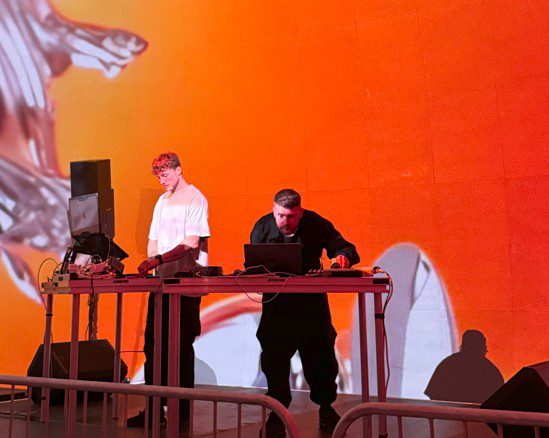
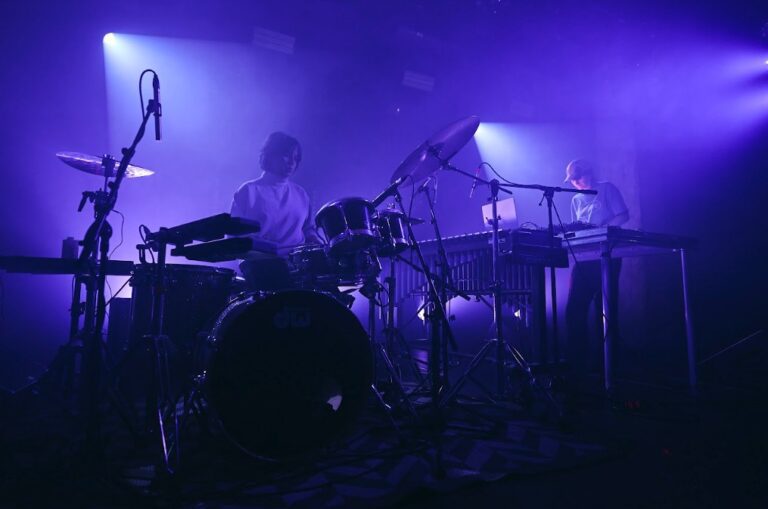
The fourth Expérience evening at Esplanade Tranquille kicked off on Friday with a raw, digital, and intensely emotional performance by Montreal duo SLIBERIUM. Formed by KUMA and Sendji, the project transported festival-goers into a collective hallucination where industrial sounds, techno energy, and R&B sensibilities collided.
Their set, which blends techno, deconstructed club, experimental hip-hop, and witch house, stood out for its unique sound texture: saturated, grainy synths, digital glitches, and abrasive atmospheres. Driven by muffled, pulsating kicks, their music moved forward with a kinetic force that invited listeners to both move and let themselves be swept away by the trance.
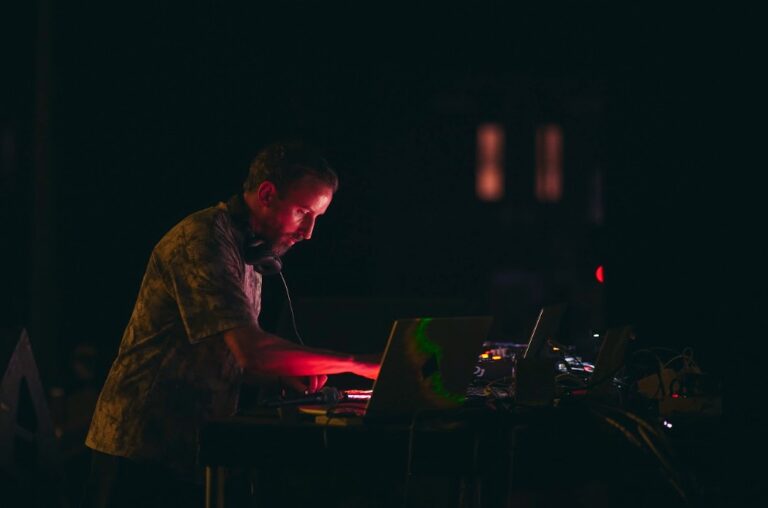
Behind a minimalist setup—computer, mixer, standalone instruments—Sendji brought a sensual dimension to this digital landscape with his voice. Processed by autotune, his tone oscillated between human warmth and digital coldness. His inflections, reminiscent of alternative R&B, contrasted with the robotic voices scattered throughout the concert, creating a back-and-forth between intimacy and otherness.
SLIBERIUM has thus created a transhuman universe, where the world appears as a shifting territory: hallucinatory dreams and raw everyday life, electronic chaos and vibrant humanity, digital beats and pop sensibility. A first “victory lap” for KUMA and Sendji, who ended their performance in jubilant ecstasy, transforming their musical intimacy into a collective, festive, and uncompromising experience.
Thursday evening, a unique event at the Théâtre Maisonneuve: Max Cooper’s Lattice 3D/AV, sold out. Renowned for his immersive audiovisual experiences, the British artist returned to Montreal with a performance that, far from the expected spectacular, proved to be introspective and deeply contemplative.
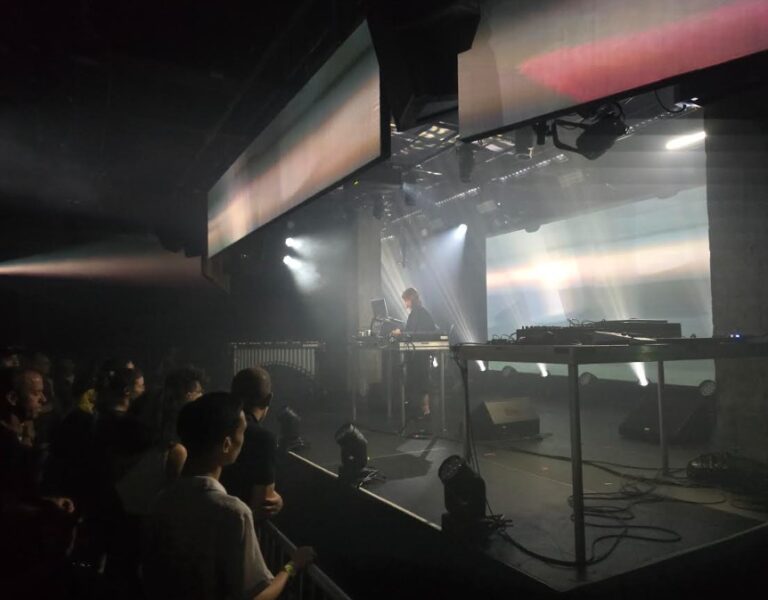
From the very beginning, the scenography imposed its clarity. There was no mystery: Cooper was positioned on stage, facing the audience, with his setup clearly visible, framed by two screens: one behind him, the other in front, semi-transparent, sometimes pierced by light, sometimes masking the artist’s figure.
This deliberate transparency set the tone: here, nothing to hide, everything to reveal. The show would focus less on dazzling than on the porosity between sounds, images, and consciousness.
Lattice 3D/AV, designed with Architecture Social Club, is described as his most ambitious live project, combining projections, semi-transparent layers, lasers, and lights sculpted in space. But rather than a sensory surge, the experience unfolded in a slow build-up. The visuals, at first, vibrated in layers of shifting colors, fluid textures, and measured rhythms. The music moved forward with restraint, almost weightlessly, creating a hypnotic continuum. It was a far cry from the festive frenzy of some other MUTEK evenings, and that was precisely the strength of the show.
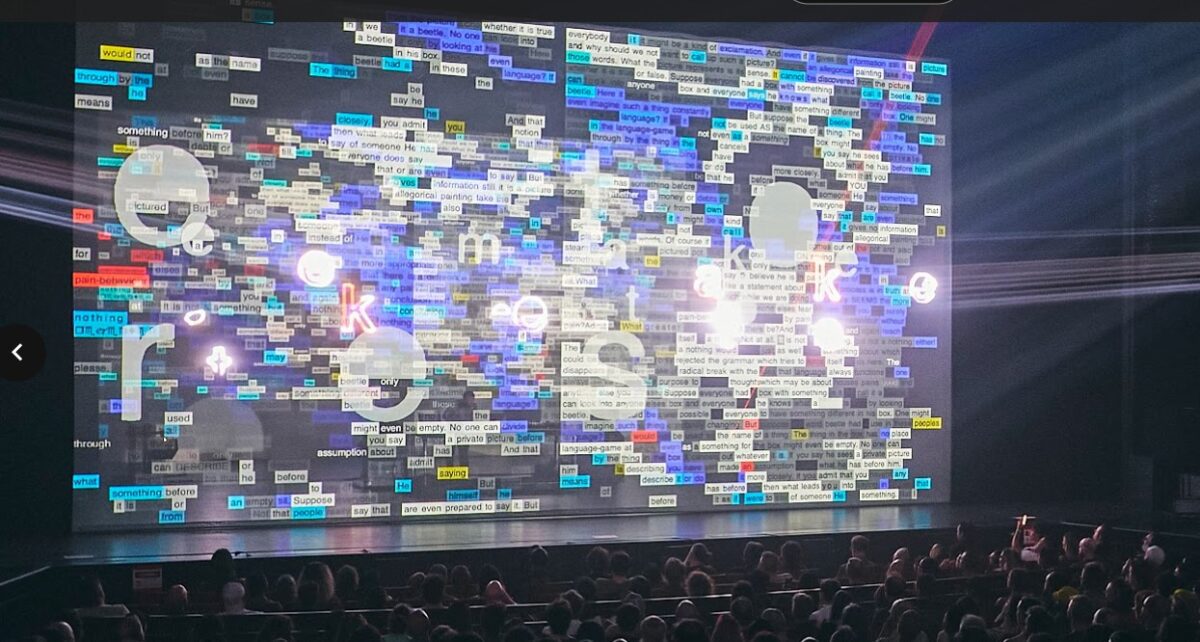
Then a pivotal moment: the appearance of the text. Projections of raw sentences, emerging as the intensity increased. This use of words, rare in Cooper’s performances, became the defining element of the set. The faster the tempo, the more the characters scrolled, until it created a paradoxical impression: that of finding ourselves face to face with the racing of our own thoughts, in a digital mirror of our saturated daily lives. The visual then took over the music, and the music, in turn, let itself be guided by this mental rhythm. It was at this moment that the effect was fully revealed. When the text stopped being projected, another shift occurred in the room: as if freed from a weight, the audience began to dance. The last fifteen minutes of the show took a more physical, more embodied turn, proof that the experience had worked, that the text had captured attention to the point of suspending the body, and its withdrawal had opened the space to the liberation of movement.
This choice echoed Cooper’s new project, On Being, which was released in February 2025. The album, born from hundreds of anonymous confessions collected online, directly questions what it means to “be” today. The responses, ranging from the most intimate pain to the purest declaration of love, served as the raw material for a work that translates the contemporary human experience into sound and image. These fragments of thought materialized in the visual space, making tangible the weight of collective speech.
In two hours, Cooper offered much more than a concert. He orchestrated a form of expanded listening, where spectators became witnesses to a shared inner landscape. In the effervescent context of MUTEK, where the temptation is to rush from one room to another, this introspective interlude suggested a valuable counterpoint. A slow breath in a festival that is often experienced at high speed. This reminds us that immersion is not only about technology and visual performance, but also about shared vulnerability. Behind the lasers and semi-transparent screens, it is our humanity that is revealed as fragile, dense, and multiple.
Tokyo and Berlin-based producer Machìna took the first edition of MUTEK’s Metropolis series by storm with a live modular techno performance that was as bare-bones as it was dumbfounding. For this North American premiere of Action, she stripped techno down to its core, improvising with nothing more than a drum machine and her voice woven into the framework of the eponymous album – a truly mesmerizing experience from start to finish.
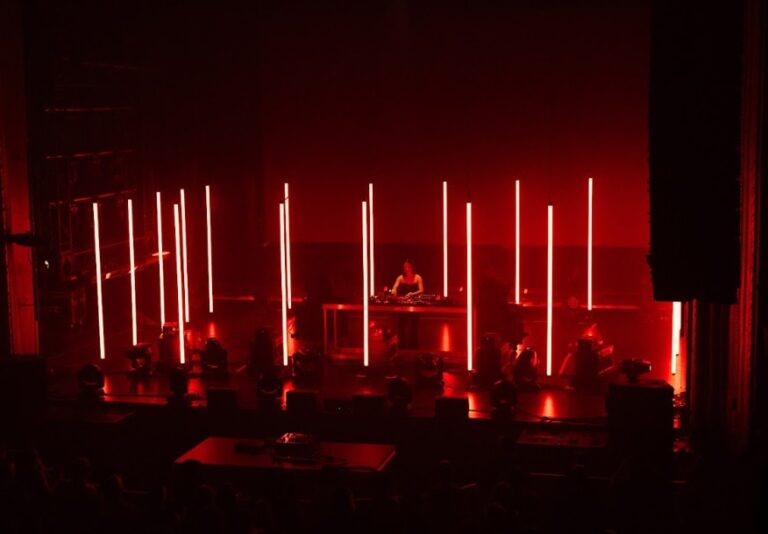
Clad in a sleek black latex dress and bathed in flashes of red light, Machìna put the venue’s monster sound system to work with classic rave sonics and an infectious minimal beat. It was a full sensory experience as the subwoofers made the floor shake and dancers responded accordingly – moving in unison and responding to shifts in tempo. Her live modular improv unfurled themselves in measured intensity – sharp snares, intricate cymbal patterns, funky distortion – electrifying both floors of the concert hall.
As the set progressed, the Korean-born artist steered progressively towards something darker and ominous. A single spotlight from above cut through the hazy stage, as vertical bars of red light enclosed her in a cage-like structure. At times, the beams seemed to drip from the vaulted ceiling like blood, a detail that strikingly evoked the infamous “Blood Rave” scene from the movie Blade. The crowd, immersed in the visuals, danced in near-ritualistic rhythm as pounding drum kicks reverberated through the space.
At moments, Machìna trimmed down the melodies to their rawest elements – the roar of the drum kicks, bouncy hi-hats & textured sounds – heightened anticipation before releasing the floor back into an all-out frenzy of rhythms and light. The alternating tension and release, combined to a formidable light installation, made the set a fully sensory experience: bass reverberated to the back of the Metropolis, lasers cut through the sea of bodies in motion, and every shift in sound eliciting a reaction from the crowd.
By the time she closed, Machìna had set the bar impossibly high for the rest of the night : fans clapped and begged for more, aThis sharp, refreshing techno set firmly established the artist as a true master, fluidly blending simple beats and layered percussion. One of the best performances of Mutek so far.
By the time she closed, Machìna had set the bar impossibly high for the rest of the night to festivalgoer’s delight. Fans clapped and begged for more, a true testament to her talent. This sharp, refreshing set that fluidly blended stripped-down beats with layered percussion was by far one of the best performances of MUTEK so far.
MUTEK | Roaming, The Art of Bringing People Together According to Gayance
by Marc-Antoine Bernier
On Friday evening, Nocturne 3, Espace SAT was transformed into a veritable party thanks to Gayance, aka Aïsha Vertus. With Roaming, the Montreal artist delivered a dazzling collective performance, inviting the audience to share a taste for dance, change, and solidarity.
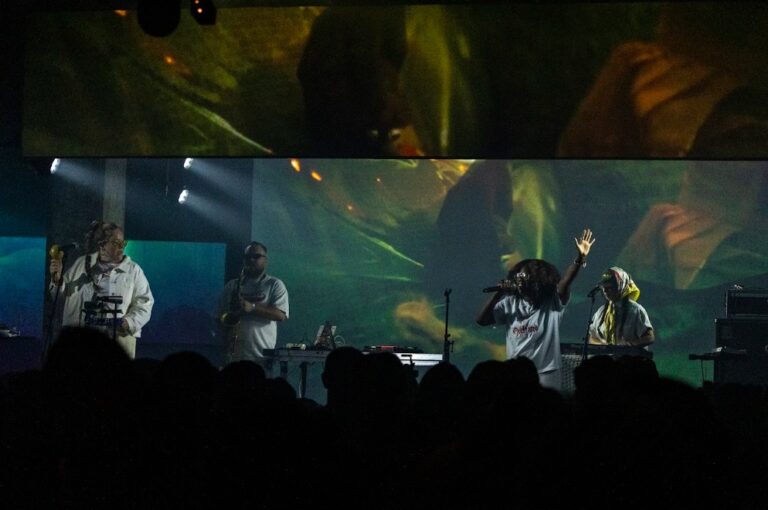
Surrounded by a close-knit group, Gayance has woven a story in several chapters, where each piece becomes an emotion to be experienced together. Alongside her are Funky Watt on musical direction and bass, Evan Shay on saxophone, Peggy Hogan on keyboards, and Judith Little-D on percussion and vocals. Three distinguished guests—Janet King, Yassin “Narcy” Asalman, and Magi Merlin—also joined in to punctuate the show with unique moments, giving the evening the feel of a collective story told in several chapters.
One of the most memorable moments was the appearance of Narcy, a pioneer of Arabic hip-hop. With a Palestinian flag projected behind him, he had the audience repeat the words “Don’t lose focus. Breathe,” reminding them that “It’s not about one, it’s about us.” ” Set to a jazz-tinged drum & bass beat, this rallying cry carried unexpected political and emotional depth, mourning and solidarity.
Between house, drum & bass, Caribbean grooves, and jazzy accents, Roaming took the form of a musical and emotional journey, eclectic and deeply human. An evening where the artists’ contagious energy transformed into a true call for togetherness.
MUTEK | REM of A Different Kind… To Dream Together
by Marc-Antoine Bernier
As part of Nocturne2, the Satosphère hosted the world premiere of Rapid Eye Movement (REM, a well-known acronym for obvious reasons) last Thursday, an immersive performance conceived by British artists Bertie Sampson and YeffYeff, aka Reeps One. Conceived as a sensory journey through sleep cycles, the work invited the audience to enter a collective dream where voices and images dissolved into a single dreamlike flow.
The performance follows the five stages of sleep, focusing on the last one—REM, the intense dreaming stage just before waking. Beforehand, the artists collected visual, textual, and audio fragments from an online audience, which they then transformed into sensory material: we were literally immersed in people’s dreams.
On stage, YeffYeff experimented live with his voice, sometimes stretched, sometimes distorted, in dialogue with Sampson’s generative environments. His soundtrack, deeply rooted in the heritage of the British garage scene, summoned UK Garage, Future Garage and UK Bass.
To his right, Bertie Sampson manipulated the 360° projected visuals: moving architecture, flower gardens, human silhouettes, abstract textures. From the iris of an eye to hybrid landscapes between human constructions and nature, his images composed a moving map of the unconscious.
On the monumental scale of the dome, Rapid Eye Movement blurs perceptions and destabilizes landmarks, immersing the viewer in a living map of the unconscious. After MUTEK, the two artists will extend this dreamlike journey with new performances at the SAT starting August 26.
Every year Mutek somehow reinvents itself by managing to find artists at the center of a changing world. It reminds us that the only certainty is that there is none, even when considering the very definitions of music. Last night, in a barrage of sounds hardly close to anything I’ve ever heard, Gadi Sassoon and Portrait XO turned into Espace S.A.T. into Plato’s cave, reflecting back to the audience their very act of listening.
Closer to sound art than music, the majority of the crowd stood fixed in perplexity at the boldness of every new scenery, each as creatively unique as the last. Rhythms grew only to quickly be stormed by what sounded like the noise of a million machines; the loudness and speed breathed through the room like a steam engine. Finally, when all expectations of a normal set were dropped, form folded under meaning and unveiled the origami of meta-narratives. Something screamed in Italian—the message was immediately understood in all languages.
If the post-human aesthetic didn’t already make it clear enough, the AI videos of children dancing to music while tanks roamed the streets solidified the urgency of their statement. And while it may seem conceptually driven at first, the sounds and performance themselves were truly heartfelt. The expression was raw, untethered, channeling violence into a stream of clearly articulated gestures that looked at the issue from all material, aesthetic, and emotional dimensions. While the sounds verged into noise and were characterized by a powerful orchestration of metallic sounds, their set still held a close tie to breakbeats, creating a stark contrast to their long stretches of formless, ethereal soundscapes. In the end, they let loose and finished their set with densely populated drum loops, which they let play while dancing, greeting the crowd’s final cheers. The sounds settled along with a thick fog that had been following us up to this point. This set was a breath of fresh air and a reminder of what unruly experimentation stands for.
MUTEK | Al Wooten Keeps His Audience Spellbound For Two Hours
by Julius Cesaratto
To close Mutek Experience 2, London-based DJ and producer Al Wooton drew inspiration from his city’s rich musical tradition, which blends genres, to deliver a percussive and ever-changing set.
He began his two-hour performance with industrial textures. We passed through a dark atmosphere before gradually moving on to woody marimbas, sampled hand percussion, and African-inspired vocals. From then on, the rhythm took over, with percussion driving the show.
Wooton’s set flowed seamlessly between laid-back British bass music and Afrobeat, with touches of acid and baile funk. It gradually evolved into heavier rhythms and complex variations of drum patterns, punctuated by well-placed breakdowns. Bird and bat calls, along with pan flute samples, infused bursts of organic life into his immersive soundscape. The distorted, percussive vocals that intertwined toward the end were particularly striking. A raw, almost ritualistic energy.
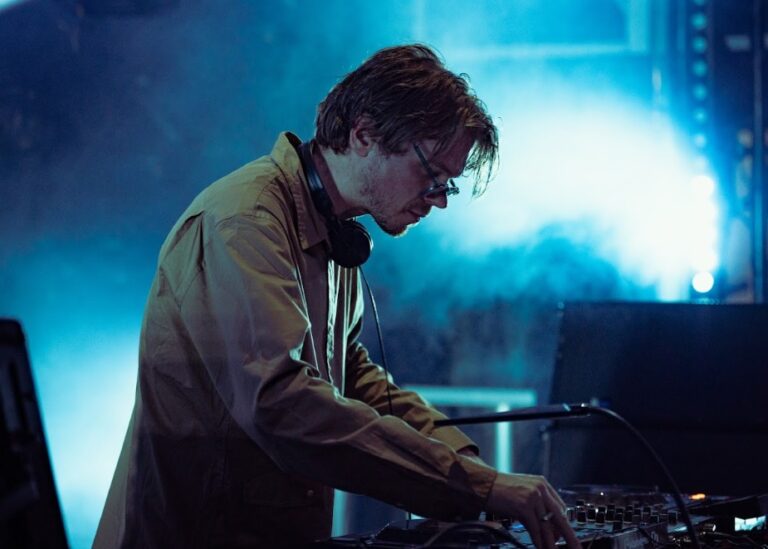
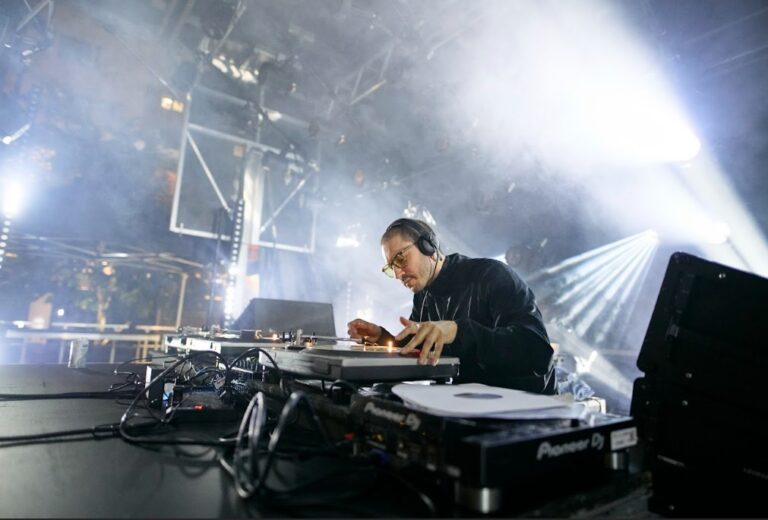
Behind the turntables, Wooton was completely absorbed in his art, rarely looking up, but clearly focused on the groove. His control of tempo changes, breaks, and rhythmic escalation kept the dance floor moving, bodies swaying to the ebb and flow that echoed the tribal journey he was charting.
This rollercoaster approach kept the audience on the edge of their seats until the very end. The final moments—a percussive avalanche of bongos, samba whistles, pan flutes, and wild Latin vocals—had the crowd screaming and applauding as the set came to its triumphant conclusion.
MUTEK | Yu Su & Myriam Boucher, A Journey Without Shores
by Marc-Antoine Bernier
On Tuesday evening at the SAT, the first installment of MUTEK’s Nocturnes opened with a spellbinding performance in which Yu Su’s music and Myriam Boucher’s visuals came together in a compelling dialogue between fluid sound and luminous vortexes. From the very first moments, we were immersed in a universe that was both intimate and expansive, where each gesture seemed to resonate with the previous one.
Yu Su’s live set began delicately, setting the tone with a shifting ambient backdrop, where a push-and-pull effect created by the interaction of the kick drum and airy synth evoked the sound of waves lapping against the shore. From the very first seconds, it was clear that Yu Su was inviting us to share in a collective dream, guided by delicate melodies and a dreamlike exploration.
Quickly, this state of microgravity shifted to the dance floor, propelled by pulsating house-style percussion. These changes in mood, characterized by unexpected contrasts, would mark the entire evening. Yu Su plays with the principle of fluidity, demonstrating a unique sensitivity for musical narration: a state of flux where motifs unfold endlessly, transporting us to a new world of sound.
Whether it’s ambient techno, progressive electronic, microhouse, experimental, or Balearic beat, Yu Su infuses it with a tangible, hypnotic, and lush atmosphere.
Visually, Montreal artist Myriam Boucher created an environment that perfectly resonated with the music, translating Yu Su’s intuition and emotions into a colorful tapestry. The meta-narrative, carried by a palette dominated by magenta, purple, and pink, enveloped the emotional and intuitive dimension of the performance: gentleness, innocence, romanticism, intimacy, creativity, and transformation, to name but a few.
Illustrating the idea of a journey with no specific destination, both expansive and playful, the visual flow unfolded in cyclical, hypnotic movements, creating a rhythmic back-and-forth with great magnetic power. These flows sometimes took the form of an abstract vortex with a mineral appearance, reminiscent of cave motifs or a shower of stars, but also the fluid momentum of brushstrokes gliding across a canvas.
This encounter between two worlds offered a moment suspended in time, where music and images intertwined to open up a space for inner travel, with no specific destination but rich in shared sensations.
MUTEK | Valentina and upsammy, Tactile and Atmospheric
by Marc-Antoine Bernier
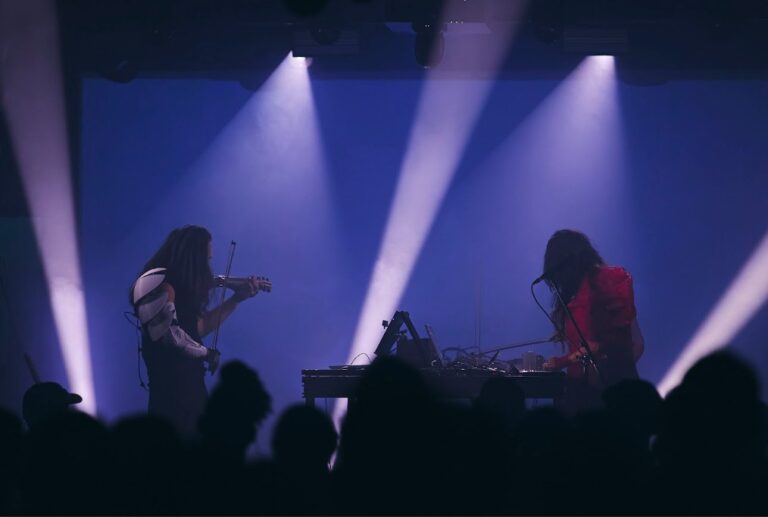
For her second appearance at MUTEK 2025, Italian percussionist Valentina Magaletti returned to the stage at the Society for Arts and Technology yesterday, this time in a duo with Dutch producer Thessa Thorsing, aka upsammy. Together, they delivered tactile, atmospheric music that oscillated between rhythmic density and melodic clarity.
Their story began in 2023, when a commission from the Rijksmuseum in Amsterdam led them to explore the museum’s acoustic spaces. This immersion gave rise to a rich soundscape, nourished by resonances, listening to the architecture, and the meeting of two sensibilities. This collaboration has now been extended into a performance that serves as a prelude to their first joint album.
On stage, upsammy remixes recordings live using loops and granular synthesis, while Magaletti weaves his beats on drums, vibraphone, and various objects. Their textures blend together, making it difficult to distinguish between percussive gestures and electronic processing. Furthermore, Thorsing’s sensitivity was particularly evident in his meticulous work of transformation and recomposition, giving rise to constantly shifting soundscapes. At the same time, Magaletti’s jungle and drum and bass-influenced drumming blurred the lines, creating an ever-changing soundscape.
The audience was carried away by this shifting narrative during the 40 minutes of their performance, between improvised momentum and sketched structures, where echoes of drum and bass, techno, and electroacoustics emerged. Their sonic dialogue stood out as an invitation to explore, as if the sound itself were guiding the listener through a tapestry of architectural resonances and palpable emotions.
This encounter at MUTEK revealed a duo in full creative bloom, capable of transforming the stage into a veritable living laboratory. A promise that heralds an upcoming album as daring as their stage encounter at MUTEK.
Montrealer Stephen Beaupré treated us to his Experience 1, the first night of MUTEK outdoors with Return, the title of a finely crafted live set featuring micro-house, sophisticated samples, and hypnotic rhythms.
Drawing inspiration from new tracks from his latest album Vanishing Night, as well as exclusive unreleased tracks from an upcoming project, he performed exclusively original compositions for the first edition of the free series, presented at L’Esplanade Tranquille.
The local micro-house pioneer took to the stage wearing a small keffiyeh tied around his neck as a tie. Bathed in pink and red light, Beaupré turned up the heat with funky bass lines, which he seamlessly blended with ethereal, dreamy vocals that intensified as night fell on the Quartier des Spectacles. In the same vein, the crowd grew louder as the sun set over the Esplanade Tranquille. Thrilling!
Although Beaupré’s sound conveys a certain nostalgia, this pillar of the underground scene brought together young dance music fans and MUTEK veterans. Longtime festival-goers embraced their old friends, creating a sense of intimacy among the crowd. One of the most memorable moments of the evening came when the vocal loop of “Free, Free Palestine” rang out, layered over a powerful drumbeat. The chant echoed across the square, reflecting the unity of the dance floor, as attendees responded to this powerful—albeit modest—show of solidarity with the Palestinian cause.
MUTEK | Nicola Cruz Sets The Tone at Esplanade tranquille
by Marc-Antoine Bernier
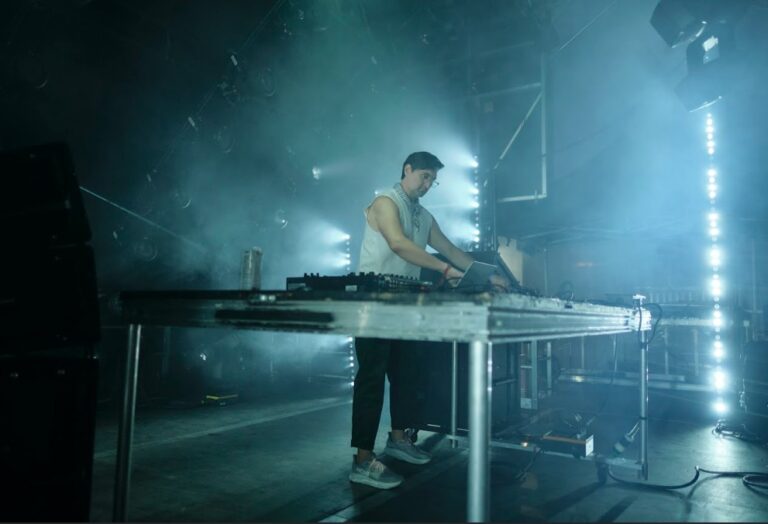
Nicola Cruz took to the stage at the Esplanade Tranquille at 9 p.m. to close the first night of the 26th MUTEK festival, in front of a large crowd who had come to experience his DJ set in person. Dressed in a turtleneck and denim jacket, with an attitude that was both playful and relaxed, he kicked off the evening with a understated yet magnetic presence.
This first DJ performance was part of a program that had already begun with Valentina Magaletti’s percussive and interactive performance, followed by Stephen Beaupré’s immersive live show, which featured synthesizers, drum machines, and Ableton Live.
The Ecuadorian producer’s equipment seemed simple: in front of him were four direct-drive turntables on which he played vinyl records from his collection. This traditional approach to DJing resulted in an eclectic set, blending techno, house, and breakbeat, while incorporating a wide range of musical influences, from the Balkans to Latin America, via the North American underground electro scene and European house.
This performance of electro-futuristic tracks demonstrated his deep attachment to resolutely physical music, which awakened festival-goers in a rhythmic communion, where the kinetic excitement continued to grow throughout the set.
Techno and electro beats resonated in the chest, triggering a visceral reaction: heads nodded, shoulders swayed, legs tapped the floor to the rhythm of the music. The most intense passages mingled with moments of trance accentuated by distortions, experimental beeps, and Latin percussion, all carried by subtle and enveloping rhythmic embellishments. In this space saturated with bass and percussion, the crowd became a single vibrating organism, breathing to the rhythm of a sustained kick. Other moments plunged us into dub techno, minimal techno, and microhouse, offering fluidity and relaxation, and putting festival-goers into an almost meditative state.
Having been granted an extra fifteen minutes, Nicola Cruz ended the evening on a high note, mixing all the genres explored throughout the set in an energetic finale marked by his edit of the Chicago house-influenced track It’s Gonna Be… (A Lovely Day). We couldn’t have asked for a better start to the 26th edition of the MUTEK festival.
Nicola Cruz will perform again on Saturday, August 23, as part of Metropolis 2, starting at 11 p.m.
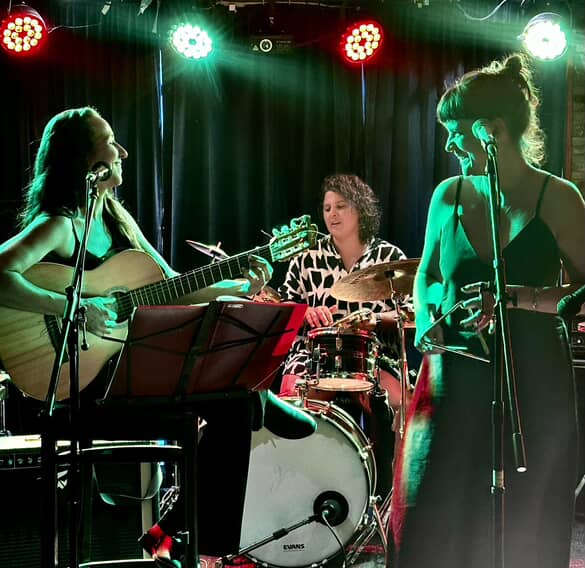
You may be familiar with this name, as I mentioned it in my review of the Gilsons concert, where she was the opening act. This time, the Toronto-based artist returned to Montreal as part of a trio, accompanied by Mari Palhares on percussion and Samyle Carvalho on guitar and backing vocals. JØY, meanwhile, plays several instruments during her songs, including the triangle and kazoo, which I discovered that evening.
She began a cappella, her voice rising in a crescendo. She started with her own original compositions, such as A Calma Acalma and Vem, before performing a few covers of Brazilian classics, such as Morena Tropicana, which was very well received. The venue filled up as the evening progressed, mainly with Brazilians and fans of Brazilian music.
Some parts of the concert felt like spiritual ceremonies, with JØY occasionally attempting to express herself in French before returning to Portuguese.
“I am a Brazilian and Canadian singer and songwriter, and I come from northeastern Brazil,” she tells us.
The synergy with her musicians was palpable, particularly with guitarist Samyle, who had a smile on her face throughout the concert. In addition to her impressive guitar playing, she also provided backing vocals on several songs.
“The next song is about our thoughts on our worldview and how we use our time,” she says between songs. The party really got going when she sang Vumbora Amar and the whole room started dancing and clapping along. JØY seems to enjoy forró, a Brazilian music style from her region, the Northeast, while adding Latin and folk rhythms.
Curiously, there was no admission fee for the concert, as the artist opted for voluntary contributions, which the audience generously provided. Her manager, Ulysses de Paula of Showzaço Productions, was on hand to collect the contributions. He is behind many of the concerts by Brazilian artists in Canada.
She ended the concert with a walkabout, while the guitarist took over on vocals. She danced steps that seemed to come from her region, moving to the center of the circle surrounded by happy spectators.
“I’m going home with my heart full of joy,” she says in conclusion, before making way for the next group. My favorite was undoubtedly her cover of Tô Sem Você, a song I discovered this year and which is currently in my top three Brazilian songs.
This concert allowed Montrealers to discover her, and others to see her again, but it doesn’t seem like this will be the last time we see her in the city. She has a large network of Brazilian artists based in Montreal, and it was with them that she continued the evening in a more intimate “roda de samba” style, until we see her again on an even bigger stage than the Marche à côté.