chanson keb franco / Indie Pop / krautpop / Krautrock / Synth-Pop

Abracadabra! Klô Pelgag is Back

by Alain Brunet

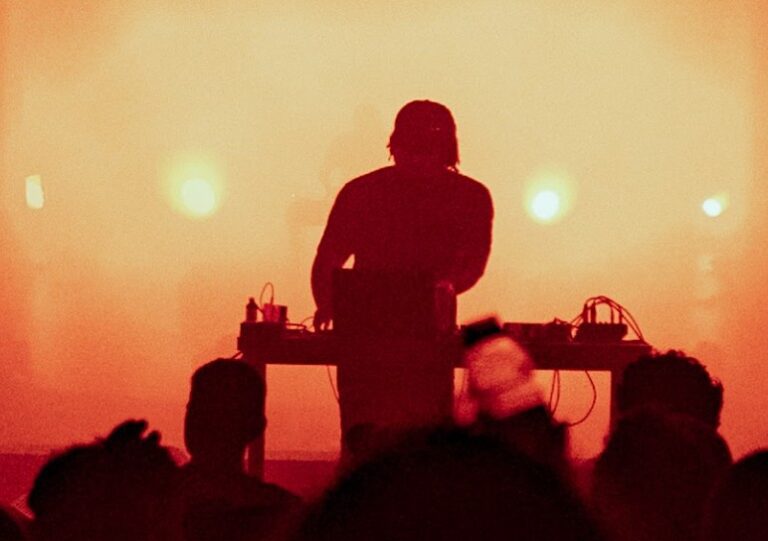
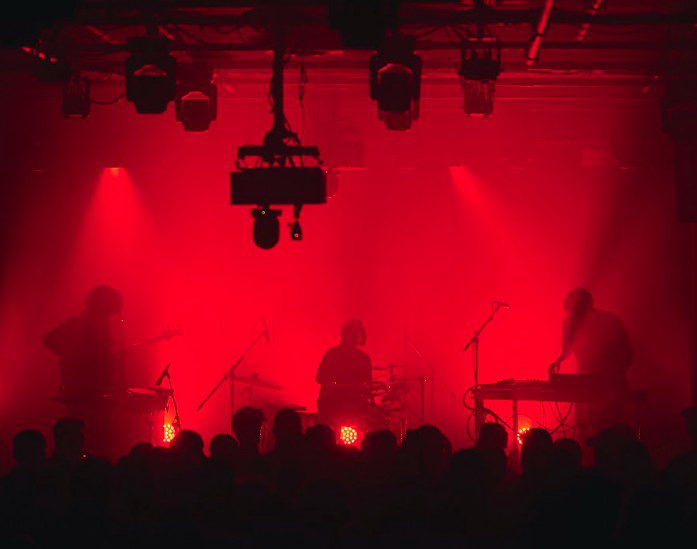
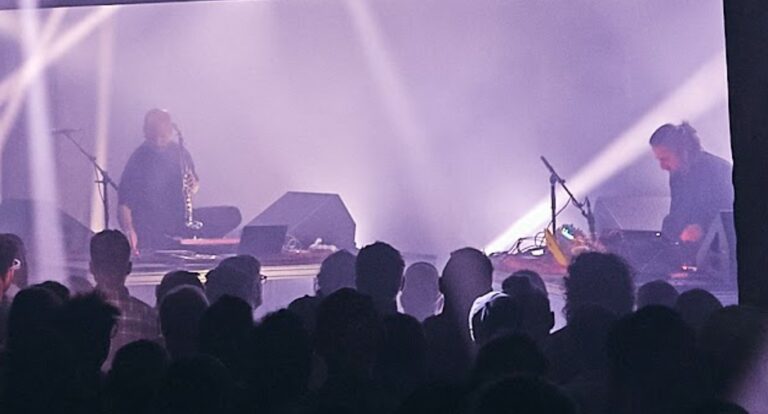
The curtain rises on this Thursday evening at MTelus, a few minutes after the powerful punk-prog discharge of the Angine de poitrine duo, just the thing for atrial fibrillation. In the chiaroscuro of special occasions, keyboards are pushed towards the stage. Then percussion, then more cossins. When the lutherie and its users are well in place… abracadabra!

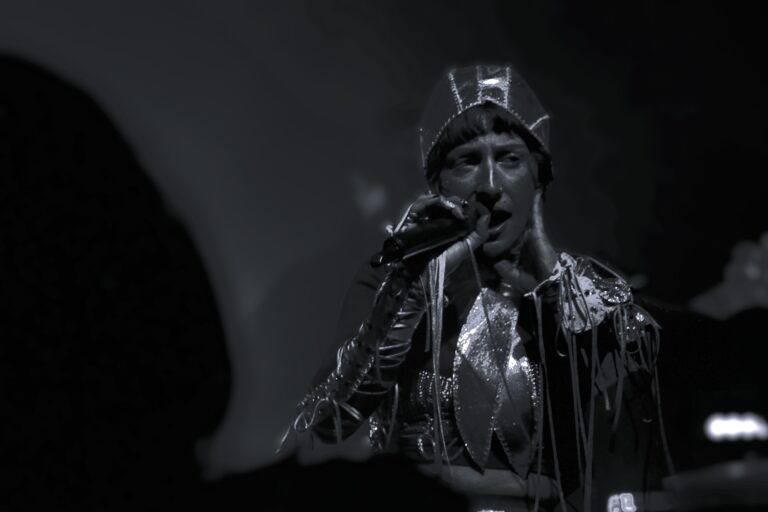
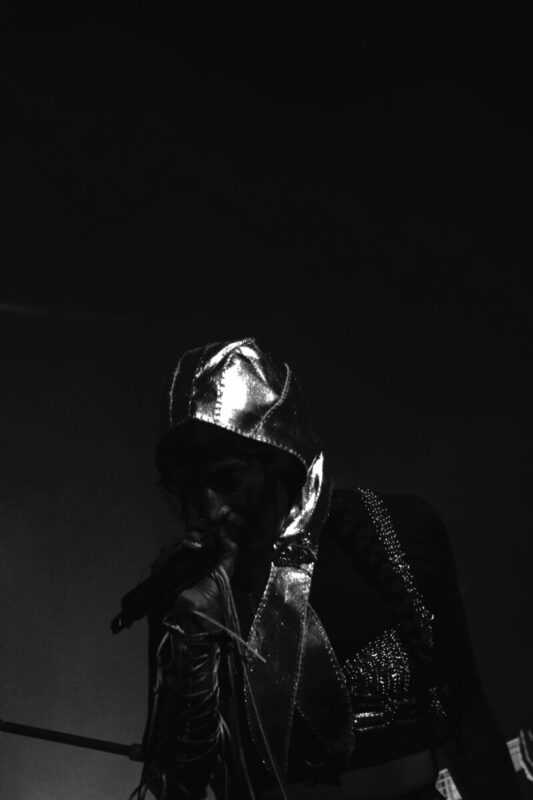
She appears at center stage, a strange creature masked in white, wearing an oversized parka at the top of the central staircase. She extends her limbs to the thunderous applause of the crowd. Underneath the parka is a crazy cosmonaut costume. Under the costume, we discover Klô Pelgag.

This set-up is the opportunity to play the instrumental Le sang des fruits rouges, initiated by a drone decorated with avian flutes, high-pitched and fluttering notes, on the verge of annoyance.

It really kicks off with Pythagore, chanted like a synth-pop anthem garnished with keyboards, wrapped in heartfelt vocals, cheered on by the fans.

Pelgag follows up with Coupable, part chamber pop, part dream pop. On the final track of this tale of a friendship conflict that weighs heavily on the story’s narrator, the singer rehearses her chorus, including a high-frequency “je n’ai pas dormi”, before striding back up the stage stairs with some heartfelt incantations.

The Quebec star then takes a love bath, enjoys minutes of acclaim and addresses her audience before claiming to wear a very large jacket, because she’s become a professional over the years. Needless to say, this absurdist humor suits the artist well, and she’s been making good use of it since her debut.

Here we are À l’ombre des cyprès… parfum de muguet…. ideal funeral in prospect, says the song as 5 white T-shirts jump around the stage with their instruments in front – keyboards, synths, percussion, bass, guitar. Fans know the song by heart, and a huge monodic chorus accompanies the soloist in full possession of her powers.

“Someone bring me a song from beyond the grave, and let’s make it jump!” she commands, before performing Les instants d’équilibre… a reminder of a past that we enter only to leave again, a past that we guess is unbalanced, unbridled to say the least, fiery, ardent.

A little Afro-Caribbean beat follows, and the balloon jacket is back and applauded for Lettre à un jeune poète, a motherly song bathed in sincere concern and benevolence.

The musician settles in at the keyboard, proposing a love song “to remedy the lack of love” from which the world is currently suffering: it’s Sans visage, the evocation of a journey for two, the proximity being such that one would recognize the other without a face. A pretty ballad with a slow, steady tempo, topped by space-pop keyboards and celestial vocals.

We tune in, and soon there will be flute sounds, played staccato. The keyboard imitates the piano and we recognize Le goût des mangues, a chamber pop evoking the return of mild temperatures.

Klô Pelgag draws on her recent opus, Abracadabra, before which she says she was “well into anxiety”, i.e. inspired to write this song served up this time in piano-vocal formula, proud to use this keyboard model she had gotten rid of before buying it back.” Keep your old things and store them with your parents!” As she sings this work oscillating between the hope and dismay produced by the current situation, we understand that Les puits de lumière “lets the rain in”.

A huge red square overhangs the stage, Jim Morrison is a wandering, a dream where we pass through paintings whose meaning we seek, where we’d like to “hold what we touch with our fingertips.”

Fever Ray could well have composed the quasi-electro song that follows: Décembre has paroxysmal moments, performed with fervor in front of the huge square backdrop, this time black, around which pink and blue waltz. Back at the top of the central staircase, Klô Pelgag lets her hair down. The intensity just went up a few notches,

The black square as a backdrop is now delineated by multicolored lines, and a funky rhythm settles in. It’s Deux jours et deux nuits, electro-pop for excited night owls, two days and two nights of dancing on the beach, following the path traced by seashells.

The party really gets going in this sold-out Mtelus. Clearly, the drama had been carefully planned, and the hot crowd welcomed Mélamine as they faded in to a well-mastered krautrock.

The crowd has reached a pinnacle of excitement, and the song Umami “comes from the heart”, where we “spend our nights thinking about the day”. Cheerful groove, cheerful indie-pop, here’s a Klô Pelgag classic and re-krautrock with Rémora.

Long thanks, introduction of colleagues, and a long conclusion spread over three encores. Les animaux, Les ferrofluides-fleurs, Comme des rames and… abracadabra we left, delighted, satiated with this Klô Pelgag crossing a vast creative plateau.

PROGRAM :

Le sang des fruits rouges

Pythagore

Libre

Coupable

À l’ombre des cyprès

Les instants d’équilibre

Lettre à une jeune poète

Sans visage

Le goût des mangues

Les puits de lumière

Jim Morrison

Décembre

Deux jours et deux nuits

Mélamine

Umami

La maison jaune

Rémora

Rappels

Les animaux

Les ferrofluides-fleurs

Comme des rames

Photo Credit: Marc-Étienne Mongrain

Art Pop / cosmic jazz / Jazz Fusion / Yacht Rock

Syncopation & Synergy: Karneef’s jazz fusion meshes with Rapallo’s corporate yacht pop

by Stephan Boissonneault

This week, courtesy of locals Karneef and Rapallo, La Sala Rossa hosted a night of eclectic cosmic jazz fusion and yachty experimental business pop, doubling as the album release of Karneef’s wacky jazz fusion LP, It’s How You Say It.

Mergers & Bangers: Rapallo’s market moves

The night began with Rapallo taking the stage, jumping into the beachy disco-funk of “Daryll’s on the News,” and then transitioning into their more business-time-style songs from their debut LP, Merger. You see, Rapallo doesn’t just play their songs—they pitch them, and everyone in the crowd is a would-be shareholder or flush swinger looking to get down. The playful dueling vocals and absurdist stories between guitarist Nick Lanyon and the mesmerizing Kyla Jolene feel a bit like Kenny Loggins dueting with Olivia Newton-John, and the whole slacker business pitch really works for the live show. But it’s more like being on a cruise with nonchalant CEOs and drinking too many Mai Tais than a full-on Q4 meeting. “The Alkalite” might be one of the catchiest songs I’ve heard live in a while, and live, it’s a wonderful fever dream. Lanyon’s lead guitar on the track “The Cage” is absolutely disgusting and hypnotic—the man can shred like Steve Vai and brush it off like nothing.

Rapallo’s vibe is all about the poppy hook to get you moving, with amazing lyrics like “Don’t call it a fantasy / You just live in it / All of the ivory in the key of C,” from “Lion’s Share.” A song like “V.I.P.” is a synth-heavy anthem with a fantastic ’80s key-man solo by Isaac Maynes—sounds like Tears for Fears if they were stuck in a WeWork. And “Breathing Underwater” is very Supertramp-coded. Rapallo’s music is pure corporate metaphor: love as mergers and hostile takeovers, vulnerability as a depreciating asset. The contrast couldn’t have been more perfect: Rapallo demanding we invest, and Karneef demanding we feel.

Liquidity in 11/8 Time: Karneef’s It’s How You Say It, in beautiful freefall

Jazz has always had somewhat of a resurgence, and within the last 15 or so years, artists like Thundercat, BADBADNOTGOOD, and Snarky Puppy have been leading the charge into the mainstream. But with his live show and album It’s How You Say It, Karneef should be added to that list.

As Karneef stepped onto the stage with his six-piece jazz band, the lights dimmed and a warm, jazzified breeze drifted in. The music was smooth, chaotic, and deeply committed to emotional communication. Saxophone, keyboard, bass, hazy guitar work, and a syncopated whirlwind of drums swirled around in polyrhythmic negotiations. Karneef is the mad vocal orchestrator of this wild group of too-talented musicians—breaking out into passionate, soulful growls and shaking his head in disbelief at the raw talent of his band: Rodolfo Rueda on bass, Max Lazich on drums, Ryan Nadin on guitar, Teddy Kadonoff on backing vocals and bass trombone, Cedric de Saint-Rome aka Housefly on keyboards, and Evan Shay on saxophones.

Their set felt intergalactic, like the band had tapped into a transmission from a parallel universe where fusion is the dominant energy source and feelings are traded like rare minerals. Karneef, equal parts wizard, preacher, and jazz court jester, steered the chaos like a man possessed by melody itself. His voice ricocheted between guttural chants and falsetto pleas, especially during “If Only You Could See Your Face Right Now,” which gave me huge Awaken, My Love! by Childish Gambino vibes. The drums by Lazich were astonishing. You know a jazz drummer is too good when you phase out and start questioning whether your hands are even correctly attached to your body. Lazich must have been raised in a metronome factory.

Karneef’s style of jazz fusion is constantly breezing on a sonic tightrope; just confusing enough for the true jazz heads, and just accessible enough for people looking to groove. A song like “Insides Match the Outside” will lay down a steady groove, abandon it like a bad lease, and then move into a polyrhythmic fire escape of invention. And then you have the wacky stage presence of Karneef—jumping around the stage like a whimsical jester and conductor, grounding the audience for moments of humble reprieve. Honestly, we are probably still recovering.

Avant-Garde / Contemporary

Le Vivier: many skills, few surprises

by Frédéric Cardin

I’d like to tell you right away that I had a wonderful evening, despite some flaws I’m about to add to the appreciation of last night’s concert. The evening, entitled Aptitudes matérielles (Material Skills), was an encounter between the contemporary creative scenes of New York and Montreal, presented at the Espace Bleu du Wilder, in Montreal’s Quartier des Spectacles, under the umbrella of Le Vivier, an indispensable musical catalyst on the Montreal scene. 

New York’s Hypercube ensemble, an unusual quartet comprising piano, saxophone, electric guitar and percussion, crossed sonic paths with three Montreal artists, Antonin Bourgault, Antoine Goudreau and Corie Rose Soumah. Only Bourgault actually joined the New Yorkers with his saxophone. For the others, the relationship took shape solely as composers. 

I’ll take several things away from this experience: the excellence of the Hypercube performers, a tightly-knit group that shows deeply intimate mutual listening and displays impressive technical quality. I also note that the musical avant-garde has come a long way in the last 50, even 75 years. We’ve reached the point where we can enjoy a concert of this kind, savoring the interpretative excellence displayed and the plastic beauty of the sounds generated on stage, without really being surprised by the proposal. Indeed, this was the feeling that assailed me during the concert: I’ve heard it all before. For in the narrative abstractions suggested, the numerous timbral projections, textural contrasts and sonic outbursts, nothing truly revolutionary, or even intriguing, emerged. Beautiful and plastically impeccable, but not surprising or off the beaten track.

That said, as mentioned, yours truly enjoyed the evening, as the music on offer was intelligent, informed by the best of musical knowhow and conceived in a clear spirit of aesthetic and sensory communication. 

First and foremost, the acousmatic portions of the scores were beautifully spatialized, with an effective octophony (if I’m not mistaken) that succeeded in plunging the audience into the center of pleasant synthetic outbursts. Musically, I’d sum up by saying that Soumah and Goudreau are the best at taking advantage of the coloristic possibilities of the Hypercube ensemble, integrating them into effective dramatic constructions, discursively fragmented but comprehensible. Corie Rose Soumah is one of the most interesting emerging voices in scholarly music, and her Soundcloud page should be a priority listen, if you’re really interested in contemporary stuff. The Montrealer is based in New York, so her close relationship with the band.

Corie Rose Soumah Soundcloud page

Hypercube’s saxophonist, Canadian Erin Rogers, has offered Mirror to Fire, a piece derived from a Nine Inch Nails song (The Lovers, from the album Add Violence). Mirror to Fire has become a kind of study in the musical possibilities of separating the harmonic and rhythmic pillars of a “popular” work, and is the easiest score in terms of discursive path that could be heard in the concert. All the works on the program were world premieres (except for one of Soumah’s pieces, a Canadian premiere ‘’only’’).

Classic avant-garde, drawing as much on Stockhausen as 1970s free jazz and acousmatic music, with no particular astonishment but undeniably seductive artistry.

Art Rock / Experimental Rock / Garage Rock / Gospel / Gothic / Post-Punk / Rock

Nick Cave & the Bad Seeds hold ceremonial court at Place Bell

by Stephan Boissonneault

At an age when most rock frontmen either fade into dad-band obscurity or find themselves on awkward “farewell” tours sponsored by insurance companies that go on forever, Nick Cave has somehow grown even more mythic — part preacher, part lounge lizard, part ghost. Last week at Place Bell, he and the Bad Seeds put on a masterclass in controlled chaos, proving that while the world around them gets cheaper and dumber, their particular brand of menace remains stubborn and gorgeously intact.

The setlist was a tightrope walk between the old gods and the new. They wasted no time, as Cave, looking like a slick mafioso, plunged straight into Frogs” — a synthy theatric gut-punch opener that immediately separated the tourists from the true believers. As Cave crooned “Kill Me, Kill Me, in the Sunday Raiiiiinnn,” I was immediately enraptured. From there, Nick Cave stalked the stage like a man who summons plagues with a finger-snap, pulling the crowd in to “Wild God,” and “Song Of The Lake.” These new songs from Wild God already felt like classics in Cave’s hands, stitched seamlessly into the old blood-soaked fabric. Somehow, Wild God isn’t a midlife crisis; but an artist in full control of their nightmare machine.

From there, we got “From Her to Eternity”—probably the closest I’ll ever get to The Birthday Party live, and the swampy gothic horror of “Tupelo.” Every scream, every whispered threat, was perfectly calibrated, yet never once felt mechanical. Cave and Warren Ellis (who made the violin his slave) were already drenched in sweat three songs in. Still, Cave gave the fans what they wanted, constantly shaking their hands mid-song or being held up by them.

Special mention must go to the Bad Seeds themselves — a band so tight they could probably perform sonic brain surgery blindfolded if asked. The gospel backing vocals matching Cave’s are spectacular, and Warren Ellis, shaggy and unhinged as ever, played every instrument that wasn’t bolted down, sometimes two at once. Larry Mullins pounded the drums with the kind of grim determination usually reserved for medieval executioners. The Bad Seeds made chaos sound rehearsed, and perfection sound like an accident. We of course got “Red Right Hand,” which is way more sinister live than recording, but my stand out has to be “The Mercy Seat,” from Tender Prey. That song is absolutely haunting live, and has this deranged energy that will be one of my forever concert highlights.

The encore was pure emotional warfare: “Papa Won’t Leave You, Henry” bellowed into “The Weeping Song” and then slid into the devastating hush of “Skeleton Tree.” Was it fun? Sure, in a funeral procession sort of way. Was it brilliant? Obviously. Nick Cave & The Bad Seeds don’t play “shows” anymore — they hold ceremonies, and if you’re lucky enough to attend, you leave a little less whole than when you first arrived.

Photos by Patrick Beaudry, evenko

Classical / Classical Period

OSM | A Morning of Lightness

by Alexis Desrosiers-Michaud

Less than twelve hours after performing a concert version of Mozart’s opera Cosi fan tutte as part of the festival of the same name, the Orchestre Symphonique de Montréal (OSM) and Rafael Payare presented two of the composer’s last works: Piano Concerto No. 27, with Kevin Chen as soloist, and Symphony No. 41, known as the “Jupiter” Symphony.

From the very first movement of the Concerto, we sense that everything will be in finesse, even before the soloist enters. At this point, our impression is confirmed; the fingers almost float over the keyboard. A real dialogue is established between Chen and the orchestra, with whom he constantly makes eye contact. The second movement is a gentle delight that takes us elsewhere, into a plaintive, restful, almost meditative world. This excerpt, full of emotion where the notes held never die, would certainly have been the subject of a replay on a digital application.

The “Jupiter” symphony that follows follows in the same vein as the Concerto, i.e., everything is lively, lilting, rhythmic, but light-hearted. All the more so since “one of the themes of the first movement is a bass aria written for an opera by Anfossi”. There’s something lyrical about this first movement.

The third movement could have been more dance-like, in keeping with the minuet tradition. Marked Menuetto : Allegretto, it tended more towards the second part of its surtitle, with a little more gallantry than usual.

The exclamation point of this symphony is undoubtedly the final movement. Indeed, Mozart’s final symphonic page is a jewel of contrapuntal writing, with no fewer than 5 (!) themes continuing uninterruptedly. It’s a compositional tour de force, but also a challenge for the conductor, who has to balance the sound so that the whole doesn’t become a jumble, which Payare succeeds in doing brilliantly. Constantly on his toes, he keeps everything under control. He even does the long reprise, like Labadie and Nagano’s previous versions, but which is not fashionable on disc. The timpani, hidden on the right, punctuates the phrases and ends of the sections, and provides the energy for the various climaxes. A quick note to say that the concert opened with pianist Chen’s solo performance of the Fantasy in C minor K. 475. This sombre but beautiful piece had more the air of a salon piece. Not because of the interpretation, quite the contrary, but because of the slight uproar caused by the admission to the hall of the dozens of latecomers who had arrived by bus for this school morning. No doubt listening to the same concert in the evening would have been different. But there was something beautiful about seeing and hearing the OSM’s “regulars” repeatedly questioning and taking an interest in these young people from all over, some wearing a piece of clothing bearing the effigy of their music program.

Photo Credit: Antoine Saito

Contemporary Jazz / Electroacoustic / Électronique / Experimental / Contemporary / Instrumental Hip Hop

African American Sound Recordings at SAT : Noise Floor

by Loic Minty

In a world of untraceable movements, this liquid form of music is barely contained by the term “experimental.” A post hip hop posts it exists only here and now, where hip hop has become more what is felt than what is heard. 

And yet it is still everything that has made it, only noisier and further away, like a signal passing through old wires. African American Sound Recordings seems to look from above at this infinite network and finds the subtle voices, like Morpheus looking through the matrix for the human heart. “Where is that noise coming from?” After 20 minutes you start forgetting, after 30 minutes it has sucked you in, and after 45 minutes you are now a part of it.

Dismantling all expectations, A.A.S.R. sculpted a form beyond music, an anthropology to black culture: from punk, to 70’s soul, to a saxophone screeching like it was cursed by the Pharoah himself. There is an authenticity and an originality in his approach that seems to have been the common thread of this evening.

Slow Pitch Sound’s turntablist approach sent the crowd into a twilight zone. Mixing like he was on a cosmic trip with Lee Scratch Perry in Studio One, his chop and screw approach reminisced of classic scratching acts such as DJ Screw, while at the same time completely renewing it in his choice of samples. Finding loops in accidental sounds, Slow Pitch Sound crafted his rhythms on the spot and had the crowd hanging on his every move. The forgotten art of turntabling showed its untapped potential as an instrument and, combined with digital tools, built a warm and distinct sound made into art by the graceful mastery of his tools.

But the most unexpected surprise of the night was Dumb Chamber’s debut performance, as he showed Montreal the shape of electronic music to come. Always bringing you somewhere new, the dense patchwork of sequences teased rhythm and built up in swells of emotive orchestrations. Somewhere between Luc Ferrari, Dean Blunt, and Oneohtrix Point Never’s “Replica”, his sound was distinguished by a soothing mix of field recordings and sensitive melodies borrowing from classical orchestration. 

Dumb Chamber had a big smile on his face as he effortlessly moved between genres; even his twist at classic house held a distinctive style, as noises uttered counter-rhythms in the background. The crowd, which could have been a Ssense staff party, may not have been as warmed up for dancing, but there was the feeling of deep listening and appreciation for the passionately researched sound experiments we were witnessing.

It was one of those experiences where you walk out not quite feeling the same as you walked in. Maybe it was the wall of low frequencies that got into your bones, maybe it was from sitting on the cold concrete, but it felt like a new space opened in imagining music as a performance that I look forward to exploring.

Sylis d’or 2025 Final: Salsa Ahead of Afro-Colombian Roots and Réunionese Maloya

by Frédéric Cardin

The final evening of the Sylis d’or 2025, held last night at the Fairmount Theatre, lived up to its promise of exhilarating ambience, festive rhythms and sunny music. The three bands in attendance – Raiz Viva, Kozé and Marzos & Mateo – delivered solid performances, but with finishing touches that made all the difference.

Marzos & Mateo’s fiery salsa took the gold Syli honors, while Raiz Viva’s exhilarating roots took second place for silver, with Kozé’s Reunion maloya taking bronze.

Kozé’s uneven performance explains this third-place finish, despite a vibrant incarnation on stage of the singer and dancer who leads the charge in a Maloya style originating on Reunion Island, colored by traditional songs accompanied by percussion. While the entrance to the stage was beautiful and the finale exciting, a central episode with approximate tonalities on the part of the backing singers probably harmed the group for good. A fine-tuning that remains to be done, but the collective still has some fine moments to offer future festival-goers who will be hearing them across Quebec and Canada.

For my money, it was Raiz Viva who offered the evening’s finest combination of surprise, energy and originality. An intense, sustained thirty-minute performance, based on a rhizomic cumbia from Colombia that dares to touch on some soil close to Brazil, but also to the country adopted by the members of the group, Quebec. There’s no electrification in this hyper-efficient proposition, just traditional flutes and a heap of percussion, but a stunning sense of rhythm and a full, voluptuous occupation of sonic space, backed by catchy melodies. Superb music from which emanates a convincing authenticity. I’d like to hear this band in full concert as soon as possible. And you too.

It was to be expected that the Marzos supergroup with soloist, guitarist and singer Mateo would hit hard. 14 people on stage, if I counted correctly, with a double ration of trumpets and trombones, a powerful baritone sax, a keyboard, backing singers, a singer (excellent) in addition to the star Mateo and a bunch of percussion, that’s enough to impress. Salsa that’s fairly predictable in its deployment, but certainly packs a punch. The atmosphere was explosive, as always in the finals (and semi-finals too) of the annual Sylis.

Modern Classical / Modern Jazz / période romantique

Soir de jazz symphonique à Laval

by Alain Brunet

À travers leur vies professionnelles qu’on devine intenses, les saxophonistes Yannick Rieu et Lionel Belmondo ont mis deux ans à mettre ce programme au point : un jazz symphonique construit, aménagé et reformulé autour des compositeurs Johannes Brahms, Maurice Ravel et Lili Boulanger, soit la fin du 19e  siècle et le début du 20e au service du jazz moderne. Malgré la tenue du débat des chefs et le match décisif du CH pour accéder aux éliminatoires de la LNH, une salle André-Mathieu bien garnie a chaudement accueilli l’exécution de ce programme.

La première intervention au programme est baignée de ces harmonies romantiques exécutées sur un mouvement lent et des notes graves. Les trois souffleurs de jazz se fondent dans l’Orchestre symphonique de Laval sous la direction de Daniel Bartholomew-Poyser. Jazzmen et interprètes classiques se fondent dans la partition, aucune improvisation n’est ici prévue.  

La section rythmique sextette s’amène pour une relecture orchestrale du Nocturne de Lili Boulanger, sœur cadette de la grande pédagogue parisienne Nadia Boulanger, soeurette dont les musiques sont de plus en plus jouées, un siècle après sa disparition tragique et prématurée: Louis-Vincent Hamel, batterie, Rémi-Jean LeBlanc, contrebasse, Jonathan Cahier, piano. Le menuet en do mineur de Ravel est parfaitement propice à la jazzification. On observe déjà les croisements entre le Français  Maurice Ravel et l’Américain George Gershwin, dont se sont nourris les plus grands penseurs du jazz moderne,de Bill Evans à Duke Ellington. 

Cette fois, le sextette s’impose au sein de l’OSL et impose cet équilibre entre jazz moderne et musique classique moderne. Les French, très solide trompettiste australien transplanté à Montréal, prend le premier solo, suivi du pianiste Jonathan Cayer, devenu l’un des très bons jazzmen de la période actuelle sur le territoire québécois. Les deux saxophones et la trompette sont entrelardés dans certains thèmes, familiers et agréables à l’écoute.

Composé pour le piano seul, ce Menuet en ut dièse mineur de Maurice Ravel a été orchestré et arrangé par Lionel Belmondo  pour orchestre symphonique et sextette de jazz. Le thème principal met en relief le saxophone soprano de Belmondo complété par les bois de l’orchestre, suivi du saxo ténor de Rieu. 

Inspirée du premier mouvement de la Symphonie No 4 de Brahms, cette pièce de Yannick Rieu implique l’improvisation des vents dont les lignes mélodiques ajoutent un contrepoint supplémentaire à la progression harmonique prévue pour l’orchestre. Il est alors intéressant de noter l’unification heureuse des deux esthétiques, cette fois dominée par le romantisme brahmsien.

S’ensuit Nostalgie, une pièce de Yannick Rieu dont il est le soliste principal aux côtés de Rémi-Jean LeBlanc, mais la partie jazz de l’œuvre demeure très jazz, l’orchestre se transforme alors en faste accompagnateur et rappelle les arrangements et orchestrations typiques des grands orchestres américains au milieu du 20e siècle.

Un riff de contrebasse introduit l’orchestre, le piano et les autres solistes du sextette. Le piano mature et assuré de Jonathan Cayer et le sax soprano de Rieu sont ici mis de l’avant. Les somptueuses harmonies  sont tellement propices au jazz moderne qu’on en oublie les fondements originels. Il faut toujours rappeler que les jazzophiles ont intégré les musiques romantiques ou classiques modernes sans nécessairement en connaître précisément le répertoire, en voilà une autre éloquente démonstration intitulée Ritournelle.

La suivante,Ballade sur le nom de Maurice Ravel , a été composée par Yannick et arrangée par Lionel, cette œuvre relativement courte est introduite par les cordes ravéliennes de l’OSL qui précèdent le thème exposé par le sextette. La nappe est dressée pour un riche exercice harmonique à l’échelle symphonique, l’excellent trompettiste Lex French y est mis en valeur pour une improvisation fervente qui en coiffe la conclusion.

Un solo de batterie bien senti de Louis-Vincent Hamel, et puis c’est parti dans un swing soigneusement enrobé par l’orchestre symphonique. Pour Pharaon de Yannick Rieu, des accords de piano précèdent le thème exposé à troix voix, on se trouve dans un romantisme luxuriant, et le piano s’élance sur un groove lent et ternaire avant de donner la réplique à l’orchestre symphonique et ses collègues du sextette pour conclure aux côtés des saxes, cuivres et compléments orchestraux.

Inspirée des Jeux d’eau de Maurice Ravel, La Couleur de l’eau est l’occasion pour Lionel Belmondo de fusionner le discours ravélien avec un jazz moderne typique des années 50, époque hard bop et Third Stream, s’envole alors Lex French dans un chemin dont il connaît parfaitement les balises.

On conclura ce programme ambitieux avec Embrahms-moi de Yannick Rieu, une pièce qui ne fut pas sans difficultés côté arrangement, dixit Lionel Belmondo. Le piano s’exécute d’abord et puis le romantisme brahmsien, donc pré-moderne et tellement repris dans les trames cinématographiques hollywoodiennes, se fond dans le discours de Yannick Rieu  dont le thème au saxophone est purement romantique.Solidement ficelé tout ça, au plus grand plaisir des mélomanes.

Experimental Rock / Post-Punk

FACS, WORKS, and DahL at Quai Des Brumes

by Stephan Boissonneault

Last weekend we had a ripper of a show at Quai Des Brumes in the form of FACS, WORKS, and DahL, all single-word band names, all with their own vibes, dabbling in the “experimental” or abstract rock sound genres. Many in the crowd were here for FACS, but some where just looking to support a live show and had their feeble minds twisted—and better for it.

We begin with the arsty trip-hop rock stylings of DahL, who take us on a psychedelic journey through their 2024 album, That’s It, adding a cerebral live energy during songs like “Edie and Ginger” and the crowd favourite, “Una Minutes.” I’ve seen DahL three or four times and it’s always good. Lead singer and guitar player, Nassir Liselle always seems to go into a trance of swagger, fully taking on the form of the characters he sings about, demanding prasie from the audience. Then we have Bryan Greenfield holding down the funk with his bass, modular synth, and occasional reverb-y backing vocals. William Winston adds another layer on another all-encompassing synth, and drummer Edward Scrimger holds down the chaos with his jazzy drumming, popping in a few ghost notes for more flair.

Next up is another local band, WORKS—whom I was unaware of until this show, with a wave of noisy art rock that immediately feels like the Montreal equivalent of the UK’s Dry Cleaning. Singer Skylar Aung-Thwin puts her own spin on the spoken word post-punk style, occasionally throwing in a weird, falsetto-y vibrato that brings to mind bands like The B-52s—as the WORKS dual guitar players unleash wave after wave of angular guitar riffs. The MVP of WORKS has to be bassist Zakir Jafry, who does not miss a beat during the off-kilter jams. Aung-Thwin’s stage prescence was cool and aloof, and kind of surreal as she offered the crowd apples, not once, but three times.

A few beers in, our heads are on swivels, waiting for FACS to take the stage. For the uninitiated, FACS is a weirdo noise rock three-piece from Chicago, who just released the album Wish Defense—the last album engineered by the legendary Steve Albini before his passing last year. As FACS take the stage, the bass guitar lets out the fuzzy and sludgy opening to “When You Say”—from 2023’s Still Life in Decay, and lead singer/guitarist Brian Case lets out his discordant and bright guitar harmonics. As he riffs, Case falls into the Quai Des Brumes walls, as if he’s being constantly hit by some luring presence. He looks like he’s in a constant fight, elevated by the fact that he raises his head to scream into the mic. Live, FACS’ music feels an inescapable vortex. This was of course, an Analogue Addiction show, so the quality was brimming, meaning the lead up to FACS—a local combiantion of DahL and WORKS—was weirdly perfect.

Classical

Université de Montréal: Stars shine on music’s next gen

by Frédéric Cardin

Saturday evening, April 12, saw the Université de Montréal’s Rising Stars concert. Graduates in conducting, composition and flute performance presented the results of years of learning. It was inspiring.

Conductor Marie-France Mathieu began by presenting the first three pieces on the programme, creations by three composition students, Gabriel José Melim Schwarz, Amichai Ben Shalev and Charles-Vincent Lemelin. Schwarz offered a tonal and rather sunny neo-romantic piece, ironically entitled Folle (Crazy). Vibrant with energy and inspired by Schwarz’s native Brazil, it is a work that is pleasant to listen to and not very demanding for the listener.

This was followed by A Groyse Metzieh by Ben Shalev, a musician also known as a member of the ensemble Les Arrivants. The title means ‘a beautiful find’, which is in fact a sarcastic formula typical of Jewish humour, meaning ‘not much of anything’. I really enjoyed this post-modern piece, which mixes tonality with noisy avant-gardism, thanks to a wide range of instrumental techniques linked to experimentation. It begins in a sombre atmosphere with a warm string theme, quickly interspersed with bursts of colour that would not have displeased Messiaen. The rest moves slowly but surely towards saturation, punctuated by thunderous stridencies, before ending with a return to consonance, but with the brass choir. Superb.

Finally, Lemelin’s Passacaille had the greatest effect on me. In this piece, which treats the orchestra as a living mass, dark but nonetheless criss-crossed by many luminous streaks, and which gradually swells to its maximum sonic and harmonic density, I perceived echoes of Saariaho and Rautavaaraa, but also of a certain Straussian monumentalism and the muscular expressionism of ex-Hollywood composer Goldenthal. Passacaille is a demonstration of quiet power, perfectly calibrated and constructed. Your humble reviewer thoroughly enjoyed it.

The rest of the programme featured Romantic repertoire, starting with a charming Concerto for two flutes by Franz Doppler, the king of the flute (along with his brother) in the 19th century. It was an opportunity to see and hear at work two young performers who won 3rd prize in the OUM 2024 Concerto Competition, Gabriel Lapointe Guay and Sarah Billet. The two artists injected all the right sparkle into this smiling, feel-good music.

The second part was devoted to Schumann’s Manfred Overture and Stravinsky’s Firebird Suite (1919). Above all, it was an opportunity to judge the conducting work of Marie-France Mathieu and Paul Karekezi. It was the latter who gave us a Manfred full of drama, inhabited by a necessary discharge of conflicting emotions. Perhaps a little tempered, but beautifully embodied.

The Firebird was brought to life with beautiful colours and crystalline details, powerfully underlined by conductor Mathieu.

Since the two young conducting artists also led the OUM (Orchestre de l’Université de Montréal) in the creations mentioned above, I noticed two different but complementary personalities of baton and control.

Paul Karekazi, who conducted Lemelin’s Passacaille (and, as I just said, Manfred), gave a clear performance, but above all one imbued with emotional intensity and inner strength. This favoured strong nuances and a legato imbued with heartfelt lyricism.

Marie-France Mathieu, on the other hand, is more sober in her outpourings, but nevertheless skilfully brings out the detailed colours and textural contrasts in a limpid manner, thanks to a surgical baton that leaves no room for doubt. She conducted the pieces by Schwarz and Ben Shalev, the Doppler (and of course the Stravinsky) very well.

Karekazi and Mathieu are students of Paolo Bellomia, the two flautists come from Denis Bluteau’s class, and the three composers benefit from the knowledge of Jimmie Leblanc, Ana Sokolovic, François-Hugues Leclair and Olivier Alary.

It was a wonderful evening for the future of music in Montreal, Quebec and Canada.

Photos: Tiago Curado

Jazz Pop

Magnificent Heiresses

by Marilyn Bouchard

This Wednesday, April 8, at Théâtre Outremont, was the opening of Héritières, a show imagined by composer and singer Karine Pion, who we’ve known for some time as the lead singer of Belle et Bum and a member of the group Galaxie. As she opens, she explains that the project was born during the pandemic, and that she had long toyed with the idea of an all-female, multi-performer show. Indeed, none of the 20 performers on stage (plus the stage management artists) are men. A look back at an evening of feminine celebration.

The show opens with the soloists: Erika Angell, Simone Bournival, Marie-Christine Depestre, Coral Egan, Soleil Launière, Kim Richardson, Mamselle Ruiz, Meryem Saci, Malika Tirolien and Karen Young. In chorus around fire-like lighting, they follow Karine’s lead in an almost dance-like fashion.

The pleasure and bond between the singers is palpable, right from the start.

This is followed by an intergenerational journey for women, with recordings, memories and confidences from loved ones punctuating the narrative, often with humor and tenderness. Accompanied by double bass, cello, viola, violins, saxophone, drums and sometimes guitar, we hear the performers’ mothers, sisters and grandmothers share their visions and memories of what it means to be a woman.

There’s a jazzy duet, a creative and sensitive drum solo, engaged lyrics, a surprising canon of vowels, slam-poetry and a magnificent Spanish song that transports us for a moment to the warmth of the South. And let’s not forget the power of Kim Richardson, who, even without amplification at times, moves through us with the same resonance as her miked colleagues. All this skilfully highlighted, notably with memorable side lighting that creates an oversized shadow of the performer on the audience wall. Very theatrical.

All in all, it a very fine evening “to the rhythm of legends and traumas,” in which Quebec women’s talent takes pride of place and where the committed tone is a reminder that victories and women’s rights are never easily won and that the struggle to achieve them is never over.

Drum & Bass / Hip Hop / Trap

Tunisian Goddess Emel Presents MRA

by Sandra Gasana

If there’s one thing Emel Mathlouthi has mastered, it’s the art of staging a performance worthy of a tragedy. Accompanied by her two musicians, on drums and keyboards, Emel Mathlouthi, known as “the voice of the revolution,” made a spectacular entrance on stage, adding lighting effects and appearing like a goddess on top of her throne. Wearing a sophisticated crown and an antique-style white dress from the 15th century, the Tunisian artist presented her most recent album, MRA, which means woman in Arabic, released in 2024 and produced entirely by a team of women.

Always with a screen behind her, her voice is rarely in its natural state. She uses a lot of reverb and plays with her microphone, adding an enigmatic effect to her universe in which trap, hip-hop, and drum ‘n’ bass cohabit harmoniously. Emel really gets into her character and lets herself go, inserting saccadic dance movements on several tracks. She taps her drum at times, complementing the work of her drummer and adding to the danceable effect.

At the end of the third song, the audience starts dancing, contrasting the solemn style of the first two tracks. Emel also adds pre-recorded sounds that merge with the looped images, a true sensory cocktail. Most of her songs are in Arabic, but she also sings in English, a language she mastered, and French. She switches from one to the other when addressing the audience.

Unfortunately, Naya Ali, who was due to perform, was unable to attend after all. That said, one of the highlights of the concert was when artist Narcy took to the stage for the track Yemenade. And that’s when the evening took a turn for the better, as his energy was felt throughout the room. He managed to get us singing, dancing, all in one song, while Emel danced behind him, banging her golden drum.

The other artist I was looking forward to seeing again was Ziya Tabassian. Also performing on four tracks, he added a traditional Middle Eastern touch to the show. He was perfectly attuned to the drummer’s rhythms, with whom he exchanged glances.

“I hope you like crazy percussion like we do! We don’t know how it sounds from your end, but we like it,” she says between songs. “I can’t seem to make soft songs, I can’t help it,” she confides.

During the song “Souty,” which means “My voice”, she scrolls through sheets on which it is written “My voice is time less like the wind” among other words, as if these were the lyrics of the song. She also takes the opportunity to mention the names of prisoners on some of the sheets.

Emel took the time to share a message from a Palestinian activist who wrote to her to give her the state of play. Indeed, Palestine was the backdrop throughout the show, including during the opening set by Checkpoint 303, a DJ duo who set the table for Emel’s performance. My favourite song is “Mazel,” which means Again, and speaks of the hope she still carries within her, and the new tomorrow she intends to build. In the background, we could see the faces of activist women from all over the world.

She finished with “Rise,” involving the audience on the chorus, before giving us an audience-pleasing encore. I was expecting to see a packed National, but that wasn’t the case. But one thing’s for sure: the people who were there went home satisfied with their evening.

Photo Credit: Ola Choukair

Subscribe to our newsletter

Inscription
Infolettre

"*" indicates required fields

Type of Suscribers