micro-house

MUTEK | An A-1 Experience With Stephen Beaupré

by Julius Cesaratto

Montrealer Stephen Beaupré treated us to his Experience 1, the first night of MUTEK outdoors with Return, the title of a finely crafted live set featuring micro-house, sophisticated samples, and hypnotic rhythms.

Drawing inspiration from new tracks from his latest album Vanishing Night, as well as exclusive unreleased tracks from an upcoming project, he performed exclusively original compositions for the first edition of the free series, presented at L’Esplanade Tranquille.

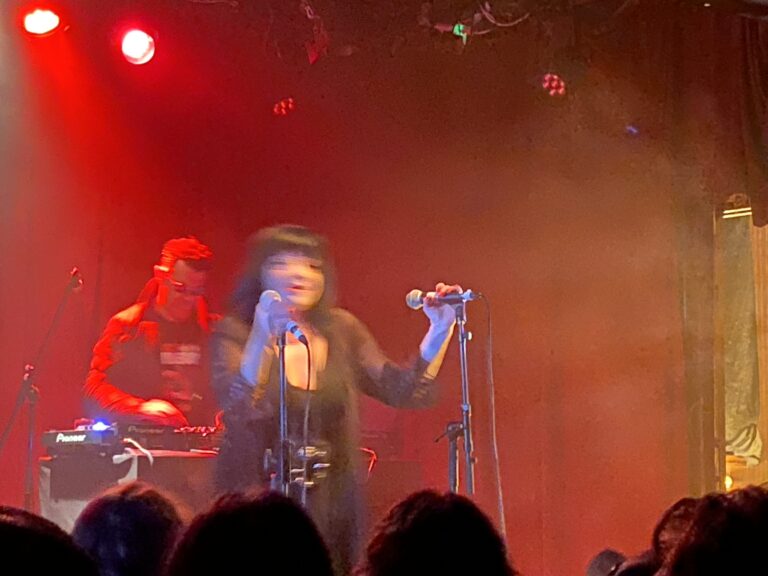
The local micro-house pioneer took to the stage wearing a small keffiyeh tied around his neck as a tie. Bathed in pink and red light, Beaupré turned up the heat with funky bass lines, which he seamlessly blended with ethereal, dreamy vocals that intensified as night fell on the Quartier des Spectacles. In the same vein, the crowd grew louder as the sun set over the Esplanade Tranquille. Thrilling!

Although Beaupré’s sound conveys a certain nostalgia, this pillar of the underground scene brought together young dance music fans and MUTEK veterans. Longtime festival-goers embraced their old friends, creating a sense of intimacy among the crowd. One of the most memorable moments of the evening came when the vocal loop of “Free, Free Palestine” rang out, layered over a powerful drumbeat. The chant echoed across the square, reflecting the unity of the dance floor, as attendees responded to this powerful—albeit modest—show of solidarity with the Palestinian cause.

Publicité panam
Amérique latine / Breakbeat / Electronic / House / Techno

MUTEK | Nicola Cruz Sets The Tone at Esplanade tranquille

by Marc-Antoine Bernier

Nicola Cruz took to the stage at the Esplanade Tranquille at 9 p.m. to close the first night of the 26th MUTEK festival, in front of a large crowd who had come to experience his DJ set in person. Dressed in a turtleneck and denim jacket, with an attitude that was both playful and relaxed, he kicked off the evening with a understated yet magnetic presence.

This first DJ performance was part of a program that had already begun with Valentina Magaletti’s percussive and interactive performance, followed by Stephen Beaupré’s immersive live show, which featured synthesizers, drum machines, and Ableton Live.

The Ecuadorian producer’s equipment seemed simple: in front of him were four direct-drive turntables on which he played vinyl records from his collection. This traditional approach to DJing resulted in an eclectic set, blending techno, house, and breakbeat, while incorporating a wide range of musical influences, from the Balkans to Latin America, via the North American underground electro scene and European house.

This performance of electro-futuristic tracks demonstrated his deep attachment to resolutely physical music, which awakened festival-goers in a rhythmic communion, where the kinetic excitement continued to grow throughout the set.

Techno and electro beats resonated in the chest, triggering a visceral reaction: heads nodded, shoulders swayed, legs tapped the floor to the rhythm of the music. The most intense passages mingled with moments of trance accentuated by distortions, experimental beeps, and Latin percussion, all carried by subtle and enveloping rhythmic embellishments. In this space saturated with bass and percussion, the crowd became a single vibrating organism, breathing to the rhythm of a sustained kick. Other moments plunged us into dub techno, minimal techno, and microhouse, offering fluidity and relaxation, and putting festival-goers into an almost meditative state.

Having been granted an extra fifteen minutes, Nicola Cruz ended the evening on a high note, mixing all the genres explored throughout the set in an energetic finale marked by his edit of the Chicago house-influenced track It’s Gonna Be… (A Lovely Day). We couldn’t have asked for a better start to the 26th edition of the MUTEK festival.

Nicola Cruz will perform again on Saturday, August 23, as part of Metropolis 2, starting at 11 p.m.

photo: Vivien Gaumand

Publicité panam
Brazilian / Forró / latino

JØY Brandt’s Joie de Vivre

by Sandra Gasana

You may be familiar with this name, as I mentioned it in my review of the Gilsons concert, where she was the opening act. This time, the Toronto-based artist returned to Montreal as part of a trio, accompanied by Mari Palhares on percussion and Samyle Carvalho on guitar and backing vocals. JØY, meanwhile, plays several instruments during her songs, including the triangle and kazoo, which I discovered that evening.

She began a cappella, her voice rising in a crescendo. She started with her own original compositions, such as A Calma Acalma and Vem, before performing a few covers of Brazilian classics, such as Morena Tropicana, which was very well received. The venue filled up as the evening progressed, mainly with Brazilians and fans of Brazilian music.

Some parts of the concert felt like spiritual ceremonies, with JØY occasionally attempting to express herself in French before returning to Portuguese.

“I am a Brazilian and Canadian singer and songwriter, and I come from northeastern Brazil,” she tells us.

The synergy with her musicians was palpable, particularly with guitarist Samyle, who had a smile on her face throughout the concert. In addition to her impressive guitar playing, she also provided backing vocals on several songs.

“The next song is about our thoughts on our worldview and how we use our time,” she says between songs. The party really got going when she sang Vumbora Amar and the whole room started dancing and clapping along. JØY seems to enjoy forró, a Brazilian music style from her region, the Northeast, while adding Latin and folk rhythms.

Curiously, there was no admission fee for the concert, as the artist opted for voluntary contributions, which the audience generously provided. Her manager, Ulysses de Paula of Showzaço Productions, was on hand to collect the contributions. He is behind many of the concerts by Brazilian artists in Canada.

She ended the concert with a walkabout, while the guitarist took over on vocals. She danced steps that seemed to come from her region, moving to the center of the circle surrounded by happy spectators.

“I’m going home with my heart full of joy,” she says in conclusion, before making way for the next group. My favorite was undoubtedly her cover of Tô Sem Você, a song I discovered this year and which is currently in my top three Brazilian songs.

This concert allowed Montrealers to discover her, and others to see her again, but it doesn’t seem like this will be the last time we see her in the city. She has a large network of Brazilian artists based in Montreal, and it was with them that she continued the evening in a more intimate “roda de samba” style, until we see her again on an even bigger stage than the Marche à côté.

Classical / Jazz / Pop

Virée classique | Improvisation Trip

by Alain Brunet

Fortunately, the rain had no impact on this improvisation game planned for Sunday by the Virée, since the exercise was conducted at the Espace culturel Georges-Émile-Lapalme at noon. Actors, actresses, musicians and musicians put all their skills to the service of improvisation on a series of themes whose purpose is to captivate, make people laugh or even move them. Martin Racine was the referee and host of this improvisation game pitting two teams of actors (Emmanuelle Fadin, Julien Normand, Marie-Lune Falardeau-Drolet, William Bernaquez) against each other whose theatrical improvisations are this time accompanied by music imagined in real time. André Moisan on clarinets, Hélène Lemay on trombone and percussion, Jimmy Lahaie on guitars and electronics. In complete coherence and cohesion with the imposed themes (the seasons, The Sleeping Beauty, etc.), this power trio will have suggested several improvisations often inspired by well-known tunes, from Rimsky-Korsakov’s Flight of the Bumblebee to Van Morrison’s Moon Dance, including Joseph Kosma’s Dead Leaves, JS Bach’s The Well-Tempered Clavier and others such as When the Saints Go Marching In. We were not exactly in the strict classical corpus of the OSM, you understand!

photo: Gabriel Fournier

Publicité panam
Classical / Modern Classical

Virée classique | Discovery Trail: From Carillon Bells to Octobass Resilience

by Alexandre Villemaire

The Maison symphonique discovery tour is a recurring activity of the Classical Spree. Present at each edition, it allows the Montreal public to discover and take ownership of this great concert hall in a different and privileged way. Aside from the interior tour dotted with information stations, the demonstration and exhibition of the carillon bells and the octobass served as the heart of this activity.

With half an hour each – and they would certainly have gladly taken more – Serge Desgagnés, OSM solo percussionist, and Eric Chappel, double bassist and octobassist, presented their extraordinary instruments and answered questions from the audience composed of adults, young people, and children. It was beautiful and exciting to hear Serge Desgagnés share his enthusiasm for these new orchestral instruments, the fruit of the work of craftsmen from the Royal Eijsbouts Foundry in the Netherlands who made the ten bells, the largest of which (low F#) weighs 384 kg and the smallest (middle B) a mere 20 kg. For the colors and richness they bring, and which he demonstrated, Serge Desgagnés cherishes the dream of seeing his family of bells grow. To reach the entire chromatic scale? Why not!

The same interest and passion drove Eric Chappell, whose instrument dates back to 1850 and whose function was to amplify the orchestra’s lower register for large-scale works. In addition to explaining the history of his instrument and the challenges that its maintenance and mobility can generate, the latter was honored at the conclusion of the session as the audience heard a composition made for a quartet of instrumentalists including the octobass, two cellos and an oboe. Entitled Resilience, this work by the young Quebec composer Thierry Côté uses a figurative language, inspired by nature, its beauty, and its strength that dominates human beings and leads them to face the elements, both philosophical and natural.

The work, lasting approximately eight minutes, does not confine the octobass to a pedal role. The instrument’s low notes rumble, but move, are active, and in turn nourish the cello and oboe lines, which weave different instrumental melodies around this constant harmonic support. Each instrumental line feeds into each other in a sort of perpetual movement. Regarding the challenge of composing a chamber music piece for the octobass, we can say that Thierry Côté makes an interesting contribution to the instrument’s catalogue.

Photo : Gabriel Fournier

Publicité panam
Classical

Virée classique | In chorus, with heart

by Alexis Desrosiers-Michaud

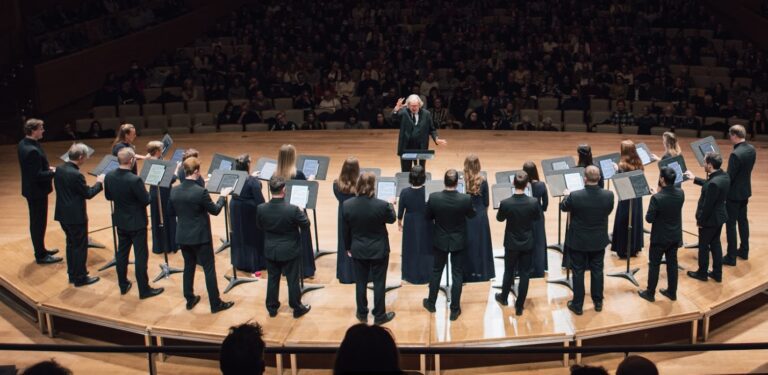
To conclude this 2025 Classical Spree, the OSM organized a large choral gathering for two free performances. This performance, featuring 135 singers from 84 choirs, was led by renowned conductor Simon Rivard. The concert began with a world premiere, “Par-dessus le vacarme,” composed especially for the 50th anniversary of the Alliance chorale du Québec by Jeanne Laforest. It’s a magnificent piece, with a beautiful text that encapsulates our values, with harmonies dissonant enough to make it accessible to all. I believe it will spread like wildfire through the repertoire of the province’s choirs.

Next came the only non-Quebec piece on the program, Fauré’s Cantique de Jean Racine. It was one of the most beautiful performances of the Cantique I have ever heard, for the simple reason that every detail of the score was faithfully observed, making all the difference between a masterpiece and a sing-along. The most challenging work on the program was undoubtedly Lionel Daunais’ playful Figures de danse. This choral classic elicited a few laughs from the audience with its humorous lyrics. Aside from a few hiccups in the final movement, the challenge was met with flying colors. At several points during the concert, the audience was invited to sing along with the choir to the popular songs from the concert. Although he was rather discreet about traditional songs, he gave himself over to Leonard Cohen’s Hallelujah and Yvon Deschamps’ Aimons-nous, before falling silent for the only a cappella piece of the concert, a touching arrangement of Quand les hommes vivront d’amour by the late Raymond Lévesque.

The concert ended with a celebration of the 50th anniversary of the Choral Alliance, and of the 50th anniversary of the song Gens du pays, by Gilles Vigneault.

Publicité panam

Classical

Virée classique | Harmony of the ride, the tradition continues

by Alexis Desrosiers-Michaud

As is the tradition every year, there was a (twice) presentation at the Complexe Desjardins of the Harmonie de la Virée, a wind orchestra of high school youth from Joseph-François-Perrault schools, Notre-Dame, Laval and Jean-Eudes colleges, the Pensionnat Saint-Nom-de-Marie as well as FACE. This year, the Harmonie was conducted by Stéphane Forgues, an experienced teacher at JFP.

This program of music written exclusively for wind orchestra represented a beautiful blend of nature (the theme of this Outing), the seasons, and the four elements (fire, earth, water, and air).
The first piece, “Hounds of Spring,” resembles a village dance set to a pastoral rhythm. It showcases the orchestra’s ensemble qualities. Next came “Come Down Rain,” which depicts a rainstorm in an arid region. Inspired by Arabian music, Jack Wild’s work allows several young soloists to shine. The middle piece is “October” by Eric Whitacre, also known for his choral pieces. As its name suggests, October captures the calm of autumn.

The penultimate work is Frank Tichelli’s ebullient Vesuvius. It’s a highly energetic piece that inevitably recalls the tragedy of Pompeii. Rhythmically complex, Vesuvius gets the most out of the teenage musicians, and Frogues, a master technician, never lets up and demonstrates extreme precision. The concert ends with Rossano Galante’s The Wilderness. A very catchy piece, especially thanks to the percussion, it feels like several times that one is on board a train hurtling through the snow-capped mountains and forests that cover North America.

Publicité panam
Classical

Virée classique | Helmchen and Taylor: Through a Storm of Emotions

by Alexandre Villemaire

It was a well-attended symphony hall that discovered the sensitive playing of pianist Martin Helmchen and the deep voice of mezzo-soprano Beth Taylor. These two internationally renowned performers won over a diverse audience, ranging from seasoned classical music lovers to those experiencing the atmosphere of the symphony hall for the first time.

In terms of repertoire, they were treated to two works of great contrast. In the first part of the concert, Martin Helmchen performed Mozart’s Piano Concerto No. 24 in C minor, K. 491. One of the composer’s last works, this penultimate concerto in his series of twelve is filled with theatrical flourishes and nuances in the interplay between the piano and the orchestra, which Payare and Helmchen brought out with finesse. Martin Helmchen’s playing is delicate and agile, even in the more lively moments. One of the qualities of Helmchen’s interpretation is also his sense of musical phrasing and his use of silences in the music. He allows the pauses in the music to breathe naturally, particularly in the final cadenza of the concerto, with great theatricality.

The stylistic contrast was striking with mezzo-soprano Beth Taylor’s interpretation of British composer Edward Elgar’s Sea Pictures cycle. The work, based on five poems by different poets, evokes the sea in all its forms, from its immensity and calm to its unpredictable nature. Bath Taylor conveyed the different emotions conveyed in the text and music with a vivid interpretation. From the very first note of “Sea-Slumber Song,” the Scottish mezzo-soprano’s round timbre, both dark and luminous, struck us and transported us into a world of sound and poetry. There was a slight misstep in the second verse of the fourth poem, “Where Corals”—whose perpetual offbeat rhythm can be tricky—but it did not lead to a major derailment of the vocal line. She concluded the concert with a performance of interpretive aplomb.

It was an evening of concert finesse, albeit punctuated by noise from the audience. There are some things that can be overlooked in the context of the Virée Classique experience, but bringing a young baby to hear this type of repertoire does no one any favours.

Photo : Antoine Saito

Publicité panam
Classical / Classical Period / Modern Classical

Virée classique | Two excellent soloists performing a second-rate work

by Alain Brunet

I preferred the excerpt from Míkis Theodorakis’ Sinfonietta for flute, piano, and string orchestra, performed Saturday evening at the Maison symphonique, to the more violent, rhythmic, virtuosic, and unique fourth movement of his Symphony No. 2, Le chant de la terre, performed last Wednesday at the Olympic Stadium.

In both cases, Godwin Friesen was the soloist. Initially, his instrument was placed at the centre of the orchestra, somewhat in keeping with his atypical role: a solo truly interwoven with the orchestral discourse, whose individual performance blended more than in a “normal” concerto for piano and orchestra.

Secondly, we are dealing with a work closer to the modern or post-Romantic orchestrations developed at the beginning of the previous century and revisited in the middle of that same century by the Greek composer, in 1947. This time, we see a more melodic, more conformist inclination, except perhaps for the peculiarity of presenting two soloists in the context of a composition that is easier to play. Namely, concert pianist Godwin Friesen and OSM solo flutist Timothy Hutchins.

The technical demands of the late composer, who was very prolific, were therefore somewhat less demanding for this second performance of his works in the same Virée. In my opinion, the performance was flawless, a proper work whose objective is clear: to allow two excellent musicians, one an emerging soloist and the other a veteran, to express themselves.

We were then treated to a delightful Pastorale served as the main course by the OSM and Rafael Payare, Beethoven’s most reassuring symphony. It was composed between 1805 and 1808 by the famous composer, who was disappointed with the urbanization of Vienna, which he found detrimental to its natural surroundings. Two and a quarter centuries have passed since then, with the results we all know…

PROGRAM

Artists

Rafael Payare, conductor

Timothy Hutchins, flute

Godwin Friesen, piano

Works

Míkis Theodorakis, Sinfonietta for flute, piano, and string orchestra (22 min)

Ludwig van Beethoven, Symphony No. 2, The Song of the Earth, “Pastoral” (38 min)

Publicité panam
Classical / Modern Classical / Tango Nuevo

Virée classique | Four Seasons of Buenos Aires… Female students? Male students? The audience can’t tell the difference!

by Alain Brunet

The Four Seasons of Buenos Aires, or Las Cuatro Estaciones Porteñas, four works of modern tango by Astor Piazzolla, brought together in homage to Vivaldi’s Four Seasons, have been featured in countless classical programs over the past three decades.

As Andrew Wan, who was entrusted with the task of conducting the transcription of the work for 12 strings, pointed out, this work is now part of the language that must be mastered. And that is why the best students recruited to carry out this mission had to master this tango nuevo before taking to the stage, and no one was disappointed in the quiet Esplanade audience on that beautifully sunny Saturday.

So, the arrangement by violinist Leonid Desyatnikov, popularized in the past by the great Gidon Kremer, was chosen. Except for the lead violinist, 12 instrumentalists were recruited, producing an ensemble effect very different from the original instrumentation: bandoneon, violin, double bass, piano, and electric guitar.

To stay true to the spirit of the piece, the soloists must use typical tango effects, notably bow strokes in the high register at the end of certain phrases.

Each of the four guest soloists: Eva Lesage’s fluid playing in Verano Porteño (Summer) was marked by lyricism and firmness, a magnificent season accompanied by direct references to a season imagined by Antonio Vivaldi in the Baroque era. Otoño Porteño (Autumn) highlights the talent of Anaïs Saucier-Lafond, whose playing has a powerful gravity and even a very beautiful sound, combined with very solid articulation, despite a few tiny details that need to be corrected in this case. The soliloquy at the end was particularly promising.

The most delicate piece, in my opinion, was Olena Kapersky’s Invierno Porteño (Winter), which begins in icy tranquility and reveals an angular discourse from the soloist, who expresses himself before receiving a vigorous response from his dozen colleagues, concluding with an obvious reinterpretation of Vivaldi.

Finally, Charlotte van Barr brought the program to a beautiful close with the very dynamic Primavera Porteña (Spring) and distinguished herself with her impeccable articulation in the virtuoso phrases required by the score.

Connoisseurs and laymen alike were delighted!

The only other member of the OSM present at this program, violinist and violist Victor Fournelle-Blain conducted the first student performance on the program, on the romantic side: Edvard Grieg’s Holberg Suite, an instrumental suite in five movements, composed in 1884 in the style of baroque and ancient works – prelude, sarabande, gavotte, air, and rigaudon. This Baroque style allowed the Norwegian composer to make direct references to JS Bach, to which he added elements of Norwegian folklore in certain movements. Very beautiful, very lyrical, very close to Nordic nature, as suggested by the general theme of Virée 2025.

As Victor Fournelle-Blain explained at the outset, the work was originally written for piano before he adapted it himself for string orchestra. We cannot conclude that this was an academic performance by these model students, but rather one of emerging virtuosity already imbued with the spirit of music.

Artists

Andrew Wan, violin and conductor

Soloists:

Eva Lesage, violin soloist, 1st season, from Quebec, graduated from the Montreal Conservatory, currently studying in Vienna

Anaïs Saucier-Lafond, violin soloist, second season, from Quebec, currently studying at the Conservatory

Olena Kaspersky, violin soloist, third season, American from Los Angeles, currently studying at McGill

Charlotte van Barr, violin soloist, fourth season, from Ottawa, Ontario, currently studying at McGill

Julien Haynes, viola

Victor Fournelle-Blain, viola

Sophia Tseng, viola

Sophia Battel, cello

Ellamay Mantie, cello

Evelyne Méthot, cello

Étienne Beaulieu-Gaule, double bass

William Deslauries-Allain, double bass

Pieces

Edvard GriegSuite Holberg

I. Praeludium. Allegro vivace (4 min)
II. Sarabande. Andante espressivo (4 min)
III. Gavotte. Allegretto – Musette. Un poco più mosso (4 min)
IV. Air. Andante religioso (5 min)
V. Rigaudon. Allegro con brio (4 min)

Astor Piazzolla, Les quatre saisons de Buenos Aires

  • Otoño Porteño (6 min)
  • Invierno Porteño  (7 min)
  • Primavera Porteña (5 min)
  • Verano Porteño (7 min)
Publicité panam

Singing songs for moody souls, wicked scenes for grotesque tongues and…

by Z Neto Vinheiras

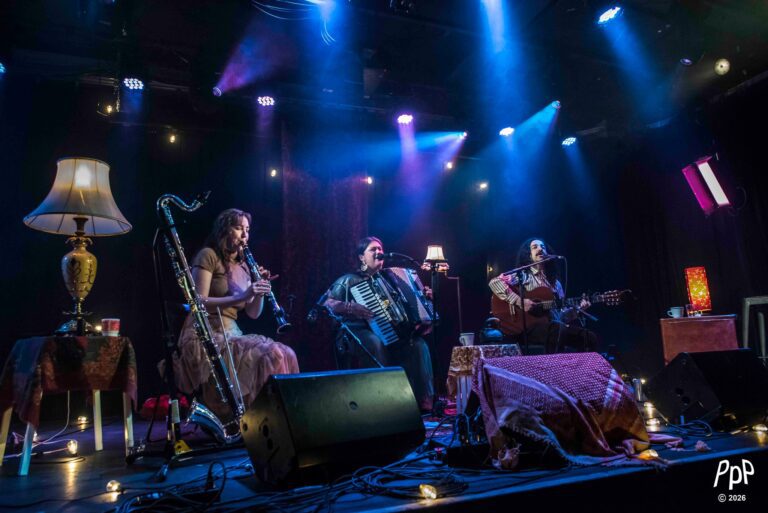
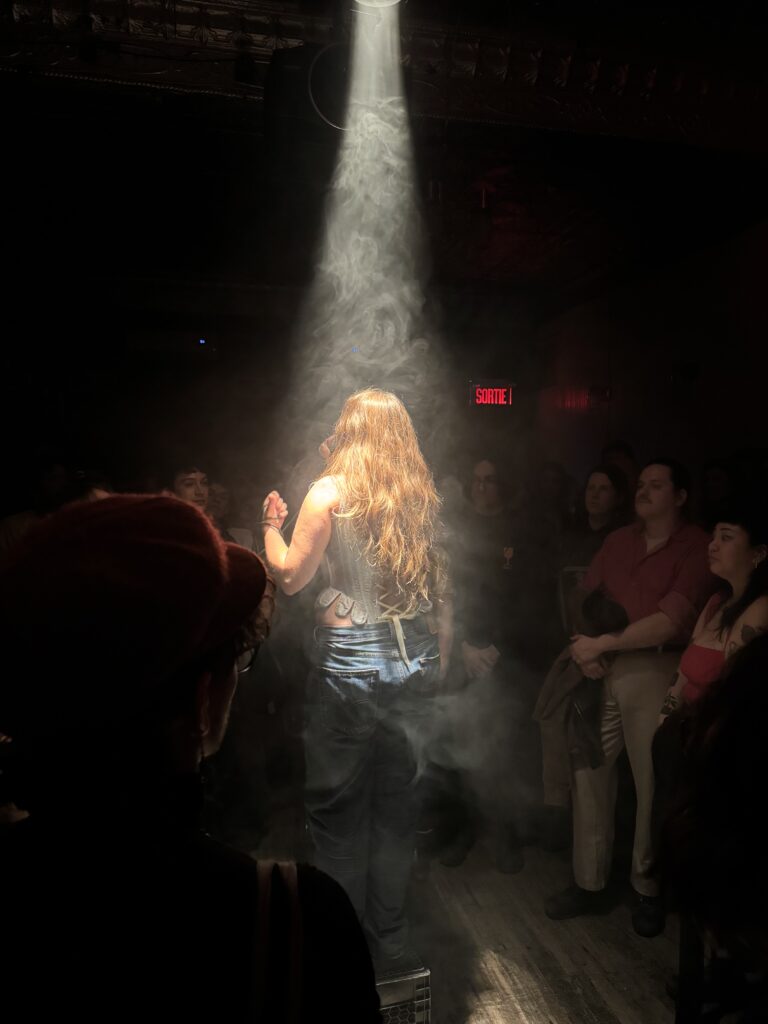
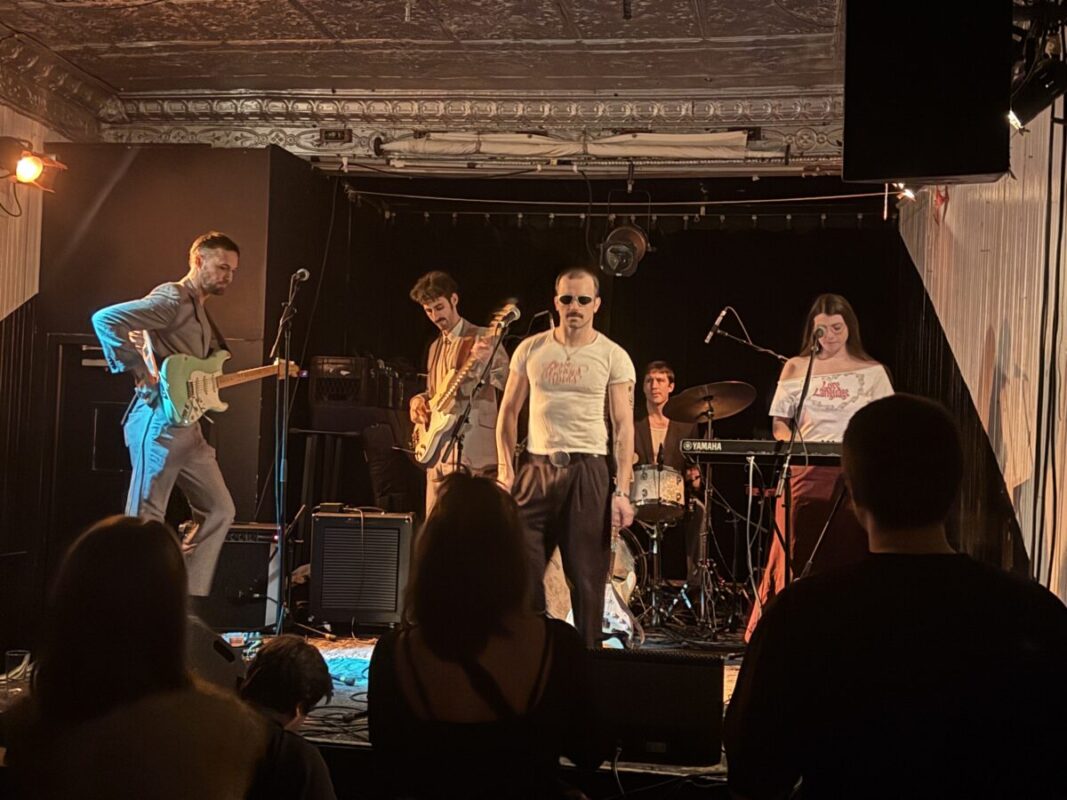
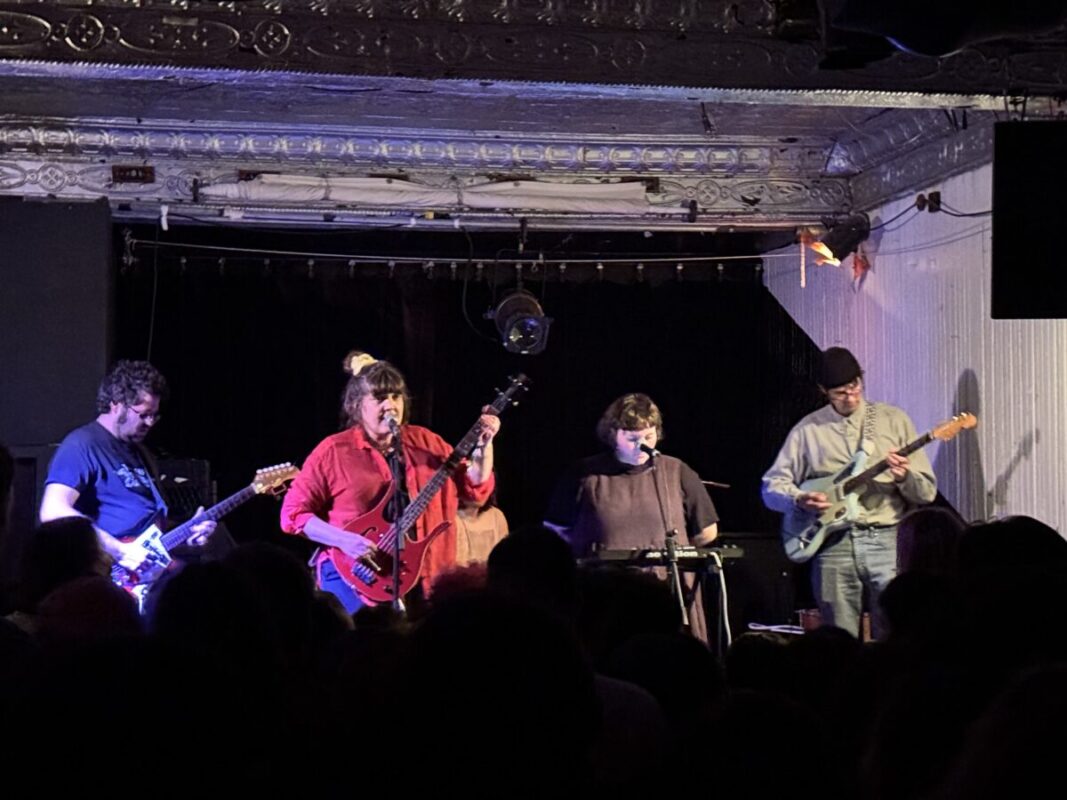
EAF and SAT attracted the dedicated audiovisual community into a night for all savours: Samuel Gougoux setting the mood with his ambient-jazz impressionist chansons, CECILIA embodying and orchestrating all forms of art in a single performance, and the collaboration between VISIO and Orchestroll strolling through sonic and visual matter.

In a seated setting, the space is inviting for a more attentive listening and overall experience. The night starts smoothly yet moody, navigating in the flow of a feeling in between angelic lights – Samuel Gougoux makes us feels like we’re in our friends’ living room on a Sunday late afternoon, singing and listening to each other, the sunset light  invading the room through the windows, bathing, caressing our skins. The character is simple, honest, pictorial and intimate.

On a contrasting note, CECILIA’s silhouette cuts through the scene dragging a chair for a promising confrontation – she seats with the back facing the audience, wearing a long dark coat backwards – she has stories to tell, poetry to unmask, images to be seen, mirrors to be broken. WHAT EYE FOR is an impeccable junction of all art forms, each one manipulated with sharp intention and a very clear reason. Nothing is meaningless or superfluous. With detuned vocals, a theatrical space, words gazing back at you, shadow play and images moving between the dream and the real, CECILIA takes us to the gloomy side of things – extravagant excess but never exaggerate; exquisite yet so human; raw and bold without forcing it on your face; classy and so strange. A most creative whole-scenic performance that will linger in your memory.

Lastly, the headliners Orchestroll and Italian artist VISIO present their collaborative work AURA SLEEPTRACK – combining electronic, acoustic instruments and oneiric imageries, it feels just like a dreamy heatwave or an igneous way into sound and visuals. The here trio gives us density, mass and matter for a spectacular closing, each one very tuned to their instrument and with this sort of volcanic energy that does not leave the audience go home unshaken. A blast to the senses!

And a great night for EAF, SAT and us devoted listeners.

Publicité panam
Classical / Contemporary / Indigenous peoples / Inuit

Virée classique | Mozart by sleigh to the Far North

by Alain Brunet

Dina Gilbert, a conductor who has been closely associated with the OSM for several years (she was assistant conductor from 2013 to 2016), conducted this small ensemble on a journey “from Vienna to the Far North.” She appeared on Saturday before a nearly full Fifth Hall.

The idea was to divide the program into two distinct parts for the same ensemble: violin, double bass, clarinet, bassoon, trumpet, trombone, and percussion. This instrumentation corresponds to that chosen in 2008 by maestro Kent Nagano for a tour of Nunavik with the OSM. A commission was then placed with Inuit composer Alexina Louie, which was performed in various Arctic locations.

First, Gilles Bellemare’s arrangement of Wolfgang Amadeus Mozart’s Eine kleine Nachtmusik, more specifically Serenade No. 13 for strings in G major, a well-known piece that every Westerner has heard. The effect is rather average in a small ensemble in front of an audience, and this has nothing to do with its performance. It feels like listening to a mini military band from the pre-industrial era, and the choice of complementary piece to the main work could have been very different. While it is understandable to want to popularize music among these novice music lovers who systematically applaud between movements (no one has told them not to, mind you), linking contemporary music with such a mega-hit by Mozart, composed in the 18th century, seems questionable in this particular context.

A better complement would have been preferable to accompany the pièce de résistance, an Indigenous work imagined by an Inuit composer. Alexina Louie is one such composer, educated in Western music faculties and keen to pass on her Indigenous culture. In this case, the composer evokes the Arctic landscape, dog sledding, summer mosquitoes, and other elements of traditional Inuit daily life through sound, adding two throat singers to this classical ensemble: Taqralik Partridge and Julie Larouche were called in at the last minute because their colleagues were unable to fly this weekend for reasons we can imagine.

It should be noted that Inuit women’s throat singing is primarily a game that 20th-century ethnologists and composers found to be very musical. Since then, interest in throat singing has remained high, as we regularly see projects featuring it—Oktoecho did so just a few days ago at Présence autochtone.

Throat singers are no longer the exotic curiosity they were in the 1970s and 1980s. They have developed their technique, and the variety of their guttural textures, the rhythms of their performance, and the patterns of their phrasing have evolved considerably. However, the sound material remains fairly basic, and the musical potential of throat singing remains limited. Ultimately, more work is needed to develop the language. As for the instruments of the “South,” we were at the service of a rather consonant work, marked by repeated motifs and leaving room for individual expression. Worthy of interest, certainly…

ARTISTES

Taqralik Partridge, throat singing

Julie Larouche, throat singing

Marianne Dugal, violin

Ali Yazdanfar, upright bass

Alain Desgagné, clarinet

Mathieu Harel, bassoon

Paul Merkelo, trumpet

James Box, trombone

Serge Desgagnés, percussions

Works

Wolfgang Amadeus Mozart (arr. G. Bellemare), Une petite musique de nuit (16 min)

Alexina LouieTake The Dog Sled (21 min)

Subscribe to our newsletter

Inscription
Infolettre

"*" indicates required fields

Type of Suscribers