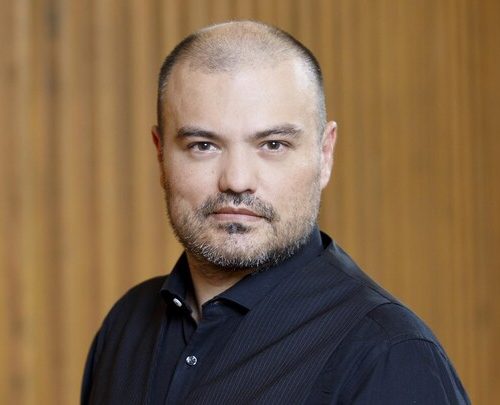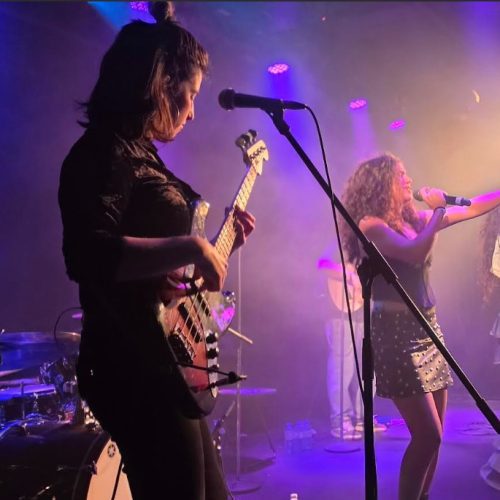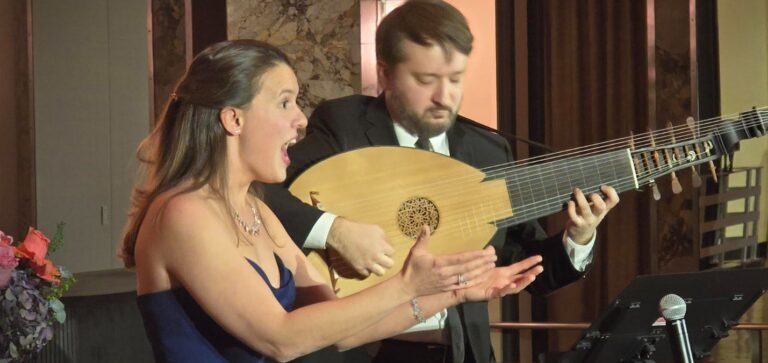
Kerry Bursey and Janelle Lucyk marked the release of their self-titled debut album (Leaf Music label) with a concert at the nearly full Art Deco hall Le 9e on this first Tuesday of March—a perfect way to wrap up the workday and beautifully usher in an evening in the middle of the week.
Accompanied on lute and violin, the duo Ménestrel explores early and Baroque repertoire, weaving songs together in a program full of creativity. It makes for a soothing hour, certainly conducive to a burst of energy much needed in these troubled times.
À la claire fontaine (traditional), Ma bergère tendre et fidèle (Michel Lambert, 1610–1696), and En montant la rivière (traditional) were linked with a Cape Breton melody and the Scottish air Fhear a’Bhàta (The Boatman).
The soloists’ voices are pure and luminous—naturally lacking the projection of fully trained operatic technique from the Baroque period. What is lost in volume is more than compensated by purity. This repertoire does not demand operatic power; these voices are natural, unforced, and without vibrato.
Lute accompaniment is rare in today’s music scene, yet Kerry Bursey has chosen to cultivate this fertile ground. The lute truly transports the listener back to ancient times and the musical atmospheres of the past. This choice led the artists to perform works by English lutenist, singer, and songwriter John Dowland (1563–1626), the most famous composer of the Elizabethan era, whom Bursey humorously calls the ultimate “emo” composer—he passed away exactly 400 years ago. Bursey, as lutenist and tenor, first performed Now, O Now, I Needs Must Part, harmonized by Janelle Lucyk’s singing, paired with an obscure Francophone song, Le doux silence des bois (Honoré d’Ambruys, 1660–1702).
Dowland’s repertoire was also featured in the program’s conclusion with Can She Excuse My Wrongs? and Come Again, Sweet Love. In between, the program included a mix of traditional and classical songs: Se l’aura spira tutta vezzoza (Girolamo Frescobaldi, 1583–1643), the humanist courtly standard Mille regretz (Josquin des Prez, 1450–1521), and Si dolce è ‘l tormento (Claudio Monteverdi, 1567–1643).
Other traditional songs enriched the concert, including Once I Loved with Fond Affection, featuring Janelle Lucyk as the principal soloist—an angelic rendition—preceded by two famous blackbird-themed songs performed by Kerry Bursey: the traditional If I Were a Blackbird and, as you might guess, The Beatles’ Blackbird.
This program served as a reminder that lovers of Baroque and early music are very much alive today, fully embracing modernity while drawing inspiration from our distant past.