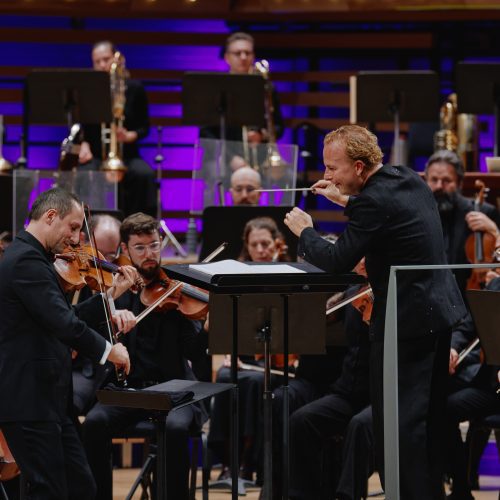
The concert on Saturday evening at the Amphithéâtre de Lanaudière featured a stunning performance by the Orchestre symphonique de Montréal (OSM), conducted by Rafael Payare, in formidable technical and expressive form. On the program: Egmont by Beethoven, Dzonot (a cello concerto) by Gabriela Ortiz, and Shostakovich’s Tenth Symphony.
Before launching into the scheduled music, the orchestra performed a piece by Antonio Estevez (1916-1988), Mediodía en el Llano, in tribute to the victims of the earthquake that occurred in Venezuela on June 24. The title, which means Midday in the Plain, effectively evokes the enveloping heat of the tropical sun, in an elegiac and beautifully lyrical language, somewhat like a film score. The OSM fully succeeded in creating the desired radiance. The music was followed by a minute of silence, which was fully respected by the audience. It should be noted that the introduction of the piece was made by cellist Alisa Weilerstein in English, Spanish, and French (very good).
Beethoven’s Egmont was meticulously constructed by Payare and his musicians, culminating in an elegantly heroic finale, slender yet appropriately muscular.
Dzonot by Gabriela Ortiz (born in 1964) is a cello concerto premiered in 2024 by Alisa Weilerstein. The work also won a Grammy Award for Best Classical Composition of the Year. We understand why. Ortiz’s music is a true expressionist firework that pays homage to the nature of her country. The composition is divided into four movements: Luz vertical (Vertical Light) for the cenotes (very deep water-filled sinkholes); El ojo del Jaguar (The Eye of the Jaguar); Jade, in reference to the vibrant colour of underground rivers in certain regions of Mexico; and El vuelo de Toh (The Flight of Toh), which evokes a colourful bird that is endangered.
The score by Ortiz pulses with a feverish energy. The orchestra is pushed to the limit of its coloristic subtleties. The technical difficulty is impressive, and only a top-tier orchestra can do it justice. That was the case on Saturday. Payare drew the best from the OSM and the many rhythmically difficult passages. In certain passages, one felt like dancing with the musicians. But the biggest nod goes to the soloist Alisa Weilerstein, for whom the composer has woven lines and soundscapes of a savage difficulty. Nothing to slow down the American artist, who showcased the vastness of her talent without a hitch. Dzonot is a true gem of orchestration, a contemporary music that knows how to charm and dare at the same time, filled with lyrical traits, swaying episodes, and bursts of contemporary expressionism naturally integrated into the narrative fabric.
The main piece arrived after an interminable pause where the conductor, ready to start the music, had to wait a few long minutes for the entire audience to settle down and fall silent. As they say, everything comes to those who wait, and in this case, everything came together masterfully. Payare is deeply inhabited by the soul of this music. He constructs a world steeped in melancholy and gloom, but powerfully imbued with humanity and emotions. The slow episodes are fortunately not too emphasised, which would weigh them down. They breathe abundantly and very naturally. The conductor guides them through the stormy passages, where he unleashes the power of his orchestra. A paroxysmal power, but always controlled. The sound quality is breathtaking. Let’s note the exceptional solos of all the winds called upon for this purpose (flute/piccolo, clarinet, oboe, English horn, bassoon/contrabassoon, horn).
An absolute masterpiece interpreted at the height of its intentions. For the first of the concerts that the OSM will give in Lanaudière, Rafael Payare has just set the bar very, very high.
It is with this program (in part) that the OSM will go on a European tour in August. I think the audiences in Edinburgh, Warsaw, Aarhus, and Hamburg will get their money’s worth.