Additional Information
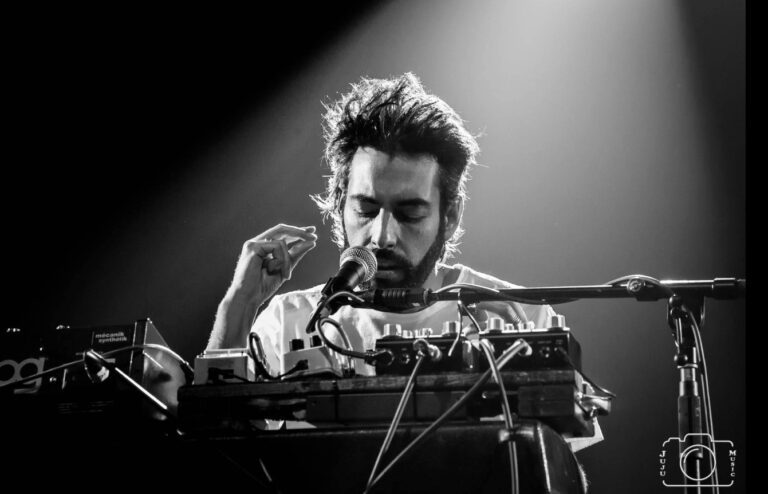
Born in northern Ontario to a French-speaking mother and an English-speaking father (of Norwegian descent), Montrealer Leif Vollebekk belongs to that community of timeless songwriters whose classic, consonant forms draw inspiration from the best in history. For our review, we think first of Bob Dylan and Leonard Cohen, but also a touch of Paul Simon, a tear from Neil Diamond, a hint of Chris Rea and much more…
The author, composer, and singer has chosen to contribute to a genre that is well known to the general public. Leif Vollebekk continues the cycle of Revelation, an album released in September 2024, whose material continues to attract audiences around the world. Now it’s the Palais Montcalm’s turn to welcome him on February 5, following in the footsteps of his fans in Quebec City. Before that, we’ll chat in both languages for a good hour, and here is a brief, partially translated version of this most enjoyable conversation.
PAN M 360: You’re originally from Ontario, you’ve been in Montreal for quite some time now… Let’s summarize your journey!
Leif Vollebekk : Since 2010.
PAN M 360: I know your work. I also know your two main influences, Leonard Cohen and Bob Dylan.
Leif Vollebekk : Exactly. They’re the big ones.
PAN M 360: You grew up with that, but you’re definitely not from that generation, since you were born in 1985. Have you seen Cohen live? Bob Dylan live too?
Leif Vollebekk : Yes, I saw both of them on stage.
PAN M 360: Did you see Leonard Cohen’s last show?
Leif Vollebekk: Yes, I saw him in Ottawa and I was blown away! He had such a generous stage presence!
PAN M 360: Your latest album came out 16 months ago, and you have a great discography to your credit: 5 albums and 2 EPs. In Quebec, your bilingualism has allowed you to establish yourself in both solitudes: Francophones and Anglophones know you well. You could say you’re a true Montrealer! Furthermore, your repertoire is very accessible.
Leif Vollebekk : I always wanted to keep a pop flavor in the mix.
PAN M 360: Despite your exemplary bilingualism, you don’t sing in French. Why?
Leif Vollebekk : Writing in French is quite difficult for me. When I read the lyrics of songs by Louis-Jean Cormier or Charlotte Cardin, I feel intimidated because I don’t have that same ease in writing French lyrics. I haven’t ventured in that direction yet, but perhaps one day I’d like to. In English, I write with precision; there’s no difference between what I feel and what I write.
PAN M 360: Few artists have a perfect command of English and French.
Leif Vollebekk : You know, the chords, the instrumentation… it’s American.
PAN M 360: Yes. Your work draws on Americana aesthetics and simply arranged chamber pop. Over time, your overall style has become increasingly refined. That’s the evolution of a musician who endures!
Leif Vollebekk : Ah, good, thank you!
PAN M 360: I would add that your work is very much rooted in the North American folk tradition. No noise, no dissonances, no complex chords, nothing weird.
Leif Vollebekk : You know, at the beginning of my career, I was trying out more complicated stuff, harmonic extensions, chords I couldn’t even name, really strange ones. Then I realized it was just for me, that nobody was affected by those elements of my songs. Like, nobody cared. I realized I was just doing it to prove to myself that I could play weird chords. But, you know, all the great songs are just four chords and the truth, you know?
PAN M 360: You’re right, but there are exceptions: Joni Mitchell, for example, is much more harmonically evolved than Bob Dylan and Leonard Cohen. Well… from the album Court and Sparkle onwards, everything that followed.
Leif Vollebekk : Yes, but the Joni Mitchell songs that everyone sings are the simplest ones from her earlier period, with just three chords. If you want the audience to sing along, the harmony and melody have to be simple. Perhaps that shouldn’t be the case, since complexity is appreciated and valued in other art forms.
PAN M 360: There’s a kind of anti-intellectualism in pop music in general. It’s been like this for a century; this culture of simplicity is ingrained in the collective imagination. The music industry is extremely conservative when it comes to anything that’s successful. From generation to generation, audiences become conservative without even realizing it.
Leif Vollebekk : Yes, interesting. I imagine that’s it, but I would also say that the great melodies of the classical repertoire, by Bach or Beethoven, are also built on simple chords.
PAN M 360: We could discuss this for a long time! Generally speaking, you’re right about the Baroque, Classical, and Romantic periods… but what about after that? That’s another story. Let’s talk about the evolution of your work.
Leif Vollebekk : At first, I was obsessed with Bob Dylan, I was searching for myself, and then I finally found the concept. I don’t know where it came from, but I still believe I need to be able to play a song solo acoustically on guitar. Otherwise, for me, it’s not a song.
PAN M 360: From there, what happened?
Leif Vollebekk : After experimenting with complexity, I recorded simpler things to allow the emotion to shine through more. At the beginning of the process, my recordings were too stark, too austere. I started imagining more elaborately arranged songs. I then realized I needed to improve the production of these recordings, without really knowing that I could be the producer of my own songs.
For my first album, I had a small budget of $10,000. I recorded at Breakglass Studios, and I hadn’t even thought about the final mix, which was done there on the last day of the sessions. So I didn’t know the rules of production. I had to spend nights finishing the arrangements. In the end, I thought it would sound warm, but it didn’t. I realized that you’re so caught up in your own thoughts when you’re recording that you don’t really know how it’s going to sound.
PAN M 360: What’s next?
Leif Vollebeck : I wanted to push the boundaries further, particularly by working with analog equipment and magnetic tapes—no digital at all. I then identified another flaw in my work: I was performing my songs too quickly because I felt rushed given my limited production budgets. For the second album, North Americana, I was completely immersed in Bob Dylan; I wanted this album to be a bit more demanding to listen to, and for the listener to be able to focus more on the lyrics. Then I saw The Killers at Osheaga. It was a revelation for me, one of my favorite bands, especially for the lyrics. Leaving the show, I thought, “Too bad you don’t make that kind of music.” It was weird because I was stuck in a minimalist, ascetic, purist mold, focused on vocals and lyrics, zero pop. I no longer knew why I wanted to do that.
Then I thought to myself, “On the next album, figure out what’s wrong.” So I decided to hire myself as producer. I booked the studio, we did sound checks, and I spent a whole day evaluating the sound I wanted for each instrument. The next day, I walked into the studio wearing my artist’s hat.
Then, I just spent a day being a sound critic. And we put microphones everywhere. The next day, after all the sounds were exactly how I wanted them, as a producer, I went back to being an artist. The artist wasn’t allowed to be stressed about money; he just had to play. And we played seven days straight with an excellent band. Unlike the previous album, the tempos had slowed down considerably!
PAN M 360: Changing roles in your head had therefore been beneficial.
Leif Vollebekk : And that’s how I made the recordings that followed: Twin Solitude, New Ways and Revelation.
PAN M 360: And so, since then, Leif’s true sound has been found in these albums.
Leif Vollebekk : In any case, I feel closer to these songs. There has definitely been a progression. For example, I studied the synthesizer and kick drums for the recording of Twin Solitude. I added a little distortion here and there.
PAN M 360: And where are you today?
Leif Vollebekk : At a certain point, I just didn’t want to be technical anymore. I’d gone too far. With the last album (Revelation), I did everything I wanted to achieve in terms of sound. I even got to hire the legendary drummer Jim Keltner at the legendary Sunset Sound studio! The surprise? Unlike other drummers, he tried to follow the lyrics while playing rather than sticking strictly to the score. I asked him if any other drummers did the same, and he replied that he’d already talked to his buddy Ringo Starr about it, and Ringo told him he did the same thing! And he told me so many great stories.
PAN M 360: All this is exciting, but you have to go to the concert at the Palais Montcalm! You will be performing in a small group: you on vocals, guitar and piano, Robbie Kuster on drums, Michael Felber on bass, Parker Shper on keyboards.
Leif Vollebekk : This is the Montreal band I’ve been touring with for a while now. Since the album came out, it’s always changing. I try to keep it open; the songs can be longer, transform depending on the context.
PAN M 360: Have you been playing the material for this concert since the fall of 2024?
Leif Vollebekk : It’s been about a year and a half. We’ve toured all over the country, and also in the United States twice. We’re doing a few dates in Quebec this winter and then we’re heading to Europe in February; apparently there’s demand in Portugal, Spain, France, and England. Then the shows should wrap up in the spring.
PAN M 360 : And then what?
Leif Vollebekk : Good question!
PAN M 360: A lifetime to answer it!