The final show of the Opér’Actuel 2026 Festival took place yesterday (but is also being repeated today, September 26, at 3 PM and 7:30 PM). The format of the show is not new in itself: a sort of showcase of excerpts from several contemporary operas in the process of being written. Opér’Actuel, before its transformation into a biennial one-week festival, was a biennial event itself, featuring a single grand event like yesterday’s, repeated over two days. In summary, they kept the formula and added other events over the course of a week. There you go.
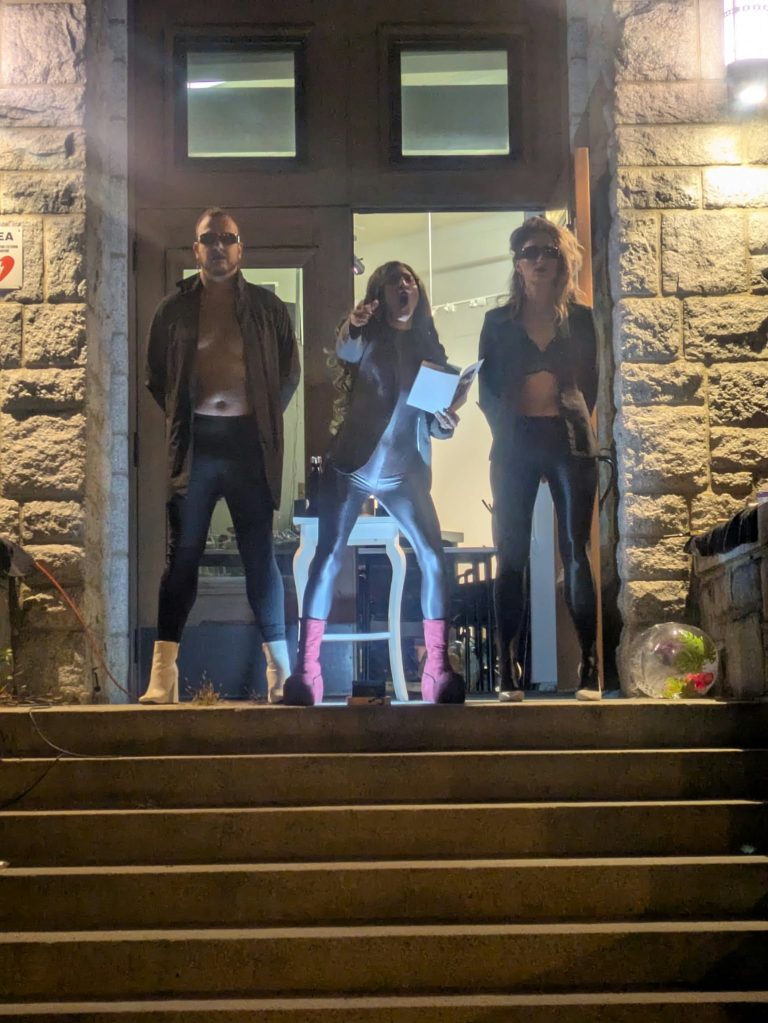
Yesterday, we were invited to discover six works-in-progress of contemporary/experimental musical theatre. All these terms are appropriate because the vastness of genres and approaches was impressive. The evening began outside the Calixa-Lavallée Center (in Lafontaine Park in Montreal), where the audacious soprano Sarah Albu (who was also the curator, programmer, and director of the evening) offered us a sort of happening experience in which she harangued the audience, sometimes asking them to rub against each other, jump, and take turns screaming in front of her, screams she repeated exactly (I immediately thought of Marina Abramović), or to imitate animal sounds, including those of homosexual giraffes. All this was flanked by two largely impassive musicians from the Paramirabo ensemble (Jeffrey Stonehouse and Krystina Marcoux), dressed like Glam-Goth Men in Black. The occasional passers-by were astonished. Albu gives everything in this kind of adventure, and we must salute her commitment. But, ultimately, this piece by the Brazilian-Danish Marcela Lucatelli, titled Songs of Survival: A Manual for Life, was more akin to Dadaist theatre than opera (there was hardly any singing).
That said, the playful and good-natured performance had the advantage of putting the audience in a welcoming and smiling mood for the rest of the program, which moved to the Paul-Buissonneau hall.
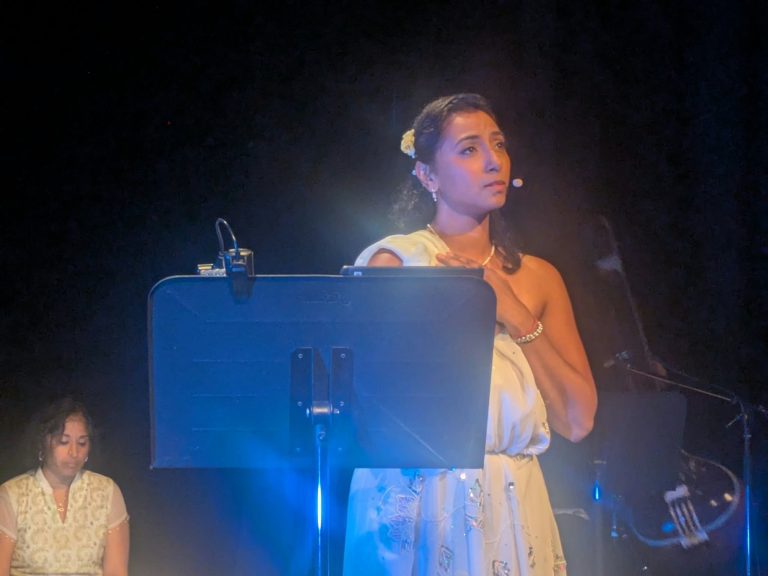
The following work immediately appealed to me. I am a fan of science fiction, and I appreciate that this literary genre is increasingly finding its place in contemporary scholarly creation. Beneath, by Jean-François Daigneault, tells the final moments of the last human on a devastated Earth, before transferring their consciousness into a quantum computer, where they reunite with their partner, already “integrated.” Before making the virtual leap, the protagonist leaves instructions to a robot whose task will be to reconstruct human history, erasing all hatred, discrimination, etc. Daigneault’s music is pleasant, modern yet melodic, pictorial, and expressive. The text is delivered in a blend of singing and theatrical narration.
The next opera was the most conventional on the list. GIANTESS, by the Canadian (based in London) Victoria Bernath, explores a part of the life of the surrealist artist Leonora Carrington, who was long institutionalised in an asylum. Set to predictably modernist music, the composer and librettist explores the idea of madness and original creation. It should be noted that Bernath also plays the viola in the score, and sometimes even sings while playing. The best moment of the opera actually occurred when Bernath interacted and conversed with the character of Leonora (very well portrayed by Marie-Annick Béliveau) with her instrument.
Next came what turned out to be my favourite of the evening: Opéra Laurentien by Gabo Champagne, with a libretto by JJ Houle. The typical Quebec brand of French language is here fully successfully instrumentalised, unlike some attempts I have already heard elsewhere, where the result seemed artificially imposed. Placed in a context of parents complaining that their child doesn’t sleep at night, the words, authentic (‘’jama’’ for jamais (never), ‘’charcher’’ for chercher (searching)) are fused with onomatopoeias and other expanded vocal techniques to create an astonishing framework of liveliness and coherence. Gabo’s music is a brilliant fusion of traditional Quebec musical colours and expressionist modernism. All the operas presented, as I said, are works in progress. Some may never be actually completed. As far as I’m concerned, Opéra Laurentien is one of those lyrical works that deserves to go through the entire process. Bravo.
Peste Bianca is a creation by the Mexican Daniela Falcon. A severe critique of both the “wellness” industry, driven by the pharmaceutical/chemical industry, and mind-numbing superficiality, while being the source of the proliferation of addictive drugs (opioids). The staging included a video of a young woman quite caricatured from the 60s, and the presence on stage of Sarah Albu, disguised as a chemist. The cynical nature of the work made people laugh, but not as much as Albu’s moustache, which kept coming off.
The last presentation was CARE by Erin Gee (music) and Laurence Dauphinais (libretto). We saw two egg cells in a woman’s womb (played by Gee and Dauphinais) questioning their true desire to enter the world. The required setup was the most imposing of all: the entire Paramirabo ensemble and a choir reuniting all the soloists of the evening. The music seemed a bit anonymous to me, except for the strong impressions left by the treatment of the choral voices, which created a kind of hallucinatory sound bath, enveloping the text recited powerfully by Dauphinais (and sometimes sung by Gee).
Hats off to the artists present. The Paramirabo ensemble, consisting of Jeffrey Stonehouse on flutes, Gwénaëlle Ratouit on clarinets, Hubert Brizard on violin, Viviane Gosselin on cello, Romain Pollet on piano, and Krystina Marcoux on percussion. The vocal soloists: Marie-Annick Béliveau, Sarah Albu, Émilie Versailles, Virginie Mongeau, Liz Lima, and Clayton Kennedy. Stephen Mulligan, solid, was at the helm.
Beyond everyone’s personal feelings about each work (my preferences will probably not be the same as yours or others, and that’s the beauty of it), Opér’Actuel, both in its traditional showcase format and Festival, has just demonstrated its relevance, if only to stimulate and support new creations deeply connected to the contemporary world and to allow the public to taste it, even if just for a few minutes.
See you (after today’s two additional performances) in 2028.