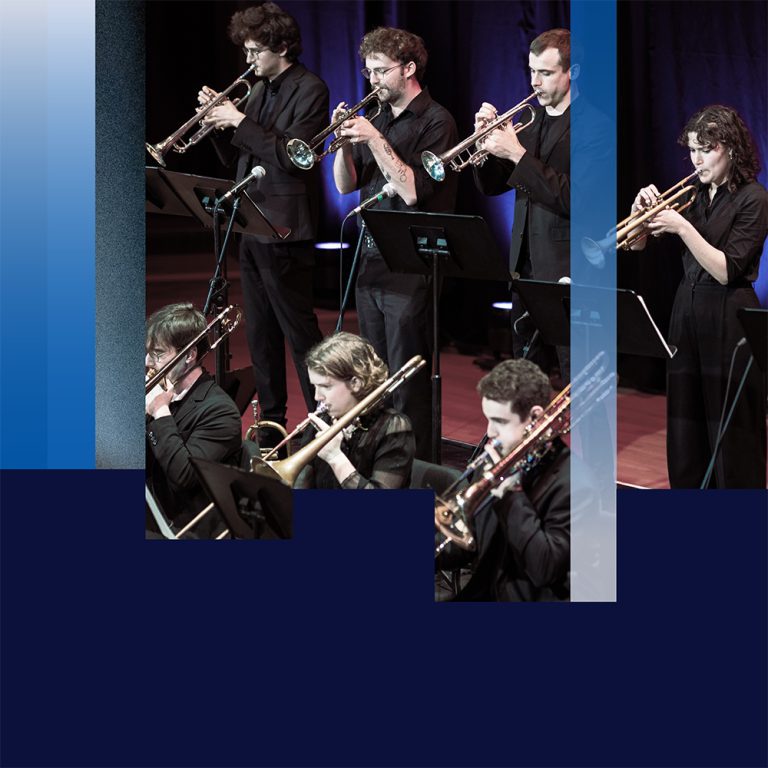
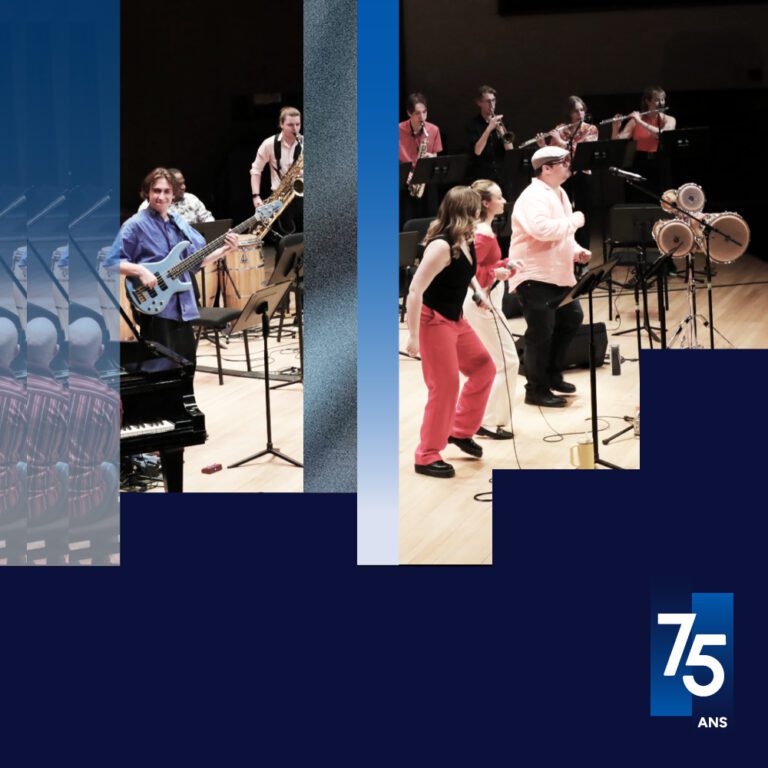
With the cold and torrential rain pouring down on Montreal, it took a bit of courage to venture to the concert hall at the University of Montreal’s Faculty of Music. But it was well worth it: the radiant saxophone of Chilean Melissa Aldana awaited us, accompanied by a student Big Band that seemed to be firing on all cylinders. Rain? What rain?
Melissa Aldana has garnered much praise in recent years for the originality of her playing and the quality of her compositions. “She’s one of the best saxophonists on the planet,” João Lenhari, trumpeter, teacher, and musical director of the Big Band, told me during our interview. And by that, he meant regardless of gender.
Melissa usually performs in a sextet or quintet. Her only experience with a big band was a project with the Frankfurt Radio Big Band, inspired by the Mexican artist Frida Kahlo. It was a version of this project that we were treated to at the Salle Claude Champagne.
João Lenhari stated it from the outset, in his French beautifully tinged with a Portuguese accent: reproducing these compositions by Melissa Aldana arranged by Jim McNeely was a serious and complex undertaking that required many rehearsals.
Overall, the concert was excellent. The kids did a fantastic job. These pieces, which are jazz with a subtle Latin influence, are indeed difficult to perform. But overall, everything flowed smoothly. The rhythm section was particularly impeccable, in my opinion as a layperson who listens to a lot of music.
What’s particularly wonderful about this kind of concert is the humility of the “star.” Melissa Aldana gave the students plenty of space for their solos, applauding and encouraging them. I don’t know if you find that in classical music. There was a particularly moving moment when tenor saxophonist Maude Gauthier and Melissa Aldana were in dialogue, responding to each other. I wondered how fast Maude’s heart was beating. It’s an incredible opportunity!
In short, it was a warm and musically excellent evening. The only slight drawback: at times, the Big Band somewhat overpowered Melissa’s saxophone, which often conveys very subtle emotions. Fortunately, she was able to showcase her full talent in an unaccompanied solo, where the breadth of her range and nuances was evident.
I therefore recommend that you listen to her latest album Echoes Of The Inner Prophet, to appreciate her talents as a saxophonist and composer.
On December 7, the Salle Claude Champagne will host saxophonist Bob Minzer, accompanied by the university’s alumni Big Band.
Two anniversaries celebrated with Quebec’s musical genius
by Frédéric Cardin
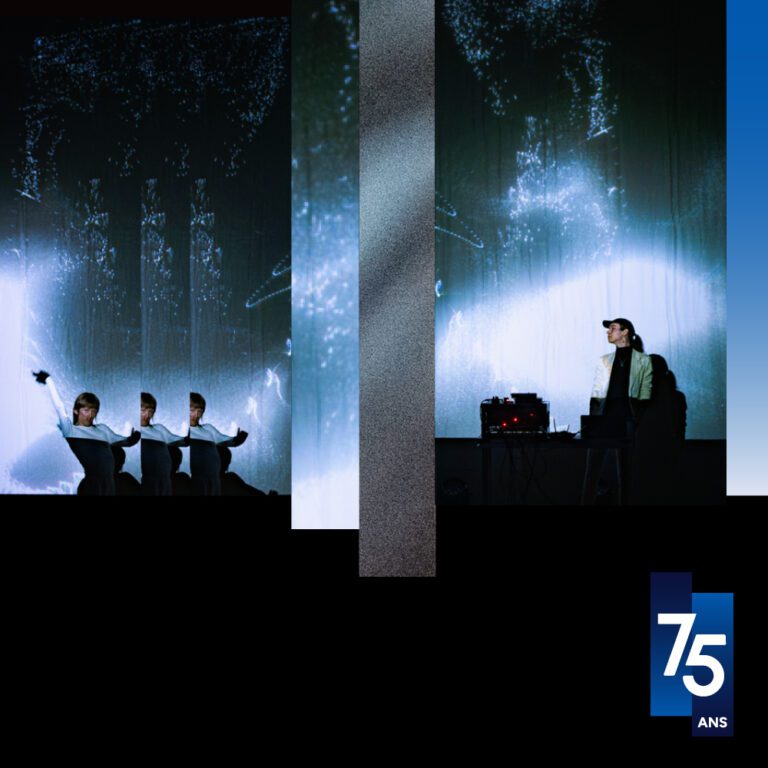
Saturday evening at the Claude-Champagne Hall of the University of Montreal, a concert was held to celebrate the anniversaries of two venerable Quebec musical institutions: the 60th of the Quebec Society of Contemporary Music (SMCQ) and the 75th of the Faculty of Music of the University of Montreal (UdeM). Contemporary Confluences, the title of the concert, highlighted the many intersections between the two organizations. The program honoured the various musical directors of the SMCQ throughout history (Serge Garant, Gilles Tremblay, Walter Boudreau, Ana Sokolovic), who have all also been teachers at UdeM. As a bonus, a creation by a young composer, Maxime Daigneault, because we must not forget that the mission of both institutions is also to ensure the future of contemporary classical music. It was the SMCQ ensemble, led by Christian Gort, and the UdeM Contemporary Music Ensemble, led by Jean-Michaël Lavoie, who shared the stage and the pieces, sometimes in tandem.
The program showed the depth of scholarly creation in Quebec music. Boudreau’s Coffre III(a) (Le Cercle Gnostique I {}) launched the evening with the composer’s usual mark, his stunning colours and sparkling energy. The trio of young students from UdM, composed of Jérémie Arsenault on clarinet, Alona Milner on piano, and Leîla Saurel on cello, was impressive in terms of technical quality, precision, and timbral beauty.
Following was Serge Garant’s Quintet for flutes, oboe/English horn, percussion, piano, and cello, a true marvel of arch construction, whose expressive beauty relies on an exceptional sense of colour and thematic metamorphosis. Ana Sokolovic’s Five Locomotives and Some Animals bears the mark of the Montreal composer’s efficient style. Descriptive episodes including rhythmic and stylistic motifs from Balkan folklore, interspersed with short interventions driven by exciting motor energy. Ironically, it was the work that seemed the most fragmented of the evening in terms of sonic coherence, whereas the others were rather seeking to create an integrated, morphic and organic whole despite their omnipresent pointillism. Nevertheless, Sokolovic’s writing remains irresistible.
Souffle (Champs II) by Gilles Tremblay reminded us of how the formal and intellectual complexity of the composer’s works is equally matched by a fascinating mastery of expression and discourse. The abundance of colours and the stunning poetry of this seductive abstraction never fail to move. Very great art, as Lavoie and the UdeM Ensemble reminded us.
I really enjoyed the last piece of the evening, Sensations: Lueurs du néant (Sensations and glimmers of nothingness) by Maxime Daigneault. This commission, performed by the largest number of musicians in the program, testified quite explicitly to the nature of contemporary language in 2025, compared to that of its predecessors, concentrated in the years 1978 to 1996. Daigneault’s music is organic, metamorphic in the sense of a moving fluid that almost never contains sound breaks. This fluidity is very representative of current music in scholarly creation, probably informed by post-minimalism and neo-romanticism. In the 21st century, we seek to fill the expressive field, to cover it entirely. It is very different from the atomism that dominated avant-garde and institutional musical thought in the second half of the 20th century.
Daigneault told me before the concert that the idea of this piece was to translate the compositional process that characterizes his own approach. At the moment of starting to write a work, there is nothing. A blank page, or rather a dark void. Then, through persistent searching, a few luminous threads appear, ideas, intuitions. He pulls on them, sees what he can do with them, ties them together, and eventually transforms the darkness into light. Sensations: Lueurs du néant is totalitarian music, in the sense of a total monopolization of the sound space, without breaks, or almost. It is also a very strongly expressive music, and one that has an almost physical impact on the listener. As far as I’m concerned, a great success. Why did it then seem to me that the applause was a bit too polite?
The musicians of both ensembles were at the forefront of the numerous demands of the scores. With perhaps the advantage going to that of the SMCQ, which is also the most experienced.
The celebration of the two anniversaries took place in a sober manner while highlighting the very essence of their missions: to promote the excellence and endurance of local musical genius.
Faculté de musique de l’UdeM : Étoiles montantes à la salle Claude-Champagne
by Rédaction PAN M 360
Qu’ils exercent leur talent en composition, en direction d’orchestre, comme solistes ou instrumentistes au sein l’OUM, les étudiants et les étudiantes de la Faculté de musique seront sous les feux de la rampe lors de cette soirée Étoiles montantes! Eun Jung Park et Igor Alfonzo Martinez Valderrama, étudiants en direction d’orchestre Julien Régol et Ming-Jing Wong, piano
Whether showcasing their talents in composition, orchestral conducting, as soloists, or as instrumentalists within the Université de Montréal Orchestra, students from the Faculty of Music will take center stage during this Rising Stars! evening. Eun Jung Park and Igor Alfonzo Martinez Valderrama, conducting students Julien Régol and Ming-Jing Wong, piano
CE SPECTACLE EST GRATUIT!
Ce contenu provientde la faculté de musique de l’UdeM et est adapté par PAN M 360
Université de Montréal: Stars shine on music’s next gen
by Frédéric Cardin
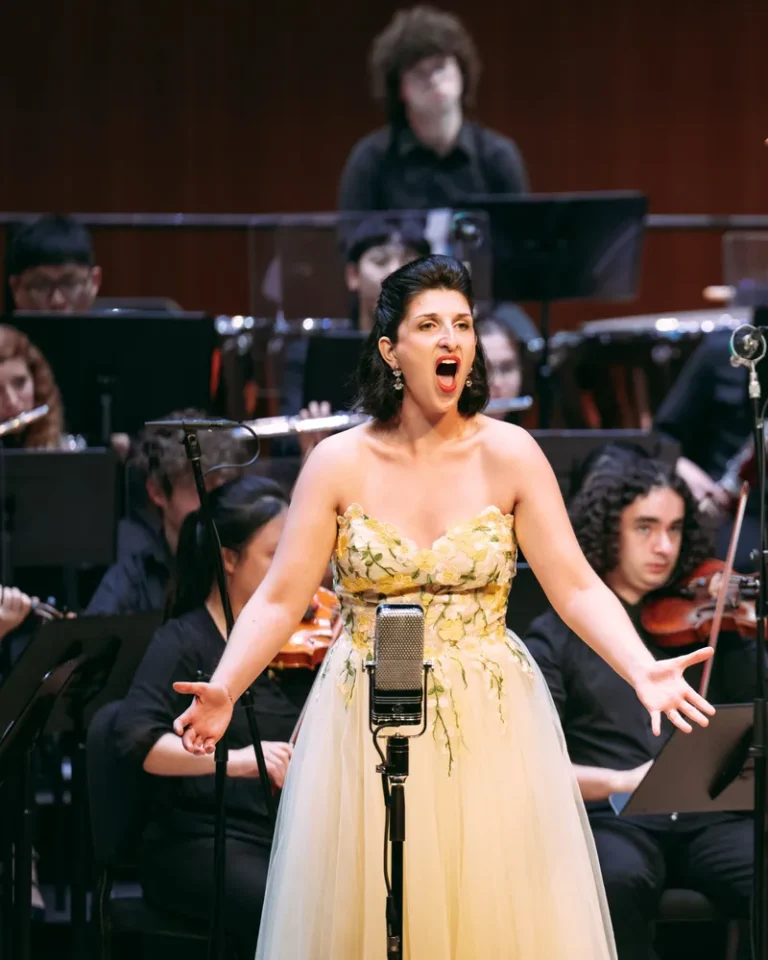
Saturday evening, April 12, saw the Université de Montréal’s Rising Stars concert. Graduates in conducting, composition and flute performance presented the results of years of learning. It was inspiring.
Conductor Marie-France Mathieu began by presenting the first three pieces on the programme, creations by three composition students, Gabriel José Melim Schwarz, Amichai Ben Shalev and Charles-Vincent Lemelin. Schwarz offered a tonal and rather sunny neo-romantic piece, ironically entitled Folle (Crazy). Vibrant with energy and inspired by Schwarz’s native Brazil, it is a work that is pleasant to listen to and not very demanding for the listener.
This was followed by A Groyse Metzieh by Ben Shalev, a musician also known as a member of the ensemble Les Arrivants. The title means ‘a beautiful find’, which is in fact a sarcastic formula typical of Jewish humour, meaning ‘not much of anything’. I really enjoyed this post-modern piece, which mixes tonality with noisy avant-gardism, thanks to a wide range of instrumental techniques linked to experimentation. It begins in a sombre atmosphere with a warm string theme, quickly interspersed with bursts of colour that would not have displeased Messiaen. The rest moves slowly but surely towards saturation, punctuated by thunderous stridencies, before ending with a return to consonance, but with the brass choir. Superb.
Finally, Lemelin’s Passacaille had the greatest effect on me. In this piece, which treats the orchestra as a living mass, dark but nonetheless criss-crossed by many luminous streaks, and which gradually swells to its maximum sonic and harmonic density, I perceived echoes of Saariaho and Rautavaaraa, but also of a certain Straussian monumentalism and the muscular expressionism of ex-Hollywood composer Goldenthal. Passacaille is a demonstration of quiet power, perfectly calibrated and constructed. Your humble reviewer thoroughly enjoyed it.
The rest of the programme featured Romantic repertoire, starting with a charming Concerto for two flutes by Franz Doppler, the king of the flute (along with his brother) in the 19th century. It was an opportunity to see and hear at work two young performers who won 3rd prize in the OUM 2024 Concerto Competition, Gabriel Lapointe Guay and Sarah Billet. The two artists injected all the right sparkle into this smiling, feel-good music.
The second part was devoted to Schumann’s Manfred Overture and Stravinsky’s Firebird Suite (1919). Above all, it was an opportunity to judge the conducting work of Marie-France Mathieu and Paul Karekezi. It was the latter who gave us a Manfred full of drama, inhabited by a necessary discharge of conflicting emotions. Perhaps a little tempered, but beautifully embodied.
The Firebird was brought to life with beautiful colours and crystalline details, powerfully underlined by conductor Mathieu.
Since the two young conducting artists also led the OUM (Orchestre de l’Université de Montréal) in the creations mentioned above, I noticed two different but complementary personalities of baton and control.
Paul Karekazi, who conducted Lemelin’s Passacaille (and, as I just said, Manfred), gave a clear performance, but above all one imbued with emotional intensity and inner strength. This favoured strong nuances and a legato imbued with heartfelt lyricism.
Marie-France Mathieu, on the other hand, is more sober in her outpourings, but nevertheless skilfully brings out the detailed colours and textural contrasts in a limpid manner, thanks to a surgical baton that leaves no room for doubt. She conducted the pieces by Schwarz and Ben Shalev, the Doppler (and of course the Stravinsky) very well.
Karekazi and Mathieu are students of Paolo Bellomia, the two flautists come from Denis Bluteau’s class, and the three composers benefit from the knowledge of Jimmie Leblanc, Ana Sokolovic, François-Hugues Leclair and Olivier Alary.
It was a wonderful evening for the future of music in Montreal, Quebec and Canada.
Faculté de musique de l’UdeM | An Effective Evening at The Opera
by Alexandre Villemaire
The 2024-2025 season of the Université de Montréal’s Faculty of Music is currently in full swing. Perched on the slopes of Mont-Royal at the top of the famous Vincent-d’Indy Avenue hill, around a hundred people gathered in Salle Claude-Champagne on Saturday to hear the current crop of young singers. It was a great opportunity to discover them in preparation for their production of Hansel und Gretel by Engelbert Humperdinck (1854-1921), to be presented at the end of February. The students were accompanied by pianist/conductor Robin Wheeler and Alona Milner.
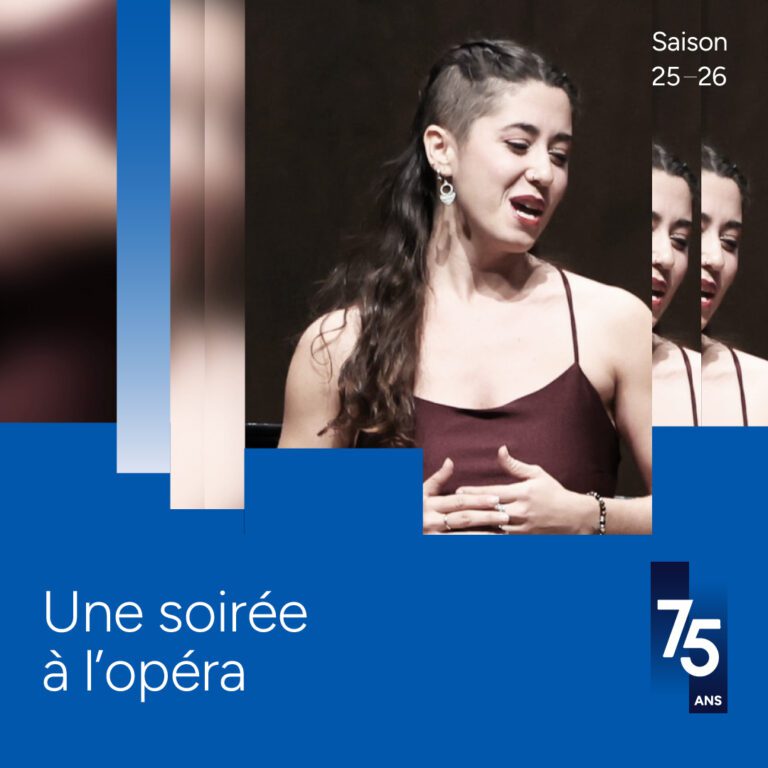
A sober evening, presented in gala form without extravagant presentation or complex staging, but not lacking in quality moments. In this operatic evening, several excerpts from works covering a vast spectrum of the operatic repertoire were presented. From German Romantic opera to bel canto, operetta and Baroque opera, it was a seamless transition. This panorama allows us to see the different performers in action, in a variety of styles, lyrical expressions and character incarnations. Verdi’s Witches from Macbeth opened the evening. With piercing eyes, the sopranos and mezzos of this chorus presented a biting, menacing reading of this page of verismo. The few choral numbers that graced the program were among the evening’s most appreciated for their strength and technical precision. The overall sound was enveloping, the articulation just right and precise. A case in point was the excerpt from Mozart’s Idomeneo “Placido è il mar… Soavi Zeffrini”, where the balance of voices between the numerous women’s voices and the five men’s voices was soaring, balanced and complementary to Marie France Eba Koua’s singing.
In terms of individual voices, several performances caught our attention. Among the men’s voices, baritone Élie Lefebvre-Pellegrino stood out for his beautiful, resonant, full, round and slightly brassy low register, coupled with good stage presence. His interpretation of Nilakantha’s aria from Léo Delibes’ Lakmé was assured and committed, as was his performance as Count Almaviva in the duet “Crudel! Perche s’ignora” duet from The Marriage of Figaro with Kevisha Williams. However, his passages in the upper register still need to be stabilized. Fellow singer Théo Raffin offered some of his best stage performances in Don Giovanni’s Leporello (“Sola, sola in buio loco”) and Romeo and Juliet’s Mercutio (“Mab, la reine des mensonges”). In both cases, his interventions were both interpretative and vocal. The only bass in the cohort, Andrew Erasmus delivered the difficult aria “O du Mein Holder Abendstern” from Wagner’s Tannhäuser with finesse and sensitivity.
As for the female voices, Maëlig Querré (mezzo-soprano) made a good impression in her role as Romeo from Bellini’s I Capuletti e i Montecchi. Her agile, assured voice with a sonorous low register complemented Nicole Ross’s Giulietta, who, despite great strength and agility in her high notes, reached the end of her range by the end of the aria. Cloée Morisette and Clotilde Moretti were equally sparkling in an excerpt from Carl Maria von Weber’s Freischütz. Another name to remember is mezzo-soprano Julie Boutrais. She distinguished herself in the duet from Moneverdi’s opera L’Incoronazione di Poppea, performed with Salomé Karam. Playing respectively King Nero and his lover Poppea, the two singers perfectly captured the passionate feelings and intoxication evoked in “Signor, oggi rinasco” as Nero announces to Poppea that she is to be his wife. Julie Boutrais also brought the evening to a close with her warm, embodied voice in Dido and Æneas‘ final aria “When I am laid in Earth”, followed by the final chorus from the same opera. A moment that sent shivers down our spines.
If we have to make one slight criticism of the concert, it’s the lack of detail in the program. A gala-style singing recital featuring a succession of arias, duets, trios and choruses from different periods and styles allows the singers to express themselves in a variety of roles and characters, and at the same time introduces the audience to protagonists and operas with which they may be less familiar. It would be a good idea to provide a little context for these works, to situate them for the audience. The excerpt from the trio “Je vais d’un cœur aimant” from Hector Berlioz’s opera Béatrice et Bénédict is a good example. Maëlig Querré, Maïlys Arbaoui-Westphal and Anne-Sophie Gagnon-Metellus performed this excerpt from a little-performed opus well, and would have deserved a little program note to appreciate it even more.
Festival d’art vocal de Montréal 2024: Classe de maître avec Étienne Dupuis
by Rédaction PAN M 360
GRATUIT – Réservations obligatoires Les contributions volontaires sont fortement encouragées. Montant suggéré: 25$
Assistez à une classe de maître en chant lyrique avec le baryton de renommée internationale Étienne Dupuis, aussi codirecteur artistique d’ICAV, et découvrez son approche de l’interprétation et de la technique. Une expérience enrichissante pour les étudiants en musique, les professionnels aguerris et tous les amateurs de musique classique.
La Salle Serge-Garant et la Salle Claude-Champagne sont les deux principales salles de concert de la Faculté de musique de l’Université de Montréal : 220, avenue Vincent d’Indy, Outremont.
Attend a master class in lyrical singing with internationally renowned baritone Étienne Dupuis, also ICAV’s co-artistic director, and discover his approach to interpretation and technique. An enriching experience for music students, seasoned professionals and all classical music fans.
Salle Serge-Garant and Salle Claude-Champagne are the two main concert halls of the Université de Montréal’s Faculty of Music: 220, avenue Vincent d’Indy, Outremont.
Festival d’art vocal de Montréal 2024: L’audition avec l’Orchestre de la Francophonie
by Rédaction PAN M 360
Soyez témoins de l’envers du décor en assistant à une audition d’opéra avec l’Orchestre de la Francophonie, sous la direction de Julien Proulx. Une expérience unique en son genre où de jeunes musiciens talentueux se produisent devant un jury international susceptible de les engager. Cette audition sans équivalent dans le monde offre une opportunité exceptionnelle de perfectionnement et de reconnaissance aux participants de l’Institut canadien d’art vocal.
La Salle Serge-Garant et la Salle Claude-Champagne sont les deux principales salles de concert de la Faculté de musique de l’Université de Montréal : 220, avenue Vincent d’Indy, Outremont.
Get a behind-the-scenes look at an opera audition with the Orchestre de la Francophonie, conducted by Julien Proulx. A unique experience where talented young musicians perform in front of an international jury with the potential to hire them. This unique audition offers an exceptional opportunity for development and recognition to participants in the Canadian Vocal Arts Institute.
Salle Serge-Garant and Salle Claude-Champagne are the two main concert halls of the Université de Montréal’s Faculty of Music: 220, avenue Vincent d’Indy, Outremont.
Der Kaiser von Atlantis: a modest but important production
by Frédéric Cardin
A moment I’d been looking forward to for a long time took place yesterday in Salle Claude-Champagne at the Université de Montréal: a performance of Viktor Ullman’s opera Der Kaiser von Atlantis. Well, almost what I expected, as it was a concert version, enhanced, that said, by some very fine video projections. Der Kaiser is a great masterpiece in a small format (not even an hour), a fundamental opera of the 20th century that almost disappeared under the carelessness of the Nazis, but survived for decades under an old mattress. Follow the link below to find out part of the story.
Der Kaiser tells a simple story: Emperor Overall (what an appropriate name) wages war on all his neighbors. He boasts that he has Death on his side, “under his banner”, and that with it, no enemy can survive. Death, fed up with being used like this, decides to go on strike. With no one left to die, war becomes pointless, and no one fears the evil imperial dictator. So much so that even people fall in love across enemy lines. Overall is in despair when Death appears to her and proposes a deal: she will resume her service on condition that her first victim is the Emperor himself. In a final gesture of redemption, the Emperor accepts, for the good of all. The direct reference to Hitler and fascism is obvious (minus the redemption), and serves as a powerful, hyper-focused symbol and indictment of the absurdity of megalomania. Ullmann died in Auschwitz in 1944. He never realized that his subject never had the strength of character of the fictional character.
Ullmann’s score is marvelous. An absolute masterpiece of eclectic modernism, typical of a certain style of the 1920s, 30s and 40s, which dared to mix atonal music, late Romanticism, jazz, popular music, consonance and dissonance. In short, what we’re used to today, a century ahead of its time.
The fifteen-strong chamber orchestra features a portable organ, banjo, guitar and classical strings, woodwinds and brass. The music is sparkling with motifs and snatches of melody that are juxtaposed and swiftly strung together, without ever giving the impression of amalgamating into a shapeless soup. On the contrary, ultra-smooth lines, drawn with a scalpel, sometimes anticipating those of Shostakovich. Ullmann keeps us constantly on our toes. A modernism that is often cynical, that squeaks and plays tight in corners, but full of humor and contagious vitality.
Der Kaiser von Atlantis – Festival ClassicaDer Kaiser von Atlantis – Festival Classica
The vocal side is divided between scansions and singing. Frédéric Caton (Death) gives a fine performance, a purring bass, very much in character. Florence Bourget in the role of the Drum, with magnificent projection and a pleasant timbre. Éric Laporte as Harlequin (symbolizing Life) is adequate, but a little thin in the treble. Pierre-Yves Pruvot plays the Emperor Overall, and his grandiloquent vibrato is blessed with a character who can live with it. I’m not sure I’d have liked it in any other context. Le Haut-Parleur, the national radio station, is conducted ”imperially” by Tomislav Lavoie, but in a German that lacks clarity. Emmanuel Hasler and Sophie Naubert are very decent in their small roles as soldiers.
This was a concert version, but ”augmented”, as I said, by video projections, combining beautiful, partially animated illustrations by Maxime Bigras and a montage of archive films by Matthieu Thoër, of Lumifest en cavale. Without this visual dimension, the experience could have seemed arid. All that remains now is to hope for a real stage production in the not-too-distant future.
I disagree with a colleague who regrets the absence of costumes in a concert version. What’s the point of “graying” singers in Halloween when they’re condemned to remain stationary? It would be ridiculous. Anyway…
The concert ended with the presentation of Montrealer Jaap Nico Hamburger’s Symphony for Chamber Orchestra No. 1 “Remember to Forget”. A fitting complement, the underlying theme of this symphony being that of one train heading for death (1st movement) and another heading for liberation, or life (2nd movement).
The link with opera was also made with Hamburger’s music, which bears some resemblance to Ullmann’s, although it is built on a much more linear discursive architecture. No sudden, even violent leaps between opposing affects, textures and rhythms. Rather, the music is fairly consonant, albeit with occasional atonal outbursts, set to a steady pulse, illustrating the train’s progress. Depending on whether the train is heading for life or death, the atmosphere changes, of course. Hamburger would make an excellent film composer. Hamburger’s parents survived the Allied landings in 1944. After the murdered Ullmann, this man’s permitted existence is a positive conclusion. One train to death, another to life.
It’s a shame that Salle Claude-Champagne was only partially filled. Was it the program or the hall itself? Not its acoustics, which were excellent, but rather its location. A cul-de-sac (literally) devoid of any form of amenity in a wide radius around it (zero restaurants, bars or activities of any kind). A dormitory district. What a pity, it sounds so good.
The fact remains that such an operatic treasure, still too hidden, absolutely must be mounted and shown everywhere. It can serve as a powerful anti-totalitarian document as well as an introduction to modern opera and musical language. Its very short duration, its archetypes that can be understood by all, and the infinite possibilities it offers in terms of staging, are all elements that make it an absolute must in the art of music. It’s not what the Festival Classica will fill its coffers with, but the cultural and social importance of this kind of proposition is noteworthy. The vision and courage of the Classica team are to be commended, despite the very modest means at their disposal to realize this project. Sponsors who support this project should know: your investment will go far beyond a monetary rebate.
Concert en trois actes, les voix éclatantes et prometteuses de la jeune scène lyrique québécoise se lèvent pour célébrer l’amour accompagné du plus grand des orchestres baroques de la métropole. Tel un hommage vibrant à l’admiration que Mozart vouait à ses interprètes féminines, ce concert-collage réunit les mélodies les plus sublimes de ses chefs-d’œuvre : La Clémence de Titus, Les Noces de Figaro, et La Flûte Enchantée. Ce concert est une inspirante élégie à l’émotion et à la virtuosité vocale. Tels des tableaux, entre ombre et lumière, capturant la beauté du caractère de ces héroïnes et le tumulte de leurs passions, offrez-vous le privilège d’entendre les plus envoûtantes mélodies du compositeur le plus épris de tous les temps.
A concert in three acts, the bright, promising voices of Quebec’s young opera scene rise to celebrate love, accompanied by the city’s finest baroque orchestra. A vibrant tribute to Mozart’s admiration for his female performers, this concert-collage brings together the most sublime melodies from his masterpieces: The Clemency of Titus, The Marriage of Figaro and The Magic Flute. This concert is an inspiring elegy to emotion and vocal virtuosity. Like tableaux, between light and shadow, capturing the beauty of these heroines’ characters and the tumult of their passions, treat yourself to the privilege of hearing the most spellbinding melodies by the most passionate composer of all time.