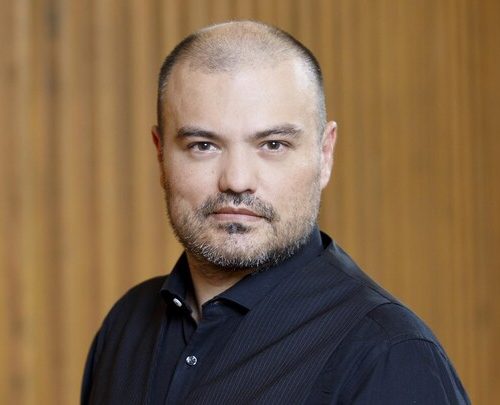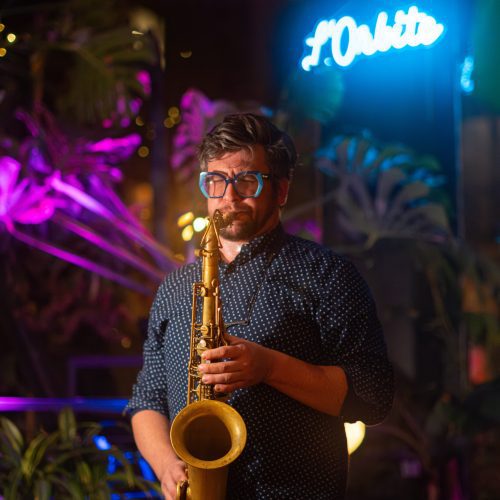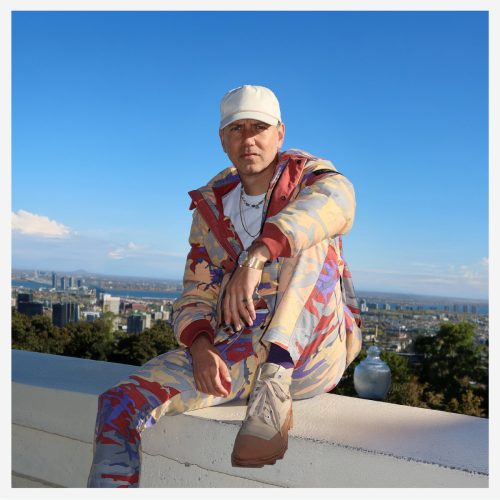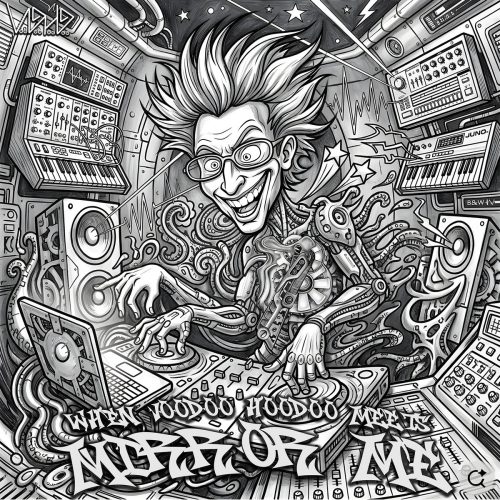
Orchestroll evokes a unique universe for me, a territory where sound and visuals aren’t two superimposed layers, but a single, multifaceted experience. I discovered them in 2024 at EAF’s first event, with Heith as a guest. That evening, I had the rare feeling of witnessing something unprecedented in my memory. Noise wasn’t foreign to me; I was already familiar with its roughness, its raw energy, its directness. But I had never seen this intensity combined with such subtlety, as if each discharge had been filed down, balanced, and then placed back into a larger circuit. This is where the strength of the Montreal duo lies: they don’t polish chaos, they give it form.
What moves me most about their music is their fearless approach to experimentation. They patch, test, and push effects until they find a point where the unexpected becomes interesting, where distortion ceases to be a rupture and becomes a transition. This freedom in the process is clearly audible in the result: the intensities don’t simply rise or fall, they interact, contradict each other, and then resolve. This creates engaging music because it never forces us into a single listening perspective for too long.
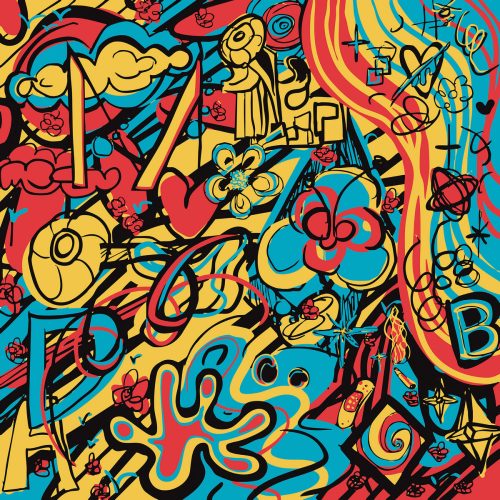
In Corrosiv, electronic instruments dominate the soundscape, but percussion drives the drama. It’s the main engine of the dynamic, the element that shifts the listening experience to the body. I still remember the first time I heard an excerpt, last Halloween, during Akousma at Usine C. It was so short that I was left with the feeling of having been interrupted mid-phrase. The album itself takes its time. It draws us into its ecosystem gradually, as if we were passing through an airlock before reaching the main room. You can tell it was composed for a space, not just for headphones.
The mix evokes an acoustic space, an imaginary yet tangible place, a room one could almost walk through in the dark before a strobe light reveals it. And even though the duo often works behind the synthesizers, it’s the moments when their hands become visible that strike me the most. When Asaël Richard-Robitaille switches to guitar, or when Jesse Osborne-Lanthier takes up the percussion, the music ceases to be merely an atmosphere and becomes an impact. These transitions give meaning to the album: they show that the performance isn’t an addition, but a direction.
What Orchestroll does isn’t simply a mix of textures or genres. It’s a way of telling the story of a world in the making, inviting us to follow its logic rather than relying on familiar landmarks. And that’s precisely what makes the experience so difficult to leave: you don’t exit this album like you turn the page of a book, but as if you’re returning from a place where the atmosphere has changed something within you.