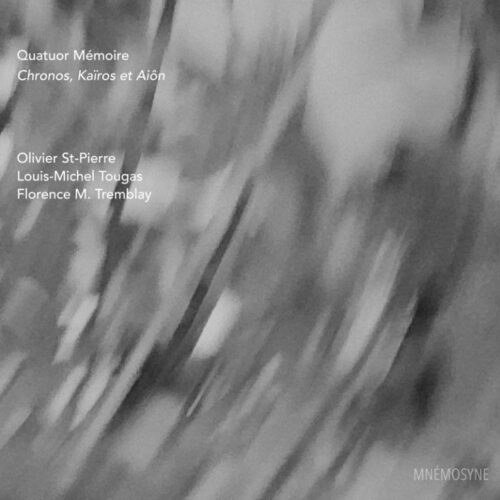
A very young string quartet (formed in 2024) whose mission is to play the music of its contemporaries, who are just as young as it is, and on top of that, on a brand new label, Mnémosyne, whose mission is convergent, can only please us immensely at PanM360! Three young Quebec artists of the sonic pen are highlighted here: Florence M. Tremblay with Insides, Louis-Michel Tougas with String Quartet No. 2, and Olivier St-Pierre with Chronos, Kaïros, and Aiôn, the album’s title track.
For Insides, Florence M. Tremblay juggles with techniques of just intonation, microtonal chords, and glissandos that serve as sinuous bridges between them, while Louis-Michel Tougas offers his very recent String Quartet No. 2 (2024), for which he lays a textured backdrop where sonic asperities seem to appear and disappear with the flow of moving, but rarely threatening, energy. Tougas’ writing favours the creation of delicate and finely drawn settings.
Chronos, Kaïros and Aiôn by Olivier St-Pierre is the most substantial work of the program, with over 34 minutes. St-Pierre studied philosophy, which explains the title, a reference to the three concepts of Time among the ancient Greeks. Chronos is measurable time, in days, hours, and minutes. We often represent it as a flowing river. Kaïros is the “opportune moment,” the ideal one for action. The image often evoked is that of a winged creature that one catches by the hair as it passes. And then Aiôn is the cyclical time, which merges with eternity, the eternal re-beginning. We imagine a circle, like the writing of the extraterrestrials in Denis Villeneuve’s film Arrival.
I listened to the piece trying to make connections with the concepts mentioned above, but I must admit that I was unable to clearly identify the different thematic markers, except perhaps for fleeting singing passages on the violin towards the end. Symbolic of cyclical eternity? Mmm, possible. But that remains a hypothesis. That said, we can perceive the evolution of St-Pierre’s writing throughout the score, with a first half (roughly) marked by very pointillistic, even atomistic, agitations, a following quarter that is rather static, becoming more lyrical and post-impressionistic in the final part. St-Pierre demands great precision from the performers, and this is sustained for more than half an hour. A probably very demanding performance, which the four members of the Quatuor Mémoire carry out with conviction.
Certainly, absorbing music in terms of listening quality, so rather for seasoned ears. That said, such a high level of intellectual and artistic expression cannot bypass this kind of appreciative investment.
If this successful first entry of the Mnémosyne label and the Mémoire quartet is an indication of what’s to come, music lovers will be spoiled.