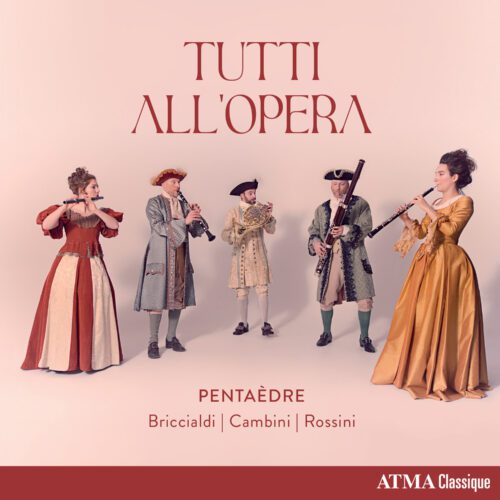
The premise of the album may initially seem misleading (although after listening carefully to all the pieces, the reference becomes clearer): it is not a complete program of arias or various excerpts from operas. Two pieces fulfil this role (three if we add the bonus track offered in the digital version of the album), while two others are quintets as classical as they come in form. It is however true that, being composed by Italians, they have an undeniable “lyrical” and “singing” character. But well, let’s move on from the semantics of a title and its commercial aspirations…
From Rossini, four excerpts from La Cenerentola (Cinderella), in an arrangement by Ulf-Guido Schäfer, are pleasantly interpreted, but it is the whirling Potpourri Fantastico on The Barber of Seville by Rossini, by Giulio Briccialdi (1818-1881), that makes the strongest impression, between the two operatic tributes.
The same Briccialdi is also represented by one of the two “serious” works on the album, the Quintet for flute, oboe, clarinet, horn and bassoon, op. 124, whose writing is in many ways reminiscent of Rossini’s for the stage. A first movement that reminds one of an overture, a second that is reminiscent of a tender canzonetta, and a third that is a finale full of energy, based on a sparkling melody, do indeed bring to mind a purely instrumental mini-opera.
Giuseppe Maria Cambini’s Quintet No. 2 in D minor (1746-1825), while not of the same artistic stature as Briccialdi, is nevertheless very attractive and historically significant because this composer is the very first in history to have written for this type of formation, which was entirely new at the time. Cambini was therefore the pioneer of instrumental and chamber music that took advantage of the technical advances made in wind instruments towards the end of the 18th century, namely a new and improved physical design (keys, pistons, valves) that allowed these instruments to be played with greater power and virtuoso ease.
The quintet presented here is imbued with classical elegance and a serious character that does not reject a certain lightness, particularly in the final movement. Again, Bel canto opera writing is not far, with the lines being bubbly and quite lyrical in their expressiveness, albeit somewhat darker in character than in Briccialdi’s piece.
For those who have purchased the digital version, a very beautiful arrangement of O mio babbino caro (from Puccini’s Gianni Schicchi), in a delicate arrangement by clarinettist Martin Carpentier, is offered.
I won’t dwell unnecessarily on the quality of Pentaèdre’s musical performance, which is a given. We never catch them lacking in good taste and technical perfection.
You will hardly find anything better to appreciate these little-known but utterly charming works.