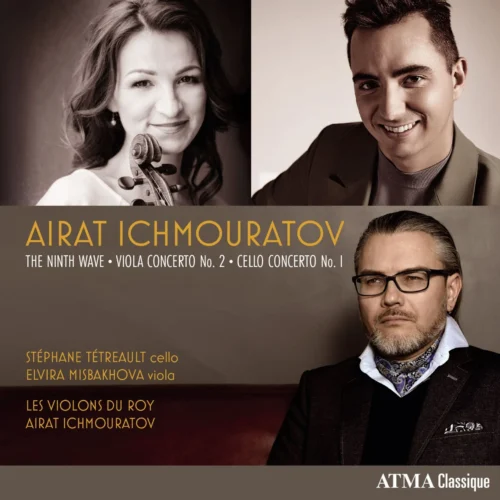
“Listen” to painting and “watch” music. That is what Yuli Turovsky, cellist, conductor and founder of I Musici de Montréal, is said to have once told the young composer Airat Ichmouratov. The latter makes use of this call to synesthesia (the ability to perceive stimuli with a sense other than the one with which we usually perceive them) in the works presented on this album. The talents of the Russian-born Quebecer as an orchestrator are well-known, as is his melodic and dramatic ease. Coming from a family of artists, mainly theatrical, Ichmouratov imbues his scores with a strong narrative energy. His openly neo-romantic style, interspersed with occasional spicy colors, plunges music lovers into sonic adventures worthy of the best film scores. The invitation made by his mentor Turovsky was therefore not in vain. Ichmuratov instinctively knew how to make us look at his music and listen to the images he wanted to share with us.
The Ninth Wave, a score tinged with sumptuous impressionism, is inspired by a painting from the Russian romantic tradition, which shows a frail skiff braving a turbulent sea, in vivid colours that skillfully blend shadow and light. The music is also agitated, but not in an aggressive way. The sonic “waves” follow one another without colliding head-on, until they calm down, perhaps for the nite, in a peaceful and mysterious finale.
The Viola Concerto No. 2, Op. 41, “Rennsteig” takes us completely elsewhere. It is written in a neo-Baroque spirit, once again fully embraced. The central idea is that of a young Bach wandering thru the landscapes of the legendary Rennsteig trail, which stretches from Eisenach to the Werra Valley. Ichmouratov draws an imaginary but realistic setting of what the young genius could have experienced while walking quietly, amazed by his world halfway between urbanity and nature. Here, then, an interior scenario entirely invented by the Quebecer, and illustrated very nicely by a writing style that borders on pastiche, but doesn’t stumble into it by making it something kitsch and a little silly. That is Ichmouratov’s talent. One could mention as a spiritual cousin the excellent Georges Delerue, in his own pseudo-classical/baroque scores (the theme of American Nite, for example). The Russo-Quebecoise Elvira Misbakhova plays with the necessary conviction, solidly supported by Les Violons du Roy.
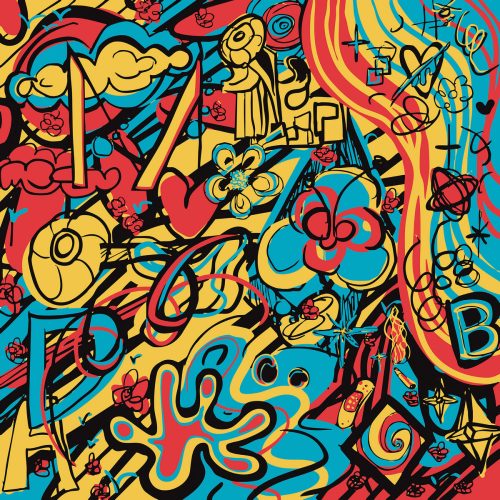
This delightful program concludes with Concerto No. 1 for Cello, Strings, and Percussion, Op. 18, performed by Stéphane Tétreault, in great form. For this one, Ichmouratov returns to a neo-romantic language decorated with folk ornaments, while adding surprising details such as a door that opens and closes! Why? To illustrate three paintings by Natasha Turovsky, daughter of Yuli and a longtime painter known for her colorful works tinged with symbolism, even surrealism. The first movement is linked to the painting Intrigues, in which ghostly figures emerge from, or enter, numerous doors, as if to embody a mode of scheming and secrecy. Intrigues, then. Ichmouratov evokes these thru a writing that sometimes calls for lightness (amusing intrigues, without malice) or elsewhere for something more mysterious, threatening (political intrigues?). And, is it me or, at the very end, does the central theme of the movement bear a strange resemblance to the theme of Darth Vader (and the Empire) in Star Wars?
The second movement is based on the painting Repentance, which evokes for Ichmouratov a very dark period in Russian history, that of the 1930s and 1940s under the ruthless rule of Stalin and the tragedy of the Second World War. The common thread is a Hebrew melody on the cello, deployed with great emotion, a bit like in From Jewish Life by Ernest Bloch. The conclusion is tied together with a very beautiful idea: a Russian Orthodox chant comes to marry the first theme, in order to suggest a multi-denominational communion in the same tragedy. Emotionally powerful.
The last movement is titled Moto Perpetuo, the same title as the painting that is the source of this part. I let the composer describe his music:
“Moto perpetuo”, offers a striking contrast of colour and character. Drawing inspiration from Natasha Turovsky’s eponymous painting, it highlights the soloist’s virtuosity, vividly reflecting the vibrant hues and dynamic motion portrayed in the artwork. The movement begins with a fanfare-like opening, transitioning to a scene that evokes the sensation of objects coming to life. It then seamlessly leads into a rondo-like theme highlighted by a cello solo that embodies constant motion. This continuous flow can be described as moto perpetuo, an Italian term for a fast, uninterrupted pattern of notes played at a steady pace
It is indeed a total change of tone and character from the previous movement. It is above all an opportunity to let Stéphane Tétreault have fun to the fullest and demonstrate his virtuoso abilities, which he does with brilliance.There is no need to wonder why Airat Ichmouratov’s music is played so often all over the world: he offers musical moments that combine both pleasure and intelligence, a certain simplicity framed within impeccable technique and refinement, and above all, an exceptional ability to tell good stories.