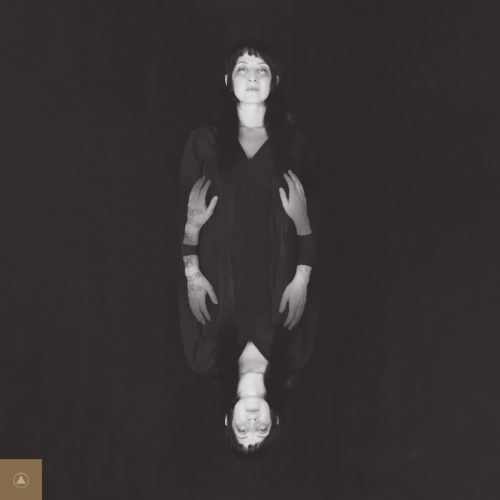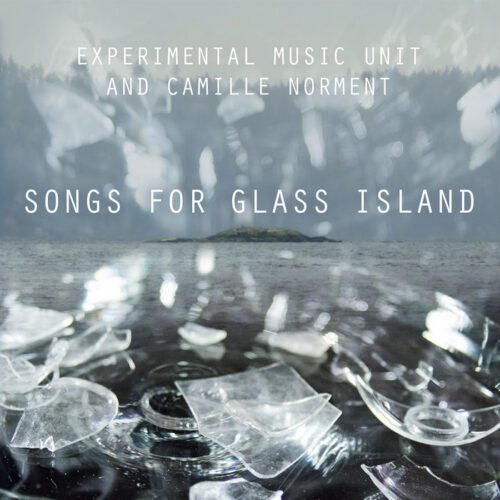
Some people find this instrument hypnotically beautiful, others think it can cause insanity. It’s the glass harmonica, invented by Benjamin Franklin in 1762. A series of crystal glasses of different sizes, rotating, and on which a musician applies wet fingers to make the glass resonate at various frequencies, which produces notes. The American-Norwegian Camille Norment plays this instrument, but not only, in this album composed of only two (long) tracks. On Songs For Glass Island, she also uses glass tubes and flutes specially designed (and blown) by a scientist specialising in experimental glass making. Norment uses no artifice, no amplification, only the cited objects touched or rubbed with water, fingers, mallets, and even voice and breath.
The result is fundamentally different from the usual sound of the glass harmonica. If you already know it, don’t even think about it. In the first part, through linked movements without pause (see details below), one gets a fairly clear sense of passing through a sparse trickle of water droplets in a damp cave in which pipes emit very softly amplified sounds of air currents passing through them. These sound like the music of a ghost playing a flute made of crystalline vapour. Beautiful and very surprising. The second part is a bit rougher, made of creaks, rubs, and percussive sounds that are more reminiscent of metal than glass.
If you think this music is strange, imagine the strangeness, if not the over-the-board grandiosity, of the art project that inspired it. In 1969, artist Robert Smithson proposed encasing Miami Islet, in the Salish Sea off Vancouver Island, in 100 tonnes of tinted glass. Although the Canadian government granted permission for the work, public pressure led to the project’s cancellation. Even for art, such an “invasion” of a natural environment remains difficult to justify.
Anyway, this pushes, and even blows up, the limits of the glass harmonica!
PART 1
I The Pour
II Unbounded Vanishing Points
III Abyssal Space
IV Tendency Toward a Primordial Consciousness
V Resolution of the Organic and the Crystalline
VI The Spiral
PART 2
VII Threshold Into Elsewhere
VIII Violent Analogies
IX Avalanche in the Mind
X Entropic Processes