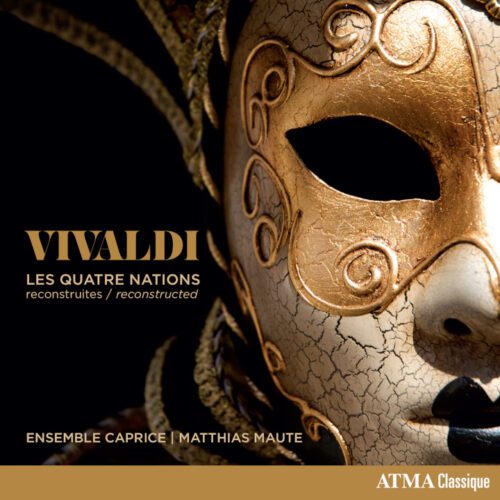
The premise of The Four Nations is tempting: the rediscovery in forgotten archives of descriptive Vivaldian concertos. Like the seasons but this time for countries. The result is not as revealing, as well as being slightly misleading. Indeed, with the exception of one of the four concertos presented, we have here reconstructions (certainly very skillful) of small masterpieces that Vivaldi intended to sell widely. This story starts with the Scottish Lord Robert Kerr, a flutist from the time of Vivaldi who brought home the score of the fourth of the concertos of this program, Il Gran Mogol, a score found in 2010 by a musicologist in the family archives. Il Gran Mogol is a rather “unexotic” evocation of India (at the time, the Mughal Empire). We know that this concerto was written toward the end of Vivaldi’s life, along with three others, also inspired by countries or nations foreign to Italy: France, England, and Spain. Vivaldi hoped to replicate the success of his four seasons and thus, perhaps, make some profits to meet his needs. These remain untraceable, but that’s not the point. Matthias Maute, leader of Caprice, undertook the perilous exercise of reconstructing the lost scores while strictly respecting Vivaldi’s Venetian style. Hence the term ‘’misleading’’.
The result is impressively convincing, Maute being so faithful and respectful of his model. That said, the national particularities remain very subtle, even hermetic for the non-specialist music lover. France certainly has a pompous side, like in a Lullian Overture, England exudes a tempestuous character, typically Vivaldian, which can be linked to the maritime aspect of the kingdom. Spain, perhaps, gives the impression of a few “heel clicks” (according to Maute), but this remains in the realm of delicate, even timid, suggestion. What is certain is that the mastery of the style evoked by Maute is impeccable and executed with great attention, in addition to being interpreted with the panache required by the original composer.
Next to the real Vivaldi concerto rediscovered in 2010 (Mogol), Matthias Maute’s real-fakes hold up well and let us dream of an imaginary concert somewhere in the 1730s in Venice.
Next to Vivaldi’s real concerto rediscovered in 2010 (Mogol), Matthias Maute’s real-fakes hold their own and let us dream of an imaginary concert somewhere in the 1730s in Venice.