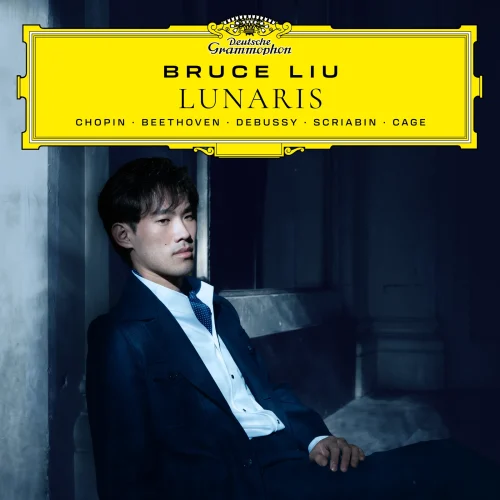
This album by Bruce Liu arrived a few months ago, but my delay will have the advantage of being closer to the only visit the young artist will make in his home province, which will be on October 16 at the Club musical de Québec. Make the most of this opportunity, people of the capital. Liu will also be in Toronto on October 30.
Schedule of Bruce Liu’s concerts
The album itself is constructed as the spirit of the times tends to suggest to all the producers of this world: in an eclecticism justifiable by a guiding principle (a concept) that underlies a certain general atmosphere (a “mood”). There is nothing wrong with that. Unlike other commentators, I won’t spend half of my text grumbling about it, daydreaming unnecessarily about the “good old days” of albums that only had pure and hard sonatas. I don’t have enough time in life to waste it on this stuffy psychological nonsense.
In short, Lunaris aims to be a journey in which Bruce Liu advocates for the exploration of various iterations of the lunar sentiment, whether it translates into “nocturne” (Chopin), “dream” (Cage), or explicitly into Moon (Beethoven, although the true connection is artificial since the composer never himself named his famous sonata no. 14 “Moonlight”….), and so on.
And like any thematic journey, rather than a theoretical or encyclopedic one, the juxtapositions can sometimes be surprising from a strictly musicological perspective. The stylistic grammar, for ultra-picky ears, can be loudly flawed. That said, if we put ourselves in the shoes of an average listener (which is probably 98% of the people who will listen to the album), the inconvenient discrepancies and other stylistic bumps of the proposed journey will have absolutely no impact on the enjoyment of the overall experience, provided that the artist’s investment is both honest and of high quality.
This is generally the case with the pieces Bruce Liu plays here. He begins with an exquisite rendition of Chopin’s Nocturne op.27 no 2, which seems to float on a summer moonlight (forgive the pun). The choice of this Nocturne is not entirely arbitrary, given that Beethoven’s Sonata No. 14 in C-sharp minor, “Moonlight,” which follows immediately, is also catalogued as Opus 27, No. 2. Staying focused.
Liu, consequently, remains imbued with the atmosphere he had favoured in Chopin, beginning his reading of the sonata with remarkable softness, like an ethereal reverie. An aesthetic choice that will not convince the most die-hard, but which has the merit of being in line with the overall theme, and which casts a different light, not bad at all, on this iconic piece. It is in the 3rd movement that Liu sheds his fluffy pyjamas to reveal the prominent musculature of his technical playing. An exciting finale that indicates that the night doesn’t have to be limited to sleepy atmospheres.
Debussy’s Reverie stands in contrast. Perhaps even a bit clumsy, but the lyricism is beautiful under the pianist’s fingers. Next comes a Prelude by Bach, curiously inserted, followed by a pop piece, Tokka, by Agnes Obel, which is more neoclassical. Pretty, like a naive diversion.
A second sonata by Beethoven comes to the rescue, the C major Op. 53, “Waldstein.” Its other rarely used subtitle is “The Dawn.” The connection is forced, highlighting the conceptual weakness of the whole. But, Bruce Liu delivers a scintillating and superbly controlled performance, built with an exciting attention to minute details and lively tempos. One can say what one wants about its place in the program, but it is musically very satisfying.
As with a slight smile, Federico Mompou’s delicate transformation of the famous tune “Au clair de la lune” provides a beneficial counterpoint that any young parent should offer to their child.
The first of Schoenberg’s 6 Kleine Klavierstücke brings a breath of fresh air, a bit nippy even, into the previously muffled atmosphere, while Ligeti’s Etude No. 4 from the First Book intensifies the said draft, making it sharper, under Liu’s super nimble fingers. One can guess that the young man would be quite a brilliant interpreter of this repertoire.
Scriabin’s Sonata No. 4 in F-sharp major, Op. 30, takes us back to dreamlike territory. Liu shows himself receptive to the composer’s mystical inclinations and paints a shimmering lunar tableau.
Like a return to the warmth of a cosy nest after venturing into the cold and barren air, Hivernale, an excerpt from Reynaldo Hahn’s The Bewitched Nightingale, offers a soothing comfort, subtly crafted by Liu. The pianist concludes this journey, ultimately very intimate and personal, with the piece Dream by John Cage. A minimalist piece, based on simple chords that enrich themselves with their mutual resonances, which was composed for a very confidential choreography by Merce Cunningham.
If the logic of the sequences proposed in Lunaris is not always optimal, Bruce Liu informs us, through this eclectic program, that he knows how to touch upon a great variety of repertoire and composers in an inspired manner.
What we will mainly remember is that we would love to hear him more often in Scriabin and Ligeti, among others.