Additional Information
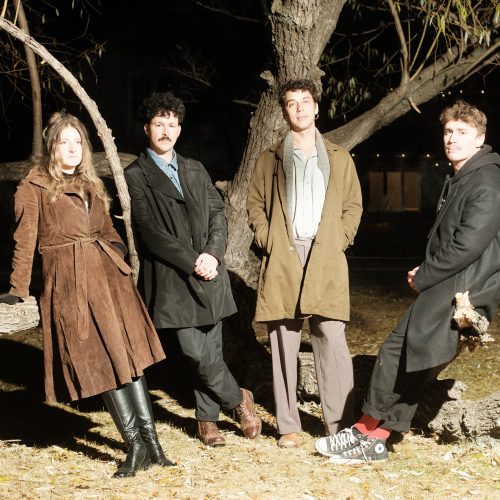
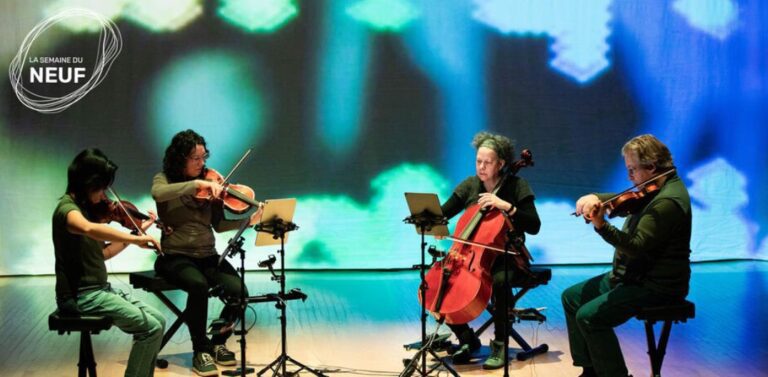
On the evening of March 9, as part of Semaine du Neuf, the Bozzini Quartet invites the Montreal public to a sonic journey built entirely around listening: listening to others, listening to silence, listening to the smallest movements that transform musical matter.
The program features a world premiere by Fulya Uçanok, created during a residency with the quartet, and the Canadian premiere of two works by Cenk Ergün, conceived as a diptych.
Two forms of writing, two gestures, two relationships to time. On one side, the piece Companionning for quartet and electronic processing explores sympoiesis—a form of collective production in which systems evolve together, interconnected without predefined boundaries. This “making-together” blurs the line between instrument and technological device. On the other side, there is a striking face-off between Celare, a microtonal landscape suspended in ancient resonances, and Sonare, a virtuosic surge stretched like a collective sprint.
In line with the theme of Semaine du Neuf 2026, this concert examines movement: movement at the edge of stillness, almost inaudible; movement at full speed, pushing toward exhaustion. Between these poles, one central question runs through the evening: what does it mean to play together today?
We spoke with Stéphanie Bozzini, violist and founding member of the Bozzini Quartet, and the renowned violinist Alissa Cheung about the concert and their creative process.
PAN M 360 : Your work has long been based on close collaboration with composers. With Fulya Uçanok and her idea of “faire-ensemble,” did this residency transform your dynamic or reveal something that was already there?
Alissa Cheung : We knew Fulya’s work and had artists in common, but we hadn’t spent much time with her before. We like to take time with composers to really understand their language and personality. By working closely together, it becomes clearer how to interpret and bring the music to life. The title of the piece, Companionning, emphasizes interaction. Fulya studies this concept in her research: how we work together, between composers and performers. Fulya observed our dynamic, our personalities, and how we react to the sounds we produce, especially because there is live processing involved. The piece is alive, rich in color, and leaves a lot of room for interpretation.
PAN M 360 : That’s beautiful. The dialogue between musicians, and between musicians and machines, is very present. From the beginning of the process until today, what has changed? Were there unexpected moments or reactions that created something new?
Alissa Cheung : The sketches she initially presented to us were more open than the final version. The finished piece is more structured. For example, the management of effect triggers and the timing of events were more precise than in the sketches. That was a surprise, but it doesn’t prevent individual expression. Toward the end, there are more openings in how the melodies can be played.
Stéphanie Bozzini : At first we thought there would be improvised or very free sections, but everything is written. That said, the way it’s written doesn’t feel restrictive at all—it’s very open. Without giving everything away, the form moves toward openness: it starts tight and small, then gradually opens up as harmonies layer on top of each other. With the sound projection, the effect is magnificent. It’s a very beautiful piece.
PAN M 360 : The two pieces by Cenk Ergün are very contrasting, one atmospheric and the other virtuosic. Do you see them as a diptych, with an intentional dialogue between them?
Alissa Cheung : Yes, they were designed as a set. There were commissions connected to the Jack Quartet, based in New York, and I think after their premiere people started to consider these two pieces as a diptych, with the intention of programming them together.
Stéphanie Bozzini : They were written to be played together but can also be programmed separately. They complement each other very well: the first, Celare, is atmospheric. It evolves slowly with microtonal chords and inflections that sometimes recall Turkish music, as well as echoes of early music. The sound is quite classical but slowed down, with a lot of silence and a kind of subtle theatricality—an amplification of silence and very measured musical gestures.
The second, Sonare, is hyper-virtuosic, very fast and demanding, exhausting both for us and for the audience, with two moments of slowing down before taking off again even more intensely. It’s very gratifying to play. Sonare dates from around 2016 or 2017; it has toured a lot, and its premiere in Turkey was an important event. We performed it in Istanbul, and next week it will be the first time in Canada.
PAN M 360 : How did the first performance in Istanbul go?
Alissa Cheung : Very well. We rehearsed with Cenk and he was open to adjusting the score for us. For example, we removed the mutes that dampened the sound too much, and he accepted that the sound would change. We also discussed dynamics: he had many indications of piano and mezzo-piano, but we preferred to write even softer dynamics, to create a kind of echo, a remnant of music. This work with the composer also involved the visual and theatrical aspects of the piece.
PAN M 360 : Could you elaborate on this use of gesture?
Stéphanie Bozzini : Yes. He explained that he is fascinated by string technique and virtuosity, and that he wanted to highlight certain gestures—sometimes slowed down and without sound, but perfectly synchronized. These gestures are subtle; they mark actions we instinctively make when handling the instrument, but here they become scenic elements.
Alissa Cheung : Celare is therefore a very close listening experience, while Sonare is an extremely intense listening experience. For about 11 or 12 minutes it’s almost nonstop, quite loud, and the virtuosity is striking.
PAN M 360 : I’m going to buy tickets for the front row. (laughs)
Stéphanie Bozzini : We played a very contrasting program recently in Madrid: a slow, meditative piece by Jörg Frey in the first half, then Baobab by Femi Bloch, very loud and projected, in the second half. The contrast worked well.
Alissa Cheung : Placing pieces side by side often reveals unexpected connections between them, or between the composers’ backgrounds.
PAN M 360 : Between Celare and Sonare, do you already feel a connection after working so much on these pieces during the residency, or will it take more time for that to emerge?
Alissa Cheung : Sometimes it takes time, even years, for connections to become clear. Right now it’s only been two weeks, so it’s still fresh in our fingers.
Stéphanie Bozzini : That’s the beauty of replaying pieces: you rediscover things, perhaps thanks to other experiences accumulated since the last time.
PAN M 360 : After such a program, how do you feel when the concert is over and you pack away your instruments?
Stéphanie Bozzini : For Fulya’s piece, I felt a lot of gratitude because she wrote it for us and we were able to make it our own quite naturally. After the technical work and the run-throughs, the concert leaves a very good feeling. For Cenk’s pieces, even though they weren’t written for us, they are very enjoyable to play. Sonare is exhausting but very satisfying—you feel energized afterward.
Alissa Cheung : After Sonare I’m full of adrenaline. It took me a few hours to calm down. It’s like being at the Olympic Games: everything has to succeed, every note, in perfect synchronization. It feels like a kind of collective sprint.
PAN M 360 : We talked about this earlier: some pieces require intense performance presence, others a meditative listening. Where does your interest in such contrasting repertoires come from?
Alissa Cheung : We’re often known for soft and microtonal repertoire, but we also like to play virtuosic pieces. These projects push us to develop our technique, our playing, and our musical perspective—not just stay within slow or gentle music.
PAN M 360 : The concert is on March 9. How are you preparing—rest or practice?
Alissa Cheung : We’re going to practice. Fulya is on a research residency in Turkey and can’t be in Montreal, so we’re working with the sound engineer to calibrate the sounds. Today and tomorrow we’ll do technical tests and run-throughs to make sure the patch works. We’re also diving back into the repertoire: over the past weeks we’ve played a lot, including pieces by young composers in England and our concert in Madrid. Refocusing for Monday’s concert is our priority.
PAN M 360 : And upcoming projects—new collaborations or revivals?
Alissa Cheung : For April, I can’t reveal everything yet, but we will perform a piece again. In June, we will participate in a project with internationally invited musicians as part of Suoni Per Il Popolo.
PAN M 360 : That certainly makes us want to stay tuned… It sounds like there are still a few surprises under the lid. Thank you very much, and we’ll speak again very soon about what’s next!