Photo: Elizabeth Smith

PAN M 360: Let’s start with the title, The Emigrants. Using the word “emigrant” obliges a consideration of uprooting and relocation from the other side, what’s given up or left behind, rather than what awaits.

George Lam: I chose The Emigrants as the title precisely because I wanted to explore these individuals’ stories from the perspective of what they left behind, and in turn, why they decided to stay in NYC. I am an immigrant/emigrant myself; I was born in Hong Kong and stayed there until I was 12, then moved to the United States to go to school, and just now I’ve moved back to Hong Kong to take up a teaching position, some 28 years after I left. I think musicians in particular have always been open to new opportunities in different places, both locally and globally. I learned a great deal from interviewing these seven amazing musicians on why they chose to leave, and what they left behind.

PAN M 360: The music you’ve composed is, to my ear, full of conflicting emotions. The same can be said of the voices of the interview subjects, if perhaps more subtly. There’s also a definite sense of urgency present. What would you say you’re trying to express?

GL: By looking at both what lies ahead and what is left behind, there is already an inherent drama in the story, and that is very much what I tried to express in The Emigrants. In particular, I wanted to highlight the drama of the spoken words through repetition and by connecting the speech rhythms with the cello and percussion. I think your description of “urgency” is especially apt here, as uprooting and re-rooting takes a lot of time. For all of us, how many such moves can we make in our lifetime while we are still able to be productive and make art?

PAN M 360: On a more technical note, it’s notable how your music, and the recorded voices, the interview passages, fit together comfortably, neither imposing on the other. Making them work together must have been an exacting process.

GL: I have had a lot of experience in working with words as an opera and art-song composer. With my ensemble Rhymes With Opera, I was able to workshop different composition approaches with our fantastic ensemble of singers, and to explore my interest in recitative. I am especially interested in recitative because of how both the words and music are informed by natural speech. For The Emigrants, I similarly approached the spoken words as a kind of recitative, and where the words can create their own conversation with the cello and percussion of New Morse Code.

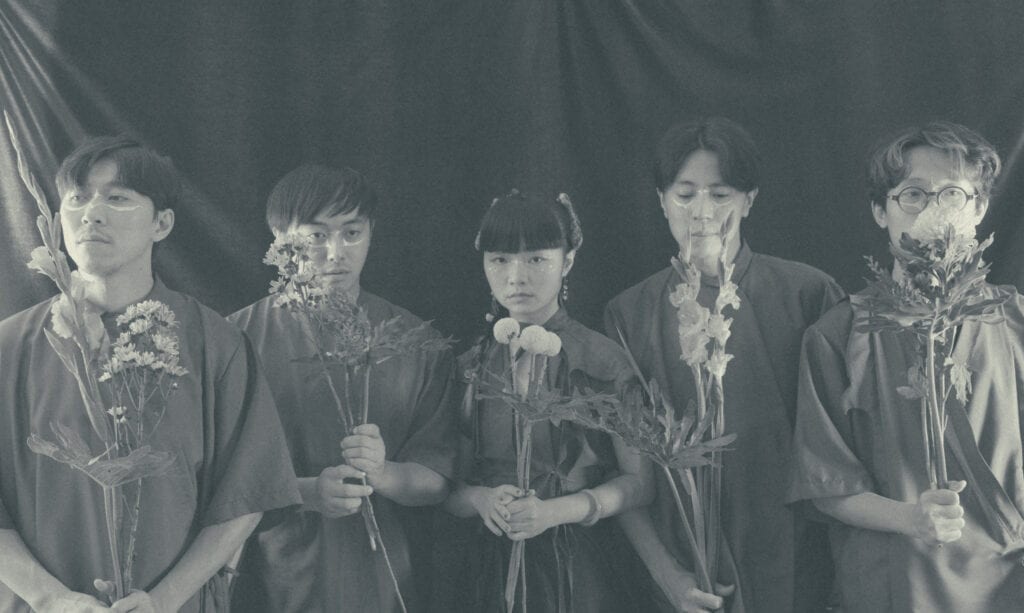
Above: The voices of The Emigrants – Alvaro Rodas, Duo Yumeno, Rafael Leal, Chris Yip, Harold Gutierrez, Nivedita ShivRaj

PAN M 360: The interview subjects whose words and voices you use are all musicians living in Queens. What more can you tell about them, and why they were chosen, or chose, to participate in this project?

GL: When I first talked with New Morse Code about a new piece, I knew I wanted to do a “documentary” work that’s also a piece of chamber music. We talked about different potential subject matters, and ultimately settled on individuals who moved away from home, since it’s a theme that hits close to home for both me and the performers. At the time, I was living and working in Queens, and originally wanted to focus on Queens residents in general. However, as I thought more about how to approach the work, I wanted to hone in specifically on emigrant musicians in Queens, since I have never written a piece “about music” before.

I reached out to a lot of different potential contacts, and tried to find people who are from different places, different cultures, and working on different genres of music. I was very fortunate to be able to include Rafael Leal, a percussionist from Colombia who is also a published author and teacher; Chris Yip, an NYPD officer and pianist engaged with community outreach; Duo Yumeno, a cello-shamisen duo based in Queens; Alvaro Rodas, a classical percussionist and music educator who founded an El Sistema-inspired strings program in Corona; Harold Gutierrez, a composer and teacher living in Queens; and Nivedita ShivRaj, a Carnatic musician and teacher also living in Queens.

For the world premiere of The Emigrants at the Queens Museum in December 2018, we also featured Rafael Leal and Duo Yumeno as performers as part of the concert. All of the interviewees are fantastic musicians, and it’s been a truly rewarding experience to work with them on this piece.

Above: New Morse Code (photo: Tatiana Daubek)

PAN M 360: The Emigrants is performed by the duo New Morse Code. Can you tell a bit more about them?

GL: New Morse Code is Hannah Collins, cello, and Michael Compitello, percussion. They are a fantastic duo who focus on new music in general, but also on developing new repertoire for cello and percussion through commissioned works. I know Michael from my time at the Peabody Conservatory, and was very excited for the opportunity to get to work with him and Hannah on The Emigrants.

Working with New Morse Code has been one of the highlights of my career as a composer thus far; to work with professional performers who not only perform on such a high level, but who also care a great deal about how to connect their audiences with new music, has been especially rewarding. For example, supporters of their Kickstarter project “New Morse Connections” not only helped to create The Emigrants, but also the opera project *dwb*(driving while black) with soprano Roberta Gumbel and composer Susna Kander, and the consortium-led commission of Catharsis by David Crowell.

PAN M 360: Yourself, as well as Hannah and Michael of New Morse Code, and several of your interview subjects, are educators, or involved in pedagogical projects. Do you think this involvement in teaching and learning informed the creation of The Emigrants?

GL: I think our role as teachers, and in particular with higher education in both the U.S. and Hong Kong, absolutely informed our work with The Emigrants. Our experiences very much resonate with most of the interviewees who support their performance careers through teaching. In particular, the second movement of the work, titled Études, features interview excerpts related to teaching and learning, and how both are integral to the musicians’ own growth as performers and teachers.

PAN M 360: What are the plans for The Emigrants, and as well, what can you tell about your project Haptic, with Michael of New Morse Code?

GL: We’ve just released The Emigrants as an EP on all streaming platforms and Bandcamp, and will continue to publicize the piece so that hopefully other performers would be interested in performing it as well – once we can get back to live performances in the near future! For Haptic, this is a new percussion duo that I first developed with Cisum Percussion in 2019, and subsequently worked with Michael Compitello on a revision and a mockup recording. I’m trying something new with the piece’s development; I made the score and recording available on my website and I’m looking for “beta testers” who might be interested in trying out the new piece and giving me feedback. I launched this effort earlier last week, so we’ll see where it goes! 

Photo: Yuji Moriwaki

Minyo Crusaders and Frente Cumbiero are two groups “that come from very similar places,” says the latter’s band leader and bassist, Mario Galeano.

“Our focus is on music, not on commercial gimmicks. We are record collectors, and have an interest in digging into our roots, into traditional music. These are all things we share. Also, we have a common heritage, our ancestors crossed the Bering Strait tens of thousands of years ago and populated the whole continent. That is part of our native heritage. It’s like meeting our long-lost cousins.”

Guitarist Katsumi Tanaka, who founded Minyo Crusaders along with singer Fredy Tsukamoto in 2012, was seeking to hybridize, revitalize, and liberate minyo, the rich tradition of Japanese working-class folk music.

“One of the factors we thought was necessary to bring minyo back to life with a new approach,” Tanaka says, “was to not lose its fundamental vitality. Minyo was originally the music of ordinary people, but over its long history it has gained prestige, and been taken into the fields of art and traditional performing arts, and away from the people, because it has been treated too reverentially.”

The cumbia connection was already established for Minyo Crusaders with “Kushimoto Bushi”, from their 2017 album Echoes of Japan. Other songs on the record drew on boogaloo, reggae, Ethiopian jazz, and more, and the international re-release on the U.K. label Mais Um caught a lot ears worldwide.

“I think cumbia continues to maintain the vitality that minyo once had in the past,” says Tanaka. “They haven’t forgotten that it’s people’s music. That’s what minyo originally had. Different countries do not make a big difference when people try to have fun. It’s a simple and powerful feeling shared around the world. And when I replaced the shamisen phrase in ‘Kushimoto Bushi’ with a guitar, it had the same feel as cumbia. I immediately heard the guiro rhythm.”

Above: Minyo Cumbiero rehearsal (photo: Yuji Moriwaki)

The two band’s time together was a mere two days of activity, but it’s a time neither will soon forget.

“We are always learning, in each interaction with musicians,” says Galeano. “In this case, I have to say we reinforced the concept of how much of a difference it makes when the vibe is in the right place. When people are happy, and faced with the challenge of communicating, the most beautiful things will happen. If in collaboration with someone else, you want your concept to prevail, it’s going to be tough. There is very little space for egos, you need to flow with the group.”

“Through music, I was able to meet many people in Bogotá,” says Tanaka. “Mario and Frente Cumbiero, their community of friends, welcomed us with the best team spirit. Everyone was serious, emotional, and creative. I think that it’s an ideal example of taking full advantage of local characteristics, and working independently.”

Easier said than done, when over a dozen different musicians are involved.

“It was especially tricky from a technical point of view,” Galeano recalls, “but our engineer Dani Michel did a great job. We basically divided the chores between instrumental groups – the horns, the percussion, the harmonic base, the singers. We already had made arrangements prior to our encounter, so it was basically, get in the studio and start playing. After maybe an hour or so of developing the idea, we were confident, so we learned the parts and were ready to record the next day.”

The four-song EP’s first teaser track was a Colombian contribution, which of course earned an injection of Japanese flavour.

“It’s a classic originally recorded by Pero Laza y sus Pelayeros,” Galeano explains, “a cult band from the ’60s who put out some very nice cumbias that are classics today. The original name is ‘Cumbia del Monte’, so it just made total sense to extend the title to ‘Cumbia del Monte Fuji’.”

The most energetic, accelerated number on the EP is “Tora Joe”, in fact a festival song from centuries ago.

“The history of ‘Tora Joe’ is very deep,” says Tanaka, “and there are various theories about it, from the origin of the song to its content. It’s said to be the oldest festival dance song in Japan. Its original title is ‘Na-nya-do-yala’ – ‘nanyadoyala, nanyad nasalete, nanyadoyala’, repeated in the song, doesn’t make sense in modern Japanese. They’re like the words of a spell or incantation.

“Some believe that local dialects transformed it. The lyrics encourage people who are struggling to make ends meet by saying, ‘let’s do anything we can!’, and express the misery of the common people with, ‘I don’t know what is happening in the world.’ There are certain theories that the song is about a woman seducing a man by saying, ‘do as you please’. There is even a theory that it’s a song about Jehovah and David, in Hebrew. In the northern part of Japan, where this festive dance song became popular, in some areas they dance around a cross, which they call ‘the tomb of Christ’. It’s a very mysterious song.

“When you look at the lyrics, they use phrases like ‘Tono-sama (lord)’, ‘the most beautiful woman in town’, ‘celebratory food’, and ‘bright umbrella” – standard phrases often used in Japanese festival songs, which are stories about celebrities, famous incidents, ordinary people’s longings, and wealth, told by ordinary people. It’s said that people of various occupations, who didn’t normally interact, could participate in the nighttime festivals together. The lyrics would create a trigger, an opportunity for those people to be in the same place and release their everyday worries. Therefore, the lyrics have changed depending on the situation, and the wordplay has changed depending on the times. In minyo, there are many songs whose lyrics have been accumulated and passed down to the 100th version.”

“Opekepe”, meanwhile, is in fact a prototypical rap song. The Minyo Cumbiero version goes even further with it, deep into a dub style.

“The song isn’t exactly minyo,” says Tanaka. “It was written in the late 1800s for comedian Otojiro Kawakami to sing on stage. He used the stage name Jiyudoshi, meaning Freedom Kid, as a pseudonym for his anarchic, politically charged art. And at a time when repression was severe, he sang what he wanted to say in the lyrics of ‘Oppekepe’. He was put in jail dozens of times.

“The song has no melody, the rhythm and tempo of the narrative are important, and the lyrics are said to have been improvised and altered, a form similar to rap. Like ‘nanyadoyala’ in ‘Tora Joe’, ‘opekepe’ is also unintelligible, a strange word, like an incantation. Some say it means ‘throw it away’ or ‘let go’.”

The Minyo Cumbiero project is exemplary of a subtle but convincing increase, in recent years, of mutual cultural curiosity between Asia and Latin America. 

“After the Second World War,” says Tanaka, “Japan tried to incorporate cultures from around the world as its economy developed. In the 1950s and ’60s, only certain people could access foreign culture. Even the educated musicians in Japan had no choice but to learn about foreign music by listening to U.S. military radio stations, and the vinyl records they obtained from soldiers. They had an excellent musical education and played Latin music with great dexterity, but with such limited access, every Latin band in Japan had to make ‘Besame Mucho’ part of their repertoire. Latin America was really far away.

“They presented foreign culture as a commodity to the Japanese populace, but I think they forgot to try to introduce Japanese culture outside the country. With the Japanese economy booming, domestic business was probably enough for them. 

Above: Minyo Crusaders in Bogotá (photo: Yuji Moriwaki)

Tanaka happily observes, however, that times have changed.

“Now, not only certain wealthy people, but also the general public, can instantly exchange cultures and convey their feelings with people abroad on social media. Japan should delve into its own culture and present it to the world. I think that sharing the same feelings and emotions, rather than a one-way information intake, will create a new culture. Frente Cumbiero’s work so far is a great example of this.”

Galeano is enthusiastic about any uptick in interaction between the two continents. 

“That would be amazing,” he says, “because we have, for the last centuries, been having to mediate our relations with Asia through Europe, so the more direct connections we can have, the better. There is quite a big underground, invisible, spiritual link between Asia and Latin America, as I say, because of our blood bond. Many melodies sung today by the indigenous Americans are originally from northeast Asia and Mongolia. There is even stronger proof that Chinese ships arrived on the coasts of Peru. The music of Peru and China are two sides of the same coin.”

It seems the same can be said of Colombia and Japan!

PAN M 360 thanks Megumi Furihata for her translation assistance.

Below: Fredy Tsukamoto and Mario Galeano. (photo: Yuji Moriwaki)

Photo: Hendrik Kussin; masks: Carol Almeida 

PAN M 360: The theme of your new EP is mythical lost continents, and you’re releasing it under a different, or perhaps subsidiary, name, DNGDNGDNG. Musically, the tracks are simpler, more skeletal, than your Dengue work. You’ve been reaching beyond nuevo-latino sounds for a while now, but in this case, it feels like you’ve created an update, with modern technology, of “roots music” from places that never even really existed… or did they?

Dengue Dengue Dengue: Yes, this was exactly the approach. Trying to imagine music that came from a lost place, made with ancient technology. We’re always trying to create and fuse rhythms, this time we really tried to push it further, while also keeping a minimalistic style of composition.

PAN M 360: Each of the lost lands that you refer to deserves a little mention, to educate our readers. We’ll start with “Lemuria”, which is supposedly in the Indian Ocean. This lost land is very important to followers of Madame Blavatsky’s Theosophy… one of those weird, artisanal American religions which is kind of a soup of everything, and makes no sense. 

DDD: We read a bit of her work but at one point, as you said, it makes no sense. But the names really have nothing to do with it, these names and concepts were proposed by earlier archeologists, historians, and philosophers. Originally, it seems that Lemuria was hypothesized as a land bridge, now sunken, which would explain certain discontinuities in the distribution of species and ecosystems. It was later adopted by occultists and new-age philosophy.

Above: masks by Jumu

PAN M 360: “Hiperborea” comes from Greek legends of a land far to the north, a cold land of giants and eternal sun. One would think they meant Sweden, but actually, they were talking about Transylvania – in Romania, today – which doesn’t have any damn giants, just lots of vampires.

DDD: Actually, I didn’t see any vampires in Romania, but maybe that’s because Peruvians eat a lot of garlic? Each author who described Hyperborea located it in a different place; some thought it was in between the Transylvanian alps, others in the Artic ocean, and others in the Ural mountains.

PAN M 360: To be serious for a moment, “Atlantida” and “Mu” both refer to places connected to the racist ideas of so many Europeans, that the indigenous peoples of the Americas must have had help from aliens or “the ancient ones” to accomplish the incredible things that they did, pyramids etc. Thoughts on this?

DDD: Just to be clear, we don’t follow these fringe theories blindly, these are concepts that we like to investigate with an open mind, but they are not more than theories. Atlantis was described by Plato originally, in Timaeus and Critias. Maybe these lost continents are an idea connected to ancient, antediluvian civilizations, or more precisely, a global, pre-Younger Dryas, technologically advanced human civilization. A way to represent the pre-cataclysm era. After the disappearance of these lost lands and the massive damage to the rest, humans founded different civilizations that rose from the survivors of that cataclysm. The buildings and monuments they found in ruins got repurposed for their own religious practices. Maybe that explains some of the advanced engineering techniques that were used in the making of some artifacts and monuments in ancient times. We are not saying that everything was built by other people, but rather the same people – back in time.

Dengue Dengue Dengue covers by Davide ‘Dartworks’ Mancini and Tania Brun

PAN M 360: Your releases and merchandise have featured illustrations by Davide ‘Dartworks’ Mancini, whose drawings seem like a cross between legendary metal artist Pushead and psychedelic “visionary” art – beauty and horror at the same time! Can you tell us a bit about working with him?

DDD: Actually, the album Zenit & Nadir, released last year, is the only project on which we had the pleasure of working with Davide. We were on tour in 2018, and in Davide’s hometown in Italy, we played at a very nice festival where he was also participating, showcasing his artwork. We immediately approached him and bought a few of his drawings and asked for his email contact. A few weeks later, we contacted him and started working on a concept for the album. We love his stuff and we are definitely gonna keep working with him on future projects.

Another amazing artist, who designed our first two albums and a few EPs, is Peruvian artist Tania Brun – you should definitely go check our her work.

PAN M 360: Just before Continentes Perdidos, you put out the three Humos EPs, as a kind of retrospective of your first 10 years. I imagine that digging into your archives for this, especially the early material, was like opening a box of old love letters – or maybe visiting old crime scenes. What was that process like?

DDD: To be honest, it was a very quick and logical process for us. We still play all these tracks in our sets, maybe some more than others, but they are definitely always in our digital record bag. All these tracks, for some reason or other, didn’t fit into the albums or EPs we were working at the moment, so we never found a proper home for them, but they were still really meaningful for us – they define certain periods of the project and, were really easy to identify.

Above: Jahel Guerra & Daniela Carvalho; masks: Twee Muizen

Photo: Geneviève Bellemare

For Jordan Officer, the COVID-19 pandemic was an opportunity to realize the extent of the damage caused by the dramatic decline in revenue from physical and digital recordings.

Sales no longer mean much, streaming has become the norm for good, but it still needs to be made economically viable and sustainable for the musicians, creators, and performers who fill the platforms every day. For the moment, streaming revenues are negligible for artists, with only a small minority of them benefiting from it.

“Has my status as a musician declined with streaming? Yes, that’s for sure. Back when you were releasing an album and you could sell thousands of albums, you could plan your life based on one income from performing and one from recording. That doesn’t exist anymore. My fellow musicians and I are all used to that. 

“Gradually, we saw the recording as a tool to make ourselves known. But since the COVID-19 crisis, we’ve realized that it doesn’t make sense to accept the disappearance of income from recording. Right now, we can record albums while waiting for shows to resume… and that could certainly be more profitable.”

Make Streaming Sustainable is the headline of a petition launched by Officer, which collected more than 6,000 signatures before being presented to the House of Commons in Ottawa. Already, Steven Guilbeault, Minister of Canadian Heritage, has shown his sensitivity to the demands of the signatory musicians, who have been mobilized by several Facebook posts by Officer on the issue of streaming. 

https://www.youtube.com/watch?v=EqdtgbKtMWc

How to explain this situation to the Canadian Heritage department?

“I had a first connection with Steven Guilbeault when he was president of Équiterre, because our daughters were enrolled in the same class in elementary school. In addition, my sister-in-law is a lawyer and knows him well. We had virtual meetings with him and his team, we also participated together in a panel discussion on Pénélope McQuade’s show. I found it really interesting that the Minister of Canadian Heritage was listening. I was then able to discuss this with a lot of people, and I am still in conversation with some very committed musicians on this issue. I am thinking in particular of David Bussières, Ariane Moffatt and Laurence Lafond-Beaulne (Milk & Bones).”

Any short-term results?

“It gave visibility to the issue, but not much happened,” says Officer. “Since the pandemic, we’ve been in crisis-management mode a lot to help musicians. As far as streaming is concerned, it’s a longer-term project, we’ll have to change laws, but we shouldn’t wait until later to start doing it. This subject must remain in the news.”

Awareness of this issue is recent for many artists, although others have been reporting on it for years. So why is a Jordan Officer lighting up in 2020 rather than 2010?

“For everyone,” he answers, “the challenges of digital technology are difficult to grasp, it’s still a new reality that remains abstract. For my part, I took the time to understand the streaming issue in order to offer a credible, honest and thoughtful voice. As I researched the issue, I realized that if I brought my voice to the debate, it could help.”

Thus, Jordan Officer has launched a 6,000-name petition that is gathering new members every day, to become one of the leading musicians in this vast issue:

“We’ve tabled the petition in the House of Commons, we’re waiting for the official response… In the meantime, we’ve seen other emergencies, that of accompanying musicians and technicians, not all of whom are eligible for assistance programs. I, for one, am fortunate enough to be able to apply for grants and propose projects. Generally speaking, it’s difficult, whether at the provincial or federal level. Elected officials are doing their best, I think, but…so much is happening at the same time.”

We know that the Canadian government is relying on a much-awaited OECD report on the issue of streaming. Ottawa could then clarify its position and affirm it on the international scene.

“In Europe,” Officer recalls, “there are laws in place to collect royalties on smartphones, computer hard drives, and anything else used for permanent or temporary storage. Other countries have started to find solutions to the issue of GAFA taxation but… every country is afraid to act first, fearing retaliation from the US government. 

“Already, however, the Justin Trudeau government could correct the Harper government’s mistakes, among others, on the private copying regime – which provides for levies collected on the purchase of blank media, CDs or cassettes, which are then redistributed to rights holders. However, this regime has not been updated for digital equipment manufacturers. The regime should normally be adapted to new technology media that allow information to be stored or streamed. Tens of millions of dollars could then be paid to artists.”

So this is a very complex problem overall, still far from being solved. Officer is well aware of this.

“I don’t know if there’s an easy solution to submit. For example, streaming sites don’t make a lot of profit, contrary to popular belief, but it’s still very profitable for other players in the industry, including Internet Service Providers who sell their services at high prices. So we are selling these Internet accesses for culture, but we avoid the responsibility of paying the artists. It seems to me that when these companies have profit margins of around 50%, we are entitled to demand royalties. Even in the context of the pandemic, we don’t always see how the money from new government support is getting to the artists. We want more transparency.”

Collective rights societies (SOCAN, etc.), artists’ unions (UDA, Musicians’ Guild, etc.) and other organizations such as Regroupement des artisans de la musique (RAM) are multiplying the number of performances to win their case. 

Jordan Officer sits on the Board of Directors of Artisti, a Quebec collective management society representing performing artists. However, on the issue of streaming music, he is more or less going it alone, speaking on his own behalf and leading the petition file tabled in the House of Commons.

“I think the RAM is doing a very good job on this issue, but I’m not directly involved with this organization or any other organizations speaking out on this issue. Will I? At the moment, I feel that I have more impact and credibility by speaking out as an individual, as myself. I may be wrong, but that is my impression at the moment. But I certainly want to collaborate and contribute to moving this important issue forward.”

Photo: Geneviève Bellemare

Normally based in Montreal, Jordan Officer was reached in Tadoussac, where he was completing the construction of a cottage with his family.  

“ I love this place! We’ve been here since the quarantine in mid-March. The albums were recorded in February, just before all this…”

At the beginning, says the musician, the idea for the three albums came from questions others had about him. How should we label him? Jazz? Blues? Country? 

“It annoys me a bit because these three styles are the pillars of mine. For a long time, I’ve had this desire to mix these influences, and develop a language of my own. But I’ve also often felt that I was depriving myself of going deeply and completely into the repertoire of each. By doing so, it would also be a way of explaining and clearly expressing these three paths within me.”

Officer even sees it as a statement.

“If I go all the way through those three genres, I can get away with it and then do what I want, and not have to explain myself. I want to be prolific, I want to do collaborations, I want to make instrumental albums, I want to express who I am as a musician. Making these three albums also means opening the door to several different projects.”

This justifies in particular the titles of the releases: Blues Vol.1, Country Vol. 1, and Jazz Vol. 1

Drummer Alain Bergé (Jean Leloup, Youssou N’Dour, etc.) and keyboardist François Lafontaine (Karkwa, Marie-Pierre Arthur, Klaus, etc.) take part in the blues and country recordings.

Photo: Geneviève Bellemare

“I’ve been playing with Alain for five or six years, we have a very strong connection as friends and musicians. He’s a force of nature on the drums. It’s like John Bonham playing Bob Wills! Alain suggested I work with François Lafontaine when I performed at the Montreal International Jazz Festival last year. I knew François, I knew he made great music, but I wouldn’t have spontaneously thought of him for my music and… it was an incredible thing, that night. I was surprised and charmed by him in our blues and soul interpretations, but I was also impressed by his organ playing in the country style, a bit cheesy, a bit old-fashioned. It was magical! We wanted to work together again, and I wanted to integrate him into this project. » 

Local Americana veterans were also invited to this celebration of excellent American music:

“Stephen Barry plays bass on the blues album because he is a friend and mentor. He’s my father’s age, 73. He has been very important to my career. Michael Jerome Brown also plays the harmonica. He was Susie Ariloi’s second guitarist for a while. We know him as a guitarist, but he also plays the harmonica so well! He releases solo albums and tours with bluesman Eric Bibb, for whom he’s the main accompanist. I met him at the time at the G Sharp, now Barfly.”

This is an opportunity to recall Officer’s immersion in this fascinating world where playing and composing are part of an almost musicological approach.

“Michael Jerome Brown and I both have this tendency. I remember his apartment before it burned down in the late ’90s, it was a museum. Michael had thousands of LPs. He used to make me tapes, and I’ve got suitcases full of them. He fed me so much blues, he’s an incredible resource! I was lucky enough to know a few people like Michael. I also think of Bob Fuller from Hillbilly Nights at the Wheel Club. I used to go there every Monday with Stephen Barry. We would sing and play there. Like Michael, Bob has mountains of vinyl records. His girlfriend was forced to store some in her backyard under a tarp (laughs)! Today, I understand my mentors for having accompanied me in my discoveries, because it’s very exciting to be able to transmit this passion and this musical richness to younger people, which is what I’m doing now.”

For the jazz part of the triptych, Jordan Officer chose to express himself with a trio.

“Sage Reynolds, who’s been playing with me for several years, could have been the bassist for the jazz project because he’s a great musician. But this project was also a great excuse to record with others than my regular band. That’s why I chose Morgan Moore on bass, an artist who really inspires me. I love everything about him. Like drummer Rich Irwin, with whom I’ve always had a great connection, we have a mutual appreciation. It was a perfect opportunity for this collaboration. As for pianist Torey Butler, it was such a great fit!  There are some incredible jazz musicians in Montreal, it’s hard to choose!”

Photo: Geneviève Bellemare

The songs and pieces on the programme are mostly classics composed in the previous century.  Old music? Officer confirms, and adds nuance. 

“The repertoire of these three albums is to tell my story through these versions. I wanted it to be a kind of musical autobiography. Also, a tribute to all the musicians and composers who have been part of my career. I’ve been playing several tunes from these three albums for a very long time, and they come from very special moments in my career and my life. Notably ‘Pennies From Heaven’ and ‘Honeysuckle Rose’, which I did with Susie Arioli during those years when her band was my main activity. In blues, I cover ‘My Baby’s Gone And Left Me’, which I’ve been singing for 25 years. I also play the music of Clarence White, a bluegrass guitarist who joined the Byrds and died very young in a car accident. I also pay tribute to violinist Harry Choates, a Cajun musician who was also very Western swing in his improvisations. His version of ‘Jole Blon’, often referred to as the Cajun national anthem, is great!”

Officer is totally embracing his old-school side. Nevertheless…

“I’m not trying to recreate music from another era. I still want to be me in 2020, and express myself as I am, like nobody else. I listen to music that has nothing to do with my music but that has influenced me in another way, in the arrangements, in the approach, in the space. That’s part of my playing. I try to be myself when I improvise in blues, country, or jazz. On these three recordings, I played with the same guitar, the same amp, no effects, just to show that it’s really me all the way through. I don’t feel like I’m making a switch from one style to another, jumping from one universe to another, it’s all connected. For me, it’s a source of pride. I don’t imitate anyone, I’ve always been attracted by subtlety and the use of space, emotion, nuances and also extravagance, virtuosity, a certain aggressiveness. These qualities can be felt in my role models, such as Ti-Jean Carignan, Charlie Christian, or Django Reinhardt.”

It must be deduced that Officer is not so much a traditionalist as a “classical” artist of American popular music, the foundations of which are perfectly familiar to him. 

“When you listen to contemporary jazz or country music, they can be considered very separate. Yet these styles were invented side by side, there were a lot of mutual influences at the beginning. That’s why I’ve always had a hard time listening to artists who have gone through all three styles. You listen to 78 rpm records and you discover certain songs which you don’t know whether they’re country or jazz or blues before the middle of the performance. Let’s take the example of Bob Wills, whose song ‘Playboy Chimes’ I play on the country album – his Western swing was so jazz! That connects to what I’ve become.”

The second half of our interview with Jordan Officer appears on Saturday (July 25th)

Photo: Milos Jacimovic

Moving from Hamilton, Ontario to New York in 2017, Lanza had to come back from her European tour at the start of the outbreak, but was unable to return to her home. So it was in the San Francisco area, where she was in quarantine with her lover, that PAN M 360 reached her.

PAN M 360: Did your new life in New York – you’d always lived in Hamilton – have any repercussions on your music or on yourself?

Jessy Lanza: It affected my life in really good ways, but it was tougher than I’d thought. I didn’t handle it very well and found that I was homesick, and felt really isolated and disconnected. So a lot of the songs for the record were written while I was feeling that way. But at the same time, I started doing this residency at The Lot Radio in Brooklyn, which is a really great radio station in a shipping container. After I started doing this monthly show there, I started meeting people, inviting some artists to the show and that opened up a whole world of producers and DJs that I always admired but never met. So it was a huge turning point for me because I felt much more connected and that felt really nice.

PAN M 360: On this album, like your previous ones, you refer to difficult feelings and anger – can you tell us more about that?

JL: It’s not very apparent because the songs are mostly joyful, with catchy hooks and bouncy basslines. But I think it’s a tension that runs through a lot of my music. I’m really always writing to try to drag myself out of this pit of feeling depressed. It’s so easy for me to get pissed off and be sad (laughs). But making music is what helps me get out of those feelings. So I always try to make music that is the opposite of how I feel. I think with always that in mind, that’s how I approach the songs. 

PAN M 360: Is the whole album informed by that kind of mood?

JL: Yes. I think the problem for me is that I feel really angry about a lot of things a lot of the time, but I don’t want to be an angry person (laughs). So I think that’s why I’m always working through that opposition in the songs. Because I want to work my way out of feeling that way. So it’s all over the album, but it’s definitely not apparent. 

Photo : Milos Jacimovic

PAN M 360: You’ve been collaborating with Jeremy Greenspan (Junior Boys) since your very first record, Pull My Hair Back (2014). How do you explain this longtime complicity, what brought you together?

JL: Jeremy is my favourite person to work with. He did all three albums with me. But this time it was a bit different because we were not living in Hamilton together. So I drove back and forth from Hamilton to New York quite a few times over the last two years for this album. Jeremy doesn’t get precious about ideas, he’s very curious and loves experimenting with equipment, and so do I. And so we’re really getting into the fun aspect of doing a lot of takes, editing stuff. I don’t know what he likes about me, though (laughs). I think we both love songwriting, despite the genre. It could be a Loggins & Messina song, or a new Don Toliver number, or some new R&B stuff. What we both have in common is that we really like hooks and pop music, whatever genre it’s been put into. 

PAN M 360: You’ve often admitted that you have doubts about your vocal abilities, that you’d like to have that big voice that some R&B and soul singers have. Is that why you prefer to pass your voice, however delicate and pleasant, through a whole range of effects?

JL: I think it comes down to a personality thing. I’m a bit of a spaz. I have trouble getting to the point. It’s in my nature. Even if something in a song is fine, I just cannot resist the temptation to fuck around with it (laughs). And also I have a lot of fun with effects. It’s fun to experiment with a new pedal that I got or a new bunch of plugins that I wanna use. But yes, I do have trouble leaving things alone. Maybe it’s because I’m impatient? That’s the best way I can explain it (laughs). 

PAN M 360: Plans for the near future? Even though it’s hard to have plans in these strange times…

JL: I have a bunch of remixes I did for a few friends, it should be coming out in the next few months. There will be some remixes for the new album that should also come out in the next few months. Since I’m not going on tour, I might as well work on some new music, so I might put something new out, maybe pretty soon, because there is not much else to do!

Tragic, funny, disturbing, strange and sometimes even moving, the ineffable performer Bernardino Femminielli leaves no one indifferent. Although he left to try his luck in Paris in 2019, it was in Vancouver that we located the colourful character, in quarantine with his wife, muse and collaborator Thea and their dog Poulet. Back in Canada for an indefinite period, the Montreal artist spoke at length about the reasons for his move to Paris, his worries and questions, and his mini-album L’Exil, four experimental French songs that serve as a kind of prelude to two other albums to be released in the coming months. 

PAN M 360: You recently returned to Canada – what was your experience of the COVID crisis in Paris?

Bernardino Femminielli: We were in Paris during the whole lockdown, without ever leaving the city. I found it really intense, but we lived it well because we stayed productive. We were able to finish a lot of the stuff for the album, edit videos… It gave us a break from the Parisian drive, and a lot of other things too. It gave us a break from the Parisian drive, and a break from the rest of the world as well! We’re in Vancouver for a while, but I don’t know for how long. The idea is to go back to Paris, but our plans are still a bit vague. We’re keeping one foot here and one foot there.

PAN M 360: Tell us a little bit about L’Exil. Although it’s a prologue to two other albums that will follow, it’s not quite one itself. And is it a mini-album or an EP? Because, although there are only four songs, it’s still 40 minutes long!

BF: Let’s say it’s a mini-LP rather than an EP. It’s a pre-conclusion to a trilogy and not a prologue, because the two other albums, which haven’t been released yet, were recorded before L’Exil. I was looking for what to do with these two albums, and it wasn’t easy with this transition between Montreal and Paris. I wanted to find the right angle, the right way to present these two albums. So L’Exil became both a gateway and a conclusion to the whole process. It’s all based on new sessions of Plaisirs américains, on which I’ve taken a different tone and lengthened. I gave myself more time to tell a story, in a more personal way. I think the four tracks on L’Exil corresponded well to what I was looking for, in terms of emotion. Something dense and visceral, but also something with good sound quality, songs that the listener would have no trouble getting into.

Despite the experimental or abstract side of these songs, there’s something seductive and bewitching about them. It’s a lot less glamorous than Plaisirs américains. The album has a very political and personal tone. It’s practically the diary of someone who’s relearning to live on a daily basis, and who wants to deprogram himself for having suffered the misfortune of a corrupt system. The album takes stock of my past life and the despair I was experiencing in order to achieve artistic success. I talk about success but I’m aware that success is not something palpable and immediate. I learned to look at success as a struggle to become a better person, one who understands his abilities, strengths, and weaknesses. I fought to get my lucidity back, and I hope I will keep it. 

Crédit photo : Grisha Burtsev

PAN M 360: This exile from Montreal to Paris is the basis of this album – it was not an easy start. You had problems with the American legal system, your adventure in the restaurant business (Bethlehem XXX/Femme Fontaine) ended badly, and maybe you felt misunderstood as an artist here? 

BF: This album is like a synthesis of many traumas. It’s the story of an entertainer who’s starting to lose his mind because his restaurant is sinking, he’s being screwed by everyone. He’s naive, he lacks experience, but he’s cunning. Except he’s too generous and people take advantage of him. His livelihood is doing his one-man shows, performing, touring, which allows him to exorcise his demons. I named this character Johnny. He’s a bit of a clown, a tragi-comic character. So, this Johnny, it’s a way of dividing myself in two and being able to express my life from another angle. It can also be a fragmented projection of myself and my problems. So, his life goes adrift and at one point he decides to run away with his wife. This exile is also a mental exile.

But the important thing behind all that is to learn to make peace with yourself, with your demons, with your frustrations with the music world and the capitalist world. Bethlehem XXX was originally an anti-restaurant. It was a place of experimentation where one could freely invest oneself in the form and thought of performance. Then big financial problems killed the Beth, but not the spirit, whereas for La Femme Fontaine, it was gradually the spirit that was poisoned by business and pretension. Despite the efforts you want to put into it, to have a restaurant or a business in Montreal is to live amid organized corruption, theft, mediocrity, sabotage, and indifference. A lot of big talkers, small doers… I believed in community, but individualism always takes over. It was time for me to take a break from all that. As I’ve always loved Paris, as I’ve always been welcomed there, and people there seem more receptive to my work, that’s where I chose to settle down. It’s also more convenient for me to travel around Europe and present my shows, make contacts, create opportunities. What I want is to be able to live from my art as I see fit, without having to make compromises, and in Montreal, that was impossible. Anyway, I don’t know what I would do if I didn’t do that!

PAN M 360: What is the borderline between derision and sincerity in your work?

BF: “The ideal is to have a poetic relationship to life, to everyday life, and not to need a stage to practice it.” I find this quote from actor Denis Lavant very inspiring. I play with grotesque stereotypes – the pathetic, oppressive macho man and the debased, giggling, intoxicated gigolo dancer. The audience is invited to laugh at these characters and ultimately condemn what they represent. I try to explore the character from the outside to the inside. I like to bring the style of the double act in my performance: the grotesque contrasts with the sympathetic character, where both make political and social statements to the audience and one shows the other, even though I’m alone on stage. I try with all my strength to always be as convincing as possible. I think that what people feel is something honest and frank. 

For the fourth time since 2011, the year of her arrival on the international scene while working in the New York studio of Sufjan Stevens, who had recruited her for his label Asthmatic Kitty after the release of her EPs Sanguine (2006) and Florine (2009), Julianna Barwick is releasing a new album, Healing Is a Miracle, which follows Will (2016), Nepenthe (2013) and The Magic Place (2011).

PAN M 360: During the last four years, after Will’s release and before Healing Is a Miracle, you’ve been working on different projects. Tell us about the music you composed for dance.

JULIANNA BARWICK: I had just moved to Los Angeles in 2017, after living in New York for 16 years. I was then asked to make music for the Ballet Collective, kind of a side project by dancer and choreographer Troy Schumacher of New York City Ballet.  He wanted to have me on stage performing with the dancers, and I’ve never done that. I had worked with dancers before, but I had never created original music, in this case a 35-minute piece. At first, I told Troy that I would love to do the music but there was no way I would play it live. 

The dance company just scared me too much, because all of the ballet dancers were in the New York City Ballet, I was way too intimidated.  But they asked me to try rehearsing with the dancers. I’d been encouraged to try, my friends told me that would be a memorable experience, and I tried it and we ended up giving three performances in New York. That was an incredible experience! It was kind of nice for me. It was a real challenge for me to move to Los Angeles, but I was very happy to be often in New York in 2017.

PAN M 360 : In 2018, still in New York, you worked with artificial intelligence to carry out a very special project: music constantly renewed by ambient sounds, captured in real time. Tell us about it.

JB: I composed music for the Sister City Hotel, with the Ace Hotel and Microsoft teams. On the top of this hotel, there was a camera reading information from the sky. Those images and sounds – birds, airplanes, or whatever – were filtered through a Microsoft artificial intelligence program. This program triggered the sounds that I had made previously and generated an ever-evolving score, nourished by its environment. Then we took some inserts from that and we created a recording of it, and then we released, in 2019, an EP called Circumstance Synthesis.

PAN M 360 : You grew up in Louisiana before moving to New York to study and live for 16 years – why are you now in Los Angeles?

JB: For so many reasons. First, I love the weather. Also there are a lot of composers and musicians out here. I have a little house here and it’s so quiet – I can record without sound irritants. In Brooklyn, there was always noise from outside, but I miss walking around the city. I need to walk… it is just the magic of New York. But L.A. is more quiet, the nature here is insane… forest, mountain, ocean, redwoods, desert… so much inspiration around here.

PAN M 360 : Last year, you started making music again for yourself, but also with artists who are friends. Let’s start with Jónsi de Sigur Rós, tell us about this collaboration in the context of your new album, for the song “In Light”.

JB: I did record in Iceland in 2012. Jónsi and I became friends, then I toured with Sigur Rós. I was, and I still am, a huge fan of Sigur Rós and his solo work. The best voice ever! Jónsi lives in L.A. now, I asked him if he wanted to sing on my record, so he agreed. I sent him a music demo, and then he told me that I would have to write lyrics. Once again, I’ve never really done that. So I said okay… anything Jónsi asks me to do, I answer yes. I sent him back this song and he recorded his part with his own production. It came out as an entirely new, wonderful collaboration. But it made me very nervous and it took me out of my comfort zone. You know, I like one take, do kind of improvisation and piece the parts together, I don’t spend too much time on it. So it was a huge learning experience for me, I’m so proud of the song that we made together.

PAN M 360: You have also worked with Nosaj Thing, an excellent producer, DJ, and composer of electronic music and experimental hip hop, based in Los Angeles. He’s released some very interesting albums on the Innovative Leisure and Alpha Pup labels. How did you connect?

JB: He and I had been in touch when I was in New York. We exchanged emails and infos, and I finally met up with him in L.A. Initially, I imagined working with him on this entire record. But he was super busy – he has his own label, he also DJs, he works with so many people, on and on and on, so it was very difficult to work with him a lot because of his schedule. Anyway, I sent him some music, same kind of deal with Jónsi. I brought him the stuff and he added some beats on it, and I put some keyboards over it in the studio. So that was a similar process, but this time I didn’t have to write lyrics.

PAN M 360:  Originally from Asheville, a small town in North Carolina that’s become an important hub for neo-folk and neo-folk-rock, harpist Mary Lattimore has released five albums since 2013. She’s worked with Thurston Moore, Jeff Zeigler, Kurt Vile, and Steve Gunn, among others… and most recently, with you. 

JB: Yes. Mary and I are very close friends, we both live in Los Angeles and we toured a lot together. I also did a remix of her record, a couple years ago. She is so amazing, I always wanted her playing on my records. I made that song “Oh Memory”, then she came over to my home studio, we did around ten takes of her playing along with that song. She’s classically trained, she did amazing things for this song. That’s how that happened.

PAN M 360: Even if one observes a tangible evolution in your music, don’t the original basics remain the same?

JB: Yes, we are in the same country. Some songs on the last album are of the same type as those of my debut. But on the other hand, Healing Is a Miracle has totally different songs. For example, what I did with Jónsi is very structured, almost pop, close to the song form. So I feel like it’s a sort of mixed bag.

PAN M 360 : To fully understand Healing Is a Miracle, one needs to know the basics of your work, so we have to go back to your professional beginnings. Tell us about it.

JB: Okay. In 2005, I started recording, after tinkering around with electronics, electric guitar, loop pedal, and my voice. I started feeding those loops and recorded it on my four-tracks recorder. I made my first master, but I didn’t really know what I was doing. I just worked with what I had, and I released my first EP in 2006. Then I got a computer and I bought Garage Band software. I taught myself and went to SoHo for free Apple Store Garage Band workshops. I released a second EP, and after that, I recorded on Asthmatic Kitty.

Instead of doing a bedroom recording as I did before, I used Sufjan Stevens studio while he was on tour. There was a piano, a drum set, other instruments… that was The Magic Place! And next thing I knew after this, Alex Somers sent me an email to record my next album with him in Iceland. So I had to get out of my comfort zone, and recorded with guests and other people watching me. Alex had an amazing home studio and we also went to the studio where Sigur Rós recorded. That was a huge 180 for me. So every record has been a step for me, in one way or another. That’s been my journey.

Photo: VonPleid

PAN M 360: How and why did this idea for such an ambitious project come about?

Navet Confit: It’s a project I had in mind for a long time. It obviously takes a lot of time to go through 20 years of recordings of all kinds. I used to do bits and pieces here and there when I had the time in the last few years, when I used to go through an old hard drive to find a lost file from a session, but I’d never delved into it as deeply as I did during the quarantine. The studio where I usually work closed for two months; I moved home with a few instruments to create, but the morale was not there. Suddenly having that much time in front of me gave me a complete overview of my archives, and it made it easier to finish the review and compilation work. Since 2000, I’ve recorded a lot, an awful lot! I don’t write the music down, my way of remembering what I create is to make a demo of it. There have been times when I’ve been able to write two or three songs a day and still have a full-time job! Even during that period, which goes back 15 years, I’d start a recording with the idea that one day a new song might come out in that form, because you never know where the recordings are going to end up. I’ve always taken care to record in a “semi-broadcast” quality (according to my standards as a sound engineer and mixer at the time, of course), so I think this project has been around since I’ve been making music. And the 20-year-old Navet is very happy that it’s finally coming out.

PAN M 360: How many songs are we talking about, altogether? When was the oldest one from? And the most recent?

NC: I think it’s 103 songs in all. I could have forced myself to make a round number. I’m sorry! The oldest tracks are from 2000, when I did a kind of eponymous demo for my friends at Christmas, homemade. The pieces “Moi aussi”, “Cancel = Skip” et “Sans titre encore” are from it and are all on volumes 1 and 2 of the Nostalgie Incubateur series. The piece “Moi aussi” is the first track by Navet Confit with lyrics (it was already very minimal). The most recent material can be found on volume 3 of the same series: these are b-sides and mock-ups of my last “real” album to date, Engagement, lutte, clan et respect (2019). Several songs were still incomplete, so among other things I added vocals on “Morts pendant le confinement”. I did the same with the Elton John cover, “Daniel” (on Covers de rêves), for which I finished the translation and recorded the vocals (with Émilie Proulx, remotely) during quarantine. The instrumental version of the song had been around for a few years, recorded for a theatre show, but never used.

PAN M 360: Was there anything you hadn’t listened to for a long time? Did you rediscover things you had underestimated in the past, where you thought, but why didn’t I play this or that? How did it feel to go back to those songs or music you had left behind?

NC: It’s crazy because music is a real machine for travelling through time and space. I found stuff I didn’t even remember having recorded. I’ve also been able to observe my reflexes as a composer, chord forms, types of melodies that come back over the years. But above all, it put me back in the state I was in when I recorded those pieces, in which apartment, in which studio… The compilations of theatre music also put me back in the context of the productions they were made for, made me think about the people I worked with, the directors who guided me and so on. I’ve also rediscovered more youthful things that I’m going to keep to myself; and through it all, funny and heartbreaking memories. But my choices have always been clear for my albums, so there’s no “I should have”.

PAN M 360: Why did all these songs never end up on disc, or any other medium?

NC: I tend to take responsibility for my choices and let go quite easily. I release a lot of albums and EPs. I have a lot of freedom in my sound and in my releases, among others thanks to my label Lazy at Work (Galaxie, Fuudge, Zouz). If this material hadn’t been released before, it was for a good reason and there was no existential crisis related to these decisions (laughs)! It’s not an easy repertoire that is found on these 10 albums. It’s really very eclectic and it can be very demanding to listen to. That’s why I suggest moderation… These are complementary universes which, a bit like my many EPs, throw a different light on the official albums. You shouldn’t press play expecting to be knocked over. But I think they go well together, these tracks, and I’m happy to release them all at the same time rather than separately on official albums. In the case of the theater-music compilations, the answer is more obvious: these pieces were not intended to be on albums in the first place. Releasing them in this way gives a glimpse (or a listen) of my “ambient” side that isn’t very present in my other productions. It’s a style of music that I like very much, and that lends itself well to the stage, its very minimal side blending perfectly with a supporting role, behind the script and the acting.

PAN M 360: How long did it take you to listen to it all again, make choices, and put it all together? Were the choices difficult? Did you have any help?

NC: As in many of my projects, I didn’t calculate my time, but I could just say – a lot. It’s a job I did quite alone, but over the years, I had often made compilations on records I burned for my friends; it had already oriented me towards what was best. The hardest thing was to compile the songs together, to make pacings that stood together. In terms of choices, it was pretty simple: what irritated me at the time (musically, in the voice or in the mix) still irritates me today. As soon as I wasn’t proud of something, as soon as something got stuck and it didn’t serve the overall understanding of the exercise, it was rejected. We change a lot over the years and the world changes too. I’ve rejected a lot of things, like lyrics that haven’t aged well or songs where I hadn’t yet found my voice or my way of singing in French.

PAN M 360: Have you reworked, remixed, or remastered some tracks?

NC: As I said before, I sometimes finished recording some pieces during the quarantine. I didn’t have access to all the multitrack sessions (I used to record with an old beige PC and pirated programs), so in some cases I couldn’t remix. In other cases, I added a bass here, recorded a voice there, and so on.

For the theater compilations, I had to remix quite a lot, the relationship to the sound in the theater being very different from the one on the album (“Nyotaimori”, for example, was originally quadraphonic when it was presented at CTD’A). Jean-Philippe Villemure did a colossal job of mastering the whole thing! He won’t say it to me, but I think I drove him a bit crazy.

PAN M 360: Are there any others left? Could you have made more than 10 albums if you had wanted to?

NC: I think I could have made at least five more albums with what I have left! You have to know when to stop in life, don’t you? On the other hand, I plan to continue the Monsieur Confit au théâtre series (I do two or three theatre productions a year, that’s a lot of recorded music) and Nostalgie Incubateur.

PAN M 360: Tell us about this virtual show you’re presenting on July 13.

NC: It’s a fake Facebook live show of about 25 minutes with my beloved Von Pleid (camera, motion design and editing) and my great friend Martin Lachapelle (motion design and editing). I was inspired by what I saw on the Internet at the beginning of the pandemic, the live shows, the famous Zoom aperitifs, which lasted a maximum of two weeks… Like theatre people, I believe that “going digital” or “reinventing oneself” doesn’t mean putting a fixed camera in the room and playing. That’s not how I see the adaptation of the performing arts to the digital format. If our content is artistic, then I think at the same time the container has to be artistic as well. So I resisted doing live shows from my living room with my acoustic guitar – frankly, I wasn’t tempted to do that at all – and instead, I thought about how to make the show without an audience more stimulating. I don’t denigrate the artists who lent themselves to the Facebook live game, on the contrary. I find them very brave to have presented themselves like that, without artifice and in rudimentary conditions. But I believe that it was a temporary solution in response to an emergency, and not a new path to take in the long term. So this show is very weird, very “treated” visually and audibly, and I put a good dose of my dubious humour in it. I’m fortunate to have collaborators who understand (and add to) this humour – Von Pleid did the cover art for Justin Trudeau Kinda Party, among others, and Martin did my live video projections. I perform seven or eight songs. There are some more literary, narrative bits, and some really intense visual moments. We worked a lot with green screens and saturated images. This is my first video production. To the team, we added a cameo by Martine G, president of Lazy at Work, my label. I think it’s really cool to work with a label that encourages me in my nonsense instead of repressing it. That’s also true of the many atypical releases I’ve made with Martine since 2013. 

PAN M 360: Can you describe in a few lines the history of each of the 10 albums, and how they were subdivided?

NC: Throughout all this, there are two series among others: Monsieur Confit au théâtre (volumes 1, 2 and 3), which compiles the music for the plays Nyotaimori, Yukonstyle and La femme plus dangereuse du Québec and Nostalgie Incubateur (volumes 1, 2 and 3), which compiles B-sides, demos, studio scraps and other experiments (a lot of stuff dating back to the beginning of 2000, instrumental and quite experimental). There’s also the concept album Aquaforme, which is mainly made up of samples of toilet, sink and guitar sounds. I’ve compiled a lot of covers accumulated over the years on Covers de rêves. There’s also a “living room show” called Bruit de fond, recorded between two albums (LP1 and LP2). And finally, a dance record (!) – the Skydancer EP (if you’re able to listen to the whole thing, I’ll pay you a compensatory sum).

PAN M 360: If you had to choose one song/music per album for a playlist, which ones would it be, and why?

M. Confit au théâtre vol. 1 / Nyotaimori: “Yoga”
It’s a track that wasn’t used in the show, but I liked it very much. It’s kind of a tribute to the melting sound of Boards of Canada, and it’s a very long, meditative, hypnotic piece.

M. Confit au théâtre vol. 2 / Yukonstyle: “Raven Requiem”
A very solemn and colourful piece, built around a mellotron, composed of samples of the voice of one of the actresses of the show, Jasmine Chen. It’s really deep. Ha ha!

M. Confit au théâtre vol. 3 / La femme la plus dangereuse du Québec: “Vulgaires siamois / Freakshow”
David Lynch meets Sonic Youth? I discovered the poetry of Josée Yvon with this show (read her work, that’s an order!). It was hyper-inspiring. And trashy. Of a great, messed-up beauty. The tracks of this album were built from a kind of jam with myself, you can hear it clearly on this track.

Nostalgie Incubateur vol. 1: “Moi aussi”
It’s the first real “song” by Navet Confit, that is to say, the first time I put vocals on one of my musical tracks, in 2000. It sets the tone for the rest.

Nostalgie Incubateur vol. 2: “JP fait de la musique”
I really like the comfortable/uncomfortable atmosphere of this track (which also has a reinterpretation later on the same album). I think it’s my first real tentative effort in electro-wallpaper.

Nostalgie Incubateur vol. 3 / Engagement, lutte, clan et rejets: “Blues plate”
…Just so you can imagine Émilie Proulx playing drums on it! Ha ha!

Aquaforme: “Aquaforme Part I”
It’s a weird concept album made mostly in one night. The Aquaforme suite (Part I to V) can be listened to when you come home late from a party, a bit drunk.

Covers de rêves: “Le monde est fou”
I never thought I’d sing Plamondon one day! That’s what I was invited to do, when I was on stage to accompany the authors at the 50th-anniversary evening of poetry from Les Herbes Rouges (a great publisher). Covered by Renée Claude, this song is inspired by the poet Huguette Gaulin (read her work, that’s an order!).

Bruit de fond: “Ambulances”
The embryo of a track that was later released on LP2, there is a certain fragility to this version, and a bit of a rough side to the interpretation that serves it well. 

Skydancer EP: “Combien je veux être avec toi”
I think it’s officially the most wonderfully disgusting song I’ve ever had to record in my entire life! It was part of Simon Boulerice’s show Javotte and I’m lucky enough to be accompanied by Larche, in autotune mode, and Erik Evans of Canailles rapping.

Photo: Von Pleid

For Rufus Wainwright, Unfollow the Rules is a return to pop music after a long neoclassical hiatus. In 2015, Deutsche Grammophon released the recording of the opera Prima Donna, composed by Wainwright in 2009. The following year, the German label released Take All My Loves: 9 Shakespeare Sonnets, a unique reinterpretation of the famous sonnets that the great American director Bob Wilson incorporated into a play of his own conception.

Four years later, Unfollow the Rules was born at the end of a loop initiated and completed in California. Well established in the world of composition for musical theatre, why did Wainwright return to more pop forms?

“I was still in mourning for the loss of my mother,” Wainwright begins. “I was ready to compose another opera after Prima Donna, I’d adapted Shakespeare’s sonnets and so I went off into the classical world. I had an incredible time, and I will return as well to opera, down the line… if we still have a planet.”

More precisely, Wainwright has seen the curve of his passion for song oscillate over time.

“All along my journey,” he explains, “I kept writing songs and I developed over time a profound appreciation for where I came from. Maybe I have been a little jaded about that, but after I’d taken a bit of distance and done my classical work, I was able to reevaluate where I came from. And then I wrote a lot of songs, quite enough to make an album. I replenished my enthusiasm for the world of pop, where I’ve spent most of my life, and enjoyed it a lot.”

This return to pop music coincided with his migration from Toronto to Los Angeles.

“I spent time with my daugther in California, we bought this house in L.A., some anniversaries started to occur – the 20th anniversary of my first album that I did in L.A., the 76th anniversary of Joni Mitchell that we celebrated here, and me returning to California – with that kind of end of a chapter, there was a tale to be told.”

To frame this formidable story segmented into twelve songs, Wainwright set out in search of the ideal producer.

“There were discussions with several producers and then, when I sat with Mitchell Froom, I knew immediately he was the guy for the job. The album started to get made. One of the things about Mitchell was his work with Randy Newman. I know Randy, I spent a small amount of time with him, but I did not immerse myself in Randy Newman until then. I listened to his records and it really did blow my mind – in a good way! I’m now a huge fan of his, I kind of admire him at the moment. Then, working with Mitchell Froom brought me close to that ideal. Thus this album was born in respect for the tradition of music-making in California.”

Mitchell Froom isn’t just anyone. Apart from three albums with Randy Newman, he’s done three with Crowded House, four with Bonnie Raitt, not to mention Bob Dylan, Paul McCartney, Tracey Chapman, Richard Thompson, Cibo Matto, American Music Club and Suzanne Vega, to whom he was married. Remember also the Latin Playboys, an avant-roots group he formed with Chad Blake and two members of Los Lobos in the ’90s. What was his approach with Rufus Wainwright?

“Mitchell wanted me to continue this tradition of ‘fabulous Rufusness’, to stage these grandiose and very elaborated characters I’ve imagined over the course of my career. On the one hand, he didn’t want to temper me. On the other hand, he wanted clarity, directness, simplicity. He wanted to highlight my eccentricity, to respect my knowledge, but he also cared about what people want to listen to or not.

“He was very attentive to what was going on at the heart of the songs, he wanted everyone to understand them. Yes, I’ve worked with a lot of producers over the years and they’ve been fantastic in one way or another, but I have to say that Mitchell is the best at exploiting the full spectrum of my music.  I’ve made records that are so amazing, but you don’t want to listen to them all the time (laughs).  But this record appeals to you, you really want to listen to it.”

Wainwright takes a moment to summarize a few of the album’s tracks.

“‘Alone Time’ is the least produced song, probably the greatest elegy of California, heavily based on Brian Wilson’s techniques, the last song time to capture this sunny melancholy that the state has so much of. Right now, this song is so poignant and meaningful!”

“Damsel in Distress”, he says, “is an homage to Joni Mitchell, whom my mother very much disliked, and kept saying she was a kind of a fraud. My mother was a real purist, she loved the real folk music.  She had a valid opinion but she was also very jealous (laughs). So Joni Mitchell was fobidden in our house. And then years later, Jorn [Weisbrodt, his husband] became a huge fan, he celebrated her 70th birthday at the Luminato Festival – where he was the artistic director. We became friends with Joni, and I discovered her world for the first time at an older age. And so came my homage to her, musically. This song isn’t about her, but about her vibe.”

“This One’s For The Ladies (THAT LUNGE!)”, Wainwright explains, “is one of those Mitchell Froom moments, it’s what he’s done for years in his production. It’s not Laurel Canyon at all, it’s more ’80s Ohio or something (laughs). But I’m so happy that we got that in. Mitchell worked really hard on that background.

Unfollow the Rules is an epic journey which I take the listener through. It’s one of those incredible panoramic journeys of this music inspired by Laurel Canyon in the ’70s, through which, with this piece of music, you can be totally carried away to this fantasyland, you can be transported into your own imagination. There is depth and also darkness in this music.”

Here’s another bridge between classic pop and chamber avant-pop, between generations and styles, between pop and classical music, courtesy of Rufus Wainwright. We know him to be a prodigy of creative pop, a sort of Cole Porter for our time, and one that is also based in a great family tradition.

“My new album is a continuation, but also the final product of a long process. During all these years, I didn’t struggle or play too much with words and sounds, but… I sometimes caught the tiger by the tail, or found myself in an imaginary and crazy country. Some people have been there and some haven’t. But it was always an effort for me to get there, and this time I landed. The journey is coming to an end, I am not necessarily confident but I am at peace. Musically, a little more. I am at the end of an era, I also consider it the beginning of a new one. So watch out! I have to get to the very end to get to the beginning!”

Unfollow the Rules, a title of circumstances? The very opposite of Trump’s base, which is resolutely anti-quarantine as we know, Rufus laughs even louder at the end of the phone.

“More seriously, this does not mean breaking the rule, but to examine it carefully before acting. Every morning of this pandemic, we wake up and feel very strange. It is hard to imagine anything more dramatic than this. And with this horrifying president, we thought this mandate would end by an election, and… it ends by a plague! Fortunately, some state governors in America, I think California or New York State, make the best of people.”

As for live concerts in front of an audience, they are obviously postponed for the moment…

“We’re assessing the situation on a daily basis. When I come back, however, with my group of five musicians, I will insist more on music than on theatricality. Having said that, I might become exasperated after five months of touring and we’ll do more eccentric and exuberant things again. I can afford to stop in this context, it’s not ideal but it’s important. 

“There will be much more to do. When I start the next cycle, a French album will be important in this process. I’d like to make an incredible album, off the beaten track, and for now, Unfollow the Rules is the end of the first act of my career. I hope to have three of them!”

Photo: Erick Faulkner

PAN M 360: Tell us about this new project. Who and what are Les Éditions Appærent?

Jesse Osborne-Lanthier: Pierre and I have been talking for a long time about starting a label to have a platform to help the community of artists around us. I was working for another label [Halcyon Veil] with our other partner Will Ballantyne, and then things went sour. So Will, Pierre, and I joined forces to start this new structure. Asaël Robitaille, who has been working with us for a long time, also joined the team.

Pierre Guerineau: We’re a whole team of friends and collaborators who’ve been working together on various projects for several years, and we wanted to pool our efforts. Every time we complete a project and release an album, we look for a label to work with, be they Italian, English, or New York labels, but often it’s not really our aesthetic, we have to deal with agendas, make compromises, so we wanted to have a platform that would allow us to represent our work, our aesthetic, and be in control from the source to the release of the record. To control all aspects, from composing to recording, mixing, design, and distribution development. So it’s a way to gather our strengths, and have something that reflects us.

PAN M 360: What are the objectives in the medium term?

PG: We already have a lot of things planned. We’ve got L’Exil, Bernardino Femminielli’s album, which will be released on July 14, and will give a sort of theatrical view of his exile from Montreal to Paris. So this record will be the first volume of a trilogy that will be released in 2020 and possibly 2021, we’ll see how it goes. There’s also a movie he made, in addition to all the videos. It’s a film that lasts a good hour. In the future, we’ll also develop something other than music. For example, Marie [Davidson, Guerineau’s girlfriend, with whom he’s teamed up in Essaie Pas] is currently writing a poetry book, and I’d also like to develop something with Madison Dinelle, Jesse’s wife and photographer. Otherwise, we have an artist from Cairo, MSYLMA, who’s going to release something excellent that we can’t wait to share. We also have bela, a Korean artist who lives in China. And right now we’re working with Montreal’s Anna Arrobas who released an EP that I mixed last year, and we’re talking about developing something with Alex Zhang Hungtai [aka Dirty Beaches, featured on the Feu St-Antoine album]. We also have a project with Heith, one of the founding members of Haunter Records, who lives in Milan… We have a lot of projects. Stylistically speaking, our vision is very broad, it goes from electronic experimentation to more dreamy pop stuff. We don’t restrict ourselves, we really go for it. So we’re pretty much in line for the year 2020 with all this big family.

PAN M 360: Let’s get to Feu St-Antoine, your first release on Appærent. The name of this project, which has been circulating for some time in Montreal, refers to the collective hallucination phenomena – and severe pain, similar to burns – that entire villages suffered in the Middle Ages following the ingestion of ergot from rye bread.

PG: Yes, I’ve been doing live performances under that name for the last two or three years. There’s a track that came out on a compilation, but this is really the first album I’m doing solo. I started composing the songs about three years ago and I’ve continued to do them occasionally without having the concrete intention of making an album, it was more like experiments that I was doing on my own in my spare time. After a while, I started putting the pieces together and finding an aesthetic that seemed coherent, to build an album. It really comes from a personal approach. It was an opportunity for me to try out new things in terms of composition and composition techniques. I think it’s music that really passes through the prism of memory and childhood memories. In fact, I dedicated the album to the memory of my mother, who passed away. So it was a work of reconnecting with a part of my identity. And I think the result is more emotional than what I’ve done in the past. I’ve always liked developing the hybrid side, with more acoustic or pseudo-acoustic sounds like string samples or guitar samples, so as to create a universe between something more electronic and something more kinematic or contemporary in terms of sound. The idea was to have a music that was both dreamlike and nightmarish at the same time, which comes more from my unconscious than my cerebral side. 

PAN M 360: A word about the title?

PG: It’s from a poem by Emily Dickinson that I thought was very beautiful and it goes like this – “Water is taught by thirst…”

PAN M 360: Was this record a kind of outlet for you?

PG: I learned a lot from making this record. I’ve been making music since I was really young, but I think I was really struggling, I was accumulating one demo after another without ever feeling like it was good enough to share, so in the end, it seems a little bit absurd because a lot of my job is to help people finish their album, to go from the demo to something fine-tuned. I’ve learned through this album to find my own language and finalise something that is worth sharing. But it’s thanks to the advice and support of those close to me, Marie, Jesse, Asaël, and all the people around me who’ve been involved in this album that I’ve been able to make it happen.

Photo: Jocelyn Boulais

PAN M 360: What made you want to record a concert?

Hugo Lachance: We wanted to show our presence on social media. Initially, the goal was to record a song to put on YouTube, just to offer a performance during the pandemic. Eventually, the situation evolved and the project grew to become a one-hour show in two parts. 

PAN M 360: I liked it, the editing of the images makes your performances dynamic. I have a hard time watching a TV show for 45 minutes, and I wasn’t bored! 

HL: That’s the fun you’re talking about, because it was really a goal. In doing this project, I decided to use my skills as an editor and director to offer something different, even if it’s not live. The goal was to use the advantages of editing to make a slightly different show, one that offers a diversity of images. It also allowed us to integrate small interviews. I didn’t want to fall into the music video or the documentary. When the opportunity to make a video came up, we decided not to just do a one-song project. So, yes, it was important for us to offer different and diverse content, to make the show work better.

PAN M 360: It reflects the personality of WD-40.

HL: Ah, that was important! The world of Alex [Jones, bass, vocals, lyrics] had to rub off on the project. It’s fun because in 6” 1, you can see everyone’s universe. Alex’s world is always very colourful, with spots of light, and smoke. We get a little bit into our personal lives.

PAN M 360: Is “Route 170” the song you wanted to put on YouTube?

HL: During the project, I suggested to Alex and Étienne [“Jean-Loup” Lebrun, guitarist] that they do a solo song, and I told Alex that it would be cool to have a new one. Since we couldn’t rehearse and come up with something very elaborate, Alex came up with an idea that had been on his mind for a long time: to do a cover of “Route 66” by Depeche Mode, but adapted to suit WD-40. He sent me what he’d recorded, I added the drums and then the guys [Étienne and Pat Mainville, guitarist] added the guitars. “Route 170” isn’t a new official song that will end up on an album, it’s the little treat we managed to cook up during the pandemic. It sounds silly, but it’s a complex project and it wouldn’t have been possible if the guys hadn’t participated 100%.

PAN M 360: What was the hardest part to do, the part where you’re each at home, or the recording of the concert at Musicopratik? In the second case, you had to comply with the many guidelines of COVID-19.

HL: These are two completely different worlds. With 6″ 1, it was easier to have some control, because we had given ourselves a way of doing it: everyone filmed themselves with their iPhone. On the other hand, 6″ 2 was like a roll of the dice. It took a lot of organization. We stood crosswise in front of each other, we brought all the phones we had at home to film. For example, I filmed Alex with my iPhone, he filmed me with his iPad, Étienne filmed Pat and Pat filmed Jean-Loup. We put several other cameras in the corners, I even used an old VHS camera I had! Jocelyn Boulais was also there, filming with a camera on her shoulder. Alex, Étienne, and I were in charge of the cameras and Pat was responsible for the sound. Alex was also responsible for the lighting. We had to adapt on location.

Photo: Jocelyn Boulais

PAN M 360: where was the song “Te souviens-tu Jean-Loup?” on 6” 1 shot ?

HL: In the yard at Alex’s house. He lives in Saint-Hubert and he has a big yard with chickens. Knowing him, I knew he’d like the idea. As for Pat, he’s at home, on his balcony, to add the guitar tracks. All this allows us to see the band from a more intimate angle.

PAN M 360: There are some songs in there that you haven’t played in a long time.

HL: Yes, we mostly do our own classics, but we’ve taken the liberty of revisiting songs we rarely do live on stage, like “Je veux vivre dans la forêt”, “Te souviens-tu Jean-Loup?” and “Ton corps qui brûle”. 

PAN M 360: Your last album, La nuit juste après le déluge… dates from 2017, can we expect a new record?

HL: What’s coming up for WD-40 is a solo album by Étienne. The pandemic allowed him to move things forward. For WD-40, the fact that we got together to do 6″ allowed us to see that we were getting bored, and it gave us a new taste for working together because we’re able to do it and we like it. I’m not announcing anything, but maybe there will be something new for the band. 

FIND OUT MORE

Subscribe to our newsletter

Inscription
Infolettre

"*" indicates required fields

Type of Suscribers