Additional Information
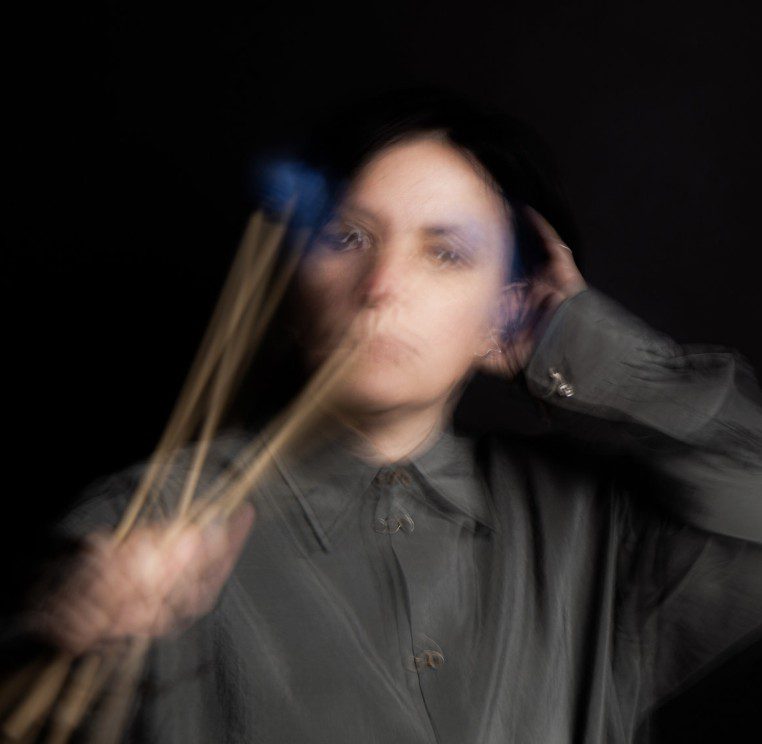
Without a doubt, Valentina Magaletti has become a prominent figure on the exploratory continents, including the MUTEK community, which is giving her a lot of visibility this year. An Italian native of Puglia (Apulia) in the south of Italy, she has been living in London for many years, where she is involved in a host of projects, including those presented here this week. Between sound checks and other professional obligations, she agreed to talk to us about her career, her current collaborations, and her approach to percussion in all the contexts that interest her: acoustic, electric, and electronic. Alain Brunet met with this extremely dynamic musician, who clearly has a gift for ubiquity.
PAN M 360: What you do is very interesting: you explore many different types of music and you play in a context that is very different from that of most high-level percussionists.
Valentina Magaletti: Yes, I did have an academic education.
PAN M 360: Classical or jazz?
Valentina Magaletti: I studied both. I studied a lot of jazz when I was younger, and then I studied classical timpani and other orchestral percussion instruments, such as the marimba/vibraphone that I use in my concerts. But let’s say that the approach and main objective of my practice is to deconstruct all these different forms of training. Over time, I’ve realized that the power of music doesn’t come from classical or jazz training, but from a continuous energy that you have to feed off of. And especially with percussion, I think that’s essential. So, I stray pretty freely from anything academic and draw inspiration from my experiences, what I listen to, and my interests in different types of music.
PAN M 360: As a player, can you explain how you deconstruct?
Valentina Magaletti: It’s a somewhat abstract and unpretentious process. My idea of deconstruction is based on challenging conventions while taking into account my playing environment. For example, when I give a concert, I try to go somewhere other than where the audience thinks I’m going. And then I take them in a completely different direction than the one they expected. By trying to avoid being a derivative, conventional, or predictable product, I engage in deconstruction.
PAN M 360: That said, you use musical references from jazz, classical contemporary music, and modern percussion, not to mention rock and the rhythms promoted by electronic music transposed to instrumental percussion. You also explore the vibraphone and other small percussion instruments. That’s where you take us.
Valentina Magaletti: Yes. I like to express myself on the ground for real or on stage; I need to be organically connected to the place where I’m going to perform. I also have the primary intention of capturing something that belongs to everyone right away.
PAN M 360: A desire for communication and accessibility without neglecting exploration, in a way.
Valentina Magaletti: And that’s what I love about percussion. There’s no filter between me and my academic background or my supposed talent. With drums, you can change the energy on stage!
PAN M 360: It’s understandable that you seek to innovate through your playing strategies, whereas most virtuoso percussionists innovate through technical prowess in a more conventional context. So you stand out in different contexts, such as your sets at Mutek, where people don’t necessarily have any prior knowledge of drumming. That’s pretty cool for you, isn’t it?
Valentina Magaletti: Yes! I was lucky enough to kick things off on Tuesday, and I was very honored to be the first to perform at this edition of MUTEK. I applaud the organizers’ decision, and I really appreciate it. I’m very pleased with the audience’s reaction and how everything went.
PAN M 360: When you work alone, how do you work with all the tools at your disposal?
Valentina Magaletti: When I started performing solo, it was a kind of acoustic journey. Then other sound elements and musicians became part of my compositions. Rather than evaluating me exclusively as an instrumentalist, people began to evaluate me as a composer and producer. People would say, “Oh, I really like this song, I really like this rhythm,” so I thought, why not create a kind of collage between what I had pre-recorded and what I was playing live, which seemed more complete to me. So I recorded my concerts, thinking it would be more complete to add something else. Especially since I’m a multi-instrumentalist, which allows me to offer a whole range of music that I’m capable of playing or producing.
PAN M 360: You mentioned the first concert in Montreal. What about the other two?
Valentina Magaletti: I’m playing quite late tonight, Wednesday, I think it’s midnight, alongside the fantastic Dutch producer Upsammy. We’re working together on an album that will be released this fall. It’s very exciting, so we’re presenting this material at the SAT, a sort of pre-recording of the album. With Upsammy, I’m working on drums and vibraphone, and she’s handling the electronics.
PAN M 360: Your colleague suggests sounds to you, but can you tell us a little more about his own creation and your relationship with Upsammy? How do you question each other?
Valentina Magaletti: It’s very simple, it’s a dialogue. We have different areas of expertise, mine is acoustic, his is electronic, and we try to establish communication, a dialogue between us.
PAN M 360: Do you value different types of percussionists, styles, and criteria for virtuosity?
Valentina Magaletti: Not really. There are so many! Please understand, I am an insatiable listener, I appreciate and admire so many musicians. My listening is always evolving, recordings and concerts, it’s a constant, ongoing process. There’s nothing interesting about settling into habits.
PAN M 360: Absolutely. Our tastes are constantly evolving through our discoveries and learning experiences.
Valentina Magaletti: And that’s why I’m also a record collector. I don’t always have time to browse in stores, but I see that in Montreal, there’s a lot of disco, funk, and dance music. I’ve been to a few shops and found some very interesting things, like dancehall, for example. I’m also a big jazz fan, and I hear a lot of jazz in Montreal.
PAN M 360: Yes, indeed, Europeans are familiar with Montreal’s disco reputation, which dates back to the 1970s. Montreal’s nightclubs and discos were conducive to DJ culture, which is closer to Europe than North America. Well, much less so now, anyway.
Valentina Magaletti: Yes! I visited a few record stores and found some very interesting and varied stuff, including a 7-inch dub record.
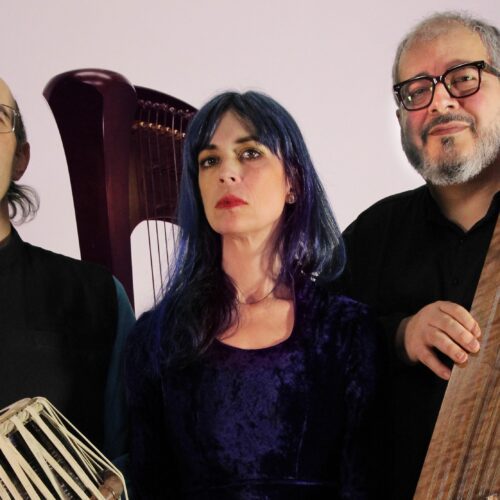
PAN M 360: Speaking of dub, you’re also going to play with Holy Tongue, with your colleagues Al Wotton and Songamin. A sort of London power trio?
Valentina Magaletti: That’s right! It’s more conventional, easier to understand, because I would say it’s a kind of live dub. If you’re familiar with dub, you’ll notice lots of elements that are reminiscent of the dub way of producing sounds, amplifying them, or adding reverb. It also has that old English post-punk vibe, which went well with dub. And it’s great to dance to!
PAN M 360: Your The Tumbling Psychic of Joy Now, which also features Sam Shackleton, is also jazz in spirit.
Valentian Magaletti: This collaboration with Shackleton has been very important to us. He joined the trio on stage a few times. We have just finished composing the new album, which I am very excited about because I think it is absolutely magnificent.
We will play a few of them at the SAT.
PAN M 360: Let’s talk about your relationship with Susumu Munkai, aka Zongamin, and Al Wootton. Tell us how this artistic relationship was built and how it has evolved.
Valentia Magaletti: I’ve known these guys for a long time, and I’m very picky when it comes to choosing my collaborators. Susumu Munkai is one of my favorite bass players; it’s a lot of fun to play with him—also with our duo VZ (Valentina and Zongamin), we made an album together. He’s also an incredible producer, and the same goes for Al, who I always played with when we shared the same programs back in the day. Then we launched the Holy Tongue project as a duo, after which I contacted Zongamin to join us.
I work with them a lot, and we share similar values when we’re in the studio. It’s always a pleasure to work with them.
PAN M 360: Do you still play a lot in strictly instrumental contexts?
Valentina Magaletti: Absolutely, yes, whenever I can. Solo, duets with cello or trombone, ensembles with guitar, anything is possible! I’m involved in so many wonderful projects. So when I’m not touring, I make music on my own or with others. I’m always open to collaborations, especially with other women at the moment. That’s my priority right now.
PAN M 360: For some, talking about sisterhood in music may have become a cliché. However, it is far from being an obsolete topic!
Valentina Magaletti: Yes! I understand this perception of cliché. It’s worrying… We currently live in a world where it’s really difficult to talk about anything without being judged or denigrated. And that’s very disappointing. When it comes to women and music, there are still a lot of prejudices and a lot of sexism today. We have to acknowledge that.
PAN M 360: You’re a real fighter!
Valentina Magaletti: Thank you, I appreciate it! I do my best. There are always forces that try to hold back your artistic impulses and diminish what you do. And we just have to not let that energy overwhelm us.
This Thursday at Nocturne 2, Holy Tongue will be performing at 12:15 a.m.