Additional Information
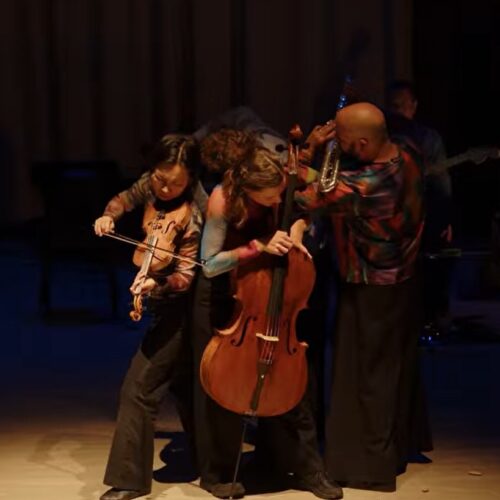
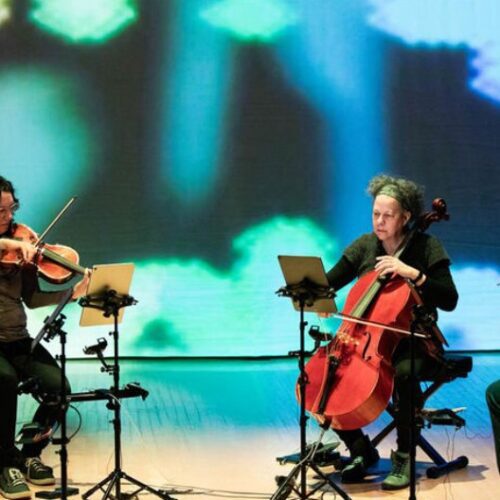
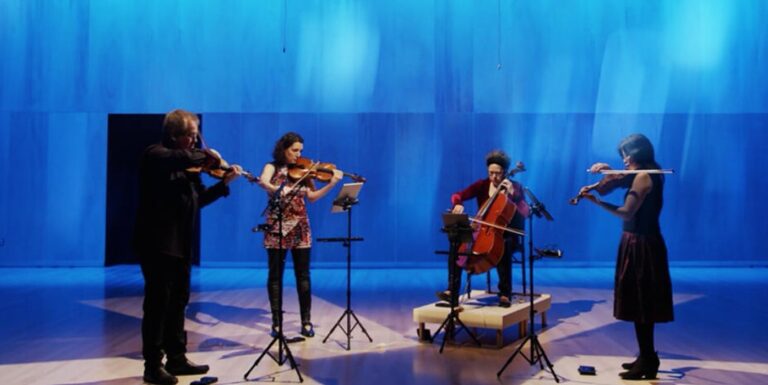
Big weekend for Bozzini! The Montreal quartet will perform twice in collaboration with Le Vivier. On Saturday and Sunday at Espace Orange du Wilder, we are treated to two packed programs, extending the quartet’s 25th anniversary celebrations until the twilight of 2025. Cellist Isabelle Bozzini and violinist Alissa Cheung help us dissect the material presented in the two concerts.
PAN M 360: So, first up, on October 18, at the Espace Orange at Wilder, at 7:30 p.m., there’s the Brook, Di Castri, Miller concert, featuring, of course, the three Canadian composers who are on the program. Their works this year are 2025: Vinetan Songs by Taylor Brook, Delve by Zosha Di Castri, and Three Songs by Cassandra Miller. So, ladies, tell us about the basis for this program.
Isabelle Bozzini: These are three artists we have known for a long time. They are three artists who have lived in Montreal, studied in Montreal, and worked in Montreal. In Cassandra’s case, we worked together, even at the Bozzini office. We’ve known them since the mid-2000s, a good twenty years. Emerging at the time, they are now established composers, you could say.
We have a long-standing relationship with Cassandra Miller in particular. We worked with her at Composers Kitchen in 2009, then another quartet in 2011, another in 2016. And now this is the fourth. We also have a recording of her music. She is truly a collaborator we greatly appreciate, who is also very close to us in our work.
PAN M 360: How did you work on this particular piece?
Isabelle Bozzini: For Three Songs, she had us sing. We’re together in the same studio where we are for this interview. We were with Cassandra, and she asked us to sing songs from our youth, or songs we sang to our children. She often asks us questions like, what kind of music do we like? What was the first concert we ever went to that made an impression on us? These questions are very personal, they encourage sharing. I think that’s also reflected in her music.
PAN M 360: How do you approach this piece as a performer? What are the challenges? Any examples?
Alissa Cheung: In the first movement (Angel), the second violin dialogues with the other three instruments. The second violin is somewhat of a soloist.
PAN M 360: In that case, who is the second violin?
Alissa Cheung: That’s me. In the second movement (Claire), it’s mainly the cello and viola that play the melody.
PAN M 360: You vary your roles from one work to another, don’t you?
Isabelle Bozzini: Yes. In Brook, Clemens (Merkel) is number one. In DiCastri, it’s Alissa. It’s very folky music, based on songs. It’s in Cassandra’s style: she treats the material in a slightly folk way, but the form is treated in a contemporary classical way. It’s interesting where she goes with that.
These are often works that require a little patience and development. For us, therefore, the challenge is to bring this music to life, within the calm or length that it imposes on us.
Alissa Cheung: I find Cassandra’s music very accessible because the material is very melodic, very lyrical. The way she works with the material is very clear; you can hear it. So there’s nothing hidden, nothing mysterious in her constructions. In the third movement, for example, the two violins and the viola are in canon. Then the cello becomes like the lead guitar, all pizzicato.
PAN M 360: Let’s move on to Taylor Brook’s work.
Isabelle Bozzini: Taylor Brook is also someone who did Composers Kitchen around 2010, I can’t remember exactly. In any case, he’s in the same vein as Cassandra. But it’s a bit of a coincidence that he also wrote a series of songs, Vinetan Songs. He’s into science fiction, and his works evolve in imaginary worlds. This time, he started with this kind of mythology of Vineta, an underwater city in the North Sea, something like that. And then he wrote us a series of songs inspired by this imaginary world.
PAN M 360: And what about Zosha Di Castri?
Isabelle Bozzini: We didn’t commission songs from anyone; it’s a coincidence. In the case of Zosha Di Castri, it was a series of tableaux in which she plays with the timbres of different mutes. It’s veiled, muffled, then comes back very open at the end. In a way, it’s like a series of tableaux, it’s also like a series of five movements—four with mutes and one without a mute.
Alissa Cheung: But there are also different materials used in each movement, so it’s hard to say exactly how many sections there are. So at first glance, it’s less segmented. With Zosha, it’s our first commission. We’ve wanted to work with her for years, but it was never the right time. Then she became a professor at Columbia University, and her work is being performed all over the world, especially her orchestral pieces. We think she has a truly unique voice. And she has a very collaborative way of working. And for me personally, we come from the same city—Edmonton.
PAN M 360: Why call this specific program the 25th anniversary program when all your 2025 programs are called that?
Isabelle Bozzini: Because the very first concert we gave in a Montreal series was on October 20, 2000. So, since our programs are presented on October 18 and 19, we thought, well, this is an opportunity to mark the occasion. The 25th, yes, because of October 20, but also because we have three major commissions that we co-commissioned with Le Vivier and international partners—Darmstädter Ferienkurse, Time:Spans, Earle Brown Music Foundation, Soundstreams, Huddersfield Contemporary Music Festival, and Gaudeamus. With Bozzini, there are seven of us who commissioned these same works.
PAN M 360: So it is a pool of organizations that jointly finance the commissions for these works.
Isabelle Bozzini: Yes, absolutely. Miller’s play was premiered in Darmstadt. Then we did the premiere of all three, the first official premiere in New York in August, and then we revived it in Zosha Di Castri at Gaudeamus. So this is the third time we’ve performed Cassandra and Zosha, and the second time we’ve performed Taylor. These are the Canadian premieres. These works are only three months old. It’s exciting!
PAN M 360: There is still a risk involved in the results! Even if we like the composers in question, that is no absolute guarantee of success.
Isabelle Bozzini: That’s true, but we’re lucky, these compositions are really interesting and very varied, making for a well-balanced program. The first performances went very well, in any case.
PAN M 360: On Sunday, October 19, at 7:30 p.m., in the Orange Room of the Wilder Building, you will present the Composers Kitchen program. The program includes works by Julia Mermelstein / Brush, Nikolaus Schroeder / Freeze Piece, Lucie Nerzi / Pour Quatuor Bozzini, and Corie Rose Sumah / We, To Be So Transformed. Remember that Composers Kitchen is a springboard for young composers, and here’s another batch!
Isabelle Bozzini: Yes, it’s the 20th batch. So, we’re celebrating 25 years of QB, but we’re also celebrating 20 years of Composers Kitchen, and 5 years of QMP (Québec Musiques Parallèles) this year, so we’re celebrating multiples of 5! And in this case, it’s in exchange with Gaudeamus. For over 12 years now, we’ve been doing an international exchange around Composers Kitchen. So, two Canadians and two others from the host country. This year, the two composers live in The Hague in the Netherlands, even though they’re not Dutch nationals—Nikolaus Schroeder is American and Lucie Nezri is French. It’s always one of the highlights of our season. It’s always a stimulating discovery for us.
PAN M 360: First, Nikolaus Schroeder.
Alissa Cheung: He writes a lot of multimedia pieces. So this piece is another example of his work. In this case, there is a tape and a video. He wanted to comment on the history of string quartets. So he used images and quotes from classical music for string quartets in his work.
Isabelle Bozzini: Julien Mermelstein is someone we had already worked with at Bozzini Lab about ten years ago. She comes from the Maritimes, lived in Toronto for a long time, and now lives in Sutton. She is a composer who is really into sound exploration. And she has a certain amount of experience, having written pieces for several ensembles in Canada for 12-15 years. I don’t know how to describe it, but I really like her approach. There’s a certain calmness in her way of working, but I sense a maturity there.
Alissa Cheung: Absolutely! As the title suggests, Brush in Air and in Resin is really an exploration of textures, of subtle sounds. And the quartet will be amplified, in fact, to bring out some sounds that are very soft and gentle. So that was her approach, because the first quartet she wrote for us was more conventional. Since then, she hasn’t written a lot of chamber music. She was doing more orchestral compositions, so she wanted to return to chamber music, either with an ensemble like ours that likes to work with sounds, that likes artistic research. So that’s why she applied to Composer Kitchen.
PAN M 360: Let’s move on to Lucie Nezri.
Alissa Cheung: Her piece is based on an Arab-Andalusian mode. It’s her native music. It’s part of her memories. When she presented her sketches to us, they were melodic fragments evoking Arab-Andalusian modal scales.
Isabelle Bozzini: These fragments become distant echoes, like Nubat. It’s quite fluid, microtonal. It leaves a lot of room for communication between us; it’s a fairly open piece, so we can add something of our own to it.
Alissa Cheung: It’s also a very melodic piece.
PAN M 360: And then there is Corie Rose’s play, We, to be so transformed.
Alissa Cheung: It’s based on Marlen Haushofer’s book The Wall (Die Wand). I don’t know how much the book inspired her. Maybe we’ll find out more during the pre-concert talk on Sunday. Corie Rose is a composer I’ve wanted to work with for years. The quartet number 2 she wrote at the end of her bachelor’s degree was so powerful. There was an awareness of the materials used. There was lucidity in her ideas. So we were so excited, and this year we’re working with her.
PAN M 360: You’ll be working hard this weekend!
Isabelle Bozzini: Yes, we’re going to work hard, but it’s like rehearsals for us. It’s already underway. It’s becoming very enjoyable to play, because we’ve mastered the pieces even though they’re still new, still fresh. At the same time, there’s room to mature a little. To get started.