Additional Information
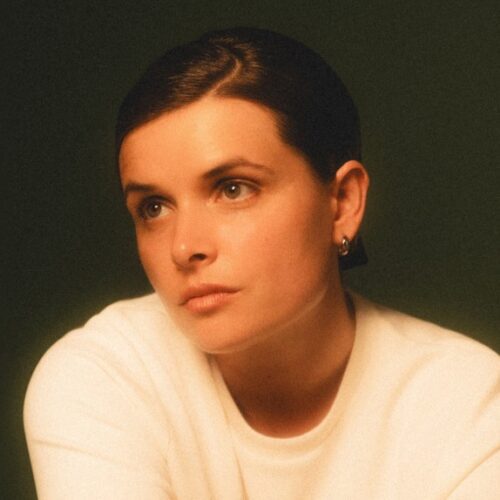
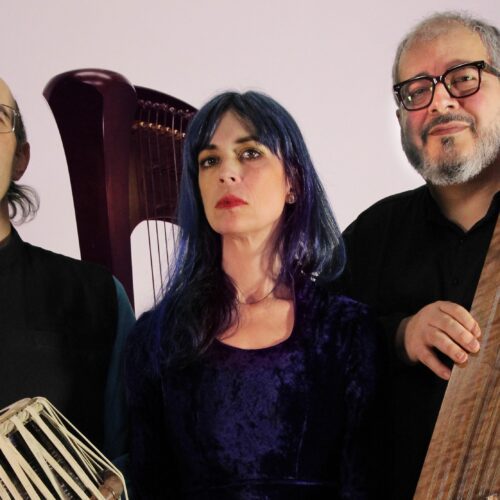
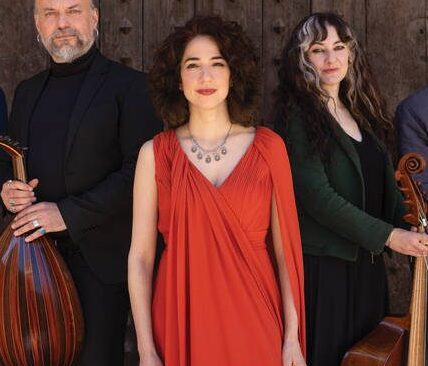
From the Minho to the Euphrates, two rivers separated by thousands of kilometres, one in Portugal and the other in present-day Iraq, more than a millennium of intercultural, religious, and artistic weaving contemplates us. This is somewhat the premise of the album From Minho to Euphrates by the Lebanese-Canadian singer and oud player Lamia Yared, her third after the two previous, very successful ones: Chants des Trois Cours (2019), and Ottoman Lights, praised right here. With her Spanish colleague Efrén López and several excellent artists from around the world, she explores a very rich repertoire made up of 4th-century Syriac chants, 12th-century Cantigas de Santa Maria from the court of Alfonso X, the Muwashahāt of Aleppo, as well as a rare 13th-century composition by Safi al-Din al-Urmawi, one of the great theorists of Middle Eastern music. Christianity coexists with Islam with serenity, maqams dialogue with hymns to the Virgin Mary. I met Lamia Yared to talk about it.
PANM360: Hello Lamia. Tell us about the repertoire of this album. What is it about?
Lamia Yared: It is a repertoire that covers approximately 1500 years of the region’s history, ranging from the Iberian Peninsula to Mesopotamia (Iraq). I wanted to create a dialogue between 4th-century Syriac chants, those sung by the first Christians of the East, with mediaeval Christian chants such as the Cantigas de Santa Maria and from the Muslim repertoire such as the Muwashahat of Aleppo. These traditions have never met, so we were keen to offer choices and bring them all together on the same album. We even go as far as Persian influence because it was strong in Syriac music (the Syrians were invaded by the Persians in the 4th century). We can hear the influence of the maqams. We have gathered a great team, me and the Spanish multi-instrumentalist Efrén López, namely Omran Adrah (qanun), Miriam Encinas Laffitte (viola da gamba), Behnam Masoumi (tombak), and Tammam Ramadan (nay).
PANM360: What are maqams and Muwashahāt?
Lamia Yared: Yes, it’s true that I use a lot of words that are not well-known. The Muwashahāt is a complex vocal form that was developed in Syria in the 18th century, both in the rituals of Sufi brotherhoods and in secular singing. The whole region was influenced by the Hellenistic and Syriac heritage. Both in churches and in Sufi brotherhoods, one could hear the same musical spirit. So it’s part of the sound of the region. And this sound from the region, it’s the maqam school. And what is the maqam school? So it’s this music that has a certain microtonality. It’s not something you play on a piano, obviously. We sing these modes so we can perform something for the deceased or something to celebrate life. These are quarter tones.
PANM360: Was it difficult to bring these traditions together, to ensure the overall coherence?
Lamia Yared: We used microtonality in the Cantigas songs to get closer to the rest and to show their proximity on several levels, including the religious level of course. All these traditions, from the 4th century to the 12th century, then up to the Muwashahāt later, passing through the music of Safi al-Din al-Urmawi, they were all united in these texts, in these approaches, by microtonality. That’s the link.
PANM360: The Cantigas de Santa Maria have been played by Jordi Savall, among others. It is an absolute reference from which you had to stand out…
Lamia Yared: Yes, and it is through the use of microtonality, at least brought to the forefront more evidently, that we did it. Moreover, I use the voice I use when I sing Arabic music and Syriac chants, not the classical mediaeval technique. So it’s a bit more my personal version.
PANM360: What does this music represent for you, personally?
Lamia Yared: You know, I grew up in Quebec, I was six years old when I arrived here. I was born in Lebanon, and I went back there later, between 2009-2013. I then immersed myself in the music I wish I had known much earlier in my life. In truth, I knew them, unconsciously, because before the age of six, I went to mass with my family there. I heard those songs, those melodies. They were ingrained in me. But I had to relearn their language when I returned to Lebanon. It came to touch me deeply. These are the expressions of the early Christians of the East. I really like the archaeology behind all of this, the fact of drawing from something so ancient, and from an oral tradition that has been passed down for a very long time. I find it to be of great sincerity, it’s something, how can I say, very pure. I like to draw from music that doesn’t have a “flashy” aesthetic, and delve into the soul of the piece to find something that resonates with me, that I want to experience and transmit. Each piece of music I play, whether I sing it, be it a Muwashahāt, a cantiga, or a Syriac chant, it lives within me. I feel that I belong to these lands, even though I am here and I live in Montreal. I am conveying something very personal.
PANM360: Will we be able to hear the result in concert?
Lamia Yared: We will launch on April 24, 2026, in the very beautiful Notre-Dame-de-Bonsecours Chapel, in Old Montreal. It’s a very appropriate place, steeped in history and spirituality, with magnificent acoustics. I invited Efrén López, and wonderful musicians from here like Marie-Laurence Primeau on the viola da gamba, Didem Bachar on the kanun, and Hamin Honari on percussion. We’ll also do a launch in Australia, because the World Within Worlds label is Australian. We also have a tour planned in November 2026.
PANM360: What impression do you want to leave on listeners and viewers?
Lamia Yared: Bringing together two traditions that flourished at the same time, but never met. We sang in a similar way in both the Christian and Muslim communities. We sang for the Virgin Mary in the Syriac language, in Aramaic, and in the now-extinct Galician language. It is a call for dialogue that is at the base of this approach. There is a way to talk to each other through art. It is also a dialogue with today’s audience, so that they feel something beyond religious history because this type of sacredness is no longer updated, but we can find reasons for ecumenical and secular rapprochement.