Additional Information
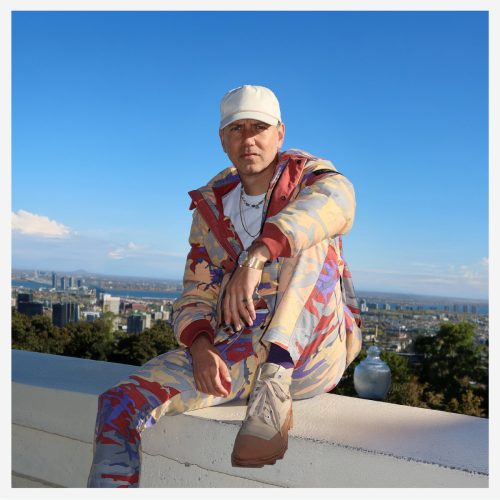
Hayti Lives, Vox Sambou’s sixth album, was launched a few weeks ago, but Vox Sambou was still out of the country. No problem, we finally got in touch with this hard-working artist, associated with the excellent composite group Nomadic Massive and also a solo singer-songwriter from Montreal, originally from Limbé, a municipality near Cap-Haïtien in the north of the island. A written conversation with a key figure in Montreal’s Afro-descendant culture.
PAN M 360: Hayti Lives is both a poetic and activist project. How can a critical or even militant stance become art in 2025?
Vox Sambou: As a musician, I always feel guided by the timeless words of the great musician Nina Simone: “An artist’s duty, as far as I’m concerned, is to reflect the times in which he lives. I think that applies to painters, sculptors, poets, musicians… For me, it’s a personal choice. But I’ve chosen to reflect my times and the situations I find myself in. To me, this is my duty.
PAN M 360: There’s so much to say about Hayti right now, which is struggling with an incredible social, economic and political curse. What are the themes of your new songs?
Vox Sambou: In my new songs for the Hayti Lives project, I tackle the themes of love, unity and resistance. It’s not a curse that strikes Haiti, but a persistent injustice. I’m writing these words to you from Limbé, northern Haiti, where I see hope in the faces of shopkeepers, teachers and young schoolchildren. Everyday reality is a lesson in resilience. Michel Vastel’s article, published in 2003, reveals a little-known truth: the Ottawa Initiative on Haiti shows the active role played by certain countries, including Canada and France, in the political destabilization of the country. France, above all, refuses to pay the ransom for independence, a debt imposed on Haiti for having dared to liberate itself. This is the real tragedy.
PAN M 360: Can you choose 3 to 5 songs and describe in more detail the choice of subject and the poetic approach?
Vox Sambou:
Eritaj :This song is a declaration of identity and memory. Through the words “Istwa nou, memwa nou se zam nou pou’n pa peri”, I want to insist on the fact that the Haitian heritage, its history, its culture, its resistance is a powerful weapon against erasure. It’s a subject rooted in a process of intergenerational transmission and reaffirmation of Haiti’s African roots. I used rhythms from the oral tradition.
Sergo: Sergo pays tribute to my mother and to all the Haitian women in the country’s history. These women are pillars of the economy, education and resistance, from independence in 1804 to the present day. The name Sergo is a symbol of dignity, courage and strength. With my musicians, I was able to work on petro percussion rhythms, Congolese influences and hip-hop. My dearest wish is to celebrate the living memory of these women through a constantly rising musical energy.
Kriminèl: This song was born of a sense of urgency about the continuing instability in Haiti. It denounces the violence imposed by the international community, but above all, it calls for collective awareness and citizen resistance. I’m calling on the population to wake up. My approach is based on the repetition and rhythmic intensity of Haitian percussion (particularly petro rhythms), amplified by Congolese, hip-hop and Afrobeat influences to create this song.
Voyaje: The inspiration for this song came in 2017 at the Helsinki World Music Festival, when I opened for Trinidad and Tobago music icon Calypso Rose. It’s a song that evokes the journey of identity, that of children of the African diaspora seeking to reconnect with their roots.
PAN M 360: As a French speaker who has spent time in Haiti, I have a partial understanding of Creole (the language of expression on this album, with some exceptions in French), but I’d like to know if you have any poetic models in Creole literature.
Vox Sambou: Ever since I was a child growing up in Limbé, Haiti, I’ve been immersed in Haitian literature. Those who have influenced me most are Oswald Durand and Frankétienne. The former, a 19th-century poet, gave the Haitian language its letters of nobility with texts like Choucoune, celebrating love and popular culture. Frankétienne, a prolific 20th-century writer and founder of spiralism, combines poetry, chaos and revolt to express the complexity of the Haitian soul. These two poets nourish my writing and my artistic commitment.
PAN M 360: How can you make Haitian Creole attractive to non-Creole speakers?
Vox Sambou: The Haitian language is already profoundly rich and attractive. For me, the best way to make it more accessible is through music, a universal language. Through my songs, I use the Haitian language to challenge our societies, raise awareness, uplift our humanity and share love.
PAN M 360: So that non-Creoles can learn more about Creolophony in song, can you tell us about your approach as a songwriter?
Vox Sambou: As an artist, I don’t impose a particular style or language on myself. For example, the chorus of the song Goumen (“to fight”) first came to me in Portuguese; I simply chose to translate it into Haitian, guided by inspiration, rhythm and message, while respecting the sounds and languages that are part of me.
PAN M 360: How do you distinguish between your solo work and your collective work, especially with Nomadic Massive? Where are the differences, the distinctions, the stylistic choices?
Vox Sambou: Nomadic Massive remains one of my great schools of life. From 2004 to 2017, I lived and shared extraordinary moments of learning, performing and artistic fraternity. This collective enabled me to develop a strong musical and political awareness. The Vox Sambou project, on the other hand, is more personal: it draws on traditional Haitian music, with a style less focused on hip-hop and more oriented towards the fusion of Afro-descendant rhythms. It’s a more intimate space, one of reflection and direct connection with my roots.
PAN M 360: Several musicians contributed to this album. Can you explain the recruitment process?
Vox Sambou: For this project, I began by working on the musical foundations with Canadian-Congolese drummer and percussionist Lionel Kizaba, before inviting the other members of my group. My approach is organic.
PAN M 360: Who are your core collaborators? In the studio? On stage?
Vox Sambou: I’ve been working with a loyal and talented team for over 15 years. In the studio and on stage, my core team remains almost the same. David Ryshpan (keyboards), Jean-Daniel Thibeault-Desbiens (drums), Diégal Léger (bass), Rommel Ribeiro (guitar), Rémi Cormier (trumpet), Malika Tirolien (vocals), Ronald Nazaire (percussion), Frank O Sullivan (guitar) and Lionel Kizaba (percussionist and drummer) are my close collaborators. With them, I’ve built up a musical and human complicity that nurtures the artistic coherence of all my projects.
PAN M 360: Who did the arrangements and production? What were you looking for?
Vox Sambou: I composed and worked out the basic structures of the tracks myself, leaving room for intuition and the soul of the rhythms. Subsequently, Rémi Cormier and Modibo Keita added their touch on certain brass sections, while Malika Tirolien signed some striking keyboard and guitar arrangements, notably on the song Kriminèl. My aim is to give the project a richness of sound that respects both my roots and my musical intentions.
PAN M 360: The musical subject of this album is said to be a meeting between the Caribbean islands (especially Haiti) and Central Africa (especially Congo): why is that?
Vox Sambou: I want to honor our cultural heritage. This album invites the children of the diaspora to reclaim their roots through the unifying power of art. I sincerely believe that art is the only bridge capable of reconnecting Africa’s scattered youth to their homeland, and thus offering them peace!
PAN M 360: The stylistic choices are eclectic: rara rhythms, voodoo, dancehall, afrobeat, soukouss, rap kreyol, afro-jazz, etc…. How would you describe yourself?
Vox Sambou: I make traditional Haitian music fused with jazz and hip-hop
PAN M 360: You’ve chosen an instrumental approach, so there’s very little electronics in your work? It’s simply a matter of taste? Can you describe your musical garden? What makes you tick the most?
Vox Sambou: I’ve always been drawn to an organic, instrumental approach. I’m drawn to drums, human voices, brass blasts and deep-rooted rhythms. My musical garden is the land of Haiti, nourished by echoes from Africa, the Caribbean and the streets of Montreal. It’s a place where tradition and innovation meet, where every sound carries a story, a cry, a living memory. Above all, I seek to create links, to make people vibrate.
PAN M 360: What are your next projects, solo or otherwise? Shows and others?
Vox Sambou: On May 17, we launched the Hayti Lives album in São Paulo, an important milestone in this new project. In June, we’ll continue with concerts in Rio de Janeiro, then head off for a series of dates in Europe. This summer, we’ll also be touring Western Canada. Whether in Canada or abroad, each performance is an opportunity to forge links, carry our messages and celebrate the richness of Afro-descendant cultures.