Additional Information
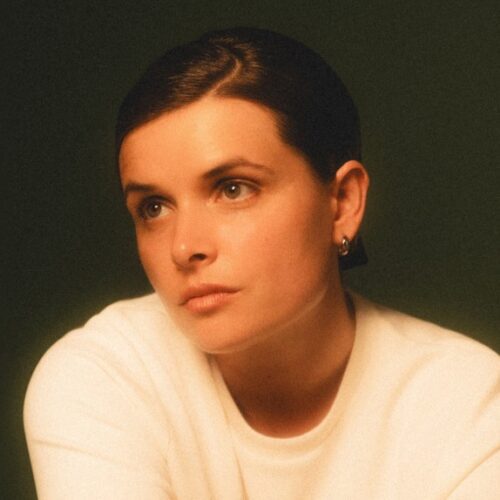
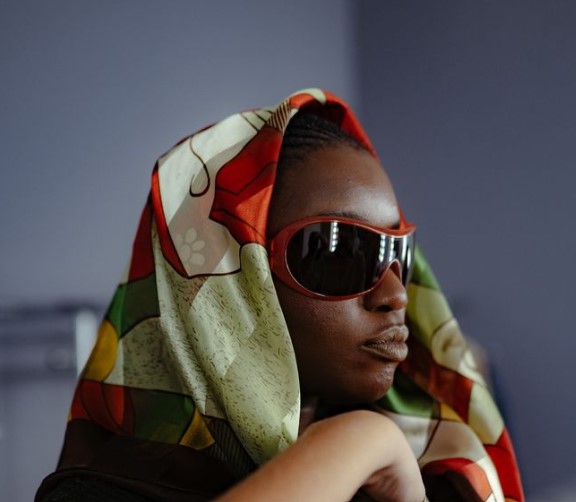
Originally from Senegal, Sarahmée has been a full-fledged Quebecer since early childhood, and was raised as an adopted child by a family in Quebec City. Today, she is the most renowned Afro-descendant singer/songwriter in French-speaking America. Since she first came to public attention with the song T’as pas cru, her aura has continued to expand across the land.
In case you haven’t already heard, which is unlikely, she is the sister of the late Karim Ouellet. Sarahmée’s CV is impressive: four albums, a career hosting documentary films and TV shows, including the coolest of the Adisq Galas – not the Sunday night one, you got it.
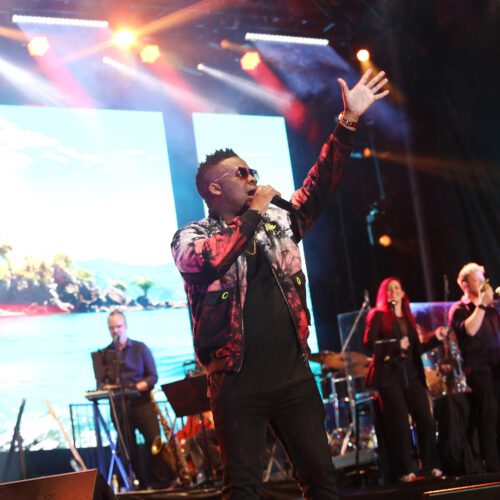
Tonight, at 7pm, Sarahmée performs at Les Foufs in Montreal, defending her brand new album, Pleure pas ma Fille, sinon Maman va pleurer, a succinct mix of afrobeats, hip-hop, nusoul, house and even konpa. To this end, she agreed to a telephone interview with Martial Jean-Baptiste for PAN M360.
Here’s the interview!
PAN M 360: Hello Sarahmée, I’ve spent the whole weekend listening to your music, and frankly I’ve fallen under the spell of your recordings. You’re a very committed singer-songwriter. How did it all start?
Sarahmée: I grew up listening to a lot of French rap when I lived in Senegal. To tell you the truth, I fell in love with the music, the energy and the culture surrounding rap. I think I was 10, so on the eve of my adolescence, if you like, I started to push my passion a little further by recording freestyles, listening to the radio, listening to albums on repeat, trying to understand the lyrics. It’s music I’ve listened to a lot, and studied a lot too. And when I came back to Quebec City to do my CEGEP, I was introduced to a whole bunch of people who were already in the music business, beatmakers, rappers, studio engineers. And I started rap school, let’s say, like that, making recorded songs, writing demos, and then one thing led to another, a group was born in 2009, we made an album, and then after 2010, solo albums.
PAN M 360: Tout finira par finir (sunu) , the first song on Pleure pas ma Fille, sinon Maman va pleurer, is it a tribute to your brother?
Sarahmée: Yes, but it’s also a tribute to Senegalese culture and that of other West African countries. We can call on griots, the women often sing and the men sing backing vocals and play various instruments. In fact, the griots I invite celebrate someone’s life: a birth, a marriage, a death. And so the griot or griotte sings about that person’s life. That’s why I really wanted to start the album like that, because I had an enormous need to be, to do, to leave an important place for my origins. I needed female voices on this album and I also wanted to pay tribute to my family, and of course to my brother.
PAN M 360: You can really feel Africa and Senegal in your songs!
Sarahmée: Yes, that’s the fun of it! You can hear an Afro rhythm, to which you can add a more pop or house texture. And it’ll sound different after a lot of trial and error. It’s all about trying things out! So I listen to an attempt and then no, we’re not there yet, so we start again and find another sound. I want it to dance too! I like the dynamic side of songs, I like soft songs, ballads, but it’s the energy that drives me in what I do. So I want each song to have its own particular energy.
PAN M 360: Do you ever write lyrics or music with collaborators?
Sarahmée: Some people have helped me with the lyrics on two or three songs. But most of the time, I write alone. When it comes to music, there are more than one of us, so there’s a lot of composing, beat-making and arranging involved. On the song Pour de l’ argent, Nyssa Sech wrote the pre-chorus, after that, it’s all about featurings. In fact, I work with people on the writing when I feel it’s time to call on their skills.
PAN M 360: Is there a Sarahmée sound?
Sarahmée: Yes, absolutely! Before composing, I listened to lots and lots of music. Before making this album, I listened to a lot more: afrobeats, Latin music, pop, house, etc. I like a lot of different styles of music. I like different styles of music, and I like to look at what distinguishes the composition from one song to the next; the little details, the fine-tuning… I really pay attention to all that.
PAN M 360: Where does your inspiration come from?
Sarahmée: I think there’s a lot of divine inspiration, I won’t lie. I mean, it doesn’t all come from me, there are times when it really does come from on High! I will tell you, though, that for this album, I developed the thing by taking a lot of notes over the last few years. I knew that at some point I was going to make another album.
PAN M 360: For two years running, you’ve hosted Adisq’s Premier Gala. What about your hosting side?
Sarahmée: I also hosted a documentary for TV5, called Elle. We shot in 12 countries in a year, a year and a half, so we shot internationally. I found it very demanding, both mentally and physically, but it was an extraordinary experience, a dream job! But through it all, I had to take a break, rest and then get back into the swing of things. Then came the summer, then the album, then the show. Time flies and you don’t realize it!
I think this documentary gave me a huge boost and still gives me a boost in all things animation. It was a very strong project that remains very strong, and one that ultimately shaped me. It was my first real experience of animation, and so yes, I was very flattered and welcomed with open arms by the Adisq organization. I was given a lot of latitude and openness in my approach. I was well supported by the team that has been putting on this Premier gala and the big Adisq gala for years.
PAN M 360: You’ll be taking to the stage this Thursday at Les Foufs, so we imagine you’ll be performing songs from your new album?
Sarahmée: This album is completely made for the stage, and I want the auditory experience that people have had listening to the album to be transformed into a visual, emotional, sensory experience too. I think it’s going to be a journey into human emotions, as you can already tell from listening to the album. I think we’re all going to have a lot of fun and experience a lot of strong emotions together. I’ve put my heart and soul into the staging and vision of this show.