Additional Information
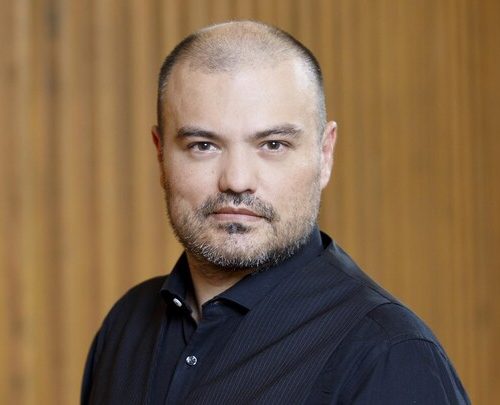
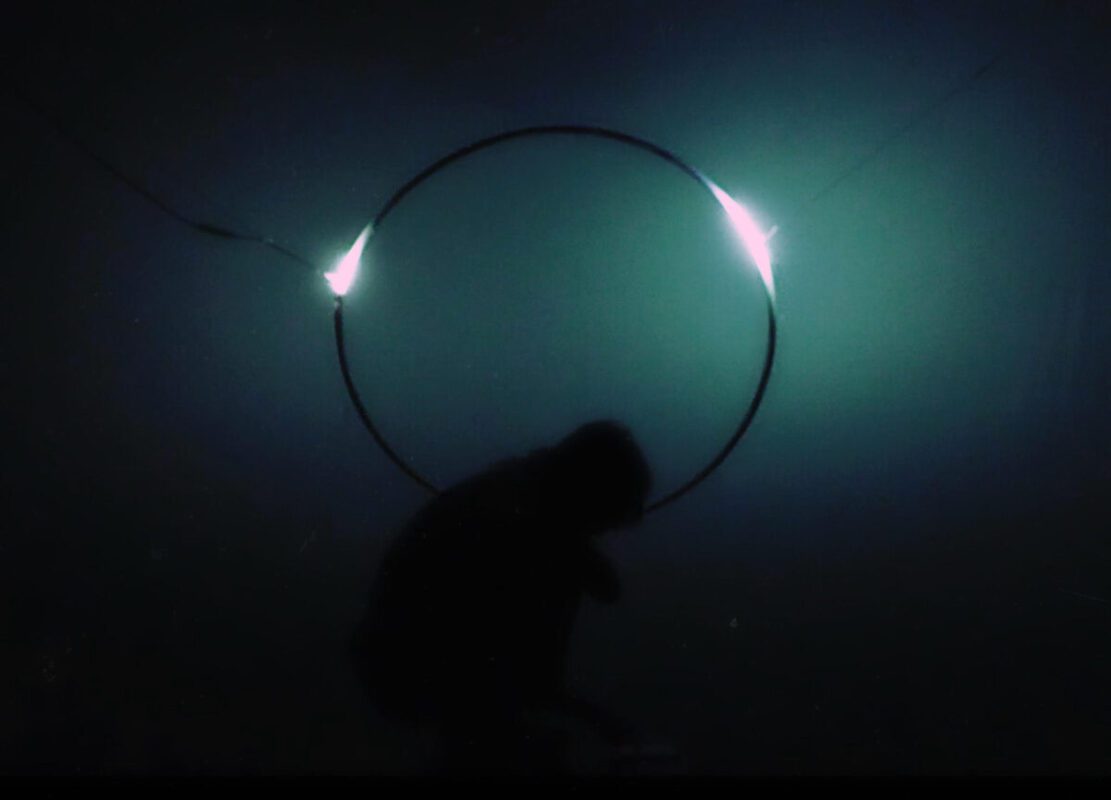
Presented on Saturday November15, by Codes d’Accès, an organization whose purpose is to promote emerging composers, the electroacoustic program Troubles et méandres features “innovative artists whose works blur the lines between musical and performance conventions.” For those who responded to the call, PAN M 360 is posting their responses online and wishes them a long and fruitful creative career! Loic Minty was going to present Amour/Mort on Saturday, a piece based on the notion of cyclicality that highlights a musical-light instrument of his own creation. This set has been cancelled and/or postponed. Nevertheless, here is the creator’s background.
PAN M 360 : Le but étant de vous rendre plus visibles, présentez-vous !
Loic Minty:
I recently graduated from UdeM’s school of Musiques Numériques. I did it out of curiosity for what challenged me the most in my personal life. I was afraid of integrating technology into my own music because I felt technology was alienating me from my environment. It seemed cold, noisy and heartless but at the same time, electronic music is what was speaking to me the most. All this to say, I approached it with a lot of resistance, carefully inspecting how the tools were being used rather than what was being produced.
I realized the electroacoustic “in the box” practice didn’t match the physicality I sought from music. It came to a point where I felt that the intentions behind the technology I was using had more influence over what I was producing than myself. Thankfully, the teachers there are very open minded about this stuff. I decided to break out of DAW’s, and dove into instrument building with more of a sociological sensibility.
The way I see it, our current sequential interfaces are not only limiting the affective potential of human-computer interaction, but are also very linear in their conception of time. I decided to build something that could bring me closer to circular time, to the trance effects of Sufi music, or the idea of gong cycles in Gamelan music. They form a paradigm that reflects a deep difference from ours in our perception of life and death.
Along the way I’ve been inspired by the words of Donna Haraway, Philippe Breton and Pia Baltazar, to name a few. I think if anything, I’m even more apprehensive about technology today than ever, the difference now is I know where I stand.
PAN M 360: Present your work in the program: title, subject matter, content, form, stylistic references, instrumentation, performers (if any), live performance, angle of approach.
Loic Minty: The instrument is lumino-sonic, meaning the music and sound exist as one experience. The engine is based on the most simple sound manipulations you could make in a DAW, scrolling and looping, but with a renewed form of interaction and visually reconstituted in a circle. I’ve been working with it for a while now, always tweaking it when I can. I’ve come to a version now that I’m happy with. I can be quiet as I can be loud, and it’s chaotic enough that I really need to listen to what I’m doing in order to get any meaningful sound out of it.
The performance is completely live and mostly improvised. There is no backing track, no plan b. If I leave the stage or if the patch crashes (which I can only pray it won’t), it would be dead silence. Musically I wanted to make sure the content of it doesn’t solely rely on technology. I will be using my voice and bringing in samples from The Fall. It has a dark, introspective touch, as the title Troubles et Méandres appropriately suggests, but it’s also slightly grimey with sections of noise and ambient.
PAN M 360: How are you all connected to this program, whose titleTroubles et méandres seems to suggest a theme? Or to the organization Codes d’Accès? Or to an emerging cohort on the creative music scene?
Loic Minty: On the same bill with me are several people who I studied with. As a cohort I feel like we collectively broke the mold of what Musiques Numériques was previously like. We arrived in a transitional period where, after the pandemic, younger teachers were opening the gates of the “high-art” acousmatic music towards more interdisciplinary practices. We were ready. Electronic music sounds amazing, but its appreciation in the context of a performance is still nebulous, there’s a lot to explore in order to make it a living art. There have been some incredible shows that came from that period: Nicolas Bourgeois, Graham Hudson-Jameson are some names to look out for. Then obviously Alexandre Sasset Blouin’s Permutations, which is played by UdeM’s orchestra of synthesizers. I have seen it before, it’s an impressive piece.
PAN M 360 : Vos prochains projets ou événements?
Loic Minty: In the short term if I want to keep playing this instrument and develop on some of the musical concepts I discovered in preparing the show. In the long-term, my objective is to make the instrument fully transportable on a bicycle and tour around different parts of the world collecting sounds and sharing them between communities.