Additional Information
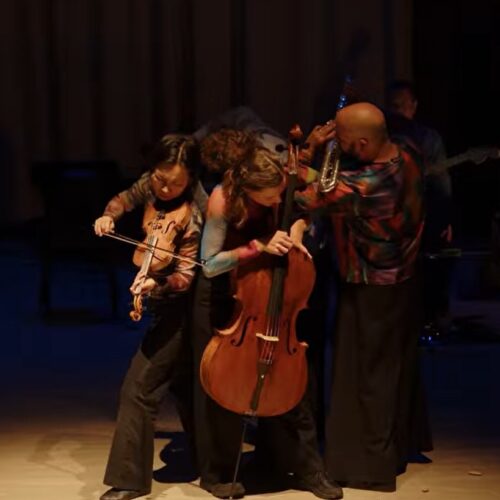
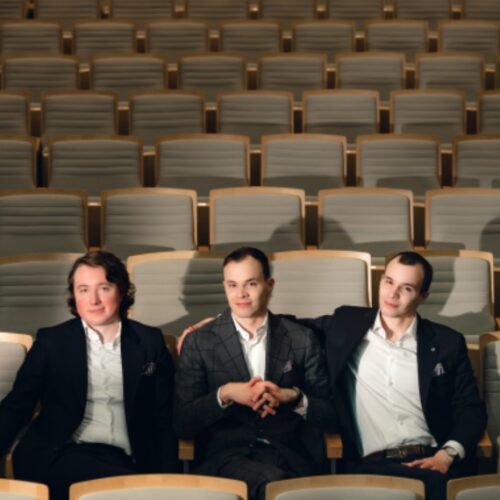
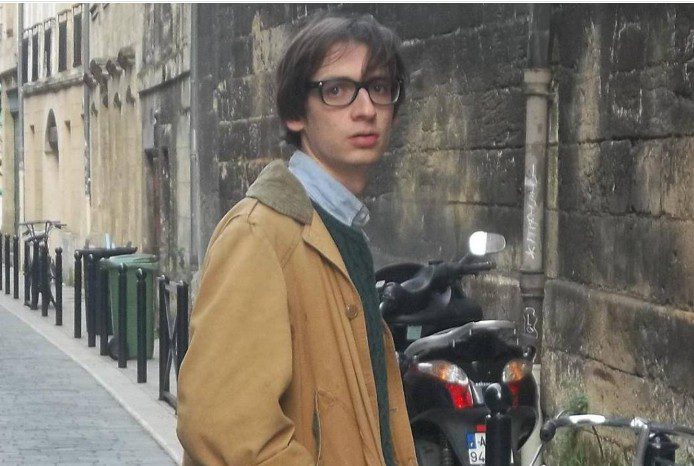
Presented this Monday, March 23 at 7:30 p.m. at the Chapelle Saint-Louis – Le Saint-Jean-Baptiste, Battements brings together three emerging artists from the world of contemporary creative music. PAN M 360 has chosen to introduce them one by one before the concert; we begin with Alexandre Amat and his piece Tracé, Fossile for violin and cello (2023, 12’).
Tracé, Fossile is inspired by the slow mineralization of organic matter. Through a gradual metamorphosis from fluid sounds to rough textures, the piece is conceived as a summary of a fossilization process extending across several geological eras. Through the progressive increase in density and the gradual rarefaction of movement—both temporal and physical—Tracé, Fossile becomes a reflection, even a meditation, on the becoming of matter.
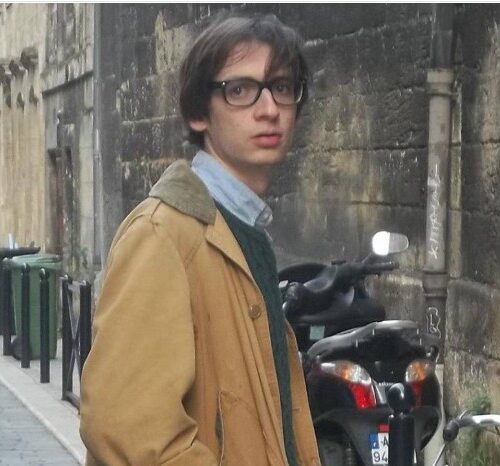
Alexandre Amat, composition
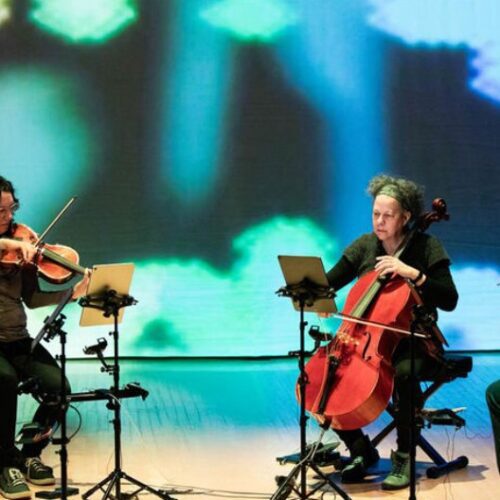
Paul Ballesta, violin
Audréanne Filion, cello
PAN M 360 : Remind us who you are, your training, how you came to composition, and what you have produced so far.
Alexandre Amat : I am a composer of instrumental music, currently pursuing a doctorate in composition and sound creation at the Université de Montréal. Originally trained as a horn player, I followed a classical musical path in several conservatories in western France, from childhood until obtaining my performance diploma in 2011. I then studied musicology at the University of Bordeaux before turning toward instrumental composition by joining Jean-Louis Agobet’s class at the Bordeaux Conservatory. After earning my composition diploma, I decided to continue my studies at the Université de Montréal, first in a master’s program with François-Hugues Leclair, and then in a doctorate under the supervision of Jimmie LeBlanc.
I believe several paths led me to composition. I could mention my interest in performing contemporary music since adolescence; my practice of free improvisation on horn and analog synthesizer; and probably a particular attraction to imagination, exploration, and the unexpected, which led me to take an interest in contemporary artistic practices and experimental music in the broad sense.
Over the past decade, I have written more than thirty works almost exclusively for instruments and have collaborated with several ensembles, mainly in France and Canada, including the Orchestre National Bordeaux Aquitaine, Ensemble PTYX, Ensemble Prisme, and the Quatuor Cobalt. Over the past year I have collaborated with Sixtrum for their latest production Espace d’interactions #1, with Stick & Bow on a commission jointly produced by Orford Musique and the SMCQ, and more recently presented my piece Zone for electric guitar and bandoneon at the most recent annual concert of the Vivier Interuniversitaire.
PAN M 360 : Regarding your piece, how is the « lente minéralisation d’une matière organique – slow mineralization of organic matter » evoked in the work?
Alexandre Amat: The idea of process, transformation, and transitional states interests me greatly. In my compositional practice, I systematically consider sound as a material that evolves, unfolds, or deteriorates through time. In the sound of an instrument as in nature, nothing is immutable: the growth of a tree, the course of a river, the shape of a continent—everything constantly transforms according to its own temporal scale. My relationship to musical writing tends, in a way, to draw inspiration from natural, geological, and physical phenomena by considering musical form as a continuous metamorphosis between sonic states and textures of different qualities. This way of approaching composition is inspired by drone music and spectralism, but also by the sculptor Giuseppe Penone’s work with natural materials.
The trajectory of Tracé, Fossile is built through the articulation of two parallel processes: a progressive reduction of movement and a progressive increase in sonic density. The piece begins with dynamic figures whose energetic trajectories are mobile, unstable, and unpredictable, evoking a certain form of organic fluidity. It then gradually moves toward a static, granular state, as if the sound were becoming solid, drying out, and fossilizing over time. This trajectory affects the sonic material but is also embodied in the performers’ physicality, as their movements gradually diminish and slow down.
PAN M 360 : Could you give us some indications about the musical structure, the choice of instrumentation, and the playing techniques requested from the strings?
Alexandre Amat: I conceived the piece as a duo for violin and cello that avoids the usual logic of dialogue and interaction often found in writing for two instruments. I wanted to treat them as a single dense and fused sonic organism, a kind of “super string instrument,” by bringing their timbres close together and introducing slight temporal displacements between the voices through writing techniques close to canon.
My writing is based on a tactile approach to instrumental performance and particularly explores the idea of contact: the entire structure of the piece is inseparable from gradual variations in pressure, position, speed, amplitude, direction, and movement of the bow and the left hand on the strings. The piece especially explores certain extreme bow positions, from very high positions on the fingerboard to various positions behind the bridge. Finally, a slight scordatura in the violin allows me to explore a microtonal harmony in a section built on alternating open strings and natural harmonics.
PAN M 360: How do you relate this work to your compositional signature? Where do you situate it?
Alexandre Amat :Tracé, Fossile is a piece that I consider quite representative of my musical language as it has evolved since my arrival in Montreal. The exploration of the noisy dimension of instrumental sound in a slow, continuous, contemplative, and almost minimal way is an aesthetic direction I pursue in many of my recent works.
It also occupies an important place in my creative journey. It is the first piece I composed as part of my doctoral studies, and it seems to synthesize many of my current musical, conceptual, and poetic concerns: approaching sound in terms of materials, textures, sensations, contact, transformations, and temporal scales, and seeking an immersive listening experience analogous to certain sensitive connections we sometimes experience with our natural environment.