Additional Information
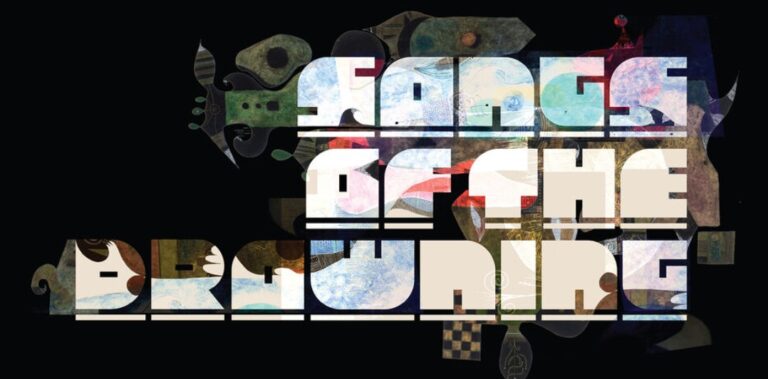
Presented in four languages by Chants Libres, Paramirabo, and Le Vivier, uniting music, poetry, and image, Songs of the Drowning promises to be an interdisciplinary performance by Roozbeh Tabandeh, inspired by the poems of Sandeep Bhagwati and the paintings of Khosro Berahmandi. PAN M 360 speaks here with the composer, artistic director, and “unifier” of the disciplines involved in this program presented at the Wilder this Wednesday, October 15.
PAN M 360: How is this interdisciplinarity of music-poetry-painting articulated?
Roozbeh Tabandeh: The work is situated at the intersection of Sandeep Bhagwati’s poems and Khosro Berahmandi’s paintings. It invites the participating artists to reflect on the themes addressed in Sandeep’s poems and the figures, textures, and colors of Khosro’s paintings, and then to express their understanding through the prism of their artistic discipline. How can an imaginary space be created that invites contemplation on the themes of the poems while drawing inspiration from the visual world of the paintings? What does this space look like from a musical perspective? How do the scenographers and visual artists perceive it? And what does this space offer the public to discover? These are the key questions of this project.
PAN M 360: Through Sandeep Bhagwati’s poetry, the central thread of the work is expressed in four languages. How do you involve four languages—German, English, French, and Farsi—in a narrative framework?
Roozbeh Tabandeh: The decision to present the poems in four languages contributes greatly to the work’s inclusivity and linguistic diversity. German is the original language of the poems and the poet’s mother tongue. Farsi is my mother tongue, as well as that of Khosro, Hadi, and Haleh, three important artists in this work. The work will premiere in Quebec, where the artistic team lived and created for several years. French therefore seems like an obvious choice. And English makes the work accessible to a wider audience across Canada and internationally. This work raises important questions about the condition of human (and non-human) beings in our time. These kinds of themes are broadly inclusive, and the four languages used symbolize the universality of these questions and concerns.
It was also a big challenge because some of the themes addressed in the poem are deeply rooted in culture and extremely difficult to translate. It seems like some parts of the poem just don’t want to be translated! So we had to be extremely careful and find a way to navigate these languages and the cultural connotations associated with them. This reminds us that, although these questions are universal and broad, the perspectives for answering them are extremely diverse and specific to each culture.
PAN M 360: This poetic cycle by Sandeep is said to be a critical contemplation of the human condition in our time. Can you give us some more details about the content and form of these nine texts?
Roozbeh Tabandeh: Sandeep wrote these nine short poems in the post-pandemic context we have all been experiencing, as we grappled with the challenges facing humanity in our time: the senseless wars, the corrupt politicians constantly struggling for power, the way we treat our species, non-humans, our environment, our planet… We are indeed living in troubled times, and we, as artists, cannot simply choose to close our eyes, “live a good life,” and not react to the realities of the world we live in. However, this work is not a statement of reality. Rather, it is a space for contemplation that floats above reality and invites deep reflection.
When I first read these poems, I was also going through a difficult time in my life, facing personal difficulties. So these poems touched me deeply, both in my heart and in my mind. And I thought it might be a good idea to stage this, invite other artists to reflect on these topics, and finally present it to the public.
In short, all the different lines of thought in this work converge around the theme of drowning. However, we try hard to distance ourselves from the negative connotations of this term. Obviously, one can drown in water, but one can also drown in one’s thoughts, memories, daily life, even in a piece of music! There are drownings from which one does not survive, but there are also other drownings from which one survives, but without ever remaining unchanged. It therefore has a transformative and stimulating quality. And this is our goal in this piece: through nine scenes, just as in the poems, we extend the metaphor of drowning (in any form) to several dimensions. The piece slows down the process of drowning, metaphorically placing it under the magnifying glass of contemplation.
PAN M 360: The work fuses these four languages with the music of Roozbeh Tabandeh, yours, as well as video works by Hadi Jamali inspired by the paintings of Khosro Berahmandi as well as a scenography created by the scenographer and architect Haleh Vedadi and Roozbeh Tabandeh. Further explanations?
Roozbeh Tabandeh: The music is composed from the ideas presented in each poem. Then, the formal structure of the music and its timeline define the architecture of the piece, within which other artists begin to create their own spaces. The result is an imaginary space formed by the assembly of these individual spaces, overlapping each other. It is indeed a complex, multi-layered universe.
PAN M 360: The show is a co-production under the artistic direction of Roozbeh Tabandeh, co-broadcast with Paramirabo, Chants Libres and Le Vivier.
Can you explain to us the choices and approaches of your composition (styles involved, instrumentation, arrangement, your own style)?
Roozbeh Tabandeh: Songs of the Drowning is a 70-minute composition, my longest in a career spanning over twenty years. It also concludes the ideas I have explored in several works and installations over the past decade. Thus, in addition to presenting new compositions created specifically for this performance, I make several references to my own past compositions. I also make numerous references to the works of important 20th-century composers.
The dance movement is an obvious homage to Stravinsky’s music in The Rite, which inspired my piece with its abrupt rhythmic structure and the strong ritualistic qualities inherent in his music. In the context of this work, I extend the idea of ”dancing oneself to death” from The Rite of Spring to that of “dancing while drowning.” This is an interesting aspect of this piece: here, not only are the subjects aware of their drowning state and express themselves about it, but they even sing and dance while drowning.
The third scene begins with a strong reference to Brian Ferneyhough’s music in his piece Mnemosyne, where an extremely complex and detailed solo bass flute floats above a flattened palette of long gestures presented in the pre-recorded media. The idea of extreme complexity versus extreme flatness reminds me of Khosrau’s painting, where we sometimes find large areas of solid color, such as a huge red circle, and right next to it, an area covered in a dense texture composed of extremely detailed lines, dots, and ornaments. I then staged this idea in a unique context, with a large bell instrument specially designed and manufactured for this piece, which extends to the grille with bells installed above the heads of the audience. Thus, the stage space begins from the stage, but animates the entire architecture of the hall.
In this work, there are also further references to the sound manipulation techniques of early musique concrète, as well as to the traditions of noise music, and questioning the superficial boundaries between music and noise.
So it’s a wide range of musical ideas brought together in a single 70-minute piece.
PAN M 360: Since you work with other creative materials beyond your own composition, what about your artistic direction in the context of this interdisciplinary work?
Roozbeh Tabandeh: As artistic director, my role is to bring people together. To channel the flow in a particular direction while offering artistic freedom to the participating artists. I believe artists should have the right to present their proposals, even if I don’t personally identify with some of them. I don’t think everything should pass through my gaze in a collaborative context like this. On the contrary, it would be counterintuitive for me to comment on Khosro Berahmandi’s paintings, for example: looking at a blue rectangle and asking him to change it to a red circle because I prefer it that way! Because interdisciplinarity also means being placed between several art histories, between different artistic conceptions from multiple perspectives. I don’t have the same knowledge of the history of painting as Khosro. Likewise, he doesn’t have my understanding of music, nor the experience that Haleh and I have in scenography and architecture.
So, while participating artists are invited to express their opinions and react to other elements in the work, we try to go beyond the superficial levels of basic brainstorming and allow a great deal of freedom for deep artistic expression across multiple disciplines. That’s why I believe this work is not dialogical. It’s an imaginary space formed at the intersection of several individual monologues, and my role as artistic director is to facilitate the coexistence of these different voices.
Tableau I
- We, the Drowning … Are Witnesses
- Chasing the Sparkle
Tableau II
- A Scene That Heats Up on Every Side
Tableau III
- Salty Waters Keep Spreading
- Dance of the Drowning
- Metamorphing Beasts
Tableau IV
- They Will Envy … or Curse Us
- Monuments Compressed Into Rock
- Soundless Eternal Language
PAN M 360: Could you briefly explain each painting in the program?
Roozbeh Tabandeh: Each painting represents a poem or group of poems by Sandeep. It’s as if we were creating an exhibition with a sound and spatial collage from fragments of the poems, merged with images from Khosro’s paintings, and presenting them in a performative space where sounds, images, lights, human beings, and objects coexist.
The first scene is the opening, with a reduced number of musicians. The viola joins the ensemble in “Chasing the Sparkle.” The ensemble is positioned at the edges of the space for this scene and occupies a vast area. Then, the musicians physically move to the center for Scene II (A Scene That Heats Up on Every Side) to form a concentrated circle in the middle of the stage. During this scene, the bell instrument extends the sound far around the ceiling. Scene III is a concentrated musical experience. There is no movement onstage, no video, no scenic elements, or changes in lighting. These 24 minutes present some of the most challenging musical ideas in the entire work. On a grand scale, Scene IV constitutes the culmination of the work. It encompasses the most intense moments of sonic and spatial complexity in the piece, as all elements lead to a final moment of defragmentation that ends with a sharp cut, where finally everything and everyone becomes “monuments compressed in the rock,” observed from the perspective of a distant observer, after millions of years.
Sandeep Bhagwati (poetry)
Khosro Berahmandi (painting)
Hadi Jamali (digital visual arts)
Roozbeh Tabandeh (composition, scenography)
Haleh Vedadi (scenography)
Juan Mateo Barrera (lighting design)
Mélanie Léonard (conductor)
Jeffrey Stonehouse (flutes)
Gwénaëlle Ratouit (clarinets)
Pamela D Reimer (piano)
Hubert Brizard (violin)
Viviana Gosselin (cello)
Lyne Allard (alto)
Pierre-Alexandre Maranda (double bass)
Charles Chiovato Rambaldo (percussions)
Virginie Mongeau (soprano)
Gabrielle Cloutier (alto)
Alasdair Campbell (baryton)
PAN M 360: How did you put together this considerable team?
Roozbeh Tabandeh: These are artists I’ve known for a long time. Khosro Berahmandi was the first artist I met when I moved to Montreal in 2015, and we’ve formed a close relationship ever since. I met Sandeep Bhagwati at Concordia, where I studied music composition. Over the many years I studied with him, worked with him, and traveled with him, he remains one of the most influential people in my artistic life. I’ve also known Hadi for several years. His close relationship with Khosro was also a significant asset in this project: the two visual artists have a deep understanding and respect for each other’s work. I first met Haleh in 1999 at architecture school in Iran. We grew up together 26 years ago! We studied architecture at the same school, founded our own architectural practice, which was active for about 15 years, got married, then immigrated to Montreal together, and worked on several productions over the years. Haleh and I share an extremely similar artistic aesthetic, or at least two complementary facets of the same vision.
I also have a very special relationship with Paramirabo. I’m friends with most of their musicians and have worked with them individually on various projects over the past ten years. But this is my first project with the full ensemble. And it’s just the beginning, I hope! Chants Libres has remained another partner in the project since the presentation of a first version of the work as part of OperActuel 2024. Their fluid structure allows various singers to join them and participate in different productions, such as Songs of the Drowning. Le Vivier has been with us since last year as a host organization, and we have developed a very positive and professional relationship during the production of this project.
PAN M 360: Will there be an audiovisual document from this performance?
Roozbeh Tabandeh: Indeed, the concert and rehearsals will be documented and made available to the public in the future.