Additional Information
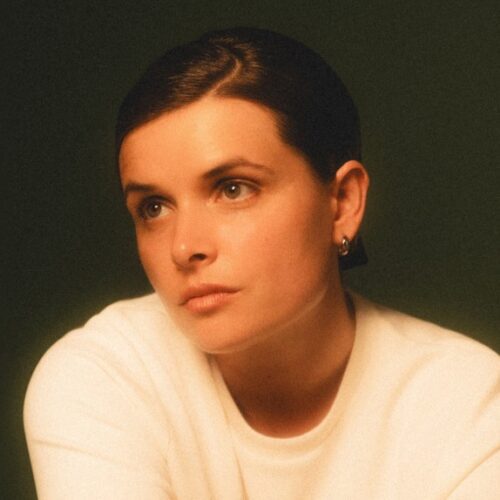
The first artist to present a work, Sonic Memories of Fleeting Times, at the Akousm festival on Thursday, despite her physical absence, Vivian Li is also the recipient of the Canadian Electroacoustic Community’s (CEC) Time Play competition. This competition showcases new electroacoustic works produced by young or emerging composers and sound artists from or living in Canada.
A recent graduate of the University of Montreal, Vivian Li is a sound artist and composer whose work explores the interplay between memory, presence, and the ephemeral nature of lived experience. Our contributor Léa Dieghi reached her in Beijing. Her well-crafted story is a compelling read!
Outside, there is a weeping willow, whose branches sway in the wind. It contrasts with the architecture, which she describes as a “cage”.
Beijing is waking up, and so is Vivian Li.
“What is close to you? Who do you meet? What do you experience? What do you see in the morning when you open your eyes?”
In Montreal, it was ten o’clock at night. In the dim light of my apartment, I waited for her call on the WeChat app, the best communication channel for reaching and communicating with China from Canada. I stared out onto Ontario Street, waiting for a response.
After a few seconds, she answers, her voice hoarse with sleep. Traveling in China, the country of her origin, Vivian Li has just woken up. It’s eight o’clock in the morning, and in her hotel room in Beijing, she tells me about her trip, her identity, her music, and all the things that make her and her art a cohesive entity, which she reveals with vulnerability to the world.
A recent graduate of the University of Montreal, Vivian Li is an interdisciplinary sound and music artist based in Tiohtià:ke / Montreal. Through hypnotic melodies accompanied by synthesizers and punctuated by sound recordings from her daily life, her work attempts to open a breach in her own intimacy. A bridge between her world and ours.
“In a way,” she said in English before switching to French, “I’m trying to create a connection between me and other people… Even if the people who listen to my music don’t necessarily have the same experiences as me, some things seem universal, like the tone of a voice, laughter, tears… All these expressions and emotions are what bring us together as human beings, but it’s also the uniqueness of my sound recordings that reveals my identity in my pieces. I’m Chinese and Canadian. For me, it’s not just the use of traditional instruments that reveals my identity—anyone can use those. It’s my recordings of conversations with friends and family, my intimate voice memos, what I hear in the street when I’m walking around.”
By adding recordings she captures in the field, her radio technique and her spatial composition, she constructs immersive sound environments that oscillate between documentary and romanticism, leaving room for the melancholy of memories.
This documentary approach blends, in a sense, with a certain collecting of past moments.
“I feel like a collector,” she opines. “Since I was eight years old, I’ve kept diaries that I reread over the years, and in my creative process, it’s a bit the same thing… I collect sounds, noises, fragments of memories and feelings, which I assemble later, so that, in that moment, they take on new meaning… I listen to my old recordings, my unfinished projects, I look at photos of myself, of the people around me… I’m very attached to melancholy.”
In one of her most recent pieces (acousmatic, multiphonic, and spatialized), Sonic Memories of Fleeting Times | 流声逝忆, which she is presenting this Wednesday at the Akousma Festival, she explores these themes of intimacy, memory, and time. Sharing ordinary yet profoundly personal moments from her life, she transports us into her own space-time.
This construction of her universe took place over time, by herself, but also through the experience of collaboration, notably with Coralie Gauthier, in their Echonymphia project.
“Coralie,” she confides, “is someone I respect a lot in life. I feel so grateful to have met them… This is my first serious project, and she has taught me a lot… Thanks to her, I’ve been able to let go much more in my music; I listen and create more intentionally.”
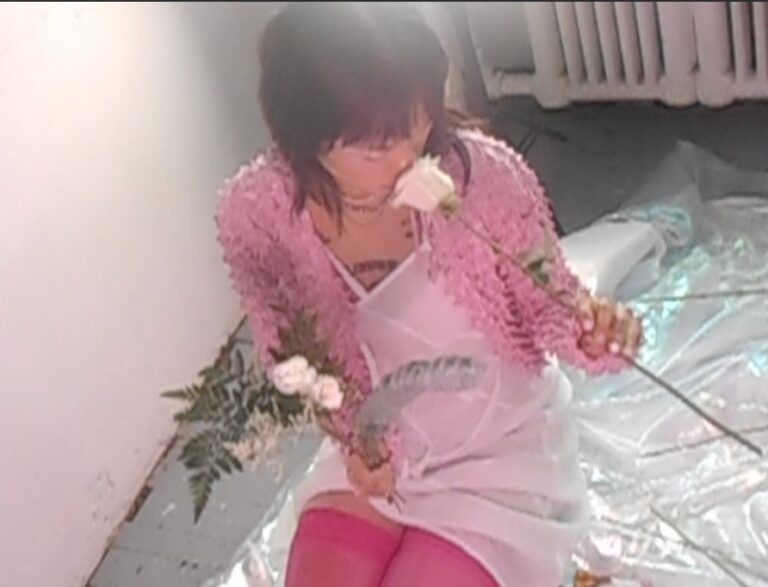
Coralie plays the harp, and Vivian the piano. In their collaboration, it’s the active interplay between their instruments that stands out. A kind of wordless dialogue, where one plays, and the other responds. Yet, the emphasis placed on visual aesthetics also seems to contribute to this dreamlike experience. Seated on the floor, just like the audience, they sit on sheets stretched against the walls, projecting dreamy visuals in light colors. Sometimes, dead flowers and vapors of essential oils drift into the room. And their bodies, moving gently to the rhythm of their instruments,
“Whether it’s with Coralie or in my personal projects,” Vivian points out, “what I’m really trying to create is a feeling of intimacy, gentleness, and introspection… The setting also plays a big part in this experience… We want the audience to have the opportunity to slow down, to let go completely, with the intention of listening, but also of connecting. With us, with others, but also with themselves.”
Navigating between solo and group projects (with Coralie, but also with members of her cohort at the University of Montreal), Vivian Li is currently in the midst of creating a new album, which “brings together different pieces created in recent years.”
And, although travel, collaborations, shows, or even the design of her new album take up most of her time, she continues to dream, silently, of new collaborations.
“One of my dream collaborations right now? Someone talented in percussion, I’d say… But also, definitely RAMZi.”
And we wish him that his dream comes true.