Additional Information
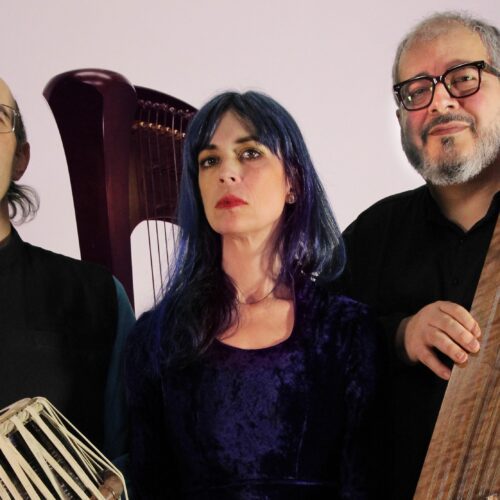
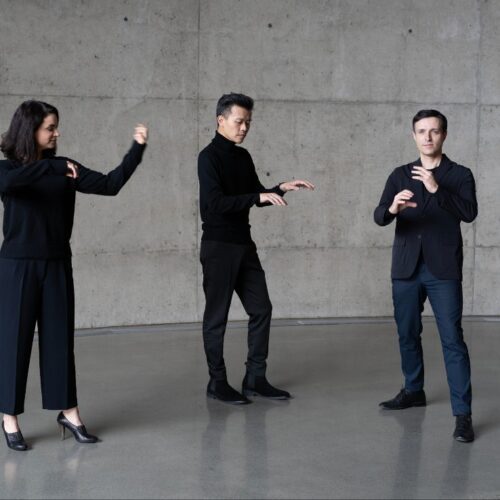
During a Wilding AI residency exploring the role of artificial intelligence tools in artistic practice, Pia Baltazar, Gadi Sassoon, and Daniela Huerta ultimately discovered that they would not be using them after all. But the conversation didn’t end there. These three artists share a keen awareness of our society’s descent into techno-feudalism.
As we discussed this topic with Pia Baltazar and her collaboration with these two exceptional artists, our conversation quickly expanded to broader philosophical reflections on art, technology, and power.
Pia Baltazar has been at the forefront of these issues for years, not only as an artist, but also as a researcher and lecturer. Having worked for many years on the S.A.T.’s innovation team, while also running her own multimedia studio, her words convey a passion and depth that spark curiosity.
PAN M 360: Seeing your name at Akousma, alongside Gadi Sassoon and Daniela Huerta, who, in my opinion, were the stars of MUTEK this year, I thought I should find out more about this project. Can you explain a little about the roles you share in this project?
Pia Balthazar: Yes, so, I’m going to backtrack a little bit. The three of us participated in a project called Wilding AI, which was a research-creation project. It was really an exploratory project, where the idea was to try to see how to question AI tools, not only theoretically, but also practically.
Then also, what were the issues involved in these questions, because working with AI is a much-discussed topic at the moment, and, in my opinion, sometimes in a somewhat superficial way. So we really said to ourselves, “Right, let’s go and see what this is all about.”
It wasn’t planned at all at the beginning, but we were in Amsterdam for a festival with several people, including Gadi Sassoon. One evening, we experimented a little. Gadi had a system that uses an AI agent called Claude. He had found a way to give Claude instructions to create tracks in Ableton with whatever we told him. So he would create an instrument, effects, notes, patterns, etc.
I gave the most absurd instructions I could think of. I don’t remember exactly what they were, but it was breakcore with a fuzz double bass and a flute playing kitsch melodies with inserts by Pierre Boulez. It was Muzo noise. We had a lot of fun. But in reality, the result produced by the AI wasn’t that interesting. What was really interesting, however, was seeing how Gadi and I interacted in this process.
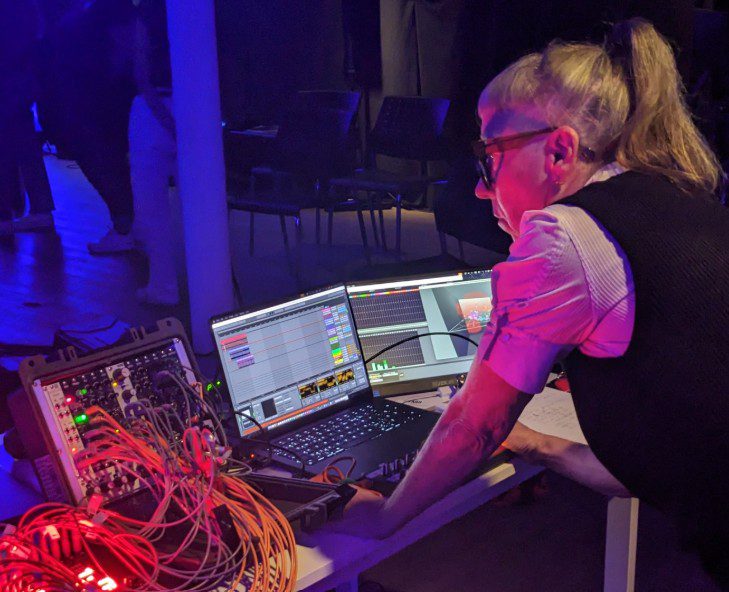
A few weeks later, I went to see him in his studio in Milan. We had set out with the idea of taking this way of working with AI tools further, but in fact, we realized that it was much more fun to just go with electronics, voice, and improvisation, and use the studio as an instrument.
We did a first take like that, then we worked in Montreal in the spatialization studios at the University of Montreal. And then Daniela came along. We also added takes with vocals and analog synthesis. So, in a way, it was really the opposite of what you can do with AI. It was all live performance, using only things we generated ourselves with our movements.
It was also our response to the fact that often, with AI, it’s like, “Ah, I have an idea, I have an instruction, and presto, it’s going to generate my track. ” Here, we did exactly the opposite, which is to say we worked very intuitively with these instruments that are our bodies, our voices, and analog synthesizers that we adjust with their little knobs and all that. And that produces this music that is very… you’ll see what you think, but it’s very visceral.It was also our response to the fact that often, with AI, it’s like, “Ah, I have an idea, I have an instruction, and presto, it’s going to generate my track. ” Here, we did exactly the opposite, which is to say we worked very intuitively with these instruments that are our bodies, our voices, and analog synthesizers that we adjust with their little knobs and all that. And that produces this music that is very… you’ll see what you think, but it’s very visceral.
PAN M 360: I can’t wait to hear it. But if you’ve decided to leave generative AI out of your process, how does this concept manifest itself in the work?
Pia Baltazar: Our thinking ultimately went beyond the generative AI tools that everyone sees and uses, such as ChatGPT. The discussion was more about AI systems such as recommendation algorithms and how they make us totally addicted. That’s AI too, you know.
And finally, what we asked ourselves was: what is the connection between these AI tools and our nervous system? Ultimately, the way AI hybridizes with us is not necessarily like the classic image of a cyborg. For example, if you ask AI to show you a cyborg, it will show you a human body with some kind of prosthetics. But in reality, the way it works is that it completely changes our relationship with our nervous system, our relationship with time, our relationship with addictions, our relationship with how we react, our anxiety levels. All of these things ultimately interact in a very intimate way with our nervous system.
So we ended up making this really dark song. It’s really, really dark, this song. It’s kind of ambient, doom, something like that.
And in a way, it was also by working with Daniela Huerta, who is into very witchy stuff, that we realized that it was actually a kind of exorcism.
PAN M 360: I find it very interesting that you mention this link between technology and the nervous system. We don’t often talk about the addictions it creates, but I’m sure it resonates with a lot of people, myself included. Are these effects intrinsic qualities of AI algorithms and technologies, or do they point to a bigger problem?
Pia Baltazar: AI is just two words put together, but then it’s about practices and technological development choices made by certain people, in this case a handful of guys who live in Silicon Valley and all think pretty much the same way.
In other words, AI is not an autonomous entity, contrary to how it is often presented—that is a myth. It is true that AI, operating through a black box, is rather opaque in its functioning, but what is important is the criteria you give it.
So, you tell it, for example for Instagram, that the goal is to make the person as addicted as possible so that they stay hooked on the app. The algorithm will find ways to achieve this that we have no idea how it works internally. It’s a very heuristic approach, in fact, which is the opposite of what was thought of as artificial intelligence when five other guys got together at a conference in 1957 and talked about artificial intelligence.
It was completely different from what they thought. They thought it would be something very controlled. In fact, it’s not like that at all. The way it works is completely chaotic. It’s just trying to find ways to learn heuristically how best to achieve the result.
So, the only thing we can define in relation to how most AI algorithms work today is: what is the objective?
And in this case, the goal for the tech bros, Zuckerberg, Sam Altman, Elon Musk, and that whole bunch of crooks, is to see how they can maximize profits.
Except that, on top of that, these guys share what they call a kind of dogma, which they refer to as a “mindset.” And there are studies on this. It’s documented in relation to things that are said, that are written, seminars they attend.
And how do they see it? They see it as follows: the planet, the Earth’s ecosystem, is doomed anyway, and AI is the next step, the superior form of intelligence, so there’s no point in trying to save what’s there. What’s important is to achieve as much autonomy as possible for this superior intelligence.
So, if you like, there’s this kind of dogma, this ideology behind it. Their wet dream is that their brains will be updated and uploaded into AI, which will ultimately give them eternal life.
So, that’s the ideological system that underpins the entire way in which most of the AI that is manufactured today is based on this ideology.
PAN M 360: Unfortunately, this ideology extends beyond Silicon Valley, but that doesn’t make AI any less appealing as a subject for artistic research. Is it still possible to approach these technologies in a critical way?
Pia Baltazar: Technology is never neutral.
And to say, “Oh yes, technology is neutral, it depends on whether we use it well or not,” is completely illusory. The reality is that technology carries within itself the way it is made, in its very nature. So that’s the mainstream view of AI. Faced with this, there are ways to resist it, to create alternatives.
That’s what we did, particularly with this project I set up when I was working at the SAT, called ARIA, where basically the idea was to say: this idea of AI as a continuation of technology as it has been since technology came into existence.
Well, how could we create alternative models that would correspond to the values, practices, and imaginations of artists? So, we conducted a large consultation that was funded by the Ministry of Culture, and we realized that artists, depending on what you put behind the words “AI,” are not necessarily against it.
And if it’s something that respects them, that isn’t going to steal intellectual property, that isn’t going to have terrible consequences for the climate, that isn’t going to have all those biases, well, people are interested.
And that’s when other models are generated. They may be smaller models, models that you train yourself, models over which you have some form of control, and so on, in fact. So, what I mean by all this, and this long journey I’ve taken, is that AI is what we make of it.
To answer your basic question, AI is what we make of it, and AI is just a way of giving a name to what is the main paradigm of technological development.
PAN M 360: How do you see your role as an artist in all this?
Pia Balthazar: It’s a bit like David versus Goliath because we’re very small, we don’t have much money, and that’s just how it is.
But on the other hand, as artists, I believe we have a strength, which is that we are capable of telling stories. And the stories we tell are what will also determine how people imagine things, what myths they believe in, and what worldviews they develop based on those myths. So we have a responsibility in that regard.
In this case, on this particular part, we didn’t use any. We used it for experimentation purposes.
But otherwise, I believe that one of the best ways to do this is to divert, tweak, and turn the tools against themselves.
That’s what we all do as artists. We have tools that are designed to do a certain thing, and then we make them do something other than what they were designed for, and that’s where it gets interesting, you see? And that’s precisely why these technologies aren’t interesting in themselves. I remember Robert Bresson, who was a filmmaker in the 1960s in France, part of the New Wave. He said something like, “These prodigious machines that fell from the sky, use them to repeat, to reproduce the artificial.”
In a few decades, it won’t make any sense anymore, you see? And it’s kind of the same thing, in that today, where AI is dangerous is when, instead of using someone with a certain skill, a certain sensitivity to produce an artistic artifact, we entrust it to an AI that will do some kind of standardized thing. And what does that do? It reproduces what a human would have done in relation to that, but emptied of all substance.
In fact, it’s just like reproducing the external form of things. So what I think about this is that ultimately, no matter what tools we use, what matters is what our stance is, what our attitude is, and how, ultimately, we don’t just settle for what the instrument, the tool, the technology gives us, but how, through it, we manage to stretch and transform it to ultimately produce something that is a human emotion.
And so, for me, I’ve never been able to settle for the tools I found on the market. I’ve always had to tweak them, to make my own tools.
PAN M 360: I’m starting to understand your point better about how AI is really just the technology of the moment. If we take Super 8 as an example, we often say that it’s warm, analog, nostalgic, when compared to an oil painting, Super 8 must have seemed cold at the time.
Pia Baltazar: That reminds me of a story. It was about Karlheinz Stockhausen, a composer from the 1960s, after the war, who went to see a Zen master and had a big contradiction because he worked with analog synthesizers. So, which is precisely in line with what you’re saying today, that all musicians who do a bit of experimental music use analog synthesizers because they’re hot, they sound good. Well, at the time, he went to see this Zen master and said to him: “I have a real moral dilemma because I want to make natural music (that’s the term he used), but I use tools that are artificial,” and the Zen master said to him, “That’s not the issue. The issue isn’t what tools you use, but how you use those tools, whether naturally or artificially.” ” So, the term ‘natural’ is a bit outdated now, but I think it’s the same attitude that we need to adopt.
How do you use your tools? Do you use them to imitate what already exists, or do you use them for their own capabilities? And in that regard, AI tools can be interesting because they hallucinate. That’s what they do all the time, they hallucinate. Often, it’s right, but often, it’s wrong!
So, if we’re going to use AI, we might as well let it run wild. That’s how I see it.
PAN M 360: Recognizing the creative power of each of these artists, this collaboration is sure to leave some jaws on the floor. And that’s the whole point. A reminder that, in the age of AI and automation, nothing can replace the visceral quality of human expression. At Akousma, on this Halloween night, we will remember that certain presences haunt not machines, but minds.