Additional Information
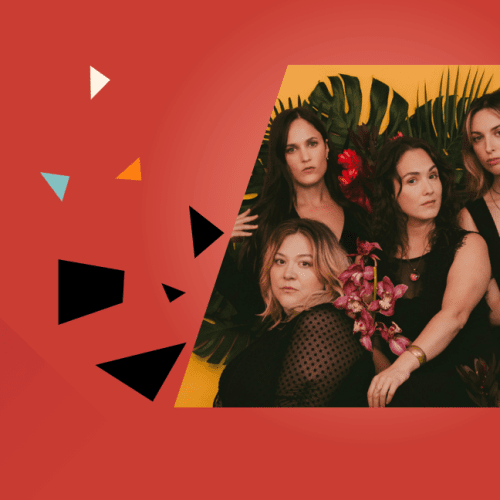
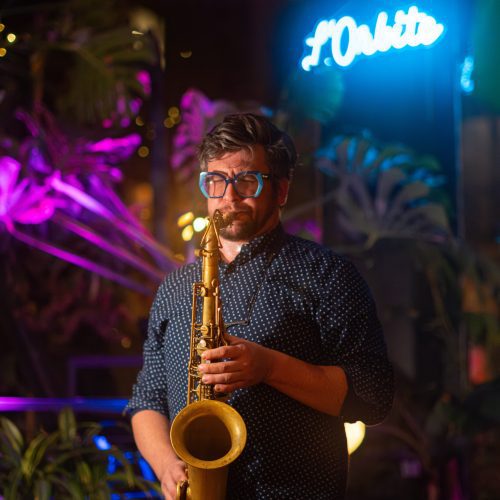
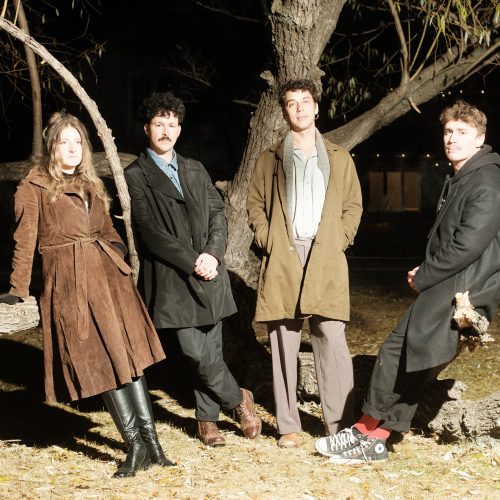
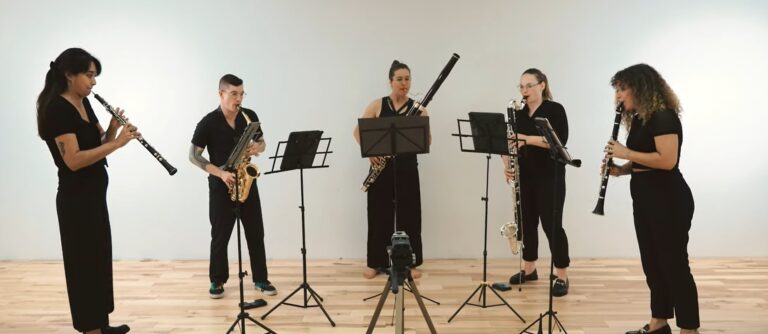
The 5ilience (pronounced “Silience”) woodwind quintet will perform “Devinim” this Wednesday, March 18, at Quai 5160 in Verdun—a concert centered on the unique movement each piece evokes. PAN M 360 presents this interview with artistic director and saxophonist Thomas Gauthier-Lang to discuss the concert program.
PAN M 360: Hi Thomas, I’m really happy to be here with you today. Could you tell me about 5ilience for someone who hasn’t heard of it yet?
Thomas Gauthier-Lang : 5ilience is a woodwind quintet—the first of its kind in Quebec. Our primary focus is on performing and promoting music composed for woodwind quintets, which, although still a relatively new ensemble type, has its own distinct repertoire.
The first reed quintet was called Calefax and was formed in the 1980s in the Netherlands. At first, they mainly performed arrangements, since there was no existing repertoire, but they launched a composition competition that still exists today, and works are now regularly composed for reed quintets; it is therefore a vibrant ensemble that is constantly evolving.
Now, depending on where the quintet is in the world, it also finds its identity in relation to the composers it collaborates with, because this is something new and therefore closely tied to musical creation as well. That’s why, as a saxophonist who plays contemporary music, I was really excited to create a project like this. Then there are two pieces in our repertoire for Wednesday’s concert—Devinim by Ufuk Biçak and Astro Errante by Abraham Gómez—which were submitted to the Calefax composition competition. Since all submitted pieces are in the public domain so that other quintets can perform them, we were able to access this music thanks to the quintet’s initiative.
PAN M 360: If we take a quick look at the concert you’ll be presenting on Wednesday, you’ve chosen “Devinim” as the concert’s title, which is also the name of one of the pieces in the program. What does that mean?
Thomas Gauthier-Lang : In Turkish, “Devinim” means “movement.” I thought it was fitting to name the concert that, because the music in the program isn’t exactly without themes. There are musical themes, actually, but they’re much more rhythmic themes than, say, a melody. So, to refer more to movement than to an accompanied melody. To me, that made more sense.
Then there might also be a little nod to La Semaine du Neuf, where the theme was movement, and since 5illience is also a group participating in a Vivier project, the Pôle Relève.
PAN M 360: I was just about to mention “Semaine du Neuf,” where we had the chance to see how various ensembles interpret the theme in their own way—how the movement is represented, so to speak, in your concert.
Thomas Gauthier-Lang : That’s a very good question. I’d say that the central theme of this concert is the way the composers approach the concept of melody. Rather than unfolding in a lyrical form, they appear as short motifs and rhythmic leitmotifs.
PAN M 360: Let’s talk about the pieces you’ll be presenting next Wednesday.
Florence Tremblay — Gravités (2023)
Thomas Gauthier-Lang : This piece was composed for us in 2023, for our concert “Flore temporelle”. It was like a continuous concert. The goal was to stretch out time or create a sense that it was speeding up.
In *Gravité*, Florence focuses on creating soft forms, so to speak. There are moments when we’re all very aligned—there’s something very vertical—and at every point where we come back together, that shape emerges anew. Musically, she achieves this through lines that are constantly shifting, either upward or downward, with the instruments entering one after another.
There is always this form in constant motion, flowing downward or upward. Then, since this piece was specifically composed for another concert, she was interested in rewriting the beginning. Because in the Flore temporelle concert, the pieces flow into one another. So she was able to go back to that piece and rewrite a beginning that would be more consistent with the context in which we were going to present Gravité.
Theresa Wong — Letters to a Friend (2017)
Thomas Gauthier-Lang : It’s a piece that, on first listen, has something about it that I find very cheerful. But in the piece, Theresa Wong learns a poem from her best friend, who has sadly passed away. So she takes that poem and translates it into Morse code. And that Morse code is the rhythms. It is therefore performed by the woodwind quintet. So everything you hear is the Morse code version of the poem.
Ufuk Biçak — Devinim (2022)
Thomas Gauthier-Lang : Devinim, there’s something really funny about this score. At the beginning of *The Lord of the Rings*, I think it’s Galadriel who says, “I feel it in the earth,” or something like that. So all the sections of the piece are named after that first kind of monologue we hear in *The Lord of the Rings*.
But as the piece progresses, something about that text undergoes a transformation. Because the composer was interested in highlighting humanity’s impact on nature. It’s constantly in a state of transformation, but it’s also perhaps something we take for granted and will never have again in the same way. Because we may not be taking care of it, and in terms of form, there’s a continuous element. It’s a subject or motif that’s constantly transformed right up to the end.
Arvo Pärt, arr Thomas Gauthier-Lang— Summa (1977,202 4)
Thomas Gauthier-Lang : “Summa,” which we also performed at the “Flore temporelle” concert by the Estonian composer Arvo Pärt—a piece I arranged myself. In fact, I think it’s fitting to include it in this program as well. For me, it further underscores this idea of something continuous. Even if we aren’t actually hearing it, there’s something eternal about this music to me. There’s a beginning, there’s an end, but it could play for ten hours.
The composer himself explains that this is the most complex work he has ever composed. But for someone hearing it for the first time, one might say that there is actually something very simple about it, because it consists of a succession of fourths, fifths, and thirds. These are simple, consonant chords, but within his system, he considered it the most complex piece. It is stripped of artifice because it needs nothing more to exist; he takes the time to let us hear the beauty or purity of the recurrence of a fourth or a fifth for about 6–7 minutes of music.
Abraham Gómez — Astro Errante (2021)
Thomas Gauthier-Lang : The play *Atro Errante* takes its title from a painting by the Spanish artist Remedios Varo, who spent part of her life in Mexico. She was a painter associated with the Surrealist movement, and in her paintings she depicted these kinds of anthropomorphic celestial bodies. These are bodies in which one can discern a human form, but depending on how they are dressed or on their head, there is something that reflects celestial bodies, something cosmic, if you will. Astro Errante is one of her paintings in which we see a body with a sun-like head that seems to be traveling through a corridor—an eternal one, if you will—though, of course, the interpretation is open to everyone.
Abraham Gomez wanted to translate that painting into music. This piece leans a bit more toward “program music,” where the form adheres more closely to classical conventions. The first movement is slower, followed by a second movement that’s more groovy.
Thomas Gauthier-Lang — Pauline (2026) *Création
Thomas Gauthier-Lang : While I was composing, I knew I wanted to write a piece for 5ilience, for that concert, because I’d never done it before. I had done it before, but for five melodicas, and those weren’t our instruments.
I thought the timing was right: “Okay, let’s go—let’s write a song for 5illience!”
Out of the blue, my uncle showed up to tell me he was in town to give me my inheritance from my grandparents—my grandmother having passed away about fifteen years ago. So he gave me my inheritance and three violins. These violins belonged to my grandmother, whom I didn’t know played.
I went to try them out. Two of them didn’t work very well. That’s to be expected after sitting unused for fifteen years, but one of them actually produced a sound. It was out of tune, of course, but on the four strings, it played “F G,” and then, an octave higher, “G F.” In my music, the intervals I like best are octaves and seconds.
I’ve always found this interval to be full of possibilities. That violin, with its four frequencies, really helped me structure my piece. So my piece is structured around the sounds that my grandmother’s violin made when I received it.
The first part is in our usual style. The second part is a bit slower and more rhythmic. I’m really looking forward to hearing how it sounds in the Quai’s hall. In rehearsals, we’re used to playing in spaces where the sound doesn’t really come alive. But here at the Quai, it’s quite reverberant.
PAN M 360: One last question: you started out as a classically trained performer—what led you to want to compose?
Thomas Gauthier-Lang : By trade, I’m an interpreter. In my role as an interpreter, what really interests me is collaborating with people to create music. It was through these collaborations that my desire to improvise emerged.
Many of the pieces created were based on “comprovisations,” a blend of improvisation and composition. A composer might say, “Okay, give me two minutes of that effect.” We’d record it, and eventually it would become part of the piece. From improvisation came the desire, one day, to compose. This happened especially after attending the Bang on a Can camp two years ago.
After attending that contemporary music and collaboration workshop, I felt validated in my decision to take on the role of composer. At the same time, I don’t take myself too seriously, because I see myself as still discovering my own musical language and how I want to convey it through a score or to an audience, but I’m very pleased with the final result of the pieces I compose.
I compose for my ensembles, the projects I’m involved in. Until now, I’ve been obsessed with the multiplicity of a single instrument—whether it’s four alto saxophones or five melodicas—so this is the first time I’ve composed for five different instruments. It’s quite an interesting challenge. I know the saxophone well, but the oboe is a creature in its own right. The bassoon is a creature in its own right. It reacts differently. It’s always a learning process, always a process of playing.