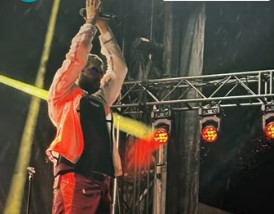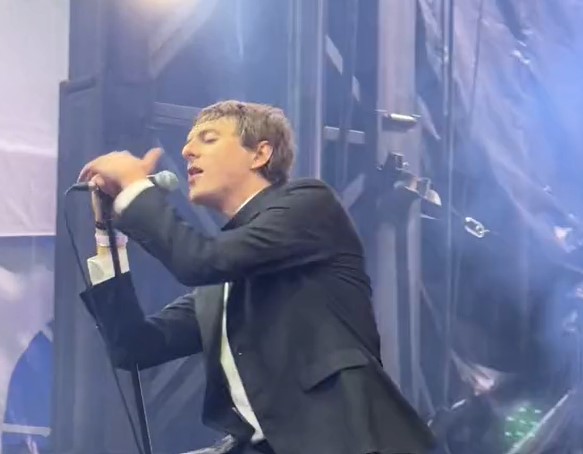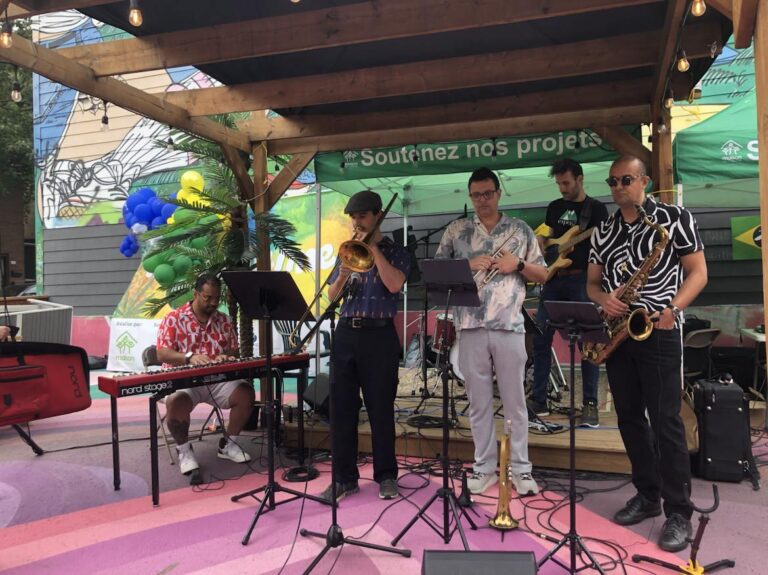
The sirocco is a warm and vast current of air exchanged between North Africa and Southern Europe. It’s also the symbol that South African cellist Abel Selaocoe uses to inspire a spirit of musical exchange between Africa and Europe in a concert programme that he and his friends from the Manchester Collective are taking on a major North American tour, including a stop in Montreal last Thursday.
The artist is as solid in Beethoven and Debussy as he is in arrangements of traditional pan-African pieces or even his own compositions. The Sirocco concert, given in front of a Bourgie hall electrified by his charismatic stage presence, left a little room for the European classics (very brief Haydn, Berio, Hans Abrahamsen and Scandinavian folklore), but gave most of it to the sounds and technical particularities of Africa (Mali, South Africa). More than commercial crossover, although it sometimes sounded a bit like it, Selaocoe offered an intercultural vision of chamber music, where a Haydn quartet had the resonance of an anti-Apartheid spiritual song from South Africa, and percussive techniques thrown at the strings or the cello body were matched by surprising, even impressive vocal inflections. These led the versatile musician to navigate deftly from delicate high notes to rumbling lows reminiscent of Tibetan throat singing. It seems that, between Africa and East Asia, age-old traditions have managed to forge a permanent cultural path.
Selaocoe and the musicians of the Manchester Collective (two violins, a viola, a percussionist and an electric bass) injected an infectious energy that earned them a long and warm ovation. The purists of another era would have hated this kind of programme, but Selaocoe is the bearer of a new future for classical music, and his message of intercultural renewal is clearly reaching a large and, above all, quite young audience.
Since everything, even the best, must come to an end, the fourth and final evening of the Montreal Anti Jazz Police Festival at Ursa took place yesterday in an atmosphere of complete satisfaction. The small venue on Avenue du Parc was packed to the rafters with a colourful, happy, attentive, multilingual and warm audience. Totally Mile-End-ian.
This final session of musical bliss began with the Martian dreams of harpist Sarah Pagé, who presented material that will feature on her forthcoming album Utopia Planitia. The great plain recently visited by a NASA rover served as levitating inspiration for the evocation of strange landscapes, to which layers of arpeggios and ethereal echoes added a touch of more earthly colour. Saxophonist Charlotte Greve followed, and she too won us over with her symbolic, spiritually-inflected minimalism, on which she deploys some beautiful, floating and inspiring vocal lines. Greve’s tenor expresses itself with a beautiful roundness that reminds us of Garbarek at ECM. Somewhere in the ⅔ of the performance, the rhythm was activated to give a more pop finish to the whole, to which the excellent Sarah Rossy has come to add her own touch of vocalism. An impeccable dynamic and stylistic progression that set the table for the second act of the evening.
The latter took the shape and sound of Oren Bloedown, singer, guitarist and bassist from New York, known for Elysian Fields, but also with the Lounge Lizards, Bruce Springsteen, Meshell Ndegeocello… The guy knows the Ursa genre quite well: he owns and skilfully manages The Owl Music Parlor, a great little place that supports good local music in Brooklyn. Bloedown does jazz with a rock, pop, blues and R’n’B twist, or vice-versa. Effective riffs and an engaging music mastered by his friends of the moment, Rémi-Jean Leblanc on bass and Samuel Joly on drums, superb. Martha, always there, came to give us her usual song… Wait, no: two! What an honour, but this was the final, so a little give away bonus is understandable. Joel Zifkin on violin and then Charlotte Greve added a not inconsiderable layer of complementary colours. The feeling was great, and the evening was only half over.
Martha Wainwright – Photo : Pierre LangloisOren Bloedown/Samuel Joly/Rémi-Jean Leblanc – Photo : Pierre Langlois
The penultimate set of this eventful conclusion was held by Unessential Oils, the latest incarnation of Warren Spicer (Plants and Animal). He was joined by Tommy Crane, Sergio D’Isanto and Claire Devlin, among others. Unessential Oils is nothing but feel-good groove, dynamic but not rushed, with a sunny character and a beautiful fullness of sound, and enwrapping emotions. Devlin’s lyrical, choral-like sax lines are like flights of fancy that carry us along with them. What we heard will be available on the band’s eponymous debut album, on sale on 24 May. Reserve your copy now!
The grand finale of the Montreal Anti-Jazz Police Festival seems to have been designed for the ‘Jazz Police’ of fame, the snobs and purists to whom few flowers have been thrown in these four days of very, very broad music, heart and style. The Nashville duo Concurrence, made up of Paul Horton on piano (Alabama Shakes) and Greg Bryant on bass (with the addition of Tommy Crane on drums) gave us the most ‘authentically’ jazz set of the whole festival. And what a great hour it was! A very high level of improvisation, mutual listening, rhythmic versatility and technical quality. Original compositions tinged with social commentary and a few well-launched standards/homages like Bird’s Now’s the Time, completely and brilliantly reinvented.
A perfect finish that will perpetuate in the minds of music lovers the image of an event of the highest quality, despite its good-natured and somewhat spontaneous side, which, in truth, is exactly the reason for its success. Montreal DIY in all its splendour and honesty, even its occasional mistakes. Everyone present, a panorama of the city’s beauty and diversity, felt the festival’s friendly, family-like atmosphere. Well done!
No promises have been made about a potential second edition. We certainly hope there will be one. But, just in case, we’ll hold on to these superb memories.
Thank you Martha, thank you Tommy Crane, thank you Ursa team and thank you to the large and enthusiastic audience. Mission accomplished.
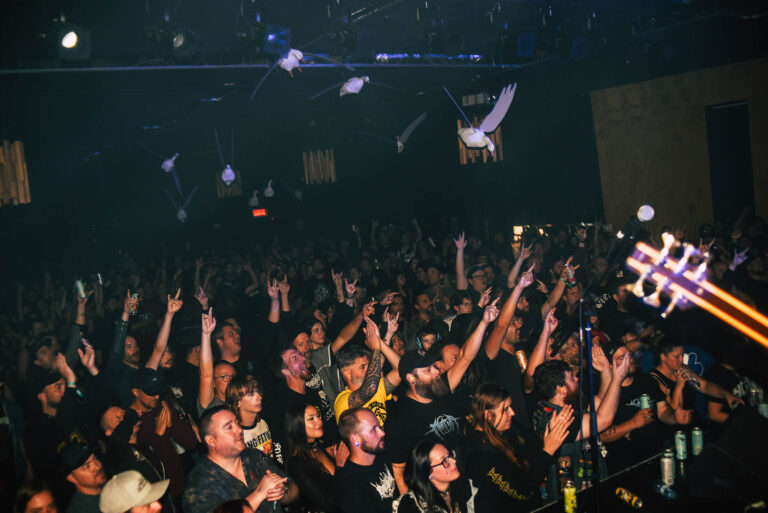
The crowd at Ursa – Photo : Pierre LangloisConcurrence with Tommy Crane – Photo : Pierre Langlois
Une des caractéristiques d’un excellent spectacle de jazz se manifeste souvent lorsque le public a du mal à contenir ses applaudissements, et ces moments ont été nombreux lors de l’événement du 27 mars. L’Orchestre national de jazz de Montréal (ONJM) a présenté un spectacle mémorable et intime, mettant à profit sa formidable section de saxophones pour offrir un répertoire captivant comprenant à la fois des classiques bien-aimés comme Stolen Moments, Night in Tunisia et Infant Eyes, et des compositions originales évocatrices, comme l’hommage poignant de Jean-Pierre Zanella à feu le saxophoniste Wayne Shorter.
Les saxophonistes de l’ensemble, Jean-Pierre Zanella, André Leroux, Samuel Blais, Frank Lozano et Alexandre Côté, ont fait preuve d’une précision remarquable dans leurs lignes à l’unisson, devenant ainsi une seule voix, et lors de leurs solos, laissant briller leurs styles de jeu uniques. Il va sans dire que la section rythmique, composée de Marianne Trudel au piano, Rémi-Jean LeBlanc à la contrebasse et Kevin Warren à la batterie, a fait preuve d’une cohésion exemplaire. L’interaction nuancée et la chimie musicale entre ces musiciens étaient particulièrement évidentes dans cette configuration plus dépouillée de l’orchestre, ce qui a permis d’apprécier davantage leur art collectif. ;
Le batteur Kevin Warren s’est distingué par son jeu dynamique et passionné, qui a constamment fait avancer le groupe avec précision et verve. Son habileté à préparer le terrain pour le succès de l’ensemble était indéniable, contribuant de manière significative à l’énergie globale et à l’impact de la performance. En outre, l’inclusion d’artistes invités, le tromboniste David Grott et Lex French, a ajouté de la profondeur et de la diversité à l’offre musicale de la soirée, le lettrage offrant une interprétation particulièrement émouvante de Lover Man en duo avec Marianne Trudel.
La performance exceptionnelle de l’ONJM a suscité deux ovations bien méritées, rappelant de façon poignante l’héritage durable de l’ensemble en tant qu’institution montréalaise chérie. Avec plus d’une décennie d’excellence inébranlable, l’orchestre continue de captiver les auditoires par son art exceptionnel et son dévouement à la tradition du jazz, laissant une impression durable à tous ceux qui ont le privilège d’entendre sa musique.
Yesterday was the third day of the Anti Jazz Police Festival at Ursa here in Montreal. We came away less satisfied than the previous evenings, not so much for reasons of musical quality, but rather of overall coherence and preparation, due to unforeseen absences. I’ll come back to that later. That said, it was not without its moments of ecstasy, thank you.
It was the artistic excellence of Montreal bassist Rémi-Jean Leblanc that launched this third opus from the new festival. Leblanc, in top form and supported by Jonathan Cayer on keyboards, Nicolas Perron on guitar and Kevin Warren on drums, took us on a journey of sound adventures with a rock bent, both prog and post in certain rhythmic-harmonic details, or McLaughlin-style fusion elsewhere. Also invited to the stylistic party were a few funk wiggles and even a brief extravagance that I felt was a nod to punk. On top of all that, Erika Angell, masterful, allowed herself a series of vocal outbursts as she knows how to propel them, at once modern, astonishing and lyrical. It was a good start, in front of a more sparse audience than on previous evenings. A pity, because RJ Leblanc is one of the great musicians of his generation.
Bellbird at Ursa
photo :Pierre Langlois
The second act of Day 3 showed us the surprising experimental tendencies of Liam O’Neil (Suuns) on drums (and other percussion). He was replacing at the last minute Parker Shper (sick?) That explains why the set was so very short, but not why it started somewhere around the same time as the soundcheck ended. As the boundary between the two proved non-existent, and above all very imprecise, the performance was perhaps already half over when we realised he was playing for real! Felt weird, but hey, good cover up anyway. Besides, O’Neil creates new colours by tapping his tools in all sorts of ways, and even dares to do so with a microphone, thanks to which he collects the resonances induced to create feedback that he transforms live into so many new colours and atmospheres. Avant-garde at the highest level.
This was followed in the same second act by the Montreal quartet Bellbird, who play modern jazz/free jazz/scholarly contemporary music/American minimalism. I couldn’t wait to hear them live. Unfortunately, it was a trio that turned up, as (spectacular) saxophonist Allison Burik was home sick. Another absence. It happens, of course, and we don’t blame them (neither do we the Festival, of course), but the result, while excellent, didn’t reach the high polyphonic levels found elsewhere, and also on their album Root in Tandem, released in 2023 (read my review HERE). But hats off to Claire (Devlin) on tenor sax, Eli (Davidovici) on double bass and Mili (Hong) on drums, for pulling out all the stops and giving us a quality set that would be the envy, albeit diminished, of any other band.
Simon Angell at Ursa – photo : Pierre Langlois
The third act was reserved for a duo we’d been hoping for for a long time: Simon Angell on guitar (and lots of electronic tampering) and Tommy Crane on drums. We’d been promised guests, and after a fine duet of atonal mischief, contemplative abstractions and bursts of rhythmic energy, Greg Bryant from Concurrence (performing tonight on Day 4) took to the stage with his purring bass. Suddenly, the whole set was spiced up. Then the other guy from Concurence, pianist Paul Horton, came in to add a layer. He’s a good pianist, yes, but he also plays the melodica at the same time! Wow. It’s a solid performance, and the room is lifted by a lightning energy and doped by an explosive adrenalin boost. But wait, that wasn’t the end of it: as if out of the blue, saxophonist David Binney and singer Sarah Rossy turn this four-piece trip into an ecstatic six-piece sound orgy. It doesn’t last long enough, but we’re well fed up all the same.
It was an uneven evening, to be sure, but one that ended with great satisfaction. If the important thing is to get off to a good start and finish well, Day 3 has proved that the Anti Jazz Police festival is very good at getting its priorities right.
Day two (or rather, evening) of Montreal’s newest music festival, and almost the same result. Once again, three well-crafted and complementary acts follow on from one another at the Ursa music club on Avenue du Parc.
Martha Wainwright sings an intro song before giving way to the soothing, gentle, melodic folk-pop of harpist/vocalist Émilie Kahn (ex Emilie & Ogden), in duet with Thanya Iyer on pastel synth sounds (a Yamaha’s Reface CS for the techno-curious). We’re settling in quietly to keep us going until past midnight. If we want to! After all, you can arrive and leave whenever you like. Then came Ivy Boxall’s quintet (Christopher Edmonson for real), playing keyboard and sax. Piano, bass/guitar, trumpet and drums are combined in an expansive, epic sound panorama interspersed with calmer, atmospheric pauses. In terms of musical technique, it’s very good. The ensemble clearly has excellent potential, and can build something solid. That said, I have to give a bad mark for the stage attitude of the leader, who rarely seemed satisfied with what he was doing and cut short certain ideas by announcing that the product “isn’t ready yet”, and that it’s a “work in progress”. Unease. If you’re not ready, my friend, you need to rethink your working methods. Music lovers didn’t buy tickets to come and see a rehearsal (unless it was advertised as such!). Or get on with it, improvise a proper finish and don’t spend your set sulking and making us feel it. We call that professionalism. But, I repeat, the potential is great and only needs to be better presented.
Sarah Rossy – photo : Pierre Langlois
The second act begins with New Yorker Claire Dickson, whose dream-pop is steeped in strangeness and seasoned with experimental alt-folk. Claire sings with a beautiful voice, the full range of which you can only guess at as she generally uses it in sighing, sussing and whispering lines, which she is quick to manipulate, stretch and butcher in all sorts of ways thanks to her digital lutherie. A few minor problems with the logistics of her equipment made my friend Monique Savoie (from SAT), who was present and knows a thing or two about this field, cringe. Personally, I rather liked the result. The other artist on the programme for this 8.30pm set was Sarah Rossy. Sarah sang a duet with Eugénie Jobin the day before, and it was superb. This time, all the attention was on her (and her musicians, who were all excellent), and it’s easy to see why she’s considered one of the rising stars of the alt/indie scene. The young Montrealer packs an emotional punch thanks to a versatile and malleable voice, as well as being beautiful and tonally assured. But it’s how she uses it, and the music that supports it, that really impress. Her compositions take us back to aesthetic sources as rich as Zappa, Radiohead, Björk and maybe even (did I dream?) Prince, occasionally. I’m just mentioning names to give you an idea, but Sarah Rossy is much more than that. She has a strong musical personality, and a beautiful psychological transparency that gives her an irresistible charm on stage. Her rise has only just begun, believe me.
This second day of festivities concludes with the third act, at 11pm, performed by the Little Animal quartet (pedal steel, bass, drums, trumpet). Sensory power, slow but irrevocable musical constructions and epic cathartic climaxes make us hesitate to describe them: Post-Rock with Jazz colours or Jazz with Post-Rock accents? Whatever, it’s pretty trippy and contemporary, the way Bad Plus is, but in a visceral Montreal spirit. I said quartet, but yesterday it was a quintet, because alongside Tommy (Crane), Joe (Grass), Morgan (Moore) and Lex (French), we were lucky enough to find David (Binney) on sax, who added his touch of swirling flamboyance to this already pretty strong ensemble. Binney is spending the week in Montreal, both for the festival and for the launch of his album In The Arms Of Light (read my review HERE), which takes place at the O Patro Vys bar on Saturday 30 March.
See you on Day 3, Thursday (what? That’s already today!). On the programme: Rémi-Jean Leblanc at 5.30pm, Bellbird and Parker Shper at 8.30pm, then Tommy Crane and Simon Angell with guests (surprises). And as always, the incomparable ambience of Ursa, a Martha’s song, and her home cooking made with love.
Arlo Parks’ infectious, festive melancholy at the Beanfield.
by Luc Tremblay
British singer Arlo Parks found herself in front of a packed Beanfield Theatre (formerly Corona) last night.
Montreal is discovering Arlo Parks on stage. 23 years old, fragile, sometimes melancholy, always touching, festive, and rocking when—at the end of the show—she hangs her guitar around her neck and jams with contagious pleasure with the excellent trio that accompanies her, carried by the precise, irresistible groove of her rhythm section.
When she performs “Cola,” the song that revealed her in 2018, the Beanfield becomes a choir and intones: I loved you to death and now I don’t really care.
Parks grew up in London, but her Nigerian and Chadian roots also cut a deep furrow on the French side, her mother being a Parisian. The richness of her origins and influences explains the depth of her creation. Some might try to classify her as indie-pop or neo-soul, but her palette is much broader; she discovered King Krule at the age of 13 and is inspired by Hendrix, Bowie, and Sufjan Stevens. In the course of the show, she gives a passing salute to Radiohead – the filiation is obvious.
As a poet, she explores the wounds of childhood and broken love. And the dangers of vulnerability; in “Devotion,” we tremble as she sings against a sharp guitar backdrop: “Your eyes destroying me, I’m wide open, all yours baby, flood me with your nervous love”. Sentimental misunderstandings are also on the agenda, as you may know from “Eugene.” No? Remedy that quickly.
Parks is moved by this first sold-out concert in America, so it’s no surprise that this stop on the Soft Machine American Tour is the beginning of a love affair between her and MTL. It wouldn’t be the first time that music lovers here have forged a deep and lasting relationship with innovative British artists.
Preceded in the first half by an outspoken Chloé George, irresistible and inspired, Arlo Parks delivers a 75-minute performance that leaves us moved. Does her poetry take us away from the heaviness of the times? So close, in fact, that all we can see and feel is profound humanity. We leave the Corona light.
Montreal Anti-Jazz Police Festival at URSA – Day 1
by Frédéric Cardin
We were promised a festival without blinkers, free from the uptight purism of the ‘Jazz Police’ (the snobs of the genre). A promise made, a promise kept. The first night of the inaugural edition of the new jazz festival founded by Martha Wainwright, with the invaluable help of drummer Tommy Crane and the entire Ursa team, is sure to be a success that will make music lovers happy and confident.
The evening, like all the others to come at the festival, is divided into three acts. The first concert takes place at around 5.30pm (approx, because we’re all about the fluidity of experience here. No stopwatch…), the second at around 8.30pm, and the third at 11pm. Three acts, then, and three dissimilar universes, only the second of which can be linked fairly directly to the world of jazz.
It all kicks off with Montreal’s Edwin de Goeij, who gets the festivities off to a gentle start with a soaring instrumental sound supported by a combination of lo-fi (background music generated by a 4-track cassette, as they used to say in the old days) and hi-fi with modern synthetic equipment. A cosmic keyboard floats above it all. It’s a neo-kitsch ambience, with no big surprises, but a very pleasant one. After this chill intro, Erika Angell introduces herself and reprises some of what she gave us at the launch of her album The Obsession with Her Voice at Ausgang Plaza two weeks ago. Against de Goeij’s rather placid interstellar cloud, Erika’s music is a fascinating extra-dimensional nebula of sound. The originality perceived on listening to the album and the launch show is confirmed beyond any doubt. Here is a proposal of ferociously new and impressive artistic uniqueness and audacity that deserves to make the rounds of the world of the most advanced indie music of our time.
Aaron Dolman cr.: Pierre LangloisDavid Binney cr. : Pierre Langlois
When the break comes, we order tacos made and served by Martha Wainwright herself! If you want to live the experience, you’ve got three nights left! The second concert is by Californian saxophonist David Binney, a musical UFO who can combine avant-garde dazzle with Musakian levitation or tight post-bop. After an intro with Martha on guitar (she’s promised to sing one of her songs every night, so be there for the next ones), Binney sets off in a muscular quartet, accompanied by a double bass (Morgan Moore, an amazing virtuoso) and two… drumsets! Yes, TWO drumsets, one held by Tommy Crane and the other by Andrew Barr. The groove, which is totally acoustic but packs a punch of power and square decibels, is simply thrilling. You’re swept off your feet by the sheer force of the sound, and Biney’s free-flowing, stratospheric flights are as exciting as they come. A few calmer pauses balanced out a memorable show (split into two sets) that will live long in the memory. OMG, that was some seriously good shit!
11pm arrives and we’re ready to continue the adventure, although our tushes are a little grumpy (the benches and chairs are a little ‘hard’ for such long sessions, the only downside to this excellent first impression). This time, we’re back to less exalted feelings, with a surprising trio: two beautiful voices (Sarah Rossy and Eugénie Jobim) and drums/percussion (Aaron Dolman). We find ourselves immersed in a post/avant-folk with ghostly softness and unexpected melodic lines, at times almost atonal. You could almost imagine the Boulay Sisters (famous Quebec folk singers) singing Schoenberg! The choice was well thought out, for this first evening ends in calm, serenity and intellectual and emotional nourishment that satiate us, just enough to look forward to the second evening.
I’m talking about a qualitative success here, but it’s also worth noting the quantitative success of this first evening of the brand new festival. The hall was full, from quite so to packed tight, for every concert! That’s very encouraging.
Opera McGill Presents Semele: An Ambitious Evening with the Gods
by Elena Mandolini
Opera McGill, after presenting Cinderella earlier this year, tackles a great work of the Baroque repertoire this weekend: Handel’s Semele. The McGill Baroque Orchestra and Cappella Antica join the cast for an evening of mythological mystery.
The opera’s instrumental overture is quite long, giving the orchestra ample time to shine. Under the direction of Dorian Bandy, the orchestra seems solid and powerful. The nuances are judiciously executed, and there’s a sense of movement in the music. The audience is immediately transported to a world populated by the gods of Roman mythology. Indeed, the opera tells the story of Semele, who has doubts about her future union with Athamas. Before the nuptial ceremony can be completed, Semele is kidnapped and taken to the palace of Jupiter, king of the gods. There, her only regret is that she is not immortal.
The staging is simple, almost minimalist, but effective nonetheless. Changes in lighting colour signal changes of location. That said, the sets (rotating triangular columns) don’t allow much interaction between the performers and the scenery. Movements are therefore limited and sometimes seem repetitive. It is understandable that the Pollack Hall, in which the opera is presented, is relatively small and imposes limits on the space available for imagining sets. The costumes, especially those of the gods, are magnificent. It is clear that there was a concern to evoke both the mortal and immortal forms of these characters.
The vocal qualities of the singers are remarkable. There are some touching, moving arias, particularly those of Sémélé and Jupiter (sung on Saturday evening by Marissa Lake and Pétur Úlfarsson, respectively). All the performers deliver convincing, solid performances. The chorus, too, is outstanding, with their performance of great unity. The balance of voices is excellent and much appreciated. Some choreography is integrated into the choral numbers, though discreetly, adding a welcome dynamism to the work. The diction is impeccable, and the lyrics are clearly discernible, with both English and French projected above the stage, as is customary.
Generally speaking, the balance between the performers on stage and the orchestra is adequate, but not without flaws. There are a few inaccuracy problems on the orchestral side, as well as moments when singers and instrumentalists seem to lose their way and are no longer together, particularly in the more dense passages. Mounting Semele was an ambitious choice, since it is a complex work, both instrumentally and vocally. We admire the ability of these students to rise to the challenge, generally very well, but this is not without its drawbacks.
The successes of this interpretation of Semele are not, however, overshadowed by certain minor negative elements. Once again, we salute the great talent of McGill University students and their ability to rise to ambitious challenges again and again.
To find out more about the Schulich School of Music program, click HERE!
Semaine du Neuf | The Power of the Organ and the Wind
by Elena Mandolini
On the penultimate day of the second edition of the Semaine du Neuf presented by Le Vivier, the public was invited to Ascension of Our Lord Church for an unusual concert: an improvisation composed for a computer-controlled organ. The work featured, L’être contre le vent by German composer Matthias Krüger, was presented as part of his residency. Although primarily an improvisation, this piece is built on the desire to explore the sound potential of the organ. Knowing that there’s almost nothing an organ alone can’t do, imagine what it’s like when you add a computer! The possibilities are now truly endless.
The piece opens with a rumble of low organ notes, in which we hear the wind. This introduction even shakes the church floor. An excellent introduction. Right from the start, you sense just how powerful, imposing and monumental the organ is. You can hear the architecture of the music in this work: the organist, Adrian Foster, plays and repeats chords, while Matthias Krüger, using his electronic device, modifies the sounds. In addition to the acoustic sounds of the organ, purely electronic noises are added, reminiscent of metal squeaks, bells and sirens.
The location adds a great deal to the appreciation of the work. One thing is certain, the listening conditions in which the audience was immersed are rare. As is customary in organ concerts, the audience could not see the instrumentalists. As a result, the architecture of the church was immersed in half-light. With the sound reverberating off the stone, we had the impression that the organ sound was coming from everywhere and surrounding us. The effect is striking, even a little disquieting, but you’re transported and moved.
The different sections of the work, of varying intensity, follow one another almost imperceptibly to paint as many images. The music created is highly evocative. At times, it’s like being underwater, and at others, it’s like being in a glittering forest. And of course, the wind is never far away.
L’être contre le vent is a moving, even troubling, work that transports and embraces us. Despite some lengthy repeated chords, the audience is constantly moving through the work and the changing sonorities. A great success!
To find out about upcoming events presented by Le Vivier, click HERE!
It was in the heart of the Elizabeth Wirth Building of McGill University’s Schulich School of Music, in its large underground multimedia room, that the Between Feathers ensemble (made up of Laure-Catherine Beyers on vocals, Audrey G. Perreault on flutes, Hannes Schöggl on percussion, and Maria Mogas Gensana on accordion) performed a selection of music by various composers from around the world in a programme entitled Sturm und Klang, or “storm and sound” in German.
The concert opened with a single, sharp brushstroke from a snare drum. The composition, “(des)en)canto” by Pedro Berardinelli, proceeds by becoming a kind of soundtrack to an evening in an otherworldly restaurant; the low notes of the accordion played like chairs scraping on the floor, two percussive bowls were struck and rubbed together, and over this, the extended technique of the other musicians like the “slap tongue” – a percussive effect – of the bass flute, and the voice singing through the snare drum, among other interesting effects.
Continuing with Tanja Brueggemann’s “La Somme des Chiffres 1+2”, the ensemble, equipped with flashing headlamps, was plunged into the darkness and gloom of the composition. There were sounds almost like rain playing in 3D through the seventy speakers around the hall, as the musicians played an ambience that evoked sea waves beneath a ship in the night, with vocal notes piercing the air like siren songs through the mist. The huge projector screen hanging over it like a big sail reinforced the image, and even when they sat at a table over a single illuminated glass, it was like a tense dinner in the ship’s cabin.
The other compositions took advantage of similar techniques, with the addition of projections for Nour Symon’s “Mâ‘lesh I – leurs étreintes bouleverserait la mer”, which followed two brushstrokes of black and multicolored ink on a scrolling canvas that corresponded to the flute and accordion, respectively; and Lisa R. Coons’ “Essay I: Mater”, in which a voice spoke over a photo of several pieces of paper with personal reflections, musical instructions, and drawings, on a table decorated with bones and flowers. This second piece succeeded in capturing the effort to define one’s craft as an artist and the incessant thoughts of doubt that accompany it, but the projections, especially the second with its montage of jumbled zooms and color changes, remained dynamic but lost their novelty before the end.
The pieces “La forma delle conchiglie” by Lorenzo Troiani and “about, away – Création” by James O’Callaghan, also had their strong points, with the addition of almost operatic moments, made all the more captivating by the grandeur of the hall. Both, with their use of lighting effects and alternative techniques, were as dramatic and cinematic as the compositions by Bernardinelli and Brueggemann.
In all, the musicians demonstrated superior control of these difficult materials and a high level of performance. Sturm und Klang indeed.
Semaine du Neuf | Collectif9 : musical hero for everyone
by Frédéric Cardin
On Friday 15 March, collectif9, supported by two composers/videographers (Myriam Boucher and Pierre-Luc Lecours), gave the North American premiere of Héros, a work first performed in France in 2020, but which has never been able to travel since because of the pandemic crisis. It was a sort of second Première for this five-movement piece, written for the ensemble’s nine instrumentalists (4 violins, 2 violas, 2 cellos and 1 double bass) and two live video artists.
Thibault Bertin-Maghit, founder and general/artistic director of collectif9, explains the process of musical creation in the interview he gave me, which I encourage you to listen to here:
I’ll just give you a brief summary: starting with Beethoven’s music (2020 was the 250th anniversary of his birth), Boucher and Lecours, who are used to working with electronics, wove a digital musical framework in which Beethoven becomes difficult to recognise, which they then transcribed for the Montreal acoustic ensemble!
From acoustic to digital and back to acoustic again, the rather original approach promised some surprising moments. In truth, this was not the case, which is not to say that it was not good. It’s just that I was expecting some technically virtuosic instrumental passages, spectacularly drawn with millimetric pointillism. I was imagining something perhaps experimental.
Instead, Héros is draped in the hyper-seductive garb of repetitive American minimalism. The five movements develop in slow-fast-slow-fast alternation with a mixed finale. The overall effect is far more ‘pleasant’ than the original premise suggests, and results in a product whose ‘exportable’ potential for touring outside the usual circles of creative music is very interesting.
Concert Héros collectif9 cr.: Philippe LatourConcert Héros collectif9 cr.: Philippe LatourConcert Héros collectif9 cr.: Philippe LatourConcert Héros collectif9 cr.: Philippe LatourConcert Héros collectif9 cr.: Philippe Latour
The video projections animated live by Boucher and Lecours move back and forth between abstraction and natural scenes (lots of birds) filtered by effects of transparency and chromatic color changes. Beethoven’s relationship with nature is probably what most reminds us of his presence in the background, as we search in vain for some melodic reference to the composer (apart from a few chords here and there). In any case, the interest lies not in finding familiar quotations, but rather in the sensory, audio-visual journey on offer.
I found the fourth movement to be the most exciting and absorbing. Against a backdrop of vertical stripes of varying widths and speeds, the highly rhythmic, even nervous music creates a hypnotic trance effect. Certain geometric bands appear in perfect synchronicity with the attacks of the instrumentalists. A fine example of live video creation truly integrated with a musical score.
The final movement offers an almost lyrical synthesis in its elegiac amplitude, touching and much appreciated by the audience.
The Espace Orange at the Wilder was filled to capacity, confirming another success for the Semaine du Neuf contemporary music festival.
As I mentioned, the export potential of Héros is undeniable. I can see this contemporary creation, which is by all accounts fairly user-friendly, being very well received throughout Quebec and elsewhere, in venues not used to the repertoire normally offered by Le Vivier contemporary music hub. Where Andréa Streliski and Jean-Michel Blais draw in the crowds, the Montreal ensemble should be able to pull its weight with Héros.
One of the highlights of the Semaine du Neuf festival, organised by le Vivier in collaboration with Innovations in concert, was the musico-video-cinematic-theatrical adventure concocted by Montreal composer and instrumentalist Sam Shalabi and Ontario writer-actor Shaista Latif. For more details on this work, whose starting point is an old Afghan film partly projected on screen during the evening, listen to the interview I conducted with the main protagonists of the creation (it’s here!!).
This intriguing proposal came to fruition on Wednesday evening, 13 March, at La chapelle scènes contemporaines in front of a packed house. On stage, a string quartet plus Shalabi himself on oud and electric guitar, and Shaista Latif standing up, narrating her own text, superimposed on the film images and music.
Shalabi’s music has a fine modal classical feel, with appropriate but not overdone oriental hues. There are rare moments of more chromatic exploration, and sparse atonal touches, as in the section where Latif’s text refers to the attacks of 9/11 2001. Here, for the only time in the show, the guitar shrieks and unleashes a strident energy that is fully in keeping with the reprise of a speech by a certain American president by a Latif oozing sarcasm. On the screen, a young girl dreaming of modernity sees planes flying overhead. She is filled with pride, but the contrast is heartbreaking with the revenge-filled speech swollen with aggressive nationalism recited by Latif. Other planes will fly over the skies of Afghanistan many years after the film, but with far less noble results for the country. One patriotism follows another, but in the end the Afghans themselves are just spectators. A beautiful reversal of direction, and probably the most powerful moment of the show.
Cr.: Philippe Latour Cr.: Philippe Latour Cr.: Philippe Latour Cr.: Philippe LatourCr.: Philippe Latour Cr.: Philippe LatourCr.: Philippe Latour
Through the character of the young girl in the film who dreams of the city and its modernity, Latif recounts her own questions about identity. The images are as much a pictorial backdrop as they are symbolic and psychological projections of a revealed intimacy. And above all, she also questions our relationship with patriotism and nationalism. Afghanistan (through the eyes of the young girl) and its shattered dreams of modernity hold up a mirror to our own shattered dreams. In relation to that country, we have “succeeded”, but to do what exactly? It’s not a question of denying anything about our way of life, but of reevaluating and reframing it in a context where we absolutely must question the values that will drive this still young 21st century, in order to get through it and come out better than when we started. Maybe.
I’d like to point out one detail of the staging (for future performances): two vertical veilsof silvery hues bordered the screen. However, where I was sitting, one of these strips obscured part of my view of the film because of the lighting reflections that accumulated on it. We’ll have to think of something else…
That said, at barely forty minutes long, the show has no time to bore and we come away satisfied with a discovery (I’d never, ever heard of this film) as well as having been moved to think soberly about some burning issues.
The original film Like Eagles (”Mānand-e ‘Oqāb” in the original language) is available for free online :