Francos | Mononc’ Serge & Anonymus, The Gallery-Hunting Outlet
by Florence Cantin
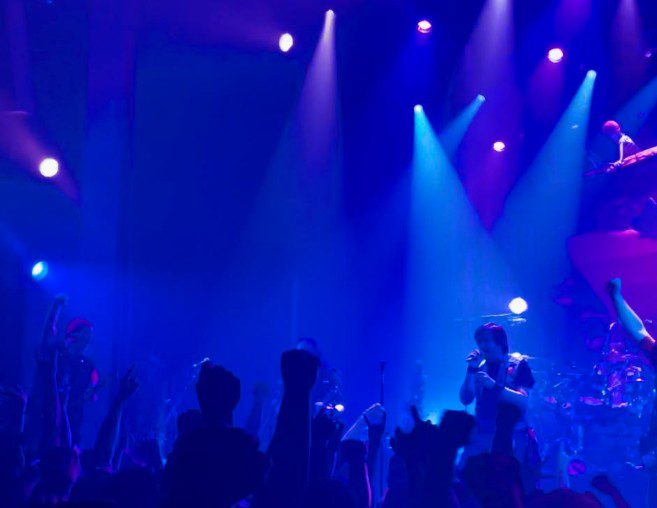
Club Soda was sold out on Saturday night, packed with nostalgic bon vivants ready to die for Canada.
Mononc’ Serge kicked off the Canadian evening with the thrash metal of La ligue du vieux pouèl, dragging his solute behind him. Alongside Anonymus, he’s been around long enough that he’s no longer a member of the young metalheads’ club – even though he insists that aging as a metal veteran is fundamentally tacky. Even before he begins his usual affectionate mockery of the audience, Mononc’ sets the tone: self-mockery reigns supreme here.
The audience, a little shy at first, as if in an observation phase, was soon shaken by Anonymus. An invitation to a circle pit from bassist Oscar Souto broke the ice. The call did not go unheard. A wave of support quickly spread through the room. The circle formed, and the crowd, still static, was suddenly animated by a galvanizing federal energy.
Some of the spectators unwillingly embodied the parody held up to them as a mirror – it was as if the Club Soda kegs had all been siphoned off before the encore. The beer age wouldn’t be nearly as enjoyable without the traditional “moron fishing”, where Mononc’ points to a fan who’s as thirsty as he is overheated – often already tipsy, sometimes downright unstable. The youngster was then brought on stage for some wobbly choreography, before wedging in his beer to the cheers of the crowd.
Hommage aux hommages was one of the highlights of the evening. With its double-bottomed text, the play mocks the very contemporary mania for multiplying tributes, salutes, tributes and posthumous celebrations to excess. The theme is deliciously ironic, carried by the memorable line: “On a mis a quelqu’un au monde / On devrait peut-être lui rendre hommage. More than twenty years after L’Académie du massacre, initially seen as improbable, this marriage between Mononc’ Serge and Anonymus remains impressively solid on stage. A symbiosis that never runs out of steam.
For 2025, multidisciplinary artist Soleil Launière chose to bring forward the solstice ceremony to June 11, and celebrate it in the company of musicians she loves. Let’s just say that the evening was a success.
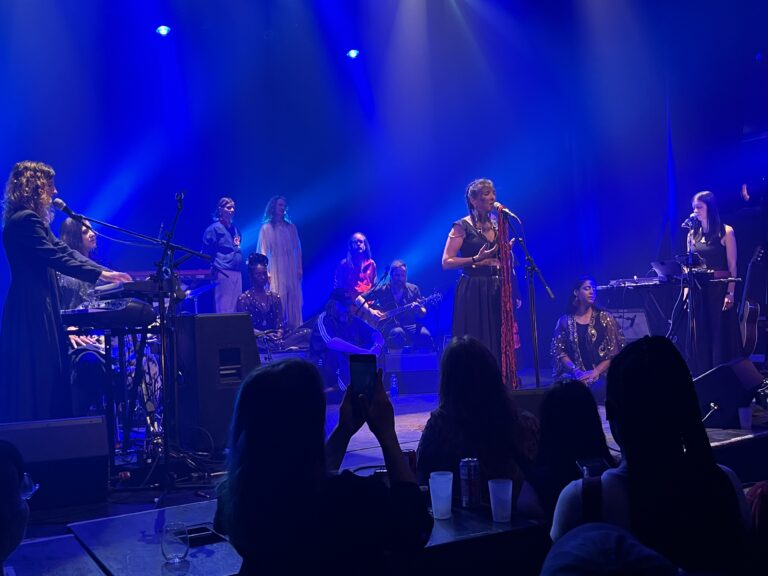
It began with traditional native drums, then gave way to keyboards and electric guitars. Soleil Launière took to the stage with the kind of traditional panache that has become her trademark. And it all kicked off with tracks from her 2023 album Taueu, an increasingly refined blend of tradition and the musical present.
Then began the well-crafted parade of female songwriters from different backgrounds: Berber Moroccan Nukad, Klo Pelgag, Cree Arachnid, Wendat Eadsé, Jorane and her cello, Dominique Fils-Aimée and the duo VioleTT Pi, the only male presence in this very feminine-feminist show. And that’s just as well.
All this was generally of a fairly high calibre. But the best moments came when the artists dialogued with Soleil Launière. I’m thinking in particular of Nukad, whose Maghrebian tradition blends perfectly with that of the Aboriginals, Jorane, very inspired and tapping furiously on her cello to play First Nations percussionist. And what can we say about Dominique Fils-Aimé, who, after a vocal solo that sent shivers down Club Soda’s spine, harmonized with Soleil Launière and the voices of accompanists Chloé Lacasse and Geneviève Toupin. It was pure vocal bliss.
It’s worth noting: the work of the accompanying band cemented this eclectic concert in a wonderful way. In addition to guitarist Simon Walls, there was the group Chances: Vincent Carré on drums, Chloé Lacasse on vocals and keyboard and Geneviève Toupin, aka Willows, on vocals, keyboards and guitars. What voices these women have!
There was another anonymous star: a one-year-old baby, who clapped his hands constantly and squealed with delight at the end of the first few songs.
It was a wonderful evening! As proof, my friend Gilles, a Belgian-born political scientist now living in India, who accompanied us yesterday and didn’t know any of the artists, came away completely enchanted by the event.
What more to say….Other than: Vive le métissage and the new wave of Indigenous music!
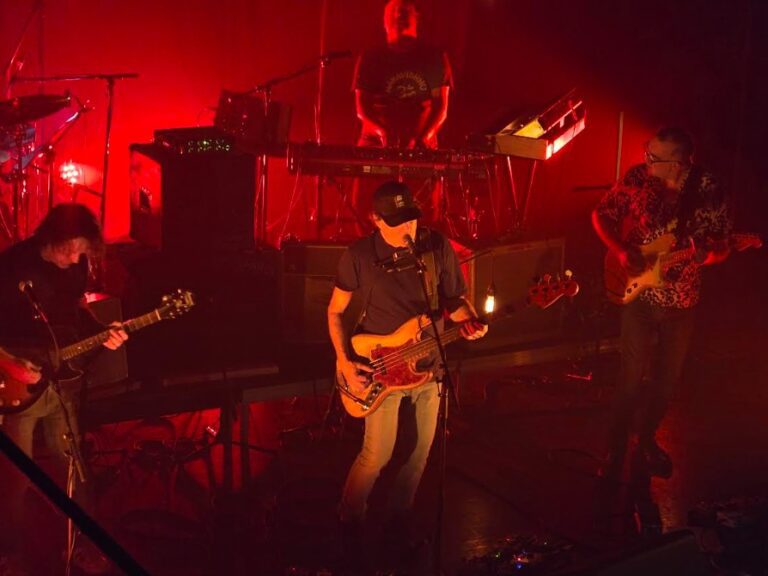
Released in 2004, Planter le décor is one of Fred Fortin’s key albums. On Friday night at Club Soda, its creator confided to his fans that he had resisted pressure to perform the material on stage. He finally agreed when his better half said, “You do it. What woman wants, Fred wants, and here we are, a room filled to the brim two nights in a row at the Francos de MTL, before a crowd essentially in their thirties and forties, who came to relive their youth for a couple of hours.
When nostalgia calls? Very rarely as far as I’m concerned, but it seemed justified this time. Justified because Fred had brought together the original line-up for the album: Jocelyn Tellier and Olivier Langevin on guitars, Dan Thouin on keyboards, Alain Bergé on drums, the singer on bass and guitars, certainly a top-notch crew in the French-speaking keb landscape.
It was a show worthy of these musicians and their Saint-Prime employer, a highly sophisticated blend of popular culture and stylistic research, a successful marriage between virtuosity, weight and well-placed roughness, between colloquial and finer language.
Two decades of maturity have done the trick: the saturation of low and mid-range frequencies, the harmonic and rhythmic subtleties complementing rock, country and blues chords, the high virtuosity of these performers, all these elements bring us back to the setting set two decades earlier.
As in the album, he began with Mélane, the tale of a man adrift under a sky of vultures, addressing his companion whom he imagines as a lifeline for his troubled existence.
He followed this up with Conconne, the rocky murder of a silly singer, tossed into the bottom of a canyon by an enraged male. The tempo picks up with Lucia, a heavy stoner rock mixed with prog and country, served up with three guits in your face, followed by Pop Citron, pure clopin-clopin’ country, describing a not exactly beautiful loser, a soap novel show-off whose face sells like pudding.
Then it’s time to please our colleagues with Ti-chien, a polyrhythmic instrumental with jazz and prog overtones, featuring the quintet’s jazzmen – Tellier, Thouin and Bergé.
As long as we’re being canine, here’s the story of the bored dog Robeur, who scurries off to row 6 before being spotted by his master, another slow-tempo stoner rock with wonderful bridges.
Here we are in Chateaubriand, the filet mignon fantasized by the desert crossing against a backdrop of Americana folk chopped tartar by increasingly beefy beats of which Alain Bergé has the secret.
And re-country at a trot, evoking a Dérape ending with a good cup of coffee to ward off evil spirits.
A little later, the story of another slip turns out to be less hop-la-vie, immersing the narrator’s face in a pool of Scotch, the sad brush of a guy without a companion. The narrator has to take a cab home, the plaintive harmonica melts into the arch-saturated prog-rock, and we’re moved by the dialogue between guitars and bass, supported by impressionistic keyboards and a beat that couldn’t be more virile.
Once the entire album had been played, Fred Fortin’s quintet went on to play another dozen of their classics, much to the delight of their front-line fans, rounding things off with three encores, two acoustic ones and a final one for the road with a full band, La Loi du chocolat.
Despite a change of direction towards a more folksy, laid-back sound on his most recent album, GreenWoodz had promised a “wicked party” for his launch party. The promise was kept: the rapper set Studio TD alight with his new songs, not forgetting his classics.
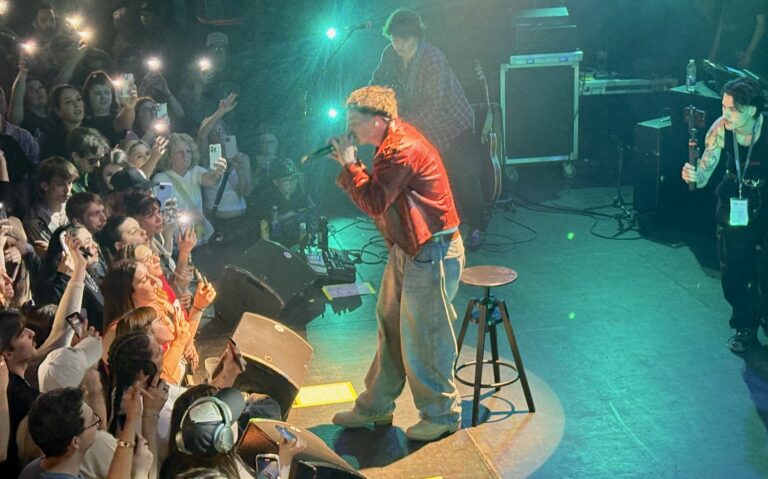
The Mandeville native was charismatic from the outset. Sporting a leather jacket and jeans, GreenWoodz has the aura of a rockstar. And when you say rockstar, you say crowd-pleaser: from start to finish, the audience in front of the stage was singing along to every one of his songs, word for word.
The evidence is striking: he maintains a special connection with those who listen to him. The launch quickly takes on the air of a great evening with friends. Throughout the party, he engaged in countless exchanges with those present, even going so far as to descend into the room on two occasions – notably for the excellent Lucifer, from his new opus.
Alongside him were a drummer, a guitarist alternating between electric and acoustic, and Cook Da Beatz, DJ and long-time accomplice. It’s on stage that the emo-rap influence that runs through his discography is fully revealed. Melancholy, love and sadness are the order of the day.
Halfway through the set, GreenWoodz approaches the audience and sits down on a small stool. He is about to perform Tommy, a poignant tribute to a friend who left too soon. Illuminated by telephone flashlights, the 7ième Ciel rapper delivers this track masterfully, bringing to life one of the most moving moments of the evening.
Fans at Studio TD were also treated to four special guests. Shreez, Rymz, Souldia and Aswell all took to the stage to perform their respective collaborations. The latter’s appearance for their track IDGAF confirmed that local hip-hop is in very good hands with these two men.
GreenWoodz delivered a generous, vibrant and flawless show. A launch in the image of its evolution.
Violons du Roy at Bourgie: symphonic excitement from Old France
by Frédéric Cardin
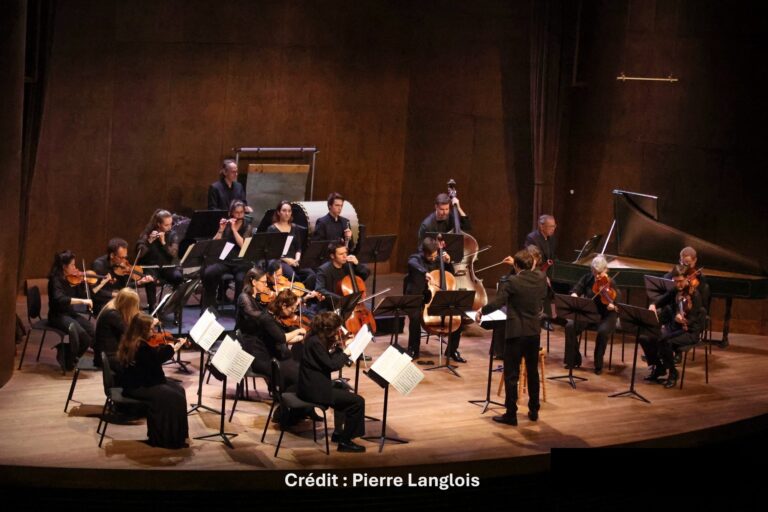
Les Violons du Roy closed the 24-25 season at Salle Bourgie last night with a program of musical bubbles worthy of Mme Cliquot. The symphony “à la française” was in the spotlight. Mind you, not Franck’s or Ravel’s, but rather the first symphony, that of the origins. We’re talking here about Gossec and Rameau, as well as a certain Duport whom most music lovers, even those in the know, have never heard.
Under the direction and thematic construction of Nicolas Ellis, the program kicked off with a sparkling symphony by François-Joseph Gossec (1734-1829), a composer still much underestimated today. And yet, this little three-movement work, one of the 49 or so he composed, has much to seduce and delight: dashing melodies, an orchestration of exciting contrasts and cheerful rhythms make it a highly recommended listening pleasure for anyone with a passion for the vivacity of a Mozart or Haydn.
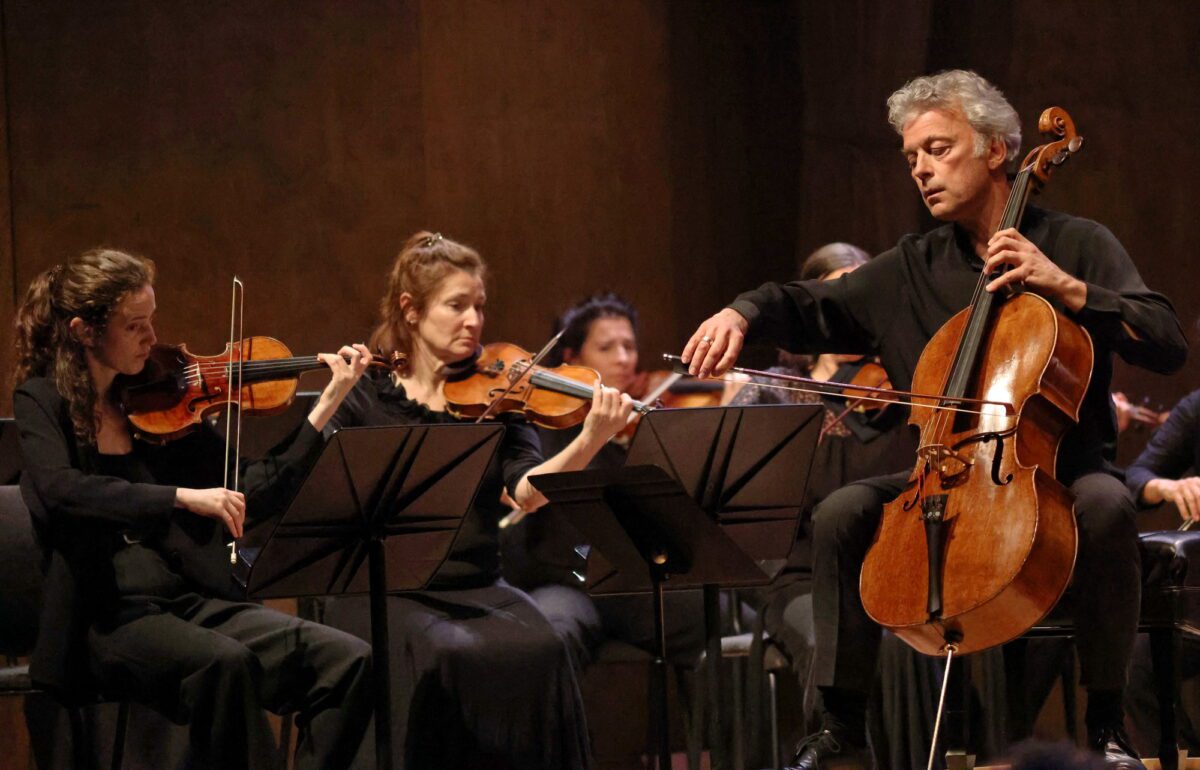
This was followed by a Cello Concerto, No. 6 in D minor, by Jean-Louis Duport (1749-1819), apparently a great virtuoso of the instrument in question. There’s no doubt about it, given the formidable nature of this score, and I weigh my words carefully. When you consider that even such a luminary as Raphaël Pidoux, a member of the Wanderer Trio (which is no mean feat), is not always able to emerge unscathed from the technical pitfalls imposed by Duport, it’s clear that this work represents a formidable challenge. That said, Pidoux has injected a dose of elegance and lyricism (very lyrical central andante cantabile) that is utterly seductive, and has been well received by the public, and rightly so. Here’s a work that deserves to attract the most seasoned of today’s soloists: there’s plenty to do!
Raphaël Pidoux et Les Violons du Roy – crédit : Pierre Langlois
The final part of the concert featured Jean-Philippe Rameau’s (1683-1764) “cosmic symphony”. The what? No, Rameau didn’t really write a “cosmic symphony”. In fact, it was a construction by conductor Nicolas Ellis, who drew on Rameau’s repertoire of operas and ballets to concoct a vast fresco in four movements evoking the creation of the world, the seasons, the earth, the wind, storms and even time. A fifth movement, a return to the interstellar, depicted the explosion of a supernova and featured a piece by Jean-Féry Rebel (1666-1741), Chaos, taken from his Élémens.
Ellis’s architecture works very well: the contrasts between the pieces create a narrative line that refuses to bore, and makes judicious use of some of the composer’s well-known tunes.
What impressed most – and this will come as no surprise – was the striking limpidity and surgical technicality of Les Violons du Roy. What a pleasure to hear this quality of playing, these abrupt contrasts perfectly achieved, these flights of tenderness chaining together piquant shears, and this perfect rapport with the discourse of the scores. Nicolas Ellis conducts with infectious freshness.
C la vie: The never-ending drum dance to close out FTA
by Stephan Boissonneault
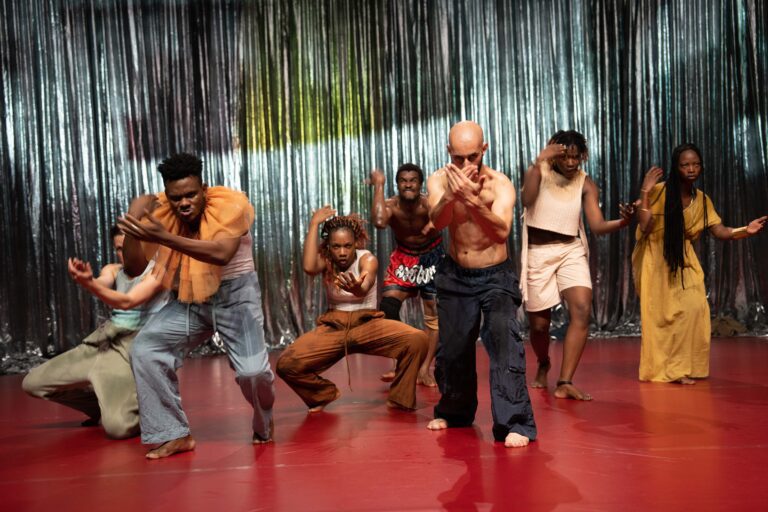
For 30 unbroken minutes, the Théâtre de Verdure in Parc La Fontaine is a living organism. Its heartbeat is driven by skin on skin—hands pounding hide, feet striking earth. C la vie, performed by a riveting dance troupe from the legendary Faso Danse Théâtre in Belgium, is less a performance than a force of nature: a nonstop barrage of rhythm, movement, and human will. The dancers emerge in a vortex of motion, seemingly born from the very thrum of the live drummer that propel them. There are no formal entrances, no moments of reset or stillness. Instead, the performance unfolds as a single, surging breath—expanding, contracting, trembling with exertion. The stamina on display is staggering. Each performer commits with a ferocity that borders on trance, their bodies locked in a choreography that demands unrelenting dexterity.
Movements loop, fracture, then evolve—shoulders rotating in sharp bursts, hips swinging in precise arcs, knees pumping like pistons. And somehow, none of it falters. Moments of song emerge like flares in the darkness—raw, resonant cries that slice through the polyrhythmic onslaught. These brief vocal eruptions, sometimes solo, sometimes choral, hint at a deeper narrative, one that’s intentionally fragmented. There are whispers of ritual, defiance, longing, joy. A woman in a golden dress, Niako Sacko, cracked with emotion, rises above the rhythm with a soaring and sometimes malignant vocie, as another dancer collapses to her knees. She seems to be in control of the dancers, who slowly strip their clothing dripped in sweat.
Devloped by Serge Aimé Coulibaly, a Burkinabe choreographer and towering figure of African performing arts, C la vie “draws on Wara and Senufo traditions along with Western carnivals,” and an insatiable lust for life. The performance, which has only seconds of reprieve between dances was a bit too much for some in the audience. Perhaps they needed an easy to digest story, but C la vie demands that the audience feel the ache in the dancers’ calves, the burn in their lungs, the iron grip of discipline beneath every fluid spiral. It’s exhausting to witness—and that’s precisely the point. An interesting way to close out the FTA.
CMIM 2025 | Assessment of a Successful First Event
by Alexandre Villemaire
For a week now, Montreal has been the scene of one of the city’s leading cultural events. A fixture on the Montreal musical scene since 2002, the Montreal International Music Competition (MIMC) is currently in full swing, with its 2025 edition devoted to the voice. A total of 23 singers from seventeen countries have taken to the stage at Salle Bourgie in Montreal over the past seven days. During the various stages of this first event, the competitors had to perform a program made up of pieces from the repertoire of opera arias and the melody genre. The cumulative points from the two stages will be used to identify 10 singers who will go on to the semi-final stage.
During the first few days of the competition, we witnessed colorful performances, full of sensitivity and musicality, as each singer took to the stage with his or her own personality. Not all of them will go on, but none of them will be ashamed of the performances they gave, which all contained interesting elements. Without being exhaustive, here are just a few of the performances we heard that made an impression on us.
First of all, Russian-born soprano Julia Muzychenko-Greenhalgh, who opened the competition, delighted with a performance of the difficult Air des clochettes (“Where does the young Hindu go”) from Léo Delibes’ opera Lakmé. A perilous choice in terms of vocal line. Canadian soprano Sophie Naubert also made a remarkable impression, notably with her strong stage presence and expressive sense, not least in the aria “Take It to Tumblr*” from Kendra Harder’s Book of Faces. The same goes for Fanny Soyer, who presented the different characters of the arias in her first test with nuance and versatility, both through vocal agility and meaningful stage gestures. Her performance of “Formons les plus brillants concerts… Aux langueurs d’Apollon” from Jean-Philippe Rameau’s opera Platée was utterly captivating. English baritone Theodore Platt is also one to watch. Blessed with a powerful, warm timbre and great musicality in his sensitive interpretation of the aria “O Du, Mein Holder Abendstern” from Wagner’s Tannhäuser during his performance of the Aria stage, he also distinguished himself in his round devoted to melody. German baritone Valentin Ruckebier’s character and playing are also worthy of note, particularly in the Machiavellian aria “Vous qui faites l’endormie” from Gounod’s Faust.
Among the South Korean representatives, tenor Junho Hwang, bass-baritone Chanhee Cho and soprano Yewon Han delivered solid performances: Hwang for his interpretation, diction and sensitive musicality in “Salut demeure chaste et pure”, also from Gounod’s Faust, Cho for her committed stage presence, and Han for her perfectly accurate interpretation of the elevated aria “I am the wife of Mao Tse-tung” from John Adams’ opera Nixon in China.
And the semi-finalists are…
At the end of the first round, the international jury selected the ten semi-finalists of the Voix 2025 edition, who will perform on the Maison symphonique stage on June 3 and 4 with the Orchestre symphonique de Montréal, the official orchestra of the MIMC, under the direction of conductor Patrick Summers. The semi-finalists are :
Junho Hwang, Ténor, South Korea
Katerina Burton, Soprano, United-States
Chanhee Cho, Baryton-basse, South Korea
Yewon Han, Soprano, South Korea
Fleuranne Brockway, Mezzo-soprano, Australia
Fanny Soyer, Soprano, France
Ariane Cossette, Soprano, Canada
Jingjing Xu, Mezzo-soprano, China
Theodore Platt, Baryton, UK
Julia Muzychenko-Greenhalgh, Soprano, Russia
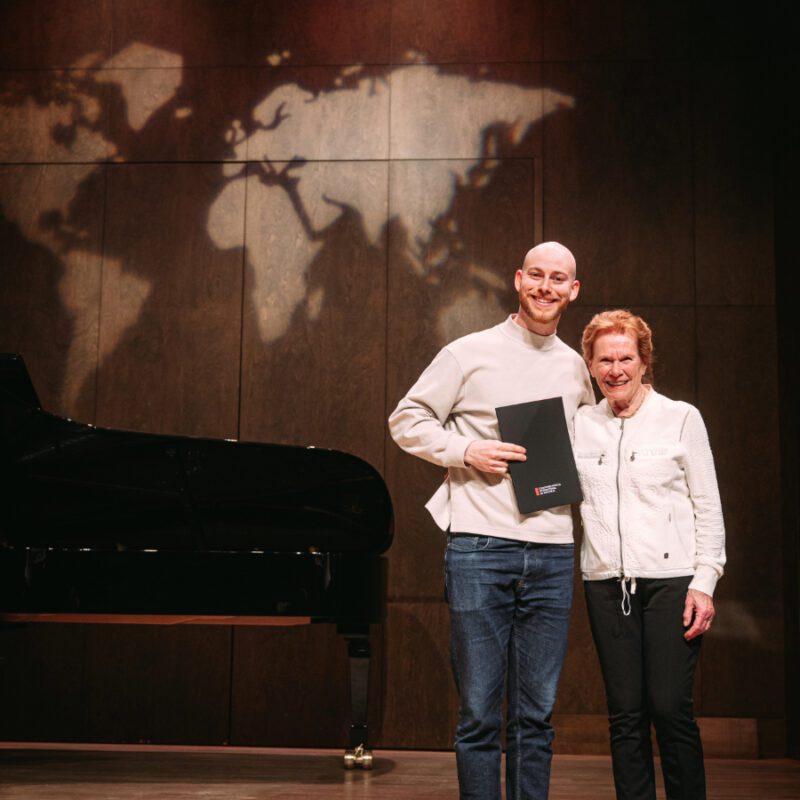
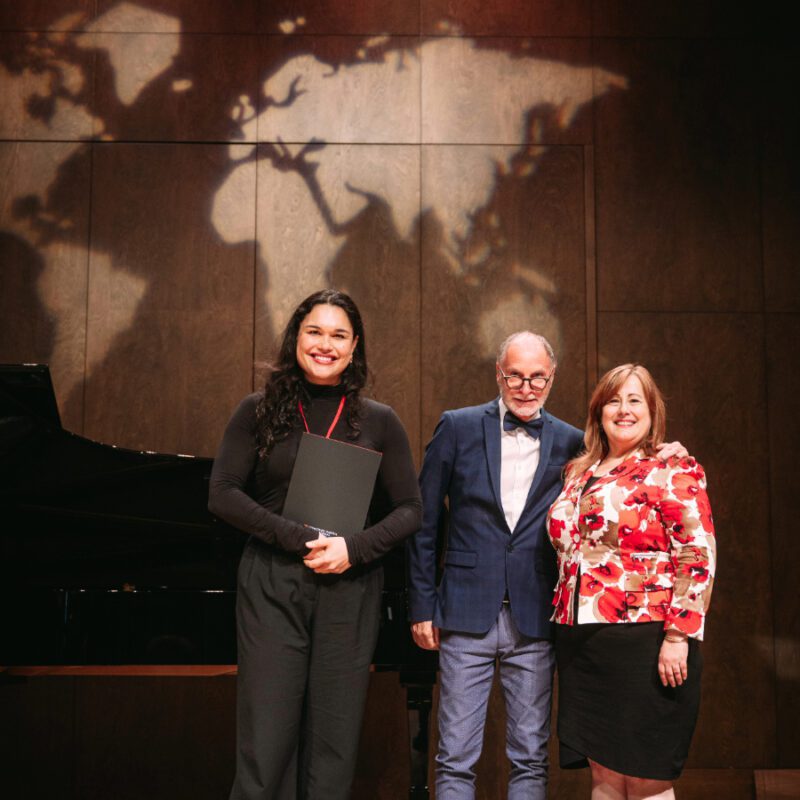
In addition to the announcement of the semi-finalists, two special prizes were awarded. Offered in partnership with Dixi Lambert, the Prize for the best interpretation of a contemporary aria, accompanied by a $2,500 purse for excellence in the performance of an aria composed after 1975, was awarded to English baritone Theodore Platt for his interpretation of an excerpt from George Benjamin’s Written On Skin.
Introduced last year at Piano 2024, the Emerging Talent Jury Prize, worth $1,000, was awarded to Australian mezzo-soprano Fleuranne Brockway. The jury, presided over by Canadian soprano Aline Kutan, was made up of vocal students and a pianist, all from the city’s three major music institutions (McGill University’s Schulich School of Music, the Conservatoire de musique de Montréal and the Université de Montréal’s Faculty of Music).
Theodore PlattFleuranne Brockway
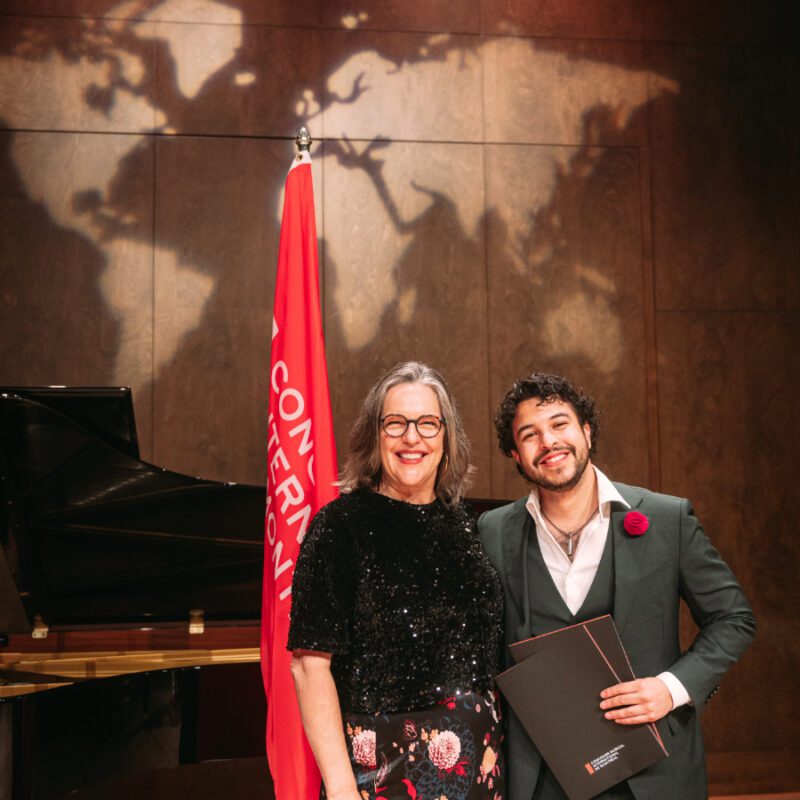
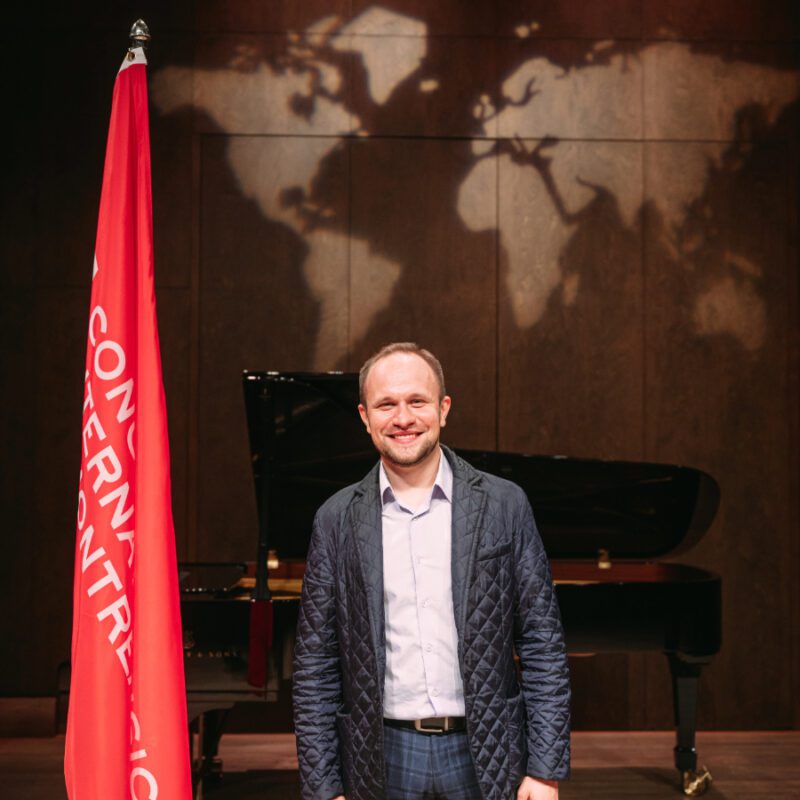
The final round of the Mélodie Prize was also held. Offered in partnership with the Nawacki Family Foundation, the $10,000 Mélodie Prize is awarded to the artist who has distinguished himself/herself the most in the interpretation of the Mélodie repertoire during the First Round – Mélodie and its final. The five finalists were Russian soprano Julia Muzychenko-Greenhalgh, English baritone Theodore Platt, Colombian baritone Laureano Quant, Australian mezzo-soprano Fleuranne Brockway and French soprano Fanny Soyer. Laureano Quant won the award with a committed interpretation of excerpts from Francis Poulenc’s truculent Chansons gaillardes cycle, and a spirited performance of excerpts from Gerald Finzi’s Let Us Garand Brings cycle. The Colombian baritone was also awarded Salle Bourgie’s prestigious Schubert Prize, which comes with a recital engagement in the new series devoted to Franz Schubert’s complete lieder.
For his part, Ihor Mostovoi (Canada and Ukraine) was awarded the Prix André-Bachand for best interpretation of a Canadian work, presented in partnership with Claudette Hould for his interpretation of Julien Bilodeau’s “Mon souverain” from the opera La beauté du monde, with libretto by Michel-Marc Bouchard.
Laureano QuantIhor Mostovoï
Now it’s off to the Maison symphonique, where the semi-finalists and the MIMC team will be taking up residence for the next few days. With the level we’ve heard so far, we can’t wait to hear what the semi-finalists have to offer in an orchestral setting.
Festival Classica | Pavane For a Flaxen-Haired Gypsy Girl
by Alexis Desrosiers-Michaud
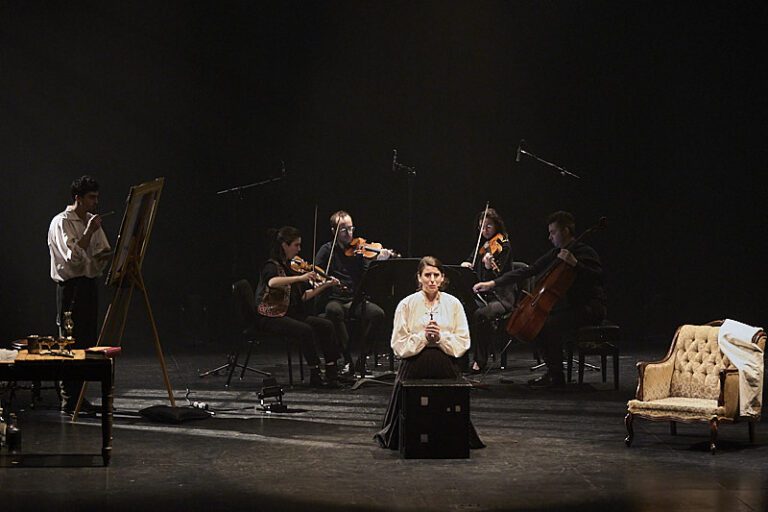
The new production of Tango Boréal was presented this Sunday at the Théâtre de la Ville de Longueuil as part of the vocal program of the Festival Classica, the Nouvel Opéra Métropolitain. After Les lettres de Chopin, Denis Plante, known for his tango repertoire and his bandoneon, brings us La Fille aux cheveux de lin, set to pieces by French impressionists Maurice Ravel and Claude Debussy.
The story is about a painter who has his sister’s unconditional help to succeed, and she gives him her undivided attention, until a mysterious flaxen-haired girl appears in the studio. Drawing freely on Charles Baudelaire’s work for the libretto, Plante explains at the outset that the two protagonists are a reflection of Baudelaire, who himself wanted to be a painter but had no gift for it.
Written for mezzo-soprano and string quartet, the 75-minute work is magnificent. Although the music is already written, it had to be arranged and lyrics added, and this is the tour de force Denis Plante and his brother Antoine have achieved. The segues between excerpts flow naturally, and the lyrics fit together well, as if they had been part of Ravel and Debussy’s pieces. What’s more, the contrasts, colors and characters of the pieces had to be carefully placed in a very precise order in order to superimpose a mise en scène, and this too is very successful. It’s simple, but just right; just a few props, an armchair, an easel and a heater are enough to plunge us into an artist’s studio at the turn of the 19th century.
In the lead role, Amelia Keenan is an excellent performer. Standing alone on stage most of the time, she understands that it doesn’t have to be showy, and that it’s just as, if not more, important for the audience to understand the text, especially without surtitles. In this respect, the French diction is perfect. Every word, every intention, every emotion is clear, both vocally and on stage.
Ms. Keenan was accompanied by a string quartet featuring Marie and Dominique Bégin on violin, Elvira Misbakhova on viola and Stéphane Tétrault on cello. Marie Bégin played very well in the excerpt from Ravel’s perilous Tzigane.
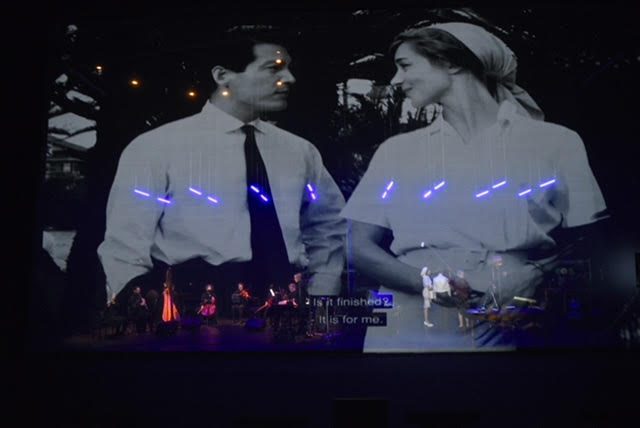
Co-produced by Carte Blanche and Chants Libres as part of the FTA, the adaptation of the cinematic masterpiece Hiroshima mon amour into a contemporary opera was an ambitious gamble. To pay tribute to this once award-winning film of great beauty, director Christian Lapointe and his Australian collaborator and composer Rosa Lind turned their attention to the musicality of the work, inviting the Quatuor Bozzini, harp, clarinet, flute and percussion to join the cast in setting Marguerite Duras’s poetry of love and death to note.
The first act opens in the “voice studio”, where performers Yamato Brault-Hori and Ellen Wieser record their dialogue in front of microphones, and where we understand that the adaptation had a surprise in store for us: the character of Marguerite Duras is also present, played by Marie-Annick Béliveau, like a mise en abîme of the creator in the creation. The second act takes place in the dressing room, where the actors undress and re-dress, finding themselves partially naked in the manner of post love. In the third act, the protagonists are played out on stage, reverting to their 1959 selves and replicating their original placements and expressions with astounding accuracy. In the fourth act, we’re in the realm of fiction, with the character of the German lover added to the mix and causing the film to burn, symbolizing the oblivion of this memory, this film and its events, exactly as the story claims. In the fifth scene, the backdrops fall away, giving us a clear view of the musicians. On a bare stage, we witness the discussion with the artists, where the fourth wall no longer exists and we are left with the duet of Yamato and Ellen upstage, slowly fading to black like our memories. Five acts follow one another in production order, echoing the creation of this mythical film and its dream of peace. Throughout the show, over 400 projections from the film follow one another, both on giant tulles and on screens, multiplying formats and effects, and the live camera blurs the line between film and stage, winking at the present. We leave with a final projection: Stop the genocide in Gaza, the one and only from modernity.
An evening in which memory and oblivion, past and present, intertwine brilliantly, in a delicately dissonant, wonderfully executed score. “In a few years’ time, when I’ve forgotten you and other stories like this one still come up, I’ll remember you (…) like the horror of forgetting”. We hope we won’t forget this one any time soon. To discover or rediscover this masterful work, brilliantly set to music and stage, I recommend that you run to Usine C.
Art of the Line: Klangkarussell’s Euro Vision at SAT
by Loic Minty
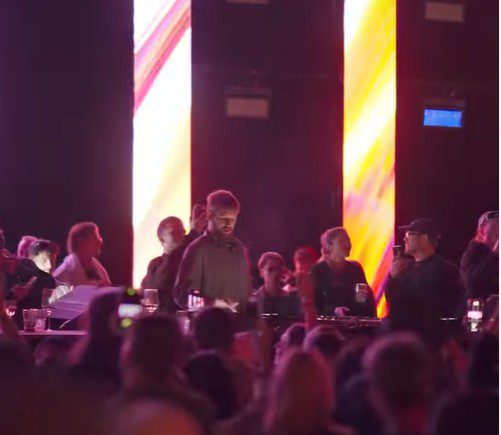
Late at night, Saint-Laurent is filled with comic book characters. They circle around their desires religiously, taking it all in by blocking it out with a cigarette and some chatter, only to dive right back into the abyss with fresh ears. Something bouncy and soft to catch your fall, but with just enough substance to entangle your attention. Trance. The Austrian electronic duo Klangkarussell has mastered the art of the line.
Before you know it, it’s under your feet, a rhythmic chord stabs as a bed for soulful vocals to stay in your head until you fall asleep. It’s textbook eurodance and vocal trance that blend in elements of disco, music meant to be shared that you fall in and out of. It’s the ambiance for the greater setting of social nightlife, where the chatter—gated by the heavy kicks—is part of the music. People cling together like bunches of grass announcing spring. I talk to a couple who tells me they came all the way from across the river to see Klangkarussell and begin to wonder where exactly these guys came from.
Gaining popularity around the same time as Avicii and Martin Garrix, Klangkarussell are part of the European exports that successfully blended pop hits with swelling build-ups and conventional chord progressions and rhythms. This late arrival of European electronic pop in North America was met with enthusiasm, as its simple formula had a trailing optimism that made you want to let go and be foolish. I remember it as the soundtrack to many early birthday parties, but judging by the older crowd, I can imagine it was just as popular in festivals during a recession era. Impressed by Klangkarussell’s ability to drive a crowd, I walked closer and closer to see what was happening. All smiles, their excitement was contagious as it announced the next rise and fall. Hands in the air pointing to the sky—when the anthem comes on, there are no limits to the mind.
As the night deepens, the dance floor becomes a kind of communion, and Klangkarussell and its quiet high priests. Their music doesn’t demand attention—it earns it, gently pulling people inward even as it lifts them up. In a world that feels increasingly fragmented, their sound offers a strange cohesion, a shared pulse. Watching the crowd sway under Saint-Laurent’s flickering lights, I realize this isn’t just nostalgia or escapism—it’s a reminder that sometimes, all we need is a rhythm to hold on to, and a place to lose ourselves in it.
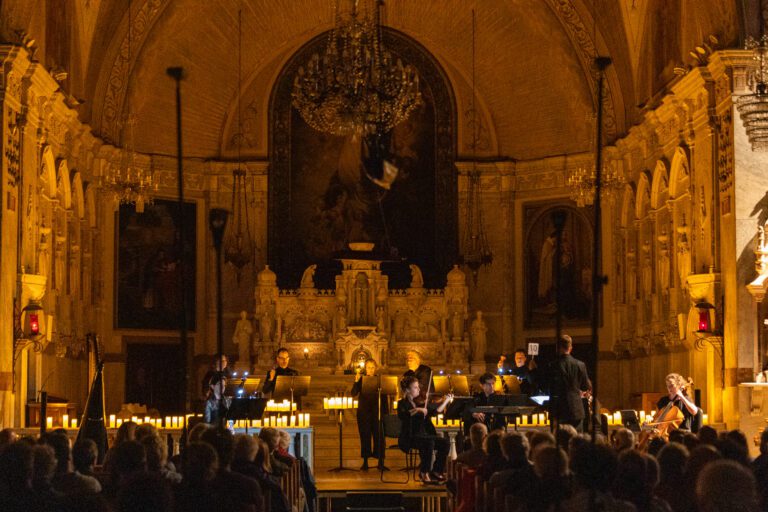
No, I’m not talking about a real Candlelight concert. It’s the final concert of the 24-25 season of the Société de musique contemporaine du Québec (SMCQ), In Memorian Jocelyn Morlock for which I’m about to write this. One of the finest concerts of the season, in my humble opinion. Musically enchanting, spiritually poignant. So why the reference to the hyper-popular concerts played by candlelight? Simply because, yesterday too, the sober but effective staging also used lots of candles to light the stage, and it was reminiscent of that kind of atmosphere. That said, aesthetically, artistically and emotionally speaking, this SMCQ concert surpassed by a factor of 1000 anything that has ever been performed in the (real) Candlelight series (I’ve seen a few).
As the title suggests, In Memoriam Jocelyn Morlock was a tribute to the Vancouver composer who died suddenly, and far too young, in 2023. This woman’s musical aesthetic has conquered a large part of the contemporary musical world and will undoubtedly continue to influence many other artists in the years to come. Regularly consonant without shying away from salient colours that skilfully titillate the ears, her music is extraordinarily pleasant to listen to for both newcomers and those more seasoned in the modern idiom. In other words, Morlock’s music is as much a pleasure to listen to as it is intellectually rewarding.
The quality and intelligence of yesterday’s programme are to be commended: around an hour and a half of music paying tribute to Morlock, whether written by her or by other composers. What’s more, a crescendo/decrescendo of intensity and sound volume that took us from a very touching soliloquy for solo oboe newly written by Samy Moussa (Jocelyn Morlock in memoriam – it’s always a pleasure to see Samy back home now that he’s settled in Berlin), to pieces for flute, viola and harp by Toronto’s Luis Ramirez (Volador) and Morlock (The uses of solitude), an arrangement for string quartet of Tanya Tagag’s Sivunittinni (the peak of the evening’s sonic intensity, a piece remarkable for the accuracy of its evocations of Inuit throat singing), Rita Ueda’s transcendent You Are a Vessel for Joy, a new work for English horn, string quartet and choir, then Morlock’s very poignant Exaudi, for cello and choir (a masterly performance by Chloé Dominguez!), ending with a reprise of Moussa’s oboe soliloquy in the darkness, like a symbol of the celebrated artist’s final departure (Mélanie Harel on oboe, who imbued her playing with immense tenderness).
What came out of the concert was a very strong sense of spiritual and humanist communion, which is beneficial in these times of social and political stress.
All the musicians are to be congratulated and commended on this unforgettable artistic performance: Voces boreales conducted by Andrew Gray, the Trio Kalysta (Lara Deutsch on flute, Emily Belvedere on harp Marina Thibeault on viola, a trio combination whose sound velvet and infinite capacity for colour I adore), string players Robert Margaryan and Daphnée Sincennes Richard on violins, Marie-Louise Ouellet on viola and Chloé Dominguez on cello, Mélanie Harel on oboe and English horn (excellent).
In a much more ideal world, a small organisation like the SMCQ would have had the means to film and record this exceptional performance in high definition, and then broadcast it as widely as possible. Unfortunately, that’s not our world, and we’ll have to resign ourselves to the fact that only a few hundred people (who were present and very attentive in the Notre-Dame-de-Bon-Secours chapel) will be left with a memorable impression of the event. Unless we manage to take this concept elsewhere too. That would be great. If it happens near you, don’t miss your chance.
The OSM and Abel Selaocoe: Evenings When You’d Like to Stop Time
by Judith Hamel
The OSM sometimes gives us gifts. Moments of unexpected communion, as was the case on May 22. The concert program featured the closing piece Romeo and Juliet, but it was the journey to get there that was most meaningful.
The concert opened with Maurice Ravel’s Ma mère l’Oye, under the expressive and precise direction of conductor Xian Zhang. This suite of musical tales featured several musicians as soloists. In Les entretiens de la Belle et de la Bête, the famous contrabassoon solo, embodying the clumsy Beast, was brilliantly performed by Michael Sundell, before the disenchanting harp glissando transformed him into a prince.
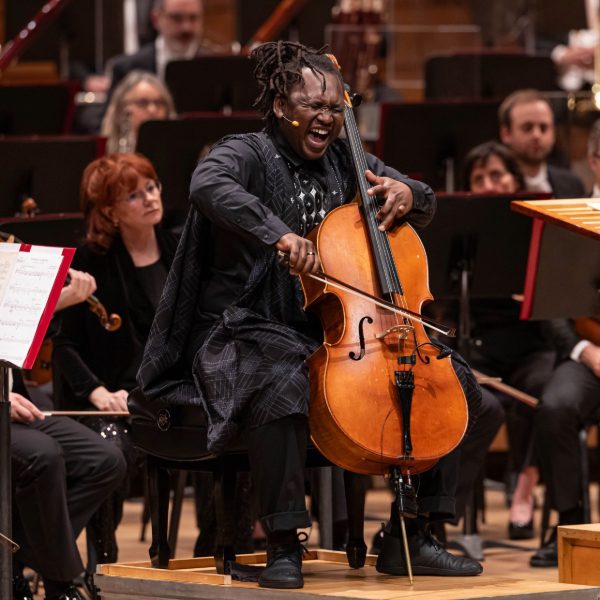
Then Abel Selaocoe took to the stage to perform Four Spirits, a song about the Sebokeng community where he grew up, accompanied by the orchestra and multi-percussionist Bernhard Schimpelsberger. Selaocoe is a cellist and singer of South African origin, bringing with him an impressive musical baggage.
Through inventive use of extended playing techniques, he explores in depth the rhythmic, melodic and above all timbral potential of the instrument, placing it at the service of expressivity. With his cello, Selaocoe manages to conjure up a plurality of timbres and functions: the instrument becomes in turn the rhythmic echo of his voice, a vocal double, or comes close to a lute or guitar. It is sometimes an accompanist, sometimes the bearer of lyrical flights of fancy, and provides a sensitive extension of his body.
As for his voice, what can I say… First of all, the well-dosed amplification in the Maison Symphonique showcases the breadth of his vocal range and ensures the grandeur of his creativity and dynamic expressions. Here again, he blends several traditions, inserting sweet Southern Sotho and Zulu songs and guttural chants that acoustically fill the hall into a solid vocal control. Together, cello and voice express inspired lyrics with a doubled range of emotions.
From the fourth movement, celebrating the spirit of community, came a timid murmur and then a chorus from the audience. After a long ovation, Selaocoe returned to the stage to offer a final aria dedicated to the present moment. He reminds us that if we failed to do the right thing yesterday, there’s still time to do it today. And a final chorus formed…
In the second half, we return to the classics with excerpts from the first two suites of Prokofiev’s Romeo and Juliet. A work which, as you can imagine, has been played hundreds of times by the musicians, but which is not without its pleasures. The performance may not have been the most striking of the evening, but it was no less effective. Between Pierre Beaudry’s solid outbursts on bass trombone and Zhang’s dramatic flights of fancy, there was plenty for the audience to enjoy.
An evening where the new and the already familiar alternate, allowing the audience to feel genuine emotions. Here’s hoping Selaocoe comes back soon!
There are evenings like this one that we’d like to relive soon.