La Luz live is a ray of psychedelic sunshine

by Vanessa Barron

At a sold-out Friday night show at Bar le Ritz, a giant golden cardboard cutout sun with googly eyes and a toothy grin took centre stage. From behind it, the four members of La Luz emerged, decked out in vibrant patterned button-downs that complemented the swirling flower projections behind them. With jangling guitar leads, ripping basslines, chilling synths, and an upbeat snare groove, La Luz transported the crowd, with their sonic waves, to a nostalgic and hypnotic dimension.

Hailing from not-so-sunny Seattle, La Luz combines the brightness of surf rock with the moodiness of ‘60s psychedelia to make a dreamy, trancey soundtrack that would fit right into a 1960s B-movie. The effortless melodies and warm fuzzy tones of the bass and guitar are nicely paired with the cooler synth leads and airy vocal stylings of lead singer and guitarist Shana Cleveland. The tracks from their latest album News of the Universe lean toward a moodier and introspective side, with a standout performance of “Poppies” as one of my favorites of the night. 

The visual elements of the show heightened that kitschy B-movie vibe I had often pictured while listening to their music. Group choreography, such as synchronized head turns and nods, and showy props like the sunshine cutout added to the goofy and relaxed ambiance. Just listen to a song like “Floating Features” and you’ll picture yourself driving along a West Coast highway in a swanky outfit after a bank robbery … or maybe you’ve just been abducted by a flying saucer and you’re in the middle of kicking some alien ass. On Friday night, the crowd got to live this fantasy as La Luz hoisted two giant inflatable neon-green aliens across the crowd, crowd-surfing the night away.

It was definitely a more relaxed vibe for Le Ritz but still packed and brimming with energy – the ideal music for smoking a joint outside and sipping exactly one tasty, overpriced beer inside. The laidback pace of most tracks encouraged a healthy amount of grooving, shimmying, and head-bobbing. And as the cherry on top of this chill ice cream sundae, the show wrapped up before 9:30 p.m. Both concertgoers and Shana herself on the mic remarked with glee about how sweet this was—an easygoing end to a dreamy and delightful night.

Photos by Amir Bakarov

Fontaines D.C. delivered the goods, but we wanted more desire

by Ann Pill

Fontaines D.C. did exactly what they needed to satisfy their sold-out MTelus show, no more maybe slightly less. Since the release of their fourth album, Romance, the Irish post-punk band has absolutely exploded. Between blowing up on TikTok, opening for Arctic Monkeys, releasing their most sonically cohesive album to date, and a ringing endorsement from none other than Elton John, I and most of the 2,300 people were crammed into the venue long before the opener started. 

The night started with the New York band Been Stellar. Their atmospheric, early ’90s Smashing Pumpkins-esque sound made perfect sense to gear the crowd up for a very Romance-heavy set. Though they looked like recent winners of their high school’s battle of the bands (I have since learned they are older than I am), they played a tight and beautiful set. The crowd was an absolute sea of teenagers. And as annoying as it was to witness them try to inorganically force a mosh, it is beautiful to watch teenagers absolutely shit their pants over something. And at 9:01 when Fontaines D.C. emerged, that’s exactly what they did. 

Been Stellar

Now, don’t get me wrong—our Irish rock saviours, Fontaines D.C., played well. It was incredible to watch some of the more orchestral songs from Romance replicated perfectly live, and it was so fun to see Dogrel songs I’ve been listening to for five years. But there was certainly something missing. I was so ready to freak out to the punchy and powerful songs from their early albums and weep to beautiful melodic songs from Skinty Fia and Romance, but they lacked the energy to deliver what I was hoping for. 

Fontaines D.C. consists of Conor Curley, Conor Deegan III, Tom Coll Carlos O’Connell, and Grian Chatten. But they also tour with Cathal Mac Gabhann and Chilli Jesson. Even with seven people on stage, it really was all about the frontman Grian. He came out in sunglasses, a hat, and a coat and hardly even looked at the crowd let alone speak to them. One of the following things was happening: either he was doing a whole “rockstar” act where he was pretending he didn’t really care, he genuinely hates his newfound teenage fanbase, or they’re tired. Or considering how different this album is from the previous three, they’re just trying something new they aren’t as good at yet.

Whatever the reason, the set lacked connection and character. The strength of Fontaines D.C. is the band’s simple but powerful sound with the poetry of Grian’s lyricism. But very little of that translated to me at the show. People weren’t really dancing, though they did know all the words, and there was never a threat to my glasses. 

Fontaines D.C.

At one point, Grian stood with his arms outstretched in a way that said “I know you love me.” And I’ll take it a step further to say it meant he knew people would devour whatever they did on stage so they didn’t have to try that hard. It does feel rich for me to complain about them not putting on more of a show. Like when your boss is mad that you did the task you were assigned but weren’t happy while doing it. But here I am begging for any evidence that they wanted to be there. 

Fontaines D.C.

From a technical standpoint, seven people switched instruments in nearly every song on stage. It sounded good but there were points where the sound person just couldn’t keep up with the literal musical chairs and things got a little wobbly. And other than the ever-present lights, which I can now call “brat green,” there was very little visual interest on stage. 

It’s not all their fault. I was standing between a kid who learned “I love you” in sign language that day and a Gen X woman trying to film the show with her flash on. But it certainly didn’t help.

I’m sure Fontaines D.C. will catapult even further into superstardom, and they deserve it. I just hope the next time I see them they have the charisma and stage presence their music warrants. 

Photos by Julia Mela

Baroque / classique

Arion Orchestre Baroque and SMAM | And Royalty Was Satisfied!

by Alexis Desrosiers-Michaud

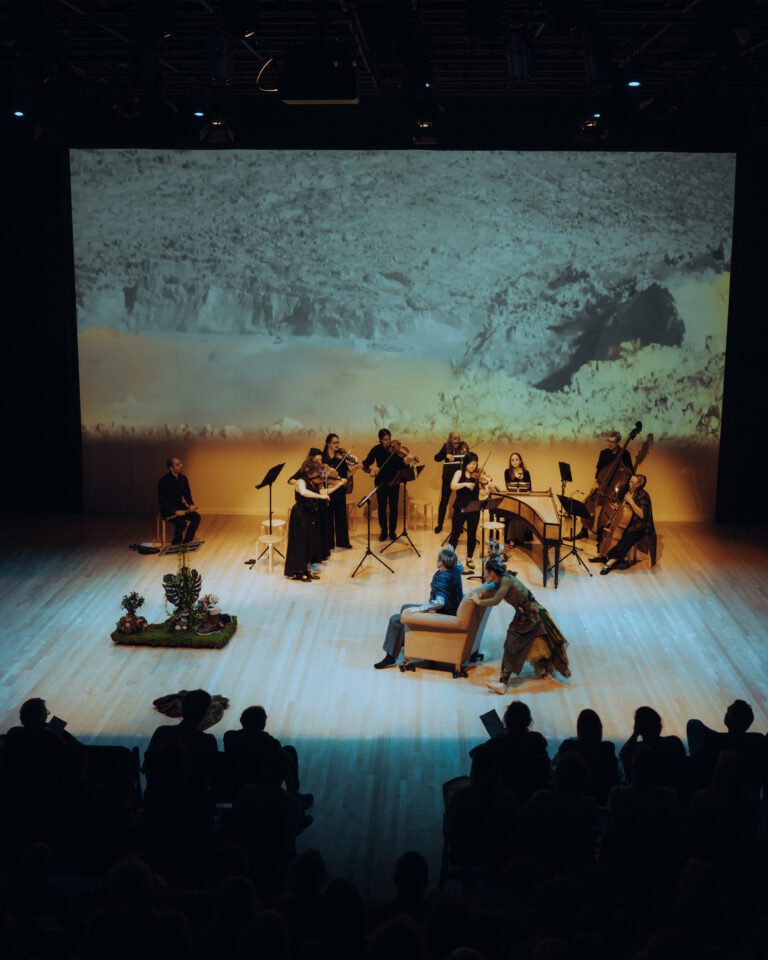
The Arion Baroque Orchestra and the Studio de musique ancienne de Montréal (SMAM) joined forces Saturday evening at the Maison Symphonique to launch their respective seasons. For the occasion, a program dedicated to works composed for various British sovereigns of the era. 2024-2025 marks SMAM’s 50th season.

In the interests of fairness, the two conductors will each conduct one half of the concert, with Andrew McAnerney (SMAM) taking charge of the first half. Unfortunately, George Frideric Handel’s Zadok the Priest, which opens the concert, lacks direction. The 22 bars that precede the choir’s entrance must be interminable in their slow harmonic progression, so much so that the entrance presents itself as a veritable revelation. Yet there is little movement, and the chorus, despite its good power, fails to fill the gap. God save the King (not to be confused with the national anthem of the same name) is the best part of this piece, thanks to the agility shown by the choristers in their vocalizations, performed at rapid speed.

This was followed by two a capella anthems, in which the vocal prowess of the choristers could be admired. First, in William Byrd’s O Lord, may Thy servant Elizabeth our Queen, the accuracy of their timbre was thrilling, while in Thomas Weelkes’ magnificent O Lord, grant the King a long life, the direction applied to each long note enabled all seven voices to make themselves heard with ease and dictate the phrasing.

It’s up to the musical directors of our institutions to decide which works will hang on to the jewels of the repertoire to complete a program. Sometimes, it turns out, we are treated to an uninteresting work, obviously placed to “make time”. But fortunately, as was the case this evening, we are treated to a complete discovery of a jewel that we feel we should see live at least once more in our lives. William Boyce’s three anthems for the coronation of George III are now on that list. The first anthem is lively, the slow part full of sweetness and the end flamboyant, and ends with a superbly beautiful delay in the cadence. The second is sublime, with the continuo as sole accompaniment, leaving all the space to the choir. Don’t remember the 3rd.

The anthem at the end of the first half falls flat, unfortunately. In Handel’s My Heart is inditing, McAnerney’s conducting is discreet and somewhat lacking in energy. He mostly leads the chorus, which responds with great aplomb, but too often leaves the orchestra to its own devices.

After intermission, Mathieu Lussier takes the baton in Music for the Royal Fireworks by the same Handel. His direction is much more committed and demonstrates the desired articulations. In the Overture, the brass lead the way with bold crescendos. Hats off to the oboes and bassoons in the bourrée and first minuet for their lightness and balance of sound.

In the last two anthems, Lussier conducts both ensembles as one. The same articulations are noticeable in the musicians and choristers, more so than in the first part. For example, in Let justice and judgment, the second extract from Let thy hand be strengthened, you can feel the weight that is placed on every first beat of every bar, both in the introduction and in every choral entry.

As an encore, conductors McAnerney and Lussier offered Messiah’s famous Hallelujah, inviting the audience to sing along. What does this have to do with royalty? The story goes that it’s a direct link to tradition that the audience rises to its feet at Messiah performances. At the London premiere, King George II is said to have stood up at this very moment when he heard the words “King of kings, and Lord of lords” repeated.

And when the king rises, everyone rises.

Baroque / Classical Singing

Les Violons du Roy | Emotions and Pleasure with a Sharp Voice for Bach

by Alexandre Villemaire

Audiences packed Salle Bourgie on Friday, October 11 to attend Les Violons du Roy’s concert, the first of the ensemble’s 2024-2025 season in the metropolis, which marks the start of its 40th anniversary celebrations.

In their introductory remarks, both Caroline Louis and Olivier Godin, the directors of Salle Bourgie, underlined the important contribution made by the ensemble, and recalled the long partnership between the venue and Les Violons du Roy, notably through the performance of the complete Bach cantatas, which has occupied their respective programs for the past eight years, and provided some very intense musical moments. In fact, the evening’s program included a small nod to this. Bernard Labadie, founder and musical director of the chamber orchestra from 1984 to 2014, also addressed the audience, highlighting the wild adventure and “little miracle” that is Les Violons du Roy. The conductor also thanked one of the founding members, violinist Nicole Trotier, who was retiring after this concert, which will conclude with another performance at the Palais Montcalm on October 12. The stage was thus set for an evening rich in emotion and pleasure. And that’s exactly the spirit in which the musicians of Les Violons du Roy gave this concert.

Divided into two parts, each was introduced by a Handel concerto grosso. Performed with energy and vivacity, these interpretations of instrumental concertante works, in addition to demonstrating the musicians’ playing and the orchestra’s palette of sound colors, served as preludes to Bach’s two cantatas for viola, featuring British countertenor Hugh Cutting. An alumnus of St. John’s College, Cambridge, the young opera artist is the first countertenor to win both the Kathleen Ferrier Award (2021) and the title of BBC New Generation Artist (2022 to 2024). One of the challenges of a voice like Cutting’s lies in projection, and it’s fair to say that on this level, the young singer particularly stands out with great vocal power, controlled and complementing the amplitude of the orchestra’s sound.

He is particularly noted for the clarity of his performances. His German pronunciation is precise, and the musical and textual discourse he weaves is limpid. His vocal agility came to the fore in the second aria of the cantata Geist und Seele wird verwirret [Spirit and soul are confused]. The aria “Gotte hat alles wohlgemacht” [God has made everything perfect] features a dialogue between organ and voice, supported by continuo. The vocal line competes with high-flying vocalizations that Cutting delivers with a heartfelt and admirable performance, but where one sometimes felt that he came to the end of his phrases slightly at the end of his aria, giving the impression that the phrase is incomplete and overshadowing the finales of certain words. The projection of surtitles at the back of the stage compensated for these slight imperfections, which on the whole never detracted from the meaning of the performance. Mélissande McNabney’s organ playing is also to be commended for the dexterity of her interpretation in lines just as exalted as those interpreted by Cutting.

With its serene, pastoral character, the second cantata of the evening, Vergnüte Ruh, beliebte Seelenlust [Blessed peace, beloved bliss], showcased Hugh Cutting’s hushed, crystalline timbre. A particularly expressive moment, the aria “Wie jammern mich doch die verkehrten Herzen” [How I pity these rogue hearts] is a sparse dialogue devoid of any basso continuo, in which the string instruments (violins 1-2 and viola) play in unison with the voice and a two-manual organ. As Bourgie does not own such an instrument, two positive organs were required on stage for this piece. Played by Mélissande McNabney and Tom Annand, this distinct keyboard interplay highlighted the intertwining of vocal and instrumental lines, petrified of tense chords, accentuating the air’s plaintive, afflictive character.

Les Violons du Roy and Bernard Labadie found in this young British man the ideal Bach voice for their program. Hugh Cutting made an impressive debut, full of emotion, clarity and refinement, which the audience in Salle Bourgie returned with a long ovation.

Photo Credit: Pierre Langlois

Baroque / classique

Ensemble Caprice | JSB, Humor, Relevance, Real and Fake Intruder…

by Alexis Desrosiers-Michaud

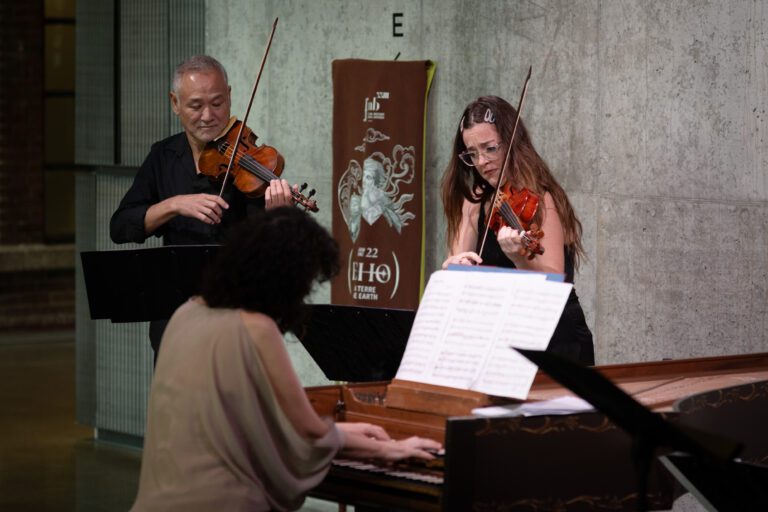
On Friday at the Maison symphonique, Ensemble Caprice and their conductor Matthias Maute presented the first of their four programs for the year 2024-2025. There was plenty of Johann Sebastian Bach and humor in this concert, with pertinent demonstrations, a fake and a real intruder.

The three Concertos brandebourgeois were each preceded by Maute transcriptions of Préludes et Fugues by… Dmitri Shostakovich! Surprising, but it’s easy to see why this is a Baroque concert.

Before the concert, the conductor explains that on his return from Leipzig, where he judged a piano competition, Shostakovich had the idea of writing his own Préludes et Fugues, in the cantor’s image. Even though they are written in an old-fashioned style, Shostakovich’s own style is quickly apparent.

Maute’s transcriptions are very well realized, even matching the orchestrations of the concertos to which the Préludes were paired.

In the 4th concerto, the dialogue between the violin and the two flute soloists is clear. The best moment is the movement, where the counterpoint is remarkable. Next comes the 1st concerto, which is denser. We’re not dealing here with soloists, but with groups of soloists; there’s the violino solo (Maute’s “baby violin”), but three oboes and two natural horns.

To demonstrate how Bach layers everything together musically, the conductor asks each section to play the first bar of the concerto separately before the performance. In this way, the audience leaves with solid reference points to follow. As the icing on the cake, to demonstrate just what a minuet is, first violinist Olivier Brault even gives a much-appreciated dance demonstration.

Musically, it’s a success, despite the fact that the violino is often lost in the density. The horns punctuate the rhythm of the movements and the ancient oboes bring an amber color, less nasal than the modern oboe. The slow movement particularly highlights this section, with a perfect balance of voices that clearly distinguishes the three instruments.

Then it all comes together until the end of the last movement, when the orchestra comes to a screeching halt to leave these same desks in a fantastic duet (or duel?), with some of them dancing while they play. Which makes you laugh before concluding.

After the interval, another Matthias Maute demonstration, this time illustrating the difference between a modern symphony orchestra and a baroque orchestra. We are treated to a simple chord, with (modern) and without (baroque) vibrato, on which the note is allowed to diminish after the attack.

Next came an excellent performance of the symbolic 3rd Brandenburg Concerto. Symbolic because for Concerto #3, there are 3 violin parts, 3 viola parts and 3 cello parts, so lots of voices.

Maute’s direction injects a great deal of energy, encouraging the musicians to move towards the first beats of the musical phrases.

They flow from one to the next. Dance rhythms are skilfully underlined. Maute picks up speed just enough to maintain the Allegro spirit, while keeping the counterpoint clear. Just follow the conductor to understand where the themes are in the two main movements.

For the second movement, “the shortest in all Johann Sebastian Bach’s music. Two chords!”, Caprice plays just the two chords, instead of letting a musician briefly improvise a cadenza, as is often the case. The Musette BWV Anh 126 that follows is party music so bewitching that you have to restrain yourself from clapping your hands. The musicians stroll and dance around the stage.

To introduce Bach’s 3rd Suite for Orchestra, Caprice plays a transcription by Maute of Tomaso Albinoni’s Adagio, the real intruder. Incidentally, the program falsely refers to Albinoni as the composer of this piece, but in reality it was Remo Giazotto who, in 1950, composed the work based on pieces from various drafts of other Albinoni pieces. Honestly, we’re still trying to figure out why this piece was included in this concert. Besides having nothing to do with Bach’s music, it breaks the mood between the Musette and the Suite. Nor was it an interpretation that will go down in history. Adagio means slowly, which is not the case with Caprice, which takes on a more moderato tempo.

The Suite is a fitting conclusion to the concert. Maute emphasizes the appearance of baroque timpani and trumpets, which then punctuate the rhythms of the various dances. In the Air, known for its ability to be played on the G string, the violins surpass themselves in phrasing and support, without vibrato, of the impeccable notes. The orchestra’s support of the dissonances contributes to the lyricism of the melody. In short, Albinoni/Giazotto goes where it has never gone before.

Crédit photos: Tam Lan Truong

Minimalist / musique contemporaine / Post-Minimalist

FLUX | Architek Percussion: Great music, cursed technology!

by Frédéric Cardin

Last night marked the final concert of the new FLUX festival, in Montreal. On the program were two works by the unjustly forgotten genius of Minimalism/Post-Minimalism, Julius Eastman, and Angel’s Share by young composer Andrea Young. 

Julius Eastman was a black and queer composer born in 1940, unable to find a permanent place in the art world of the 1970s-1980s. The contemporary classical world was still not easily accessible to non-white artists, and his sexual identity was fraught with stubborn prejudice, especially during the AIDS pandemic. Imagine he died abandoned, penniless, homeless. It took nine months for the music world to notice his disappearance! And yet, what a vision! At a time when it wasn’t really being done, he dared to fuse the principles of repetitive minimalism with modern harmonies and techniques linked to avant-garde and experimental music, as well as jazz and pop. He was a pianist, singer and dancer. If you listen to Peter Maxwell Davies’ Eight Songs for a Mad King on the Nonesuch label, the voice of the Mad King, it’s him. His personal activism in affirming his black and gay intersectional identity is an avant-garde struggle.  

Several of his compositions bear unmistakable titles, such as Gay Guerilla (heard yesterday, I’ll come back to that) or Nigger Faggot. In this sense, if his creative talent was appreciated, his identity struggle earned him a lot of misunderstanding and closure. In the end, he sank into substance abuse and homelessness, unable to find enough professional contracts to live on. His run ended in 1990. 

Eastman’s repetitive Minimalism contains elements readily associated with today’s Post-Minimalism. Over continuous pulses, Eastman develops chromatic melodic coverings, sometimes verging on atonalism. A fusion of Reich and Boulez (I’m caricaturing, but you get the idea) that was totally unique at the time, and still rarely encountered today. 

Two works by Eastman were on the program. Let’s start with the disappointment (in part only): The Holy Presence of Joan D’Arc. I was eagerly awaiting the performance of this powerful piece for 10 cellos, built on an irremediable, raging pulse, over which Eastman draws melodic lines that do, indeed, veer towards atonalism. There weren’t 10 cellists on stage. Instead, what we were offered was the performance of Toronto’s solo cellist, Amahl Arulanandam, recorded in multi-track and video multiplans, all projected on screen. Well, the impression of watching a YouTube video with a bunch of other people crossed my mind, but it has to be said that from the very first notes, Arulanandam is impressive, and the video editing dynamic enough to make the whole thing quite captivating (especially thanks to the music, of course!. A true masterpiece of emotional intensity). I was getting sucked into the visceral narrative of the piece, all was going well, when the floor collapsed. Not literally, but technologically. The video started to “drag”, like when you’re watching a movie or playing a game on a laptop/PC and the network doesn’t provide the necessary feed. Fortunately, the sound remained crystal-clear, but the image/music relationship that had initially grabbed me was becoming jerky. I spent the rest of the time (oh, two-thirds of the piece) waiting for “it to come back”, frustrated, boiling with the desire to throw the evil laptop on a wall (you’ve felt that before, haven’t you?). I could have just closed my eyes, you’re right. But I couldn’t anymore. The damage had been done. Was it the same for the other spectators? I’m not sure. But I’m certain that the effect initially intended by this program entry piece was not achieved. The faint applause seems to bear this out. It’s such a shame.

For an excellent performance of this work : Montreal’s Novarumori ensemble conducted by Isak Goldschneider at Suoni per il popolo festival 2017

I’m not the type to forget the forest and look only at the dead tree. That kind of jinx happens. And then, Eastman’s music remained heard throughout, and confirmed to me what a masterpiece he wrote with The Holy Presence of Joan D’Arc (a lost score, and reconstructed by ear from a recording). I’ll make this request to the organizers though: please offer us this piece again in the not-too-distant future, with ten flesh-and-blood cellists, so we can give it another chance, which it fully deserves, and so we can have a proper ecstatic time. Thanks.

The program followed with a piece for percussion quartet by Andrea Young from Montreal. Angel’s Share is a synesthetic exploration. That is, it seeks to combine affects associated with one sense with those of another. Here, the music in three movements is inspired by the rich, complex aromas of as many quality Scotches, three rare single malt whiskies from Scotland’s Ardbeg distillery. Without said aromas at our disposal (what a great option that would have been!), it’s impossible to fully account for the success or not of the adventure. Even if this is not the intention, and the composer wished to make this a strictly aural experience, curiosity gets the better of us, and we do feel as if we’re missing something. All the more so as the three movements of this very fine music, constructed like a fragile abstract lace, seem rather interchangeable. That’s the danger of this kind of proposal: you can’t evoke synesthesia and leave the spectator with only one half of the sensory equation. Be that as it may, Angel’s Share is a beautifully crafted, ethereal composition filled with fine textural touches, such as the presence of two musical saws.

The final piece brought Julius Eastman back to the fore with Gay Guerilla for percussion quartet and two pianos. One immediately thinks of Steve Reich and Music for 18 Musicians! There are many similarities between the two pieces, but we soon notice the fundamental difference in the harmonies used by one and the other. Reich’s harmonies are open, tonally full. Eastman’s harmonies are tight, chromatic, but never slipping into atonalism, as in The Holy Presence of Joan D’Arc . Gay Guerilla, despite its title, is ultimately an “easier” piece than the other, but its boundless energy and rising and falling dynamic tides create a narrative discourse that captivates and holds the attention of the most demanding listener. Highly enjoyable and, once again, an immense gem of Minimalism that deserves to be played more often.

The musicians’ performance was generally very good, even if here and there I detected a few discrepancies in rhythmic synchronization in the more linear and grouped episodes. But I quibble. 

This last concert of a new festival was filled with great music and leaves us eager for another edition next year. 

Electronic / expérimental / contemporain

FLUX | Phew, Masterful Performance

by Alain Brunet

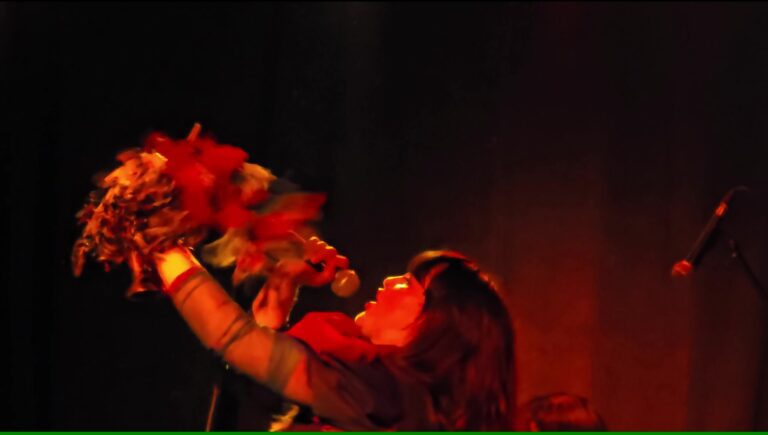
This extraordinary artist was part of the punk wave in Japan in the late 70s, after which she continued to elevate her artistic proposals. Four decades later, Phew gave her first performance in Montreal in front of an audience. Clearly, her international reputation had not reached Montreal before she came. Let’s hope she comes back, because what we heard at Wednesday’s FLUX festival at the Sala Rossa was a masterful performance.

This ageless woman (officially 65) invited us into a sonic narrative that began with soft vocals set against an electronic backdrop. This ambient, ghostly, spectral, dreamlike opening led us gently towards an intensification of sound frequencies and the introduction of synthesized rhythms drawn from popular culture (techno, reggaeton, jungle, drum’n’bass) and transformed by the composer in such a way that no direct link could be established. This is the mark of the best, who know how to transform quotations.

Increasingly pronounced rhythms punctuated the constructions. In real time, the simultaneous superimposition of several sources (beats and processed pre-recordings) resulted in an increasingly intense overall sound, a maelstrom punctuated by a blaze of horns, otherworldly voices, percussive machine-gun fire and industrial sounds. This fascinating web of sound grew heavier, peaked at the sound of a jet engine and then reversed. Lightening, elevation, evaporation, almost silence. The rhythm becomes minimalist, the tempo slower than a heartbeat, relatively discreet sounds intrude, string melodies float above, Phew’s voice re-emerges. The descent continues with the lapping of processed keyboard notes, then light percussion executed in minimalist metrics, all again wrapped in ghostly sounds.

For the finale, she had foreseen a rise in intensity, a return to stronger, more complex and faster rhythms, to stormy wind sounds that culminate in tornadoes. Against all expectations, (synthetic) piano chords accompany Phew’s voice, and the flying machine lands on the ground to the sound of a ballad close to a lament.

Great art, for sure.

Publicité panam
Bossa Nova / Brazilian

Florence K: A Show Full of Softness and … Humor

by Sandra Gasana

After a brief tribute to her mother Natalie Choquette at the start of the show, Florence K plunges us straight into the world of the great bossa nova master, Antônio Carlos Jobim, accompanied by her excellent guitarist and composer Carlos Jimenez, who recently earned a Doctorate in Music.

From the very first track, Água de Beber, the atmosphere in the room relaxes, she plays a few notes on the piano and even gets the audience, familiar with this classic, to sing along. “I’m always afraid of being unmasked in my complex by speaking Portuguese, a bit like the impostor syndrome,” she confesses between songs, quoting Freud. Indeed, she makes several allusions to psychology during the show (her doctoral studies in psychology surely have something to do with it), but she also takes the time to explain the context of each song, with a touch of humor much appreciated by the audience. She does this with Vivo sonhando and Desafinado, two Jobim classics. She also exchanges with her guitarist on several occasions, inviting him to reveal himself in turn, but to no avail.

Making an effort not to cross her legs during the show, it’s especially when she’s playing the piano that she seems completely in her element. She closes her eyes, sometimes sings over her notes, and lets herself go.

She also exchanges with her husband, who was in the audience, in impeccable English, including him in the show, always with the same touch of humor. “When you met me, did you know you were going to suffer all your life?” she asks him, before introducing the song Eu sei que vou te amar.

Drawing a portrait of bossa nova in the 60s, she seems to have done a lot of research in preparing the album “Brésil mon amour” released in 2023, teaching us that Bossa Nova means “New Wave”. She continues with Chega de saudade and Só Danço Samba, again with show-stopping piano passages. “During my 20-year career, I never used a lectern, but now my mental load is such that I no longer have the space to memorize all the songs,” she confides. That said, it in no way detracts from the accuracy of her silky voice, nor from the emotion she conveys to the audience. A highlight of the show was during the song La quiero a Morir, a special request made by an audience member for his wife. The song was far from perfect given the circumstances, but that’s precisely what appealed to the audience. That authenticity. In fact, she suggested to her husband that he should do the same at their next Paul McCartney concert, and the audience erupted in laughter.

Her songs in Spanish were a great crowd-pleaser, especially for my Colombian friend I was with, who wasn’t expecting to hear classics such as Lagrimas negras, among others. Sometimes you get the impression that she’s whispering into the microphone, giving the impression that a veil surrounds her voice.

Sad not to have any “Charles” in the room, before the track Take it easy my brother Charles, she takes the time to thank Nick Petrowski, who produced the album and whose idea it was to include this “intruder” track on the album.

Another highlight was undoubtedly the participation of her 18-year-old daughter Alice Khoriaty on two tracks: Vol de nuit, written at the time of her birth, and Águas de Março, which Jobim sang with Elis Regina. The complicity between mother and daughter was palpable and beautiful, while Carlos did a little percussion on his guitar as he played. So it was a family show on this autumn evening.

She couldn’t end the evening without singing Garota de Ipanema, which the whole room knew, especially the Brazilians sitting in front of the stage. In fact, I spotted the great Brazilian singer Bïa in the room, as well as the team behind the organization of the Journées brésiliennes. “After a 20-year career, it’s nice to know that people still come out to see me perform,” she concludes gratefully.

Indie Rock / Italo Disco / Post-Punk

Yard Act is a needed jolt of energy at 100% endurance

by Stephan Boissonneault

I’ll admit that it took a while for me to jump on the Yard Act bandwagon, and even after listening to their debut The Overload back in 2022, I wasn’t fully convinced. Not because the album wasn’t good, but because there was a constant deluge of post-punk adjacent bands from the United Kingdom that were systematically taking over the airwaves and North American music media craze. So for me, Yard Act was thrown into the mix of bands like Dry Cleaning, Fontaines D.C., Shame, Black Midi, Black Country New Road, Squid, etc.

Omni

Perhaps someone else across the pond on the American side of that ilk is a band like Omni, who opened the Yard Act Montreal show at Theatre Fairmount with a ridiculously tight set. Omni hits hard and fast, but at times does feel like a paint-by-numbers post-punk band, if that makes sense. If you googled modern American post-punk, they would come up. The songs live seemed to slightly blend together at a point, but the Omni boys kept the intensity for the main event of the night, a little band called Yard Act.

Even as a music journo whose job it is to keep up to date on the newest bands, it’s sometimes hard to keep up when it’s constantly pouring new bands. So Yard Act’s The Overload was a quick listen for me; I immediately felt the influence of bands like The Fall, mixed with the darker/more experimental, older side of Arctic Monkeys, but it was a one-and-done thing for me. The lyrics; the sarcastic wit and the self-deprecation chips of leader vocalist James Smith were somewhat lost on me because of well, my own overload… I told myself I would revisit the album, and I did… but I never gave it a proper listen. I let the other journos review it for me and that was that. Jump two years later and Yard Act’s follow-up, Where’s My Utopia? drops and I checked out a few songs. They seemed to be diving into a weird Italo disco dance mixed with a post-punk world and it seemed fun, but how would it compare live? Would it be another all-white four-piece, post-punk boys club group? I’m happy to report that no, no they are not.

Yard Act

Yard Act is best served as a live band, that is both hilarious and cleverly devious. They took the stage as a seven-piece, the core four-piece of Smith on vocals, bassist Ryan Needham, the mustachioed guitarist Sam Shipstone, drummer, Jay Russell, and backup dancers/vocalists Lauren Fitzpatrick and Daisy J.T Smith (who took as much spotlight as Smith with their delirious dance moves and shining pipes, as well as a percussionist/synth player/ and saxophonist.

Right at the start of “Dead Horse,” the gig took shape as not just a post-punk show, but a bopping dance-fuelled extravaganza. At times it felt like watching an in-tune, synchronized Motown soul band, that gave everyone in the band their own little moments; the frenetic buzzing solos from Shipstone, the smooth too-cool bass riffs from Needham, and of course the poetic-drunken wit of Smith—who sometimes sounds like he’s reading verse from someone like Yeats, but no, it’s his own insane mind that chooses to mutter through 100 words a minute that the English language is going out of style. I felt myself shaking my head at the full endurance of this band that never stopped until they did, but came back with the self-referential single encore “The Trench Coat Museum.” The new album doesn’t even give this band proper justice. This is a band that demands to be seen live.

Renaissance music

Jordi Savall | Tears flow, fire consumes, souls are fed

by Martial Jean-Baptiste

Les larmes et le feu des muses is the evocative title of a splendid concert by Catalan gambist and maestro Jordi Savall. A program which, from the very first notes, seduced an attentive and respectful audience

As curtain-raiser, we were treated to a fine performance of a cantata by Samuel Scheidt, a contemporary of Claudio Monteverdi, masterfully interpreted by the ensemble Hespèrion XXI.

The soft entrance of La Capella Reial de Catalunya was a magnificent moment in which the voices of a soprano, a mezzo-soprano, a tenor, a baritone and a bass blended perfectly with the acoustics of the Maison Symphonique, immersing us in the Renaissance.

The next part was just as successful, with music by John Dowland and Anthony Holborne. But in this first part of a program without an intermission, the influence of Monteverdi and the care taken by Jordi Savall to marry voices and viols were clearly evident.

There’s not a dull moment in this celebration of joy, sorrow and love!

The performers were generally very good, and the stage presence of tenor Ferran Mitjans was simply remarkable. I also really enjoyed Anna Piroli, a magnificent soprano. In my opinion, a highlight of the concert was the duet with Anna Piroli and baritone Mauro Borgioni. The only downside was the presence of the mezzo-soprano, whom I found a little self-effacing.

The end of the program was marked by a very long standing ovation, with bravos from all over the hall.

Speaking before the encore, Jordi Savall underlined his pleasure at playing in this magnificent hall with such a warm audience. In English, he said he was sad to see young people dying instead of making music in the Middle East conflict. Especially as October 7 marked the first anniversary of the Hamas attack on Israel and the Israeli response to the terrorist attacks in the Gaza Strip.

After more heartfelt applause, Jordi Savall took us a little further afield from Monteverdi’s Italy. He even took us to Lima, Peru in 1780, when a bishop ordered musicians to collect all the songs and dances observed around the city’s cathedral. The result: two songs and dances in an indigenous language inspired by the Passion of Christ.

It was a wonderful end to a concert that allowed me to appreciate Savall’s talent on the viola da gamba and that of his Hespèrion gambists, not to mention the superb voices of La Capella Reial De Catalunya.

Photo : Adam Mlynello

expérimental / contemporain

FLUX | A brief and polite conversation between Wadada and Sylvie Courvoisier

by Alain Brunet

Of course, you can’t expect an 82-year-old trumpeter to set his audience ablaze with explosive charges. From Wadada Leo Smith, we should rather expect wise and circumspect playing, which in no way excludes the welcome of inspiration in real time… and even some unsuspected fireworks.

In a room filled to capacity, early adopters of the FLUX festival were treated to a sober fifty-minute performance, including a few ad lib speeches by our host on the background to this duo and the meaning of life in general. While we’re at it!

In an interview a few days ago, the venerable African-American musician promised to recreate a recording he made in tandem with African-American pianist Claudine Myers, entitled Central Park Mosaiks of Reservoir, Lake, Paths and Gardens, inspired by his contemplative experiences in this vast urban park completed in 1873 under the guidance of landscape architect Frederick Law Olmsted – the same man who created Montreal’s Mount Royal Park (1876), also one of the most beautiful on the North American continent.

It was a courteous, polite and relatively brief conversation between Wadada Leo Smith and his interlocutor, the Swiss Sylvie Courvoisier.

As for the lead soloist, which is what we were there for, he’s still capable of achieving beauty, no doubt. Yes, it’s difficult to determine clearly whether his long-held notes break unintentionally or are a deliberately executed stylistic effect, but hey… the overall impression of this discourse remains interesting, and you have to react spontaneously to this approach, which obeys no law about the best way to play the trumpet according to classical or jazz criteria.As for the lead soloist, which is what we were there for, he’s still capable of achieving beauty, no doubt. Yes, it’s difficult to determine clearly whether his long-held notes break unintentionally or are a deliberately executed stylistic effect, but hey… the overall impression of this discourse remains interesting, and you have to react spontaneously to this approach, which obeys no law about the best way to play the trumpet according to classical or jazz criteria.

Wadada Leo Smith’s discourse is certainly his own: the venerable blower still has the ability to powerfully access high frequencies and other relatively demanding technical effects. The musician’s vast experience more than compensates for his barely begun technical decline.

In this subtle and delicate context, Swiss pianist Sylvie Courvoisier found herself playing the other half of the tandem. She opted for a minimalist accompaniment, respectful of her elder’s playing. Clearly, this was not an opportunity for her to display the articulation of which she is capable. Rather, the slow pace of the tandem performance led this excellent musician to the exposition of chords complementary to Wadada’s melodic discourse, but also to the production of brilliant effects via plucked notes on the strings – of that rather thankless instrument, the piano at the Sala Rossa. Nevertheless, we were able to observe all the subtlety of the musician, an expert in the art of the prepared piano and its use in real time.

We’d have taken more, but hey… let’s be polite to an octogenarian who’s decided that’s the way it’s going to be.We’d have taken more, but hey… let’s be polite to an octogenarian who’s decided that’s the way it’s going to be.

Publicité panam

expérimental / contemporain

FLUX | Nakatani Gong Orchestra: in the “had to be there” category

by Laurent Bellemare

On the floor, a minimalist drum kit, small and aged, was surrounded by metal objects and drumsticks of all kinds. To the percussionist’s left, two large Chinese gongs detached from the drum kit were used as cymbals. Without introduction, it was on the larger of the two gongs that Tatsuya Nakatani kicked off his FLUX performance at the Sala Rossa on the evening of October 6.

With his homemade bow, he set about making the instrument resonate with all the inharmonic richness of its timbre. Nakatani often used his free hand to touch various pressure points on the gong, bringing out its harmonic partials. Immediately, one was struck by the craftsmanship of a musician who had worked with these objects for most of his life.

Nakatani’s unpredictable playing, even by his own standards, has seen this slow, resonant opener evolve into a more drum-driven affair. Sitting behind those rosin-greased skins, Nakatani let his unbridled creativity explode. In a nervous game, he moved and smashed his accessories together on his snare drum and floor tom. Soft cymbals, singing bowls of various sizes and other glittering objects all had their turn to randomly alter the sound of the drums, clashing as they went and creating spontaneous textures. Occasionally, Nakatani would grab his drumsticks and improvise rhythmic phrasings on these prepared drums.

During this half-hour improvisation, Nakatani frequently switched between his drums and the gongs suspended at his side. With his eyes closed and sweating, he maintained a constant energy and tension, which in no way detracted from his remarkable mastery of dynamics and dramatic surprise effects.

Of particular note were the two gongs played simultaneously, a bow in each hand, revealing unsuspected notes through the peaks of intensity. There was also an interesting lull when Nakatani stood behind his drums. With four small singing bowls placed on his snare drum and played with a bow, he set up a four-note melodic sequence. Always interspersed with other percussive explosions, the motif returned again and again, creating a weightlessness that contrasted wonderfully with the rest of the performance. That evening, Nakatani once again demonstrated his relevance in the contemporary percussion landscape, and the unique language he has been shaping for decades.

Nakatani Gong Orchestra

After a short break, the 16 local artists making up the gong orchestra led by Nakatani took their places in the space. They had all spent the afternoon in workshops with the percussionist in preparation for this performance. Nakatani, facing his own gong and orchestra, had equipped himself with a timer and a paper diagram of the sequence of sound events. In stark contrast to the drummer’s pointillist solo playing, the gong orchestra set about developing masses of sound, for the ears and the body, that sometimes reached piercing volume of massive sound.

Nakatani directed the ensemble, prescribing various configurations according to two main playing modes: bow and mallet. His understanding of gong behavior enabled him to fluidly change the texture from an inharmonious, noisy mass to a more nuanced bath of sound where certain pitches could create intervals and inject a more melodic color into the whole affair. When he wasn’t playing the gong himself, Nakatani was directing with both hands, using a somewhat enigmatic system of symbols. The most spectacular moment was when he caused waves of sound to travel from one side of the room to the other. Also, sound windows were cut into the space according to the boundaries pointed by the percussionist’s hands. At these moments, the link between the direction and the sonic result was very clear, and the gestures seemed to be the stuff of magic.

This gong oorchestra, as Nakatani points out, is the result of a lifetime’s work. Each performance is different, a fact that was clearly felt at the FLUX festival, where we witnessed a groundbreaking collaboration between the percussionist and 16 members of the local artistic community. At the end of the show, Nakatani suggested we keep our vibrations close to us, and the least we can say is that this concert is likely to resonate for a long time to come in the audience’s imagination. In the “had to be there” category.

Publicité panam

Subscribe to our newsletter

Inscription
Infolettre

"*" indicates required fields

Type of Suscribers