OM Beethoven Marathon, Day 3 | The Finale saves the concert at the finish line

by Alexis Desrosiers-Michaud

For the final part of the Beethoven Marathon, only the two extremities of the symphonic corpus remained to be presented, with Marie-Pierre Brasset’s Amor Fati as a prelude.

Using the opening bars of Beethoven’s First, Brasset changes the ending to move towards her own musical language. Her piece is a slow progression towards an element, which doesn’t come to fruition and leaves us wanting more. It’s a pity, because the end is rather neat, as if five extra minutes had been needed to complete the piece.

The First is very well executed, with lightness and simplicity. In every movement, every detail is emphasized, but the second was the best. The various string entries are all homogeneous in style and articulation, and you can feel the movement running through the phrase. Everything remains elegant, even in the forte. It should also be noted that in the Scherzo Trio, the wind interventions are not identical the first and second times certain phrases are played.

The first movement of the Ninth is well played. The nuances are there and the musicians play with intensity. This is good, but not good enough, especially when tackling an archaic and monumental work such as this. The segues between sections lack fluidity, and there’s not enough depth in the bass. As in the First symphony, the second movement is the most successful. The sharp timpani stands out from the rest of the group in its solo interventions. Very demanding for the woodwinds, due to the many accented notes played in a fast tempo, fatigue is discernible in some of them, as evidenced by the few “ creaks ” discernible among the orchestral ensemble.

As for the following slow movement, unfortunately it quickly falls flat. The result is that one is easily distracted, for all the wrong reasons. The musical movement is very static and does not move forward; the long notes lack (enough) life and there is not (enough) relief in the whole. Although marked cantabile, we don’t get the impression that the musicians are singing the music. Then comes the famous last movement. What a Finale it was! From the first notes of the Ode to Joy theme in the lower strings, you know that what’s coming is going to be spectacular. Starting from almost nothing, this architectural construction only leads us to a glorious, liberating tutti before the entrance of the chorus. Speaking of the choir, they are vocally very diligent, despite a few inaudible consonants. The last few miles of this marathon make for an absolutely magical moment, because it’s all there: incredible soloists, nuances, accents, phrasing, power (what a long Gott [God] before the fanfare!), but above all dedication and emotion. The urge to leap to one’s feet at the very end is irresistible, but one can’t help wondering why we weren’t treated to this in everything that came before.

photo: François Goupil

OM Beethoven Marathon, Day 3 | Symphonic Buffet at Sunday Brunch

by Alexis Desrosiers-Michaud

The third of four programs in the OM Beethoven Marathon took place at 11 a.m. Sunday morning, with the presentation of the Eighth, Fourth and Fifth symphonies. Given Beethoven’s reputation for selling out, it was surprising to find that the Maison symphonique’s parterre was sparse and the boxes downright empty, despite the presence of the Fifth on the program.

The first movement of the Eighth is uneven from the outset. Articulations are not homogeneous in the different sections of the orchestra. In the strings, the staccatos are very short, but in the winds, they are more elongated, especially the resonance of the timpani. Phrasing quickly falls flat, and the forte soon reaches a plateau. The second movement is much better.

Very humorous, the incessantly repeated notes lead the rest in lightness. Punctuated by sforzandos, the effect of surprise is successful. The third movement, Tempo di menuetto, has only the tempo of a minuet, as there is no room for dancing. The third beats don’t go far enough towards the following first beats, and the latter are pressed too hard. The rest of the piece is fairly similar, i.e. faultless but lacking in sparkle.

In the Fourth, surprise! We’re treated to just the opposite.

The sound balance between sections is well adjusted, especially in the slow introduction to the first movement. This mysterious, soaring introduction leads us step by step to the festive, energetic Allegro. Honorable mention to the winds and timpani for their precision. The second movement is impeccably lyrical and soothing, with phrases that breathe and settle. The scherzo that follows surprises with mischievous attacks, and the musicians play well with the syncopations that punctuate the phrases. The final movement is very light, with Yannick dancing on the podium.

After the break, it was Fifth ‘s turn to be heard. Before getting to the heart of the matter, an explanation is in order. The program states that Beethoven was the first composer to include metronomic measures in his scores, thus clarifying the rather vague speed indications, such as Adagio or Allegro , that are still used today.

Before getting to the heart of the matter, an explanation is in order. The program states that Beethoven was the first composer to include metronomic measures in his scores, thus clarifying the rather vague speed indications, such as Adagio or Allegro, that we still use today.

A surprising start, the tempo is very fast for the 1st movement. There are pros and cons to rushing it like this. By taking the metronomic speed indicated, Yannick and the orchestra express the composer’s sense of panic in the face of his own deafness and fatality.

But he doesn’t use the high points that punctuate this movement, and goes straight to where the tension can, or should, be heightened. Thus, the construction of certain phrases is rushed, as is the oboe cadenza, which is brought in abruptly. We eventually get used to this speed and this way of seeing this famous page, which nonetheless gives us momentum, even though we come out breathless.

The second movement is equally rushed and unsinging. The tempo still passes in the first two variations, but when the low strings arrive in the triple eighth notes, everything becomes blurred, so much so that the “dolce” indication becomes difficult to respect. It’s one thing to respect metronomic measures, but perhaps not to the detriment of the music, which needs to breathe.

The third movement is the most interesting, played with vigor and mystery. The call of the horns in crescendo, rather than subito forte as written, is debatable, as this is the main theme. Everything is excellent, with biting strings, except when we get to the coda, which is played on tiptoe. There’s an alternation between string pizzicatos and woodwinds on the main rhythmic motif. The woodwinds play the long notes, which is a great contrast. Nowhere else is this long motif played, so why here?

Moreover, the transition to the final movement is led by a particular instrument that we don’t hear enough of: the timpani. While the strings hold a 12-bar long note and then slowly build the melodic line, the timpani is alone in its corner, setting the rhythm and pulling the orchestra and the crescendo towards the apotheosis of the final movement, which will leave a prominent place for the piccolo, whose Fifth marks the instrument’s debut in the orchestra.

This concert is the longest on paper of the four, with 96 minutes of music. Online, it’s announced at 1:56, including the intermission, but it ends 2:15 after the start. Will OM and their leader hit the famous 30-kilometre wall that marathon runners talk about? The danger is there, as the next concert is only 1h45 away.To begin with, the premiere of Cristina García Islas’ Ré_Silience was very interesting in terms of discourse, but slightly questionable in terms of context. The work is brilliantly structured, but sounded more like a tribute to Shostakovich, so strong were the brass and abundant the percussion. Not to mention the long phrases held by the violins in the high register, doubled by the flutes, against a background of bass pedals. In fact, the basses, placed on the left, were often lost in the collective sound. To pay homage to Beethoven, in addition to quoting the second movement of the Eighth, she adds two off-set metronomes in the percussion section. Hats off to the musicians for keeping up the tempo despite those clicks!

Electroacoustic / Electronic / expérimental / contemporain

Akousma | Hamelin, Présences imaginées, Uppender

by Laurent Bellemare

Science-fiction twilight, biomechanical arthropods, urban landscape, horror film, canine memories, naturalistic fascination… all these associations were likely to be made during the closing night of Akousma, Friday evening at Usine C.

The common thread running through Friday evening’s program seemed to be a compositional approach borrowing heavily from music to image… cinema for the ear, as composer and teacher Michel Tétreault would say.

What we gain in immersion, however, we lose in the sense of musical development. In a world beset by screens, this is surely not surprising. Unless it’s us, the audience, who are now incapable of dissociating our listening from these images…

Whatever the case, every year Akousma succeeds in offering a fine sample of the state of the art in digital music. Even if electroacoustic music still belongs to the academic world, today it is a source of increasingly diverse aesthetics, and all the better for it. Here, then, is Akousma’s final right, the last of the 6 blocks on the program.

Julien Racine

Hamelin

Julien Racine built his Hamelin piece with dense yet harmonic textures. The most striking element of the piece was the sonorities that hinted at technological malfunctions. In particular, many of the voices were filtered, granulated or pitch-shifted, sounding as if they had come straight out of an old communication device trying to listen to a lost transmission.

After this highly successful section, the piece evolved into something more dissonant. First, a texture of steadily rising pitches seemed to spin over our heads. Then, this tableau took on nightmarish twists and turns, echoing distant cries, laughter and complaints. With no program notes, it wasn’t easy to sort out this chain of events. Especially when it came to the barking heard around three-quarters of the way through the piece!

Olivier Alary

Présences imaginées

Olivier Alary’s Présences imaginées also gave us the impression of a nightmarish sound design. Voices and screams could be heard in the thickness of the sound mass. But in addition to these recognizable elements, there was a striking abstraction throughout most of the piece. One texture metamorphosed into another, and we moved easily from extreme density to sparse granules.

It’s only at the end that birdsong suddenly transforms this abstruse scene into a much more mundane affair. That and the sounds of waves buried beneath the texture in the opening minutes. The immersion was again very successful, but the compositional coherence was a little less so, in my opinion.

Felisha Ledesma

Uppender

After a quickly solved technical problem, American-Swedish Felisha Ledesma broadcast her piece ‘Uppender’, a very ambient track, much more hushed than the others. The equalization work made the sound layers soft and warm, traits amplified by the abundant use of reverb. The work also gradually became more harmonic, accentuating its bewitching aspect.

Although there were a few moments when muffled jerky sounds interrupted, the piece almost always retained its lightness, as if everything were weightless. Here too, the formal development was disappointing, something that a small peak of intensity towards the end failed to rescue.

Photo Credit: Caroline Campeau

Electroacoustic / Electronic / expérimental / contemporain

Akousma | Solace all in Drone, Complex Path, Familiar Gardens

by Laurent Bellemare

A dark, silent room, with a subtle play of subdued lights, which intervene from time to time to support the music. On stage: nobody (or almost nobody). The artists are behind the console, broadcasting a fully-worked-out piece through some forty loudspeakers, immersing the audience in the sound. Beware of anyone who drops their water bottle or forgets to turn off their cell phone. This unconventional concert situation is far from new for lovers of electroacoustic and digital music.

Now in its twentieth year, Akousma has once again put its speaker orchestra at the service of local and international artists. On Friday, October 18, 2024, we were treated to three European and three Quebec artists. All offered highly varied aesthetics, but almost always evoked a cinematic experience. The sense of musical form, however, was less obvious.

Marie Anne

Solace

The only artist of the evening to actually “take the stage”, Marie Anne grabbed her controller and developed a rather drone-like, slowly developing musical style on Solace. At first, the piece was built around breakthroughs of held sounds, which created intervals that were entirely consonant. An initial wave-like rise sounded like pentatonism in the play of pitches, while a second shot brought out a minor harmony.

For most of the work, you could have sworn you were hearing nothing but synthesized sounds. There were even, intentionally or not, vague echoes of Vangelis’ synthesizers in the Blade Runner soundtrack. This impression gradually changed, however, as an inharmonic crackling sound reminiscent of waterfalls crept in. Or was it white noise? Whatever it was, the referential aspect of the sound material was confirmed towards the end, when cricket chirps took over and brought the whole thing to a close.

Although massive, the music heard struggled to be fully immersive. In particular, the possibilities of the acousmonium were under-exploited. With richer spatialization, the audience could undoubtedly enter more deeply into the sound and better appreciate its progressive densification.

Atte Elias Kantonen

a path with a name

Finnish artist Atte Elias Kantonen’s sound is closer to classical electroacoustics, with a profusion of micromontage and sounds moving through space. From the outset, his work a path with a name (a reimagined reprise) installed a rather distinctive texture, both liquid and industrial. The sound universe was familiar, but parallel, like an algorithmic abstraction of real soundscapes.

For a long time, we heard movements going from right to left and vice versa, a bit like a page being torn. But the timbre of this tear had something viscous and metallic about it. Biomechanical centipedes running through sewer pipes? The subjective value of such associations is well known. However, there was something that was a science fiction sound design in this case. Of all the works presented, it was the one that presented the most complex articulations. For a long time, you could hear movements going from right to left and vice versa, a bit like a page being torn. But the timbre of this tear had something viscous and metallic about it. Biomechanical centipedes running through sewer pipes? The subjective value of such associations is well known. However, there was something that was a science fiction sound design in this case. Of all the works presented, it was the one that presented the most complex articulations.

Ludwig Berger

Garden of Ediacara

On Garden of Ediacara, the German Ludwig Berger unveiled sweet tableaux composed of synthesized sounds and processed voices. The whole thing was, at all times, very harmonious and de facto flashy. The voices, intensely filtered, gave an urban and dehumanized look to the music, which did not prevent it from never ceasing to captivate attention.  

The disembodied voices, pulsating rhythms and accessible sounds were sometimes reminiscent of the deconstructed club genre, this experimental reappropriation of the dance aesthetic. On the other hand, there were not many involved articulations, or even formal developments. Rather, we were immersed in familiar harmonies orchestrated with minimalism. Although the work left something to be desired in terms of its progression over time, it must be recognized that its aesthetic was very successful and pleasant to listen to. One can imagine the reactions that such a work would have aroused if it had been presented at the same festival when it debuted.

Photo Credits: Caroline Campeau

Electroacoustic / Electronic / expérimental / contemporain

Akousma | Cime, Rumors and Ghosts at Usine C

by Salima Bouaraour

Cime in nature and the extrasensory, rumors in the haunting sweetness, ghosts in therapeutic reminiscence. Three types of immersion were offered at Usine C, in the second part of the program.

Florence-Delphine Roux (ca)

Program: Cime (2024) 11’00

Chirps. Scent of the forest. Fluidity of a stream. Distant radio waves. Interference. Oscillating frequencies. Ghostly conversations. Distant aquifers. Electromagnetic fields. Ambient. 

Cime reveals itself gently in the slowness of nature. The imperceptible of the mountainous and mysterious universe of Mont-Saint-Hilaire can be revealed here in this 11-minute work. 

The recorded sounds, partly in the field or from phonographic archives, are finely covered on radio waves where the invisible to our retina becomes audible to our ears. 

Florence-Delphine Roux, a digital and sound artist from Quebec City and based in Tiohtà:ke/Montreal, who holds a master’s degree from the École Nationale Supérieure des Beaux-Arts de Villa Arson in Nice, captured the surround soundscape of the Gault Nature Reserve while inserting an analog and granular synthesis into the medium.

This is how the real, the unreal, the extrasensory and the paranormal take on their full meaning in this textured immersive performance. 

Shane Turner (ca)

Program: rumors, approximated (2024) 10’00

Shane Turner’s work, a graduate in electroacoustics at Concordia University, has been released by the Panospria (Notype) netlabel, the CEC, and at various festivals, including Mutek. 

︎Time, height, timbre and intensity have been finely structured to shape an architecture that occupies the space horizontally and vertically. Sine waves, defragmented and powered by algorithmic phenomena, overlapped with the textured work of the envelope and grain of angelic voices. The vocal cords are an instrument in their own right, the very first of the most ancient times. Music production is constantly evolving with new technologies and scientific research. Rumors, Approximated was intended to create a frontal, but ultimately poetic, syncretism between these two sources. 

The piece was soft and haunting with an entrance at the threshold of a door that opens for a minute, then the vocals of Simone Pitot/Delorca were revealed like mythological chimeras. 

The whole thing implied a kind of multisensory cartography where the morphology of the corpus was built in a harmonious discordance through a live electronic installation. 

Far from being in the realm of the approximate, this piece was scrupulously codified. 

Manja Ristić (hr)

Program: ghosts (2024) 20’

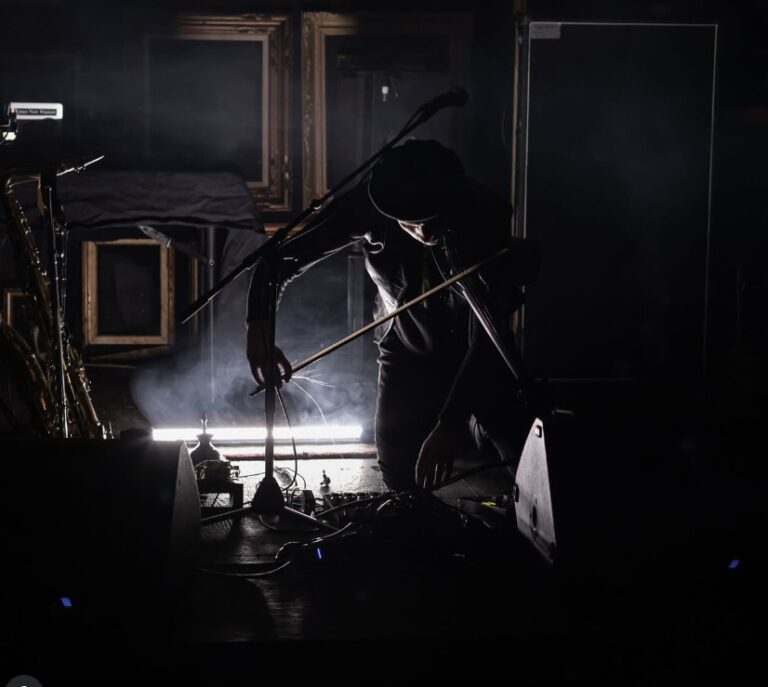
Manja Ristić was on stage to give a totally amazing performance! An EMS Synthi 100 modular synthesizer, a violin, a wheelchair wheel, two half-filled vases, mineral materials such as stones, a portable radio, a whistle and effervescent pills: this is the equipment on stage. 

Each object will be manipulated, recorded so that each sound can be transformed into a scenario of undulation, frequency and envelopment of space. 

Through an almost timeless extension, a tablet is immersed in one of the vases equipped with a microphone in a process of releasing gas in order to activate the dissolution. The bubbling is quietly mixed with the very soft synth notes that will almost never stop echoing.

Against a background of bird vocalization, pebbles or pebbles perhaps, are kneaded in the hand of the Hungarian artist as if to image a distant memory of her history…

The antenna of a small radio passes over and over under the microphone to play with the frequencies like the lairs of a ghost. The work on stage was meticulous, slow, calculated. 

In the last third of the scene, high-pitched and uncomfortable piano notes made their entrance to join the sound of the archer tearing the strings of a violin merging with the sound of a creaking wooden door. 

Born in Belgrade in 1979, violinist, sound artist, poet, curator and researcher, graduated from the Belgrade Academy of Music (2001), the Royal College of Music in London, Manja focuses on interdisciplinary approaches to sound and field recording as well as experimental radio arts to create works rich in meaning. 

Here, the historical significance was the remnant of memories of environmental devastation and war in the former Iron Curtain regions, as well as the former Mauthausen-Gusen labor camps.

ghosts, to get out of the hell of the past to sublimate it. A therapeutic work. 

Photo Credits: Caroline Campeau

Electroacoustic / Electronic / expérimental / contemporain

Akousma | Mystic Oracle, Magnetic Tumult, Granular Gymell

by Salima Bouaraour

On Thursday evening at Usine C, Frédéric Janelle’s L’Oracle had a mystical allure in its spatialization, while Monique Jean made all the phases of Tumultes magnetic, while art and science merged with Gymell, the work of grandmaster Horacion Vaggione.

Frédéric Janelle (ca)

Program: L’Oracle (2024) 8’41”

Lengthening of the note until it evaporates. Silence. Raucous, animal sound. Indistinct whirling. Acoustic flash. Muffled sound. At 2 minutes 20 seconds, an ambient phase is gently inserted, interlaced with divine cavern noises.

A long synth minute featuring envelope, VCA, VCF and probably LFO work in infinite feedback. Note holding. Noisy sequence. Repetition and length. Tone note at 3 minutes 40 seconds. Higher-pitched perception. Drone sequence. Gentle play on sound parameters.

Lasting 8 minutes 41 seconds, the piece was meditative, contemplative and serene. A very interesting way to kick off the evening, with a gentle and refined start.

Frédéric Janelle, a graduate in electroacoustic composition from the Conservatoire de Musique de Montréal, has spatialized L’Oracle in a more than mystical way.

Monique Jean (ca)

Program: Tumultes 15’ (2024)

Lacerated sound. Magnetic. Vibration. Play on resonance, filter and attack simultaneously throughout the intro against a background of long strings. Insertion of loops. At around 3 minutes, imperceptible voices fade into an indistinct crackle, then suddenly disappear.

A noisy, drone-like scene sets in. An impression of field-recorded sound like that of a railroad. Perception of metallic sound or machinery in any case. We’re heading more in a high-pitched direction. The piece becomes more textured and complex.

Diva-style vocals intermingle with echoing notes that escape the material before sinking into a sizzling pseudo-silence. A long, textured ripple is highlighted by a play of frequencies.

Monique Jean is interested in the tensions, breaks and paroxysms of sound materials. These are worked on like a complex organism. Her device integrates analog and no-input as a source of instability and unpredictability to produce her works.

Tumultes 15′, produced with the support of PRIM’s Research and Exploration program and the CAC, was the clear reflection of a continuous metamorphosis of sound flow. A fine progression before Gymell’s lightning attack.

Horacio Vaggione (ar/fr)

Program: Gymell I (2003) 9’20 followed by Gymell III (2024) 16’00

In the depths of the corpuscle, sonic matter comes to life in a stream of sparks for long minutes before being torn to shreds by sharp blows of strident, metallic notes. Laser beams tear through the material in an unreal, animalistic chirp. A process of liquefaction has enslaved the piece. From the effects of crumpled paper to the cogs of a mechanism.

Gymel, like a ferocious beast, closes the evening in two phases: Gymel I and Gymel III. Over 25 minutes of sequences of short fragments of sound, embroidered with resonant, hyper-colored attacks. A cosmic work in which the density of the grains performs on its own. It was so revealing to perceive the synthesized waves invading the acousmonium, as if to illustrate the astrophysical theory of a continuously expanding universe that could retract at any moment.

Hospitalized, the next composer was replaced by one of his greatest fans for the spatialization of his work, Louis Dufort. Horacio Vaggione, Professor Emeritus at the University of Paris VIII – researcher-composer (Studies in computer music at the University of Illinois (1966), co-founder of the Experimental Music Center at the University of Cordoba (1965-68), member of Madrid’s ALEA electronic music group (1969-73), IRCAM, INA-GRM, GMEB) – has sampled all his know-how in granular synthesis and micro-montage to prove to us that science is an art, drawing inspiration from the great scientist Bachelard’s 1932 quote: “The corpuscle has no more reality than the composition that makes it appear”.

Photo Credits: Caroline Campeau

Classical

OM Beethoven Marathon, Evening 2: On Human Nature

by Alexandre Villemaire

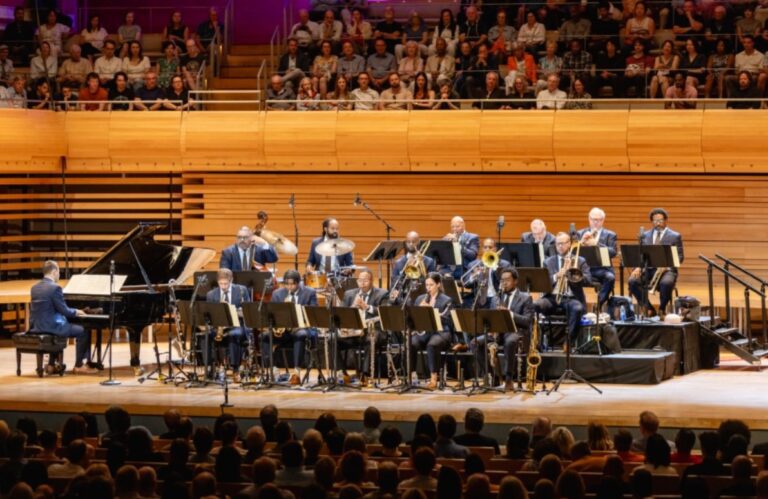
Second stop on Friday October 18 for the Orchestre Métropolitain on its Beethoven marathon at the Maison symphonique with Yannick Nézet-Séguin.

After a heroic introduction the day before, the next kilometer to be covered by the metropolis’ orchestra was devoted to symphonies no 6, known as “Pastorale”, and no 7, preceded by a premiere by young composer Francis Battah, already the recipient of several distinctions in Europe and Canada. His Prelude to Urban Landscapes, which opened the evening, was specifically conceived to precede the first movement of Symphony no 6. In this short piece, Battah reuses several thematic materials from the “Pastorale”, deconstructing and modifying them through complex language and writing. The use of several playing modes (arco for strings, flatterzunge for winds) lends the work a dynamic character and a strong timbral dimension. The piece ends with a ghostly string glissando, before moving straight into the first movement of the Sixth Symphony. The transition is naturally astonishing and fluid, so much so that the musical quotations, which we do not necessarily recognize immediately, but which we distinguish by the evocation of timbre, have prepared our ears for “l’Éveil d’impressions agréables en arrivant à la campagne”.

One of the most descriptive pieces in Beethoven’s symphonic catalog, Symphony no 6 is also one of the composer’s best-known works, in which it can be easy to fall into easy listening and autopilot, so familiar are its themes that they have been played and heard over and over again. Yannick doesn’t take the easy way out. Conducting the entire symphonies by heart, the conductor calls on every musician in his orchestra to sculpt meaningful phrasing and lines. After the luminous energy of the first movement, the second (“Scènes au bord du ruisseau”) plunged the audience into a soothing, restful state with ethereal sonorities. The third movement exuded a genuine village festive spirit, with the winds standing out overall, despite a few minor inaccuracies. After the festivities, thunder is heard in the fourth movement, heralding the storm. A storm that YNZ gently initiates, as if in the distance, before building in intensity to the point of eruption. With careful control of dynamics, the pastoral song that follows concluded the symphony with serenity.

The second part of the concert, dedicated to the Seventh Symphony, offered a contrast in its bright, rhythmic and vital character. The first movement was regal in character, with a tempo that Nézet-Séguin deployed with elegance. Magisterial was the transition from attacca to the famous second movement, a dramatic funeral march, in which everything, from dynamics to nuances, was just right and balanced. The exposition of the movement architecture was finely constructed by the conductor, in particular by highlighting the interaction between the violin and viola lines. The third and fourth movements, marked Presto and Allegro con brio, were a fantastic, breathless ride in which the rider Nézet-Séguin had great fun, almost dancing on the podium, infusing the various sections of the orchestra with a festive, captivating vitality. This performance was the highlight of the evening. At the end of the run, the orchestra received long applause from a relatively large, jubilant audience.

Addressing the crowd, Yannick Nézet-Séguin issued this invitation: “Sunday, 11am. Tell your friends!” The invitation is made. And we’ll be there for the rest of the tour.

Danny Brown at SAT: Left Field Delighted

by Guillaume Laberge

On Thursday, October 18, the Society for Arts and Technology (SAT) welcomed one of the iconic figures of underground hip-hop in the 2010s, Danny Brown. Fans of experimental hip-hop gathered to witness the Detroit-born artist on a short tour across Canada.

Before the main attraction arrived, DJ Charles Cozy mixed mostly rap songs, warming up the crowd and giving them a taste of what was to come. Danny Brown took to the stage just after 8pm, making a grand entrance dressed in an outfit straight out of the future. He began his set with a few songs from his latest album, Quaranta, released in November 2023.
From start to finish, Danny was incisive. No backtrack, just the instrumental framework. The African-American rapped every word with precision and a clear delivery, despite that singular voice that could alter the perception of clarity. Although some of the rapper’s more experimental songs are less accessible to the average listener’s ear, the acoustic quality of the venue made it all worthwhile. Even the most disconcerting tracks became quite catchy to our ears!
Danny Brown continued with several cult tracks from his catalog, such as “Monopoly”, “Dip”, and “Smokin & Drinkin”. Sung like festive anthems, these three songs helped raise the energy a notch. He also performed a few tracks from his collaborative album Scaring The Hoes with JPEGMAFIA, which helped to draw the crowd into his special world. The fans were very familiar with the various sounds the rapper had to offer, and greatly appreciated his performance. The majority sang along to the songs, adding to the overall energy of the room and hooking those who didn’t know the lyrics. A few mosh pits also formed in front of the rapper, a rare event at the SAT.
Brown concluded with his most popular songs, such as Really Doe, Ain’t it Funny, and Grown Up, all of which generated strong reactions from the crowd. The crowd chanted loudly for an encore for several minutes, even though he had only played for an hour and ten minutes, but unfortunately to no avail. Despite a rather short set and an encore that would have been more than welcome, Danny Brown put in a solid, concise performance, satisfying the audience at the SAT.

Brazilian / Funk / Samba

Céu, Between Retro and Melancholy

by Sandra Gasana

Céu, which means “Sky” in Portuguese, arrived on stage dressed all in black, with a necklace to match her dress, long black lace-up boots and a flower tattooed on her shoulder. Her stage presence was remarkable, as she alternated between dance steps and simplistic choreography.

Accompanied by her bassist Lucas Martins, who has been with her since the very beginning, Thomas Harres on drums, Leonardo Caribe Mendes on guitar and cavaquinho and Sthe Araujo, a talented percussionist, the singer transported us into her particular universe, in which she mixes soul, funk, jazz and Brazilian rhythms such as samba, always with a retro background, her signature. In fact, all her musicians are also backing singers, enriching the show.

She mainly shared songs from her most recent album Novela released this year but added hits from her other albums, such as Malemolencia, from the album Céu.

“I’d have loved to speak French with you, but I’m going to go with English,” she tells us from the outset, as several Brazilians in the room shout ”In Portuguese!”

My favorite song is Gerando Na Alta, which she sings as a duet with the Senegalese-born French artist anaiis, but which percussionist Sthe interpreted perfectly in her place. In this song, Céu speaks of the importance of celebrating friendship between women, while the word Novela, taken from the word telenovela, addresses the dramatic aspect of our lives. Some songs had no transition, while she interacted with the audience at other times. She takes the time to showcase her musicians in turn, as she does with Sthe, for example, before the song Lenda, from the album Céu, which opens with percussion.

Much to my delight, we were treated to a reggae sequence, with High na Cachu followed by Cangote from the Vagarosa album. Of course, we couldn’t end the concert without a few covers of Brazilian classics. And for this, she chose two legends: João Gilberto with Bim Bom, and Caetano Veloso with Pardo, both from Bahia.

The highlight of the evening was the encore with Bob Marley’s Concrete Jungle, which she performed beautifully with Haitian singer Paul Beaubrun, who opened the concert. The latter was introduced by his father, the great singer of the group Boukman Eksperyans. “When I saw Paul sing, I said to myself that he had to sing this song with me”, Céu confided. Indeed, Paul seems to be a great fan of Bob Marley, as during the first part he played three songs by the Jamaican icon, always taking care to add his own special touch. However, I would have liked to discover other original compositions such as Noyé, which opened the show.

classique

OM Beethoven Marathon, Evening 1

by Martial Jean-Baptiste

You have to be in top form to attend the Beethoven Marathon by prodigious conductor Yannick Nézet-Séguin and his accomplices in the Orchestre Métropolitain. The maestro has subjected his troops to training worthy of top athletes: 12 rehearsals, 4 dress rehearsals, all in a very short space of time. The complete symphonies of Ludwig van Beethoven are presented as part of the25th anniversary of the link between YNS and the Orchestre Métropolitain.

In 2022, Deutsche Gramophone released a recording of the same complete works conducted by YNS with the Chamber Orchestra of Europe. On Thursday evening at the Maison Symphonique, the maestro surpassed this interpretation. From the very first notes, one could already feel a difference, and it was undoubtedly the presence of the conquered audience that raised the game.

The first work on the program, Symphony No. 2, revealed Beethoven’s genius and the mastery of Yannick Nézet-Séguin and the OM musicians. The fourth movement (Allegro Molto) once again demonstrated the musician’s flexibility. For me, No.2 remains one of the German composer’s finest signatures.

After the 20-minute intermission, we were treated to an original composition by Montrealer Nicolas Ryan with the piece Eroi(s)ca, which served as a bridge between Symphonie n°2 and n°3.

Another highlight of the evening was Yannick Nézet-Séguin’s performance of Symphony No. 3 called Eroica, Op. 55 , in E-flat major. This performance provided an opportunity to contemplate Yannick Nézet-Séguin’s talent and the complicity he has developed over the past 25 years with the musicians of the Orchestre Métropolitain.

The marathon continues tonight with Beethoven’s Third and Seventh Symphonies. Hurry up, put on your running shoes and warm up before attending this second evening.

Photo Credit: François Goupil

Akousma | Musicfriend, Delayed Memory, Remanence…

by Salima Bouaraour

From the outset of Akousma’s first evening on Wednesday, October 16, Mikael Meunier-Bisson introduced us to his musicfriend, Vivian Li welcomed us into familiar contexts, Byron Westbrook got us thinking about the concept of remanence.

Mikael Meunier-Bisson (ca) 

Program: musicfriend (2024) 8’00” 

A composer of experimental and electroacoustic music, Mikael, an experienced self-taught enthusiast of textured ambient, presented his piece entitled musicfriend. Borrowing the technique of materiology, mainly from the field of painting where the use and assembly of various materials, often heterogeneous, create works of art, he is able to transcend the limits of the traditional.

Combining collage and montage, the performance drew on the elasticity of sound, from nothingness to infinity, interspersed with soft layers. The emphasis was on “reverse”, where the physical inversion of part of the tape allowed us to bounce back as quickly as possible to the clarity of a singular, luminous note.

Tonicity. Abstract globality. Onirism. This 8-minute work was laced with electro-acoustic violin or similar effects. Every second, a new sonority or texture came into play, as at minute 2’11 of an astonished vocal. In the end, the overall listening sensation was rather gentle and soaring, even meditative.

The corpus of the work was highlighted by the use of modified frequency. The rhetoric of this project was definitely “strewn with doubts, trials and errors, in a continuous coming and going”.

Vivian Li (cn/ca) 

Program: Memory Playback (2024) 7’00” 

Here are 7 minutes of a sonic diary pierced by field recordings in the style of sonic archaeology, tending towards the familiar and introspective. Vibrant resonance of interior and exterior decor. Salient feature of bird vocalizations. Synth note. Distant conversation in Cantonese. A touch of sweetness and nostalgia. The more we listened to the piece, the more the auditory sequences clashed or blurred in a controlled blur, like the play of memory, which compartmentalizes and mixes memories according to the emotions.

In the last third, clear notes of electrified string instruments could be heard. Children’s laughter in a “new age” echo. The winner of the Concours de Composition Acousmatique petites formes 2024 thus explored in depth the “therapeutic and temporal properties of sound” to sublimate them in Memory Playback.

A regular at national and international festivals such as MUTEK (Montreal), Pique (Ottawa), Sound Art Lab (Struer), Inkonst (Malmö), Eastern Bloc (Montreal), perte de signal (Montreal), Kwia (Berlin), Fondation Phi x Nuit Blanche (Montreal), Hectolitre (Brussels) and Karachi Biennale, Vivian Li won over the Akousma audience with the sincerity of her work.

Byron Westbrook (us) 

Program: Translucents (Remix) (2024) 20’00’’ 

Sculptural and immersive, this abstract musical embroidery was worthy of a performative installation in a contemporary art museum. Tapestries of urban field recordings such as a train, a helicopter in mid-air, the echo of road traffic, birds chattering, the scene of life on the way home… combined with performative electronic music, repetitive in sequence and inspired by concrete music.

Ideally, it would be preferable to mention scenes like chapters that open and close with a real construction, a display and mediation of raw sounds that are made, unmade or recast at times with jolts of twists and springs of sound.

Translucents plunges you into the complex, textured weave of memory, where inner and outer spaces detach and annihilate each other. Between each phase of sounds captured in the field, an electronic, acousmatic or concrete musical scene intruded abruptly, as if to symbolize the complex transmission of memories and the neuronal system. Then, without transition, we moved on to a pseudo-pause of pitch or frequency modulation, sometimes tending towards the drone.

The original piece lasts 40 minutes, but for the Festival, a remix has been reworked to last just 20 minutes, concentrating all the energy of the work.

His work has been shown at the Walker Art Center, ICA London, MOCA Los Angeles, MoMA PS1, MaerzMusik and Rewire festivals, among others.

To fully grasp the complexity of this composition, it’s a good idea to listen to the piece, available online, while observing the paintings of abstract artist Blinky Palermo to blend in with the process. Byron was inspired by them. We can safely conclude that the phenomenon of afterglow sought by the New Yorker has been achieved.

Photo Credit: Caroline Campeau

Electronic / expérimental / contemporain

Akousma | Combat Zones, Scuba Diving, Avian Extrapolations…

by Alain Brunet

The second half of Akousma’s first evening was dominated by the two female composers on the program: Estelle Schorpp and Ana Dall’Ara-Majek, preceded by Pierce Warnecke.

Lasting 21 minutes and 34 seconds, Sonopeutic Smooth Sailing by Pierce Warnecke, a Californian-born artist based in Europe, was undoubtedly the most violent piece on the program for Akousma’s first evening. The take-off is smooth, but once at high altitude, disturbances start to creep in, although some of the tools are recognizable – Akai 808/809, modular synth, generative patches that constantly reproduce certain sound patterns imagined by their creator. The rest is the result of complex, shaggy, cross-hatched and very spicy editing.

The soft frequencies become more and more intense, asperities cling to them, and you have to fasten your seat belts! Calm returns temporarily, and the initial ambience is gradually replaced by the crackling and cross-hatching of processed sound. The “plane” becomes a train hurtling through war zones. Suddenly, we’re on foot, wandering through a field of at first sparse, almost silent sound propositions. As the piece reaches the peak of its sinusoidal curve, it becomes increasingly dense, forceful, violent and downright noisy. Walking becomes an obstacle course in a Skywalker vs. Darth Vader-style laser confrontation. The game calms down fairly quickly after the peak of intensity is reached, and we can imagine some serious casualties in the narrative. Hardcore attitude in a context of high electronic expertise. Yes, violence must be expressed!

From French-born Montreal composer Ana Dall’Ara-Majek, an interplay of instrumental, electroacoustic and purely computer music was to be expected. She is interested in the sounds that microorganisms might induce, as well as those that emerge from concrete or abstract forms. Her piece Mare Buchlae, for example, evokes an underwater dive where a variety of sounds emanating from plankton are captured. However, this is an extrapolation, i.e. the recreation of an aquatic environment by means of artificial sounds generated by a modular synthesizer – Buchla 200. The story lasts 11 minutes and 53 seconds, as we find ourselves suspended in the virtual liquid, imagining that this sound environment is entirely consistent with the intentions of its creator.

Last but not least, the main course. Salima Bouaraour’s interview with Estelle Schorpp on PAN M 360 left the impression that the quality of the idea might outweigh its sensual outcome: to compose a work based on recordings of birds made in the wild over a century ago, in the age of the phonograph, hence the avian title A Conversation Between a Partially Educated Parrot and a Machine, lasting 20 minutes. The title is inspired by a quote from Eldridge Johnson, director of the famous Victor Records label at the turn of the previous century (later RCA Victor), who said of the phonograph that it “sounded like a partially educated parrot with a sore throat and a head cold”, signifying the limitations of this archaic machine.

The treatment of these archives could have turned out to be grey and clinical, but this was by no means the case. For the French-born composer and Université de Montréal professor, it was a matter of imagining a “conversation” between birdsong and recording technologies, both old and new. And no, this has nothing to do with a sound recording at the Biodôme, it’s really an immersive experience where the songs of volatile creatures, scientific rhetoric on ornithology and an artistic binder (deconstruction of avian sounds, superimpositions of textural layers, etc.) and documentary narratives create a formidable diffraction of creative materials through a sensitive and inspired discourse.

Photo Credit: Caroline Campeau

Subscribe to our newsletter

Inscription
Infolettre

"*" indicates required fields

Type of Suscribers