Future Soul / Jazz / Jazz Fusion / jazz groove / Soul/R&B

FIJM | Nubya Garcia Becomes a Star in MTL

by Alain Brunet

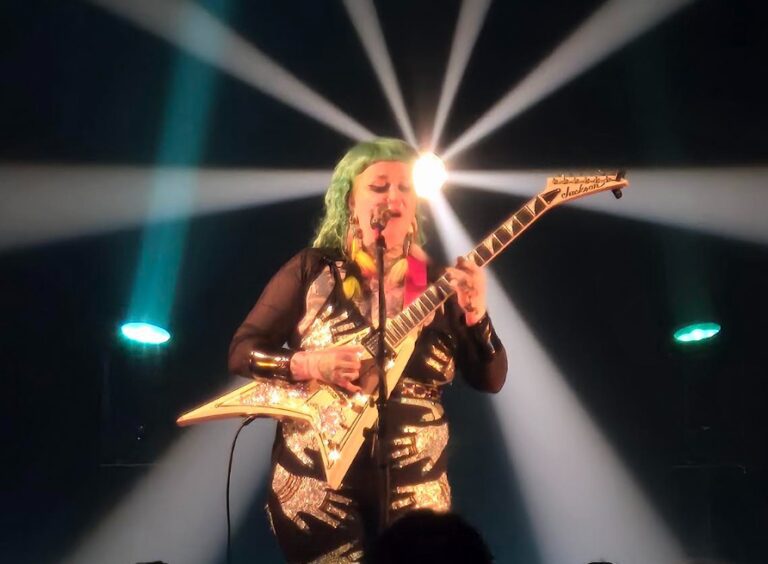
As a leader, Briton Nubya Garcia was programmed on Monday’s big TD stage, an excellent operation as far as she’s concerned. A whole lot of people didn’t know this London jazz scene existed, so a whole lot of people enthusiastically discovered this tenor saxophone specialist.

It’s safe to say that Nubya Garcia is now the most renowned saxophonist on the London scene. We’ve already seen and heard her in Montreal, notably with tuba player Theon Cross a few years ago, but not as much as at the start of this evening, the last of June.

Nubya Garcia’s primary argument is her generous, textured sound, in that long line of the most robust tenor saxophones. Her compositions are based on a solid post-fusion groove, i.e., generally outside swing and essentially inspired by hip-hop beatmaking, grime, dub, dubstep, all transposed into (mostly) acoustic instrumentation. Keyboard harmonies are closer to jazz, without skimping on soul/R&B, and melodic themes are also inspired by jazz and soul traditions. The UK side of things has to do with certain rhythms typical of post-dub or grime electronic trends, which are much less common in North America.

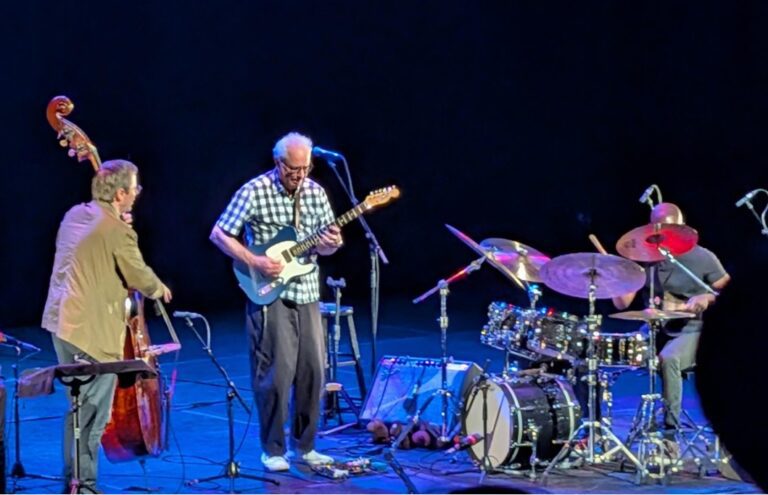
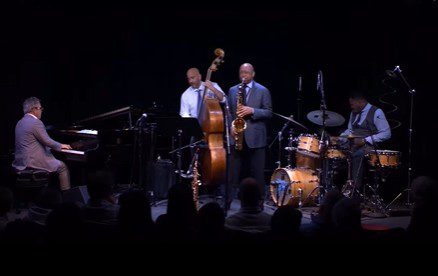
Nubya Garcia tops it all off with grace and authority. Her very chic, very feminine and very modern look contributes to the boom effect. Her music can easily claim to belong to the jazz corpus, its expression resting on the strength of the melodies, the groove, the effects of the solo instrument, and the collective power at its service – Lyle Barton, keyboards, Daniel Casimir, double bass, Sam Jones, drums.

The structures on the program are simple, and everything happens through spontaneous expression rooted in groove. And that’s why it can win over a wide audience.

Nubya Garcia has become a jazz star, lighting up jazz festivals around the world, and will continue to do so for many years to come. We invite you to discover her art via her most recent album, Odyssey, released last autumn, featuring string arrangements and high-profile guest appearances by Esperanza Spalding and Georgia Anne Muldrow.

Classical / Jazz / Jewish Traditional

FIJM 2025 | Symphonic Avishai Cohen: Bewitching magic

by Frédéric Cardin

To think I almost missed this concert! Due to an error on my part, my name had not been included on the list of press tickets for Symphonic Avishai Cohen. Damn! I had resigned myself to this curse when an angel from Roy Turner Communications (hi Flavie!!), associated with the Festival, wrote to tell me that one last ticket had been found for me. It was one of the year’s best catch-ups, and one I’ll always remember, because this concert by the Israeli double bassist/composer, with his trio and an orchestra assembled for the occasion, was magnificent.

It’s a concert that’s already been around for several years and that the artist tours from time to time. Montreal was right to import it for an evening at the Maison symphonique. The hall was full and the audience was magically lulled, as if in a velvet baby carriage, for almost an hour and a half. Traditional Jewish songs (ladinos, from the Sephardic Jews of medieval Spain), personal compositions of course, and a few well-turned standards were skilfully interpreted thanks to arrangements rich in counter-melodies and harmonic flourishes of the basic material.

No wheels were reinvented, but the magnificence of the orchestral playing and the few refined improvisatory flights by Cohen and his companions, well framed because a symphonic boat is difficult to maneuver in spontaneity, delighted the ears and heart of your humble servant.

Almost piece for piece, the program was the same as that given elsewhere (see the concert at the Philharmonie de Paris in 2016, below), and which can also be heard on the Two Roses album released in 2021 with the Gothenburg Orchestra in Sweden. The final, and unique, encore in Montreal was a “Nature Boy” of rare tenderness. The spell had been cast for good, and we were to leave the illustrious hall spellbound for a long time to come.

FIJM I Hanorah Sets the TD Stage Ablaze with Soulful R&B

by Stephan Boissonneault

Montreal’s own Hanorah delivered a triumphant hometown set at the TD Stage during this year’s Jazz Fest, performing to a steadily swelling crowd that spilled across Place des Arts. Leaning into the rich textures of her new EP Closer Than Hell, she offered up a soulful, R&B-driven performance that showcased her growth as both a songwriter and frontwoman.

Backed by a tight four-piece band and souful backup singers, Hanorah glided through a setlist that balanced velvet-smooth slow burners with infectious, danceable grooves. Tracks like “Matty” and “Barbeb Wire” highlighted her dynamic vocal range—equal parts grit and grace—while the shoegaze-tinged production lent a hazy, dreamlike quality to her more introspective moments. Her stage presence was magnetic: she danced, cracked jokes, and at one point stepped down to the front row, reaching out to the audience like a preacher sharing the gospel of self-love and survival.

By the time she closed the set, the midday concert felt more like a communal release. If there was ever doubt about Hanorah’s place in Canada’s neo-soul canon, this performance erased it.

photo Benoit Rousseau

Publicité panam
Jazz

FIJM | Jeff Goldblum: Storyteller, Comedian and Pianist

by Sandra Gasana

As the opening act, Tyreek McDole, was just finishing up, Jeff Goldblum arrived on stage while his show was still being prepared. He took the opportunity to deliver a one-man show, to pass the time as the hall emptied for a short break.

And then it was off to a monologue, in which he jumps from one idea to the other, always with a touch of humour. He even got the crowd to sing the Quebec and Canadian anthems, as he acted as conductor in Salle Wilfried-Pelletier, which sold out its 3,000 seats without too much difficulty.

He added some name-dropping to his stories, but it was, above all, the impromptu quizzes throughout the evening that appealed to the audience, who challenged themselves to answer all his questions. He also took the opportunity to promote his latest film, Wicked, in which he stars alongside Ariana Grande, among others, as well as his latest opus, Still Blooming, released last April.

He arrives accompanied by his band The Mildred Snitzer Orchestra, featuring a guitarist, double bassist, drummer, saxophonist and organist.

From the very first track, we discover a rather gifted pianist—I admit I was a little skeptical at first. He remains theatrical even on his piano, offering us a round of solos by all the musicians, followed by a drop, a term I discovered this week thanks to an artist with whom I collaborate.

Three special guests took to the stage alongside her that evening: the incredible Khailah Johnson, whom I was just discovering, all dressed in yellow, whose voice reminded me of Amy Winehouse’s in her early days. She performed “Misty, Mean to Me” and then “The Best is Yet to Come,” in which the sax is replaced by a flute.

Then Tyreek McDole returned to the stage, this time accompanied by Goldblum’s orchestra for two songs, and finally, renowned Grammy-winning American trumpeter Keyon Harrold, whom he had met that very day, joined the band. Harrold succeeded in creating a symbiotic relationship with the saxophonist, as if they had always played together.

And even in between songs, Goldblum couldn’t resist telling us some anecdotes, as funny as ever, getting up from his chair to address the audience, before returning for the next song.

We hear him sing his turn on “Manhattan,” New York being a city he’s particularly fond of. His voice isn’t extraordinary, but he still manages to hold his notes while retaining his sense of humour, a true entertainer. He ended with a song of circumstance, “Ev’ry Time We say Goodbye,” which earned him applause and a standing ovation from the audience.

Photo : Victor Diaz Lamich

Publicité panam

FIJM I Still Taking Us There, Mavis Staples Electrifies Montreal JazzFest

by Stephan Boissonneault

At 85, Mavis Staples proved why she’s a living legend of soul, gospel, and R&B. Her performance at the Montreal JazzFest was a masterclass in authenticity. Her voice, though matured, carried the same clarity of purpose—it didn’t just perform songs, it spoke truth. Backed by a tight, sinuous band with guitar by Rick Holmstrom, Staples moved seamlessly between Staple Sisters classics like “Respect Yourself” and Buffalo Springfield’s “For What It’s Worth.”

Staples infused each note with history, conviction, and joy. The band’s soulful chops provided the perfect bedrock, allowing her to shine while keeping the energy tight and focused. The performance felt timeless—equal parts church, protest, and party.

What made the night unforgettable wasn’t novelty—it was Staples’ gift for creating a communal experience, a shared uplift that transcended mere nostalgia. Whether delivering soulful classics or social justice anthems, she reaffirmed music’s power to connect generations and inspire. At 85, she didn’t just perform—she preached, celebrated, and challenged.

Her Montreal show was more than a concert—it was a vibrant reminder that some voices, like hers, aren’t just heard—they’re felt. If soul music is rooted in human spirit, Mavis Staples is its living heartbeat.

photos by Productions Novak

Jazz de Montréal 2025 MONTRÉAL, Quebec – June 26: Crédit photo: Productionsnovak
Publicité panam
Blues / Bossa Nova / Brazilian / Jazz

FIJM | Dianne Reeves and Romero Lubambo: An Intimate Duo of Virtuosos

by Michel Labrecque

Dianne Reeves is no longer the jazz flavour of the month. Her last solo album dates back to 2014. This year, all the talk is about Samara Joy, and rightly so. But the Grammy-winning singer of the ’90s and ’00s still has plenty to sing about. She gave us a convincing demonstration of this in a duet with Brazilian-born guitarist Romero Lubambo.

By sheer coincidence, over the past two weeks I’ve been attending a succession of intimate concerts in the immense Place des Arts: Alain Souchon and his sons, Mexican soloist Natalia Lafourcade and now this American-Brazilian duo. It’s like being in a living room … even though it’s huge, but in each case, it’s hit the spot with me.

Dianne Reeves and her classical guitar accomplice began with a total reinterpretation of Fleetwood Mac’s rock fetish “Dreams.” We soon realized that these two people complement each other perfectly. This voice, which climbs three octaves, skating, meditating, whispering and shouting, intertwines with the guitar notes, inspired as much by jazz as bossa nova or blues.

A great admirer of Dianne Reeves, whom I met by chance, confided to me that she never sings a song identically. As for this Romero Lubambo, he’s an outstanding and inventive guitarist.

This concert was undoubtedly marked by Brazil, as we heard versions of Egberto Gismonti, Carlos Lyra, Antonio Carlos Jobim and …Minuano by Pat Metheny. As for the rest, it was Miles Davis and McCoy Tyner, seasoned with two compositions by Madame Reeves: “Tango” and “Nine.”

Dianne Reeves also shared personal slices of life and ended on a political note, sharing her concern about the situation in her country as well as her love for Canada and Canadians. By the end, the vast majority of the 800-strong audience were humming the blues with her, clearly happy.

Now approaching 69, the singer shows no sign of letting up. She will soon be releasing an album with Romero Lubambo and participating in an album with Branford Marsalis, to commemorate the centenary of John Coltrane’s birth.

Please don’t tell me that 69 is old. I’ll reach that age in a few days…

Publicité panam
Jazz

FIJM | Stella Cole: From Tik Tok to The Biggest Jazz Stages

by Sandra Gasana

For her first appearance at the Festival international de Jazz de Montréal, Stella Cole was accompanied by her equally talented double bassist, drummer and pianist. In front of a packed Studio TD, the New York-based American appeared all dressed in red.

After a purely instrumental first song, she took to the stage and immediately introduced her pianist in the first song, followed by the other musicians in the third and fourth. She gave her musicians space, almost in every song, to do their respective solos, while she mastered her voice perfectly.

“It’s my first time in Montreal, I haven’t seen much of the city yet, but I’ve got all day tomorrow, so if you’ve got any recommendations, I’d love to hear them,” she advises, between songs.

This singer, who became hooked on music thanks to films such as The Wizard of Oz, with which she was obsessed from the age of three, loves to perform the greatest jazz classics. Her voice is so reminiscent of the artists of the ’60s and ’70s that you sometimes feel you’re taking a musical trip back in time to New York. Her covers of “Singing in the Rain,” “It’s Magic,” and “Cry Me a River” are all brilliant, with the instruments sometimes communicating with each other.

Her second album, It’s Magic, is due for release at the end of the summer, but we were treated to one of its tracks, released the day before the show, “Till There Was You,” on Decca Records.

The lighting scheme seemed to go very well with her red outfit, shifting from red to blue, depending on the song and the mood. She alludes to the film Casablanca, which marked her youth, but my favourite moment is her rendition of “I must have done something good.”

“But I want to move here,” she joked, after an audience member offered her a bouquet of flowers after the 2nd song. Well, I must admit that her interpretation of “Perhaps” was remarkable. That said, she doesn’t move much on stage, except to let her musicians shine when she steps aside a little, but other than that, she seems a little shy. One thing’s for sure: this young brunette with a contagious smile charmed the Montreal audience, many of whom queued long and hard to get into the TD Studio free of charge.

Publicité panam
Modern Jazz / Vocal Jazz

FIJM | Samara Joy: Pushing Classic Vocal Jazz Repertoire to its Limits

by Harry Skinner

When Samara Joy entered the stage at Maison Symphonique amid theatrical swells from her horn section, there was a degree of pomp and circumstance about the moment. It was the kind of introduction that can easily feel self-indulgent if the one making the entrance doesn’t back it up with their performance. Luckily it was made clear very quickly that this was not the case – Joy’s vocal stylings are instantly captivating and reflect a level of maturity one rarely hears in such a young performer.

The set started with a rendition of Thelonious Monk’s classic “‘Round Midnight” with Joy singing the same set of lyrics as the great Ella Fitzgerald, in contrast to those she sang on the same tune on her 2022 album Linger Awhile. The arrangement, by tenor saxophonist Kendric McCallister, took the piece through several different grooves, moving into double, triple, and quadruple time during the solo section. The maximalist style of the arrangement came across as almost tongue in cheek, without ever losing a sense of reverence for the piece or its countless classic versions. 

The arrangements continued to suit the ensemble and Joy’s performances throughout the evening, as the band paid homage to other great singers of the past, namely Betty Carter and Billie Holiday. It is worth noting the interesting ways in which Joy’s voice was used within the ensemble – in multiple pieces, she joined the horn section during a shout chorus or took a solo without using scat syllables, a refreshing way to bring out the lyrical quality of her melodies.

What is most impressive about Samara Joy’s singing is her versatility; she has a rich alto range, but does not shy away or falter in the higher register of her instrument. Likewise, she moves seamlessly between fast, rhythmic passages and slow, lyrical ones. She can fill a concert hall with a climactic belt or bring her voice down to a near whisper without losing any melodic or rhythmic authority. In fact, her light and airy soft phrasing is reminiscent of her contemporary Cecile McLorin Salvant (a generational talent in her own right). This level of technical proficiency and musicality in someone aged twenty-five is truly special to hear.

Endless praise could be heaped onto Samara Joy and her strikingly mature voice, but what also shone through in this performance was the polished cohesion of her band (composed of trumpeter Jason Charos, trombonist Donavan Austin, also saxophonist David Mason, tenor saxophonist Kendric McCallister, pianist Connor Rohrer, bassist Paul Sikivie, and drummer Evan Sherman). Throughout the set the arrangements exploded with ideas without overwhelming the listener. It is clear that whichever member arranges a particular piece, there is a collective understanding of how the group sounds. There seems to be a desire to see just how far each song will bend, and the joy the band takes in pushing each selection to its limit is palpable. The performance was at once a complete statement and an exciting look at what is to come for jazz’s younger generation.

Hip Hop / Instrumental Hip Hop / Orchestral Pop

FIJM | Nas symphonic and Nas not symphonic

by Alain Brunet

As symphonic rap continues to gain momentum among form fans, it’s Nas’ turn to make the trip and get his audience tripping. Gala outfit, bow tie, black suit, smoked glasses. Behind him, a jazz-groove-hip-hop band, drums, double bass, keyboards, DJ. Behind the band, a full symphony orchestra under the direction of Jean-Michel Malouf, artistic director and conductor of the Orchestre symphonique du Saguenay-Lac-Saint-Jean and the Orchestre symphonique de Sherbrooke. Big business!

Nas emerged from the pack in 1994 with the acclaimed first of his 15 albums, Illmatic. Today, it’s considered a classic of East Coast hip-hop, so much so that a symphonic version is being performed all over the rap world for the 30th anniversary of its release. And Montreal is no exception, its authority unquestionable 31 years on: two sold-out Wilfrid-Pelletier halls in as many nights.

Nas, 51, is a formidable figure. This authentic showman knows how to heat up a room of this size, and his word is golden to the ears of his fans, who know all about this emblematic album, typical of ’90s New York and featuring beatmakers and guests who were very important at the time: Large Professor (Nas’s teenage buddy and main collaborator on this opus), but also Marley Marl, Rockwilde, MC Serch, Nick Fury, Pete Rock, Faith N and even the archbishops of the boom-bap sound, Q-Tip and DJ Premier.

The program included all of the Illmatic classics: “The Genesis,” “NY State of Mind,” “Life’s a Bitch,” “The World Is Yours,” “Halftime,” “Memory Lane (Sittin’ in da Park),” “One Love,” “One Time 4 Your Mind,” “Represent,” and “It Ain’t Hard to Tell.”

Galvanized by this encounter, the audience knew all the lines, applauding wildly at every step of the program. Unfortunately, the sound system for such a marriage of rap, band and symphony wasn’t up to scratch, with the strings generally buried by the otherwise excellent electric band and its MC. The brass and reeds fared better in the context, but we can’t conclude that the orchestral symbiosis between symphony, groove and hip-hop was a success. It’s impossible to make up one’s mind about the arrangements… In any case, there’s every reason to believe that the sound engineer and the acoustics of the hall didn’t really help the cause of intelligibility.

This didn’t seem to bother the fans, who were more than happy to be there in front of a showman who was up to the task. It should be added, however, that the part of the concert without the symphony orchestra, which was machine-gunned during the last half-hour, was the most powerful: “The Message” (Grand Master Flash), “Street Dreams” (less sweet than the Eurythmics), “Got Ur Self a Gun,” “Oochie Wally,” “You Owe Me,” “Made You Look,” “The Don,” “If I Ruled the World (Imagine That),” “One Mic.” Gotcha!

photos : Victor Diaz Lamich

Publicité panam

Queercore

Suoni | The Jellicle KIKI Ball #2 – Feline Grace is Served

by Rédaction PAN M 360

Suoni has transformed La Sala Rossa into a Ball Room and welcomes for the second time the Jellicle Kiki Ball! A long awaited (and again sold-out!) night made by and for black, queer and trans community… and excellence. 

The Kiki Balls are usually events focused around community and dedicated to the younger queers and, apart from distributing many prizes, Kiki expands its community cause to a humanitarian one – 600$ were raised Friday night towards Keffiyehs for Direct Action, a SWANA and queer mutual aid initiative providing direct support towards Palestinians (check ig and website).

Put together and presented by Legendary Godmother Phoenix Sankofa – who became tonight the new Overall Mother Sankofa – Father Noam Juicy Couture and Mags Old Navy, with DJ Father Cherry KFC and MC Father Broadway Mulan, the theme of this edition is, similarly to last one, – the feline, cats, kitties, pussycats, purrs and meows… one year after the mystical “Cats: The Jellicle Ball” in New York City, a ball adaptation of the iconic musical “Cats” by Andrew Lloyd Webber, itself based on T.S Eliot’s Old Possum’s Book of Practical Cats.

This #2 Jellicle Kiki Ball offered new categories such as Nails Done, where the most extravagant catty-nail art is called to walk; a high burning, hard-fought battle between Old and New Way; the sexiest Lip Sync’s; the wildest and juiciest Tag Team Sex Siren battle, and was blessed by the invincible walks of iconic voguer and Overall Mother Koppi Mizrahi, from Tokyo, Japan. 

Solo walkers, productions, house walkers – so much talent, brilliance and high level taste and devoted work from the performers + the all time euphoric and hyping energy from the crowd couldn’t possibly fit a physical space but this is what community does – it elevates us to higher layers of possibility, it breaks society’s imposed limits and norms over one’s own power and existence – The Jellicle Kiki Ball #2 and every walker served only grace and we ate!

Publicité panam
expérimental / contemporain

Suoni | The Dark, Wicked, Warm and Absurd on the Same Dish

by Rédaction PAN M 360

Casa opens the doors in a charged, but carefully arranged, blend of dark-folk, neoclassical, noise and post-punk in the hands and voice of Fae Sirois, performing her project Girl Circles – “the art of spite and wxmenly sexual energy,” as she describes. 

In a sombre yet intimate setting, Girl Circles is a space of spells and curses, of a very raw confession of embodying one’s own shadows and from there, finding light. Fae Sirois guides us through storytelling, from her raw, scratched violin to a very melodious, lyrical, one organic and tortured machinery, and screamo techniques. 

In the midst of all the noise, sharp frequencies traversing the spectrum, whipping feedback – Fae listens attentively. She knows exactly what kind of power she embodies and experiments with.

Second act of the night is served by Ylang Ylang & Così e Così in a performance dedicated to everyone “who [was] present and anyone who spends a lot of time in hospitals.” The vulnerable, piercing poetry of Così e Così couldn’t fit in a better place than the warm bed of synths and thoughtful beats of Ylang Ylang. The duo transports us to the insides of a love letter, or else a sad glitchy flower, curating the soundtrack of the ride – it is soft and warm, melancholic yet comforting and somewhat energizing, nostalgic and so touching.

Trading Places: Un Échange artist-in-residence in collaboration with Suoni brings us Cordelia Donovan, originally from Manitoba and based in Vancouver. Donovan stretches the performative moment to a raw exploration of voice layering, texture and dynamics – she tells us about grief, inviting us to breathe together with and through it.

The headliners Ishi Tishi conquer our hearts and laughs with a playfully inventive set, scooping from the absurd and the slightly provocative while still being real about today’s doom – from keyboard synths, to vocal harmonising and electronic experiments, the trio embraces the weird and awkwardness of being a human in this mess, and does so with such a lightheartedness difficult to leave a place in a bad mood.

Jazz Fusion

FIJM | Azimuth: Brazilian Jazz Fusion of the Highest Order

by Michel Labrecque

The Azimuth band is a legend in Brazil. It started out in 1973, in Rio de Janeiro, juggling Brazilian popular music, rock and jazz. Over the years, the trio has become increasingly jazz-fusion, without ever abandoning its Brazilian roots.

Fifty-two years after his birth, Azimuth presented himself at the Gesu in spectacular form, and had the vast majority of the audience in his pocket from the very first piece, taken from his recent album Marca Passo, released this month.

Azimuth is a kind of Brazilian Weather Report, in a different form: a keyboardist, a bassist and a drummer. Of the original line-up, only bassist Alex Malheiros remains, still going strong despite his 78 years. Kiko Continento has officiated on keyboards since 2015, and Renato Massa Calmon handles drums and percussion.

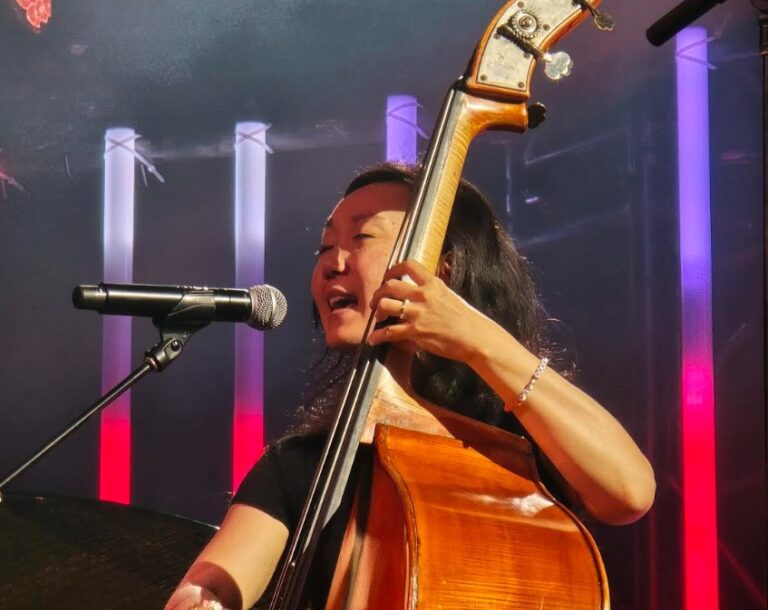
The three musicians are very close-knit and offer music that is both complex and festive, sometimes a little dated because of the keyboards: a Korg synthesizer, a Rhodes electric piano and an organ whose brand I haven’t seen. Kiko Contentino, the 55-year-old youngster in the band, plays his instruments like a teenager, while being very versatile.

Alex Malheiros handles his bass with intelligence, occasionally using slap, but not excessively. In this kind of band, the bass is more than an accompaniment; it’s an essential instrument, and the moustachioed Brazilian also knows how to solo.

Rebato Calmon brought the crowd to its feet on several occasions with his drum solos. Personally, I find him best when he accompanies with great virtuosity, mixing Brazilian percussion with drums and cymbals.

This is jazz fusion of the highest order. But the most delightful and original moments came when the band displayed their Brazilian-ness. Wordless vocal harmonies, whistles, a percussion trio – the little things that make a difference. Having lived in Rio de Janeiro for two years and listened to a lot of Brazilian music, I particularly appreciate this.

I also often say that with this kind of virtuoso band, it’s when they play ballads or slow pieces that you really notice the quality.

In Azimuth’s case, that moment arrived when they opened with “Last Summer in Rio,” from Marca Passo. They had us singing along as they deployed their improvisational skills. And we, the audience, began to levitate.

The almost-full Gesu remained in this state right up to the end.

Publicité panam
Subscribe to our newsletter